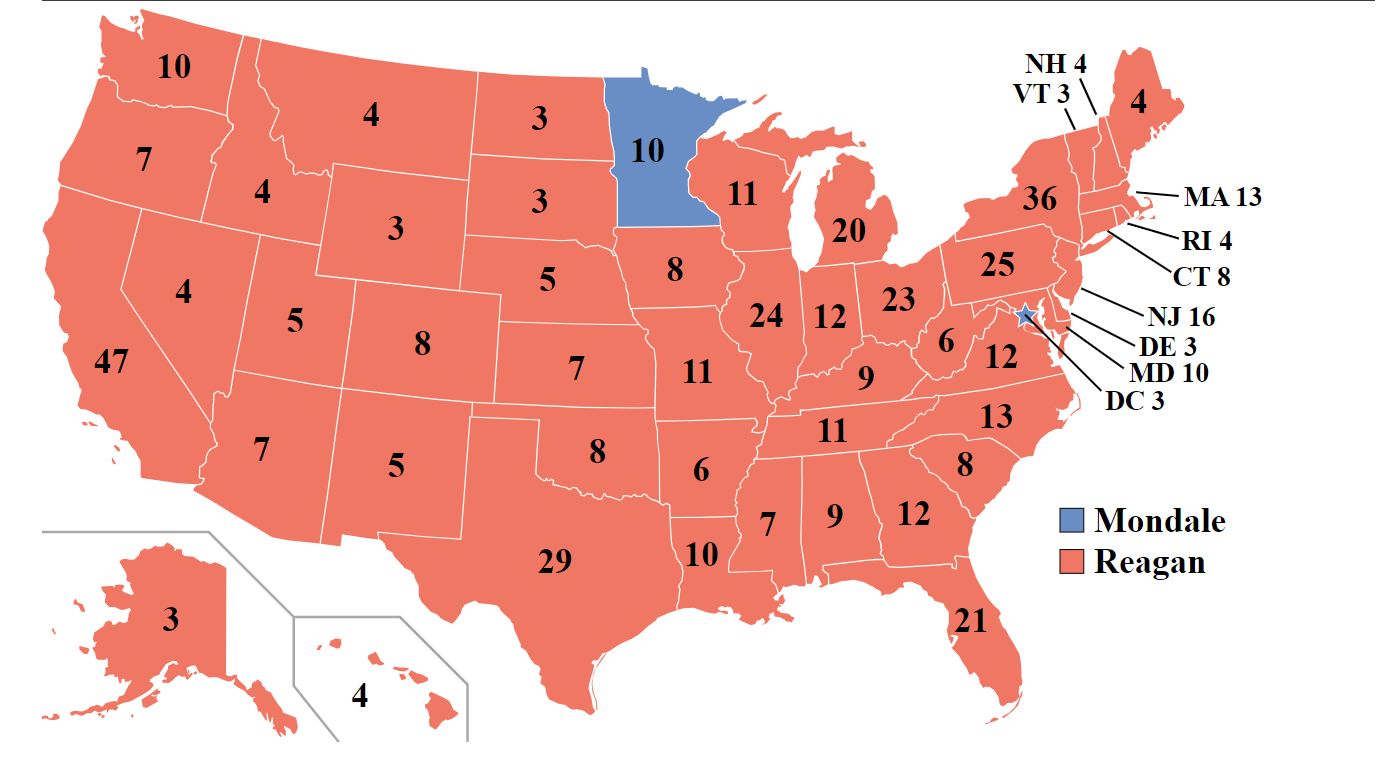
The 1984 United States presidential election stands as one of the most decisive political contests in modern American history, resulting in incumbent Republican President Ronald Reagan securing a historic landslide victory over his Democratic challenger, former Vice President Walter Mondale. Reagan carried 49 out of 50 states, capturing 525 electoral votes—the most of any presidential candidate in U.S. history—and securing nearly 59% of the popular vote. This comprehensive analysis explores the historical context, campaign dynamics, electoral map breakdown, and the lasting political legacy of the 1984 election.
Historical Context and the Political Landscape of 1984
By 1984, the United States had undergone a significant economic and psychological turnaround since the turbulent stagflation era of the late 1970s. When Ronald Reagan took office in January 1981, the country was grappling with high inflation, high interest rates, and widespread economic pessimism. The administration's implementation of supply-side economic policies—commonly known as Reaganomics—involved substantial tax cuts, deregulation, and tight monetary control by the Federal Reserve under Paul Volcker.
Although these policies initially triggered a severe recession in 1981 and 1982, the economy rebounded sharply by 1983 and 1984. Gross Domestic Product (GDP) growth surged, unemployment dropped from its peak, and inflation remained relatively subdued. This economic resurgence formed the cornerstone of the Reagan campaign's central theme: "Morning in America." Voters felt a renewed sense of national confidence and optimism, which severely weakened the traditional Democratic critique of the administration's economic record.
Simultaneously, Reagan’s foreign policy stance played a critical role. Adopting a hardline position against the Soviet Union, which he famously labeled the "evil empire," Reagan significantly increased defense spending and initiated a major military buildup. While this escalation alarmed critics who feared an increased risk of nuclear confrontation, it resonated strongly with a public eager to restore American prestige abroad following the Iranian hostage crisis and the perceived decline of U.S. influence during the 1970s.
The Democratic Primaries and the Mondale-Ferraro Ticket
The Democratic Party entered the 1984 cycle deeply fractured, leading to a crowded and contentious primary season. Former Vice President Walter Mondale emerged as the front-runner, backed heavily by traditional party powerhouses, labor unions, and establishment Democrats. However, Mondale faced fierce insurgencies from Senator Gary Hart of Colorado, who championed a modernizing, centrist platform branded as "Neoliberalism" and representing "new ideas," and civil rights leader Jesse Jackson, who mobilized a historic coalition of minority voters and progressives through his "Rainbow Coalition."
Mondale ultimately secured the nomination by leveraging his deep party ties and institutional support, but the grueling primary battle left the candidate bruised and ideologically pulled toward traditional New Deal liberalism. At the Democratic National Convention in San Francisco, Mondale made history by selecting Representative Geraldine Ferraro of New York as his vice-presidential running mate. Ferraro was the first woman ever nominated for national office by a major American political party.
Despite the initial wave of excitement surrounding the Ferraro pick, the Mondale campaign struggled to define a clear, compelling alternative to Reagan's vision. Mondale famously declared in his acceptance speech that Reagan would raise taxes and that he (Mondale) would too, a statement intended to project fiscal honesty but which ultimately handed the Republican campaign a devastating soundbite.
Campaign Dynamics and Defining Moments
The general election campaign was characterized by a stark contrast in messaging, media management, and personal popularity. The Reagan campaign, masterminded by strategists like Lee Atwater and Richard Wirthlin, ran an exceptionally disciplined operation. They framed Reagan as the benevolent guardian of American prosperity and security, utilizing powerful, cinematic television advertisements like the famous "Morning in America" spot.
Walter Mondale attempted to focus his campaign on the growing federal deficit, social justice, environmental protection, and the risks of Reagan’s foreign policy. However, he struggled to break through the narrative of national renewal. A pivotal turning point in the campaign occurred during the first presidential debate in Louisville, Kentucky, in October 1984.
Reagan, then 73 years old, appeared fatigued, occasionally lost his train of thought, and struggled with his closing remarks. The performance immediately ignited questions surrounding his age and whether he was too old to serve another four-year term. However, during the second presidential debate in Kansas City, Reagan effectively neutralized the issue with a sharp, humorous retort when questioned by journalist Henry Trewhitt: "I want you to know that also I will not make age an issue of this campaign. I am not going to exploit, for political purposes, my opponent's youth and inexperience." The quip drew laughter from the audience and Mondale himself, effectively defusing the age debate for the remainder of the race.
Electoral Results and State-by-State Breakdown
The 1984 presidential election resulted in a historic electoral college landslide. Ronald Reagan secured 525 electoral votes, while Walter Mondale won only 13 electoral votes—carrying strictly his home state of Minnesota (by a razor-thin margin) and the District of Columbia.
| Candidate | Party | Electoral Votes | Popular Vote | Percentage |
|---|---|---|---|---|
| Ronald Reagan | Republican | 525 | 54,455,075 | 58.8% |
| Walter Mondale | Democratic | 13 | 37,577,185 | 40.6% |
| Others / Independent | Various | 0 | 569,824 | 0.6% |
The geographic scope of Reagan's victory was unprecedented in modern times. He swept every single state outside of Minnesota and the District of Columbia, capturing the entire American South, the Midwest, the West, and even traditional Democratic strongholds in the Northeast such as New York and Massachusetts.
Key Voting Demographics
- Reagan Democrats: A crucial segment of working-class, union-affiliated white voters in industrial states (such as Michigan, Ohio, and Pennsylvania) defected from the Democratic Party to vote for Reagan.
- Suburban Voters: Rapidly growing suburban communities across the Sun Belt and Rust Belt heavily favored Reagan due to lower taxes and conservative social values.
- Young Voters: Voters aged 18–29 swung decisively toward the Republican incumbent, driven by economic optimism and patriotism.
- The Gender Gap: While Reagan won a majority of both male and female voters, a noticeable "gender gap" persisted, with women supporting Mondale at higher rates than men, particularly due to concerns over social spending and military escalation.
Historical Legacy and Political Impact
The 1984 election permanently altered the American political landscape and redefined the platforms of both major political parties. For the Republican Party, the Reagan landslide cemented the dominance of movement conservatism, free-market economics, a strong national defense, and social conservatism. It proved that a conservative platform could build a winning national coalition that reached far beyond its traditional base.
For the Democratic Party, the defeat triggered a profound period of soul-searching. The magnitude of Mondale's loss led moderate and centrist Democrats to argue that the party had become too beholden to special interest groups and out of touch with mainstream American values. This realization fueled the formation of the Democratic Leadership Council (DLC) in the mid-1980s, which ultimately paved the way for the centrist "New Democrat" movement and the election of Bill Clinton in 1992.
Furthermore, the election highlighted the structural vulnerabilities of the traditional New Deal coalition, demonstrating that economic prosperity and effective media communication could override decades of party loyalty. The strategies pioneered during the 1984 campaign—particularly targeted media framing, rapid response, and segmented voter mobilization—became foundational templates for modern American political campaigns.
Frequently Asked Questions
Who won the 1984 presidential election?
Ronald Reagan won the 1984 presidential election in a landslide victory over Walter Mondale. Reagan captured 525 electoral votes and 58.8% of the popular vote, carrying 49 out of 50 states.
What states did Walter Mondale win in 1984?
Walter Mondale won only his home state of Minnesota—by a margin of less than 4,000 votes—along with the District of Columbia, totaling 13 electoral votes.
What was the significance of Geraldine Ferraro's nomination?
Geraldine Ferraro, a Democratic Representative from New York, was selected by Walter Mondale as his vice-presidential running mate. This marked the first time a major American political party nominated a woman for national executive office.
What role did the economy play in the 1984 election?
The economy played a decisive role. Following the severe recession of 1981–1982, the U.S. economy experienced rapid growth, falling unemployment, and lower inflation by 1984. This recovery validated Reagan's economic policies and fueled a national mood of optimism encapsulated by his "Morning in America" campaign theme.
How did the age issue affect Ronald Reagan's campaign?
At age 73, Reagan faced questions regarding his age and stamina, particularly after a sluggish performance in the first presidential debate. However, he successfully defused the issue during the second debate with a widely publicized and humorous remark about his opponent's youth and inexperience, neutralizing voter concerns.
Conclusion
The 1984 presidential election remains a benchmark study in political communication, economic alignment, and voter coalition building. By successfully linking national pride and economic recovery to his conservative platform, Ronald Reagan achieved an electoral triumph that reshaped American governance for decades to come, while forcing the Democratic Party to fundamentally rethink its national strategy.