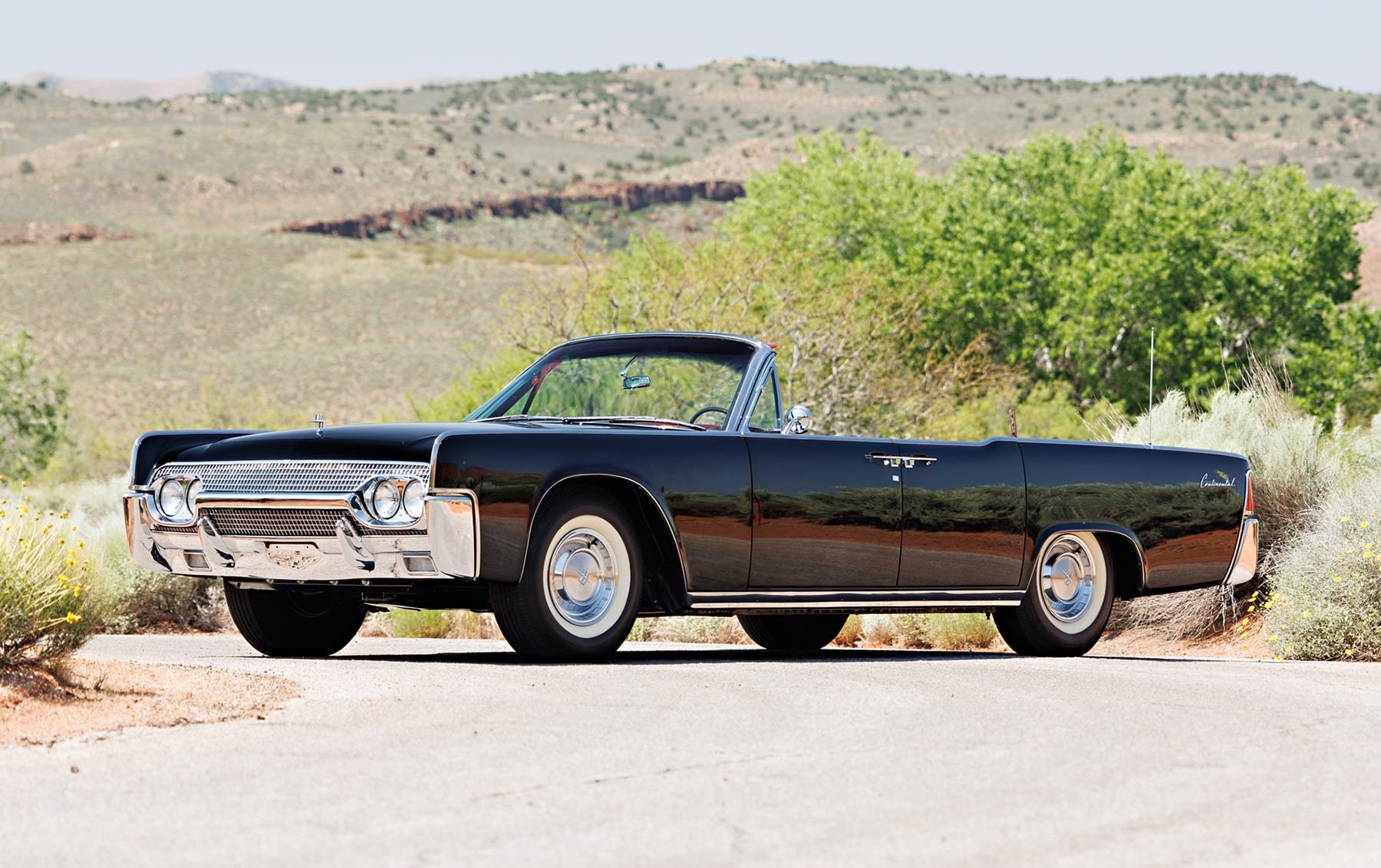
The 1961 Lincoln Continental represents a pivotal moment in automotive history, marking a shift from the chrome-heavy excess of the 1950s to a refined, minimalist aesthetic. As of 2026, it remains one of the most sought-after classic cars, celebrated for its iconic "suicide doors," unibody construction, and the engineering rigor that redefined the American luxury standard.
The fourth-generation Lincoln Continental, debuting for the 1961 model year, was a "make or break" vehicle for the Lincoln division of Ford Motor Company. Following the financial disappointment and polarizing styling of the massive 1958–1960 models, Ford executives considered shuttering the brand. However, a design proposal by Elwood Engel—originally intended as a 1961 Ford Thunderbird—was adapted into what would become the most influential American car of the decade. This guide explores the engineering, design, and market legacy of the 1961 Continental from the perspective of 2026 enthusiasts and collectors.
The Design Revolution: Minimalist Elegance
The 1961 Continental was significantly smaller than its predecessor, measuring nearly 15 inches shorter in length. Despite the reduction in footprint, it carried a higher price tag and offered a level of sophistication that its rivals at Cadillac and Imperial struggled to match.
The "Slab-Side" Aesthetic
Elwood Engel’s design is often called "slab-side" styling. It abandoned the tailfins and excessive ornamentation of the previous era in favor of a clean, linear profile. A single chrome "blade" ran along the upper edge of the fenders from the headlights to the taillights, emphasizing the car's length without adding bulk. This design language was so successful that it remained the foundation for Lincoln styling for nearly a decade.
The Return of the Suicide Doors
Perhaps the most famous feature of the 1961 Continental is its rear-hinged back doors, commonly known as "suicide doors." This choice was born out of necessity rather than mere style. Because the 1961 model had a shorter wheelbase than previous Lincolns, engineers found it difficult for passengers to enter and exit the rear seat comfortably with standard front-hinged doors. By hinging the doors at the rear, Lincoln provided an unobstructed opening, making the Continental the only four-door convertible on the market at the time with such a configuration.
Engineering and Performance Specifications
Underneath its elegant exterior, the 1961 Lincoln Continental was a feat of engineering. Lincoln aimed to produce the highest quality mass-produced car in the world, implementing a "post-build" inspection process where every engine was bench-tested and every completed vehicle was road-tested for 12 miles before leaving the factory.
The 430 Cubic-Inch V8
The heart of the 1961 Continental was the 430 cubic-inch (7.0L) MEL (Mercury-Edsel-Lincoln) V8 engine. This powerplant was designed for effortless torque rather than high-RPM racing performance. In 1961, it produced 300 horsepower and a massive 465 lb-ft of torque, allowing the heavy luxury cruiser to move with surprising grace.
The engine featured a "silent-timed" chain and was mated to a three-speed "Turbo-Drive" automatic transmission. By 2026 standards, the fuel economy is predictably low, often averaging 8–12 miles per gallon, but the smoothness of the power delivery remains a benchmark for classic luxury.
Unibody Construction
Unlike most American cars of the era, which used a body-on-frame design, the 1961 Continental utilized unibody construction. This approach integrated the frame and body into a single, rigid structure. While this provided a quieter ride and better handling, it required sophisticated rust-proofing and heavy-duty structural reinforcements, especially for the convertible models. To maintain rigidity in the four-door convertible, Lincoln engineers added massive amounts of steel bracing, contributing to the car's substantial curb weight of over 5,000 pounds.
1961 Lincoln Continental Technical Specifications
| Feature | Specification |
|---|---|
| Engine | 430 cu in (7.0L) V8 |
| Horsepower | 300 hp @ 4,100 RPM |
| Torque | 465 lb-ft @ 2,000 RPM |
| Transmission | 3-speed Turbo-Drive Automatic |
| Wheelbase | 123 inches |
| Overall Length | 212.4 inches |
| Curb Weight | 4,927 lbs (Sedan) / 5,215 lbs (Convertible) |
| Fuel System | 2-barrel Carburetor |
| Electrical System | 12-volt |
| Production Total | 25,160 units |
The Four-Door Convertible: A Mechanical Marvel
The 1961 Lincoln Continental four-door convertible is widely regarded as one of the most complex production vehicles of its time. It remains a marvel to collectors in 2026, though its intricate systems require specialized knowledge to maintain.
The convertible top mechanism is fully automatic and uses a series of eleven relays, several limit switches, and a complex hydraulic system to operate. When the driver activates the switch, the decklid opens backwards (hinged at the rear), the "flip-top" header panel retracts, and the entire fabric roof folds into the trunk space. This design creates a completely flush rear deck, a look that defines the "Kennedy Lincoln" era.
Because there is no "B-pillar" (the central post between the front and rear doors), the doors on the convertible meet in the middle. A specialized vacuum-operated window system ensures that the glass drops slightly when the doors are opened and seals tightly when closed, a feature that was decades ahead of its time.
Interior Luxury and Features
The interior of the 1961 Continental was designed to resemble a high-end lounge. Lincoln utilized premium bridge-of-weir leather and high-quality wool carpeting. The dashboard featured a symmetrical layout with walnut or metal accents, depending on the trim package.
Standard features in 1961 included:
- Power steering and power brakes.
- Power windows and power door locks (vacuum-operated).
- Six-way power-adjustable front seats.
- A "Town and Country" radio with a power antenna.
- Deep-pile carpeting and extensive sound deadening.
In 2026, the restoration of these interiors is a significant undertaking. The vacuum-operated door locks are a common failure point, as the rubber seals in the actuators perish over time. Owners often replace these with modern electronic solenoids to improve reliability, though purists prefer the silent, "hissing" operation of the original vacuum system.
Buying and Ownership in 2026
For those looking to acquire a 1961 Lincoln Continental today, the market has matured significantly. The "slab-side" Lincolns have transitioned from affordable vintage cruisers to high-value blue-chip collectibles.
Market Valuation
As of 2026, the value gap between the sedan and the convertible is substantial.
- Sedans: A well-maintained, driver-quality sedan typically ranges from $35,000 to $55,000. Concours-level examples can reach upwards of $80,000.
- Convertibles: Due to their rarity and cultural significance, four-door convertibles in excellent condition frequently command between $110,000 and $160,000. Custom "Restomod" versions with modern LS or Coyote engine swaps often exceed $200,000 at major auctions.
Critical Areas for Inspection
When evaluating a 1961 Continental, potential buyers must prioritize structural integrity over cosmetic appearance.
- The Torque Boxes: On a unibody car, the areas where the suspension meets the body (the torque boxes) are critical. Rust here can compromise the entire car's safety.
- The Convertible Top Cycle: If purchasing a convertible, ensure the top cycles smoothly. A "jerky" motion or stalled cycle can indicate expensive hydraulic leaks or failing relays that are difficult to source.
- The Exhaust Manifolds: The 430 MEL engine is known for cracking exhaust manifolds. Since these are unique to the Lincoln engine, finding replacements can be challenging and expensive.
- Brake System: The 1961 model uses a single-reservoir master cylinder. Many 2026 owners upgrade to a dual-reservoir system for safety, as a single leak in the original system can result in a total loss of braking power.
Maintenance and Parts Availability
Maintaining a 1961 Continental requires a blend of traditional mechanical skills and an understanding of vintage electronics and hydraulics.
- Mechanical Parts: Most engine and drivetrain components are available through specialists like Lincoln Land or Baker’s Auto. Common wear items like spark plugs, belts, and gaskets are relatively easy to find.
- Body and Trim: Unique trim pieces, such as the 1961-specific grille or the "Lincoln" script on the rear deck, are increasingly rare. Collectors often have to rely on "new old stock" (NOS) parts or high-quality 3D-printed reproductions which have become more common in 2026.
- Specialists: It is highly recommended to seek out mechanics who specialize in "slab-side" Lincolns, particularly for the convertible top and the vacuum systems. Improper adjustment of the top mechanism can lead to bent frames or shattered glass.
Historical and Cultural Significance
The 1961 Continental is inextricably linked to the presidency of John F. Kennedy. While his tragic assassination occurred in a 1961 Lincoln (SS-100-X, which was heavily modified by Hess & Eisenhardt), the car was also the symbol of the "Camelot" era's optimism and sophistication.
The car's influence on design cannot be overstated. It forced Cadillac to abandon its flamboyant fins and prompted a return to horizontal lines across the entire American automotive industry. In pop culture, the '61 Continental has appeared in countless films and music videos, serving as the ultimate "cool" cruiser for celebrities and enthusiasts alike.
FAQs About the 1961 Lincoln Continental
Why are the rear doors called "suicide doors"?
The term "suicide doors" refers to rear-hinged doors that open toward the back of the car. The nickname originated from the fear that if a door were to come unlatched while the car was moving, the wind resistance would blow it wide open, potentially throwing a passenger out. However, Lincoln mitigated this risk in 1961 with a safety system that prevented the doors from being opened while the car was in gear.
Is the 1961 Lincoln Continental a good investment in 2026?
Historically, the 1961–1969 Continentals have shown steady appreciation. While the cost of maintenance is high, the 1961 model—being the first of its generation—holds a special place for collectors. As of 2026, clean examples continue to outperform inflation, particularly the four-door convertibles.
How do I identify a 1961 model vs. a 1962 or 1963?
The easiest way to identify a 1961 model is by the grille and the rear end. The 1961 features a "box" pattern grille with a prominent horizontal bar in the center. In 1962, the grille was simplified, and in 1963, the car received a slightly different rear decklid. Additionally, the 1961 is the only year with the specific "floating" dashboard gauges before they were integrated more deeply into the dash in later years.
Can a 1961 Lincoln Continental be used as a daily driver?
While the 430 V8 is reliable, the 1961 Continental is generally not recommended as a daily driver in 2026. Its size makes it difficult to park in modern spaces, and its fuel consumption is significant. Furthermore, its unibody structure is highly susceptible to road salt, making it a "fair-weather" vehicle for most owners.
Final Recommendation for Enthusiasts
The 1961 Lincoln Continental is a masterpiece of American industrial design. For those who value style and historical significance, it is a rewarding vehicle to own. If you are entering the market in 2026, prioritize a car with a documented service history and a rust-free structure. While the sedan offers the same iconic look for a fraction of the price, the convertible remains the ultimate expression of the "slab-side" era. Regardless of the body style, owning a '61 Continental is less about transportation and more about preserving a piece of mid-century modern art.