The 1970s represented a transformative "Golden Age" for the American situation comedy, shifting from 1960s escapism to "social relevance." Led by visionaries like Norman Lear and Mary Tyler Moore, these shows tackled race, gender, and politics, forever changing the television landscape through sophisticated writing and the popularization of the multi-camera ensemble format.
The Great Pivot: From Rural Escapism to Urban Realism
To understand the 1970s sitcom, one must first understand the "Rural Purge" of the early 1970s. Prior to 1970, network television—specifically CBS—was dominated by "rural comedies" like The Beverly Hillbillies, Green Acres, and Mayberry R.F.D. While these shows commanded high ratings, they attracted an older, rural demographic that was less appealing to the era's emerging advertisers.
In 1970 and 1971, network executives made a calculated decision to cancel these shows in favor of "socially relevant" programming designed to capture a younger, more affluent, and urban audience. This pivot opened the door for a new breed of creators who wanted to reflect the turbulent social climate of the Vietnam War era and the Civil Rights movement. The resulting shift moved the setting of the American sitcom from the farm and the small town to the city apartment and the modern workplace.
The Norman Lear Revolution and Social Realism
The single most influential figure in 1970s television was producer Norman Lear. Lear broke the "sanitized" mold of the 1950s and 60s by introducing characters who were flawed, prejudiced, and deeply engaged with the news of the day.
All in the Family (1971–1979)
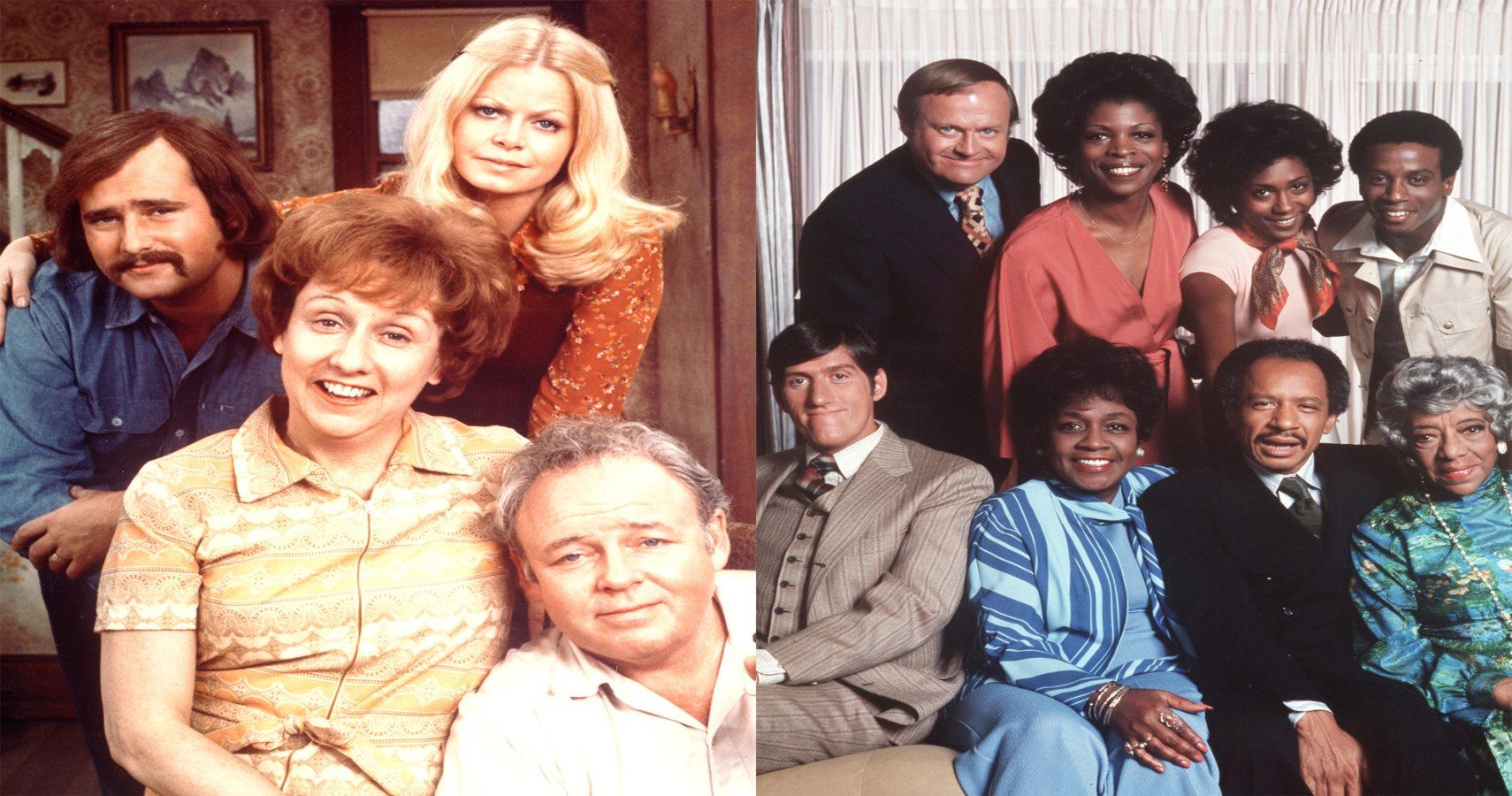
All in the Family is arguably the most important sitcom in television history. By introducing Archie Bunker—a working-class bigot from Queens—Lear forced America to look in the mirror. The show used the generational conflict between Archie and his "meathead" son-in-law, Mike Stivic, to debate topics that were previously taboo on television: racism, menopause, rape, the Vietnam War, and homosexuality. Unlike the idyllic families of the past, the Bunkers yelled, argued, and struggled with inflation and unemployment.
The Spin-Off Machine: Maude and The Jeffersons
Lear’s success created a template for the modern television universe through the "spin-off." Maude, starring Beatrice Arthur, was a spin-off of All in the Family that focused on a staunchly liberal, feminist woman. The show made history with the "Maude's Dilemma" episode, which dealt with abortion two months before the Roe v. Wade decision.
Similarly, The Jeffersons took Archie’s neighbors, George and Louise Jefferson, and moved them "on up" to a luxury high-rise in Manhattan. This show provided a rare, nuanced look at Black upward mobility, interracial marriage (the Willises), and the complexities of the "nouveau riche" experience, all while maintaining George Jefferson’s iconic, bombastic comedic energy.
The Mary Tyler Moore Show and the "Work Family"
While Norman Lear focused on political and social friction, the MTM Enterprises team—led by Mary Tyler Moore and Grant Tinker—refined the "ensemble comedy" and the concept of the "work family."
Redefining the Independent Woman
The Mary Tyler Moore Show (1970–1977) was revolutionary for its depiction of Mary Richards, a single, professional woman in her 30s who was defined by her career rather than her search for a husband. This was a seismic shift from the 1960s, where female leads were often witches, genies, or widows. The show’s brilliance lay in its supporting cast at the fictional WJM-TV newsroom, proving that the workplace could provide the same emotional support and comedic friction as a biological family.
The MTM Style: The Bob Newhart Show and Taxi
The "MTM style" was characterized by sophisticated, character-driven humor rather than broad slapstick. This aesthetic carried over into The Bob Newhart Show, which explored the dry, neurotic world of a Chicago psychologist. Toward the end of the decade, former MTM writers helped create Taxi (1978–1983), which brought a grittier, more melancholic edge to the ensemble format. Taxi showcased the "broken dreams" of cab drivers who viewed their jobs as temporary, creating a poignant blend of humor and existential dread that set the stage for 1980s and 90s hits like Cheers.
The Evolution of the Ensemble: M*A*S*H and Barney Miller
The 1970s also saw the rise of the "dramedy"—shows that balanced high-stakes drama with situational comedy.
M*A*S*H (1972–1983)
Based on the Robert Altman film, MASH* was set during the Korean War but served as a transparent commentary on the contemporary Vietnam War. The show’s ability to transition from a surgical scene involving casualties to a high-energy prank in the Swamp (the doctors' quarters) was unprecedented. Over its 11-season run, it moved away from the antics of Hawkeye Pierce and Trapper John toward a more philosophical, character-rich exploration of the horrors of war. Its 1983 finale remains one of the most-watched television events in history.
Barney Miller (1975–1982)
Often cited by real-life police officers as the most accurate depiction of police work, Barney Miller took place almost entirely within the confines of a Greenwich Village squad room. It avoided the "shoot-em-up" tropes of police procedurals, focusing instead on the paperwork, the mundane bureaucracy, and the colorful array of petty criminals who passed through the precinct. It was a masterclass in stage-like television, relying on dialogue and character interaction rather than action.
The Return to Nostalgia: The Garry Marshall Era
By the mid-to-late 1970s, the "relevance" movement began to wane as audiences sought relief from the economic stagflation and the aftermath of the Watergate scandal. Producer Garry Marshall filled this void by looking backward.
Happy Days (1974–1984) initially began as a realistic look at the 1950s (inspired by the success of American Graffiti), but it soon transformed into a high-energy, catchphrase-driven vehicle for Arthur "The Fonz" Fonzarelli. This shift marked a move toward "escapist" television. Marshall’s empire expanded with Laverne & Shirley and the sci-fi comedy Mork & Mindy, which introduced the world to the manic genius of Robin Williams. These shows were characterized by physical comedy, audience-participation "applause" moments, and a focus on youth culture.
Technical and Economic Standards of 1970s Production
The 1970s solidified the technical specifications that would define the sitcom for the next thirty years. Most 70s sitcoms were produced using the multi-camera setup, typically involving three cameras filming simultaneously on a soundstage.
| Feature | 1970s Social Sitcom (e.g., All in the Family) | 1970s Nostalgia/Slapstick (e.g., Happy Days) |
|---|---|---|
| Film vs. Video | Often shot on videotape (for a "live" feel) | Primarily shot on 35mm film |
| Audience | Live studio audience (no laugh track) | Live audience + augmented "sweetened" laughs |
| Visual Aesthetic | Gritty, muted colors, realistic sets | Bright, primary colors, stylized sets |
| Dialogue Style | Rapid-fire, argumentative, topical | Catchphrase-heavy, rhythmic, punchline-focused |
| Protagonist | Anti-hero or flawed professional | High-energy "cool" lead or "everyman" |
The use of videotape was particularly common in Norman Lear’s productions. Videotape gave the shows a "present-tense" urgency that made the political debates feel like they were happening in the viewer’s living room. Conversely, the MTM shows and Garry Marshall’s productions mostly stuck to film, which provided a more polished, cinematic look that has aged better for modern high-definition remastering.
Where to Watch 1970s Sitcoms in 2026
In 2026, the accessibility of 1970s sitcoms is higher than ever due to the maturation of the "FAST" (Free Ad-supported Streaming TV) market and the consolidation of legacy media libraries.
- Pluto TV & Tubi: These platforms currently host dedicated "Classic TV" channels. You can often find 24/7 loops of All in the Family, The Jeffersons, and Sanford and Son.
- Paramount+: As the owner of the CBS library, Paramount+ is the primary home for the MTM catalog (The Mary Tyler Moore Show, The Bob Newhart Show) and Garry Marshall's hits (Happy Days, Laverne & Shirley).
- Hulu & Disney+: Following various licensing shifts, MASH* remains a staple on these platforms, often presented in its original 4:3 aspect ratio to preserve the intended cinematography.
- Antenna TV & MeTV: For those with digital antennas, these over-the-air networks remain the gold standard for "linear" viewing of 1970s favorites like Barney Miller, Alice, and One Day at a Time.
- Physical Media: Due to licensing disputes over music (especially prevalent in WKRP in Cincinnati), many purists still rely on Shout! Factory DVD or Blu-ray releases, which often restore original soundtracks that are stripped on streaming services.
Frequently Asked Questions
What was the "Rural Purge" in 1970s television?
The "Rural Purge" refers to a series of cancellations by the major networks (led by CBS) between 1970 and 1971. Despite having high ratings, shows like Lassie, Hee Haw, and The Beverly Hillbillies were cancelled because their audiences were perceived as too old and too rural for advertisers. They were replaced by "urban" shows like The Mary Tyler Moore Show to target younger, big-city consumers with higher spending power.
Why is Norman Lear considered the most important 1970s producer?
Norman Lear broke the "taboo" barrier of American television. Before Lear, sitcoms avoided sensitive topics like racism, abortion, and the Vietnam War. Lear’s shows, such as All in the Family and Maude, proved that audiences wanted to see their real-life struggles and political disagreements reflected on screen. He essentially invented the "socially conscious" sitcom.
Which 1970s sitcom had the highest-rated finale?
MASH* holds this record. Its series finale, titled "Goodbye, Farewell and Amen," aired in February 1983 but capped off a decade of dominance. It was watched by approximately 106 million viewers, a record that stood for nearly 30 years until it was surpassed by the 2010 Super Bowl.
Were 1970s sitcoms filmed in front of a live audience?
Most were. The 1970s saw a shift away from the "canned laughter" (pre-recorded laugh tracks) used in the 1960s. Producers like Norman Lear insisted on a live audience to ensure the timing of the jokes was organic. If a joke didn't get a laugh from the studio audience, writers would often rewrite it on the spot.
How did 1970s sitcoms change the depiction of women?
The 1970s introduced the "independent woman" archetype. The Mary Tyler Moore Show was the first major hit to feature a woman who was not defined by her relationship to a man. Other shows like Maude, One Day at a Time (focusing on a divorced mother), and Alice (a single mother working as a waitress) explored the realities of the feminist movement and the economic challenges women faced in the workforce.
Practical Recommendation: Starting Your 1970s Watchlist
If you are new to the era or looking to revisit the classics, the most effective way to experience the breadth of 1970s television is to watch the "Big Three" pillars of the decade. Start with the pilot episode of All in the Family to understand the shift toward social realism. Follow this with The Mary Tyler Moore Show to see the perfection of the ensemble workplace comedy. Finally, watch a mid-season episode of M*A*S*H (such as "The Interview") to witness how the decade successfully blended comedy with profound human drama.
For the best viewing experience in 2026, prioritize streaming platforms that offer the original broadcast versions rather than syndicated "cut" versions. Syndicated versions often trim 2-3 minutes of footage to allow for more commercials, frequently removing the character beats and subtle dialogue that made these shows masterpieces of the medium.