The 34th Academy Awards, held on April 9, 1962, celebrated the cinematic achievements of 1961. The ceremony was dominated by the landmark musical West Side Story, which won 10 Oscars, including Best Picture. Another historic milestone was Sophia Loren’s win for Best Actress, marking the first time an Oscar went to a lead performance in a non-English language film.
The 1962 Oscars represent a pivotal moment in film history, bridging the gap between the golden age of the studio system and the burgeoning era of independent, socially conscious filmmaking. Hosted by Bob Hope at the Santa Monica Civic Auditorium, the night was a showcase of technical mastery, international recognition, and a few unexpected disruptions that remain part of Hollywood lore. As of 2026, these films remain foundational texts for cinema students and historians alike, representing the pinnacle of early 1960s production values.
The Dominance of West Side Story
No discussion of the 1962 Oscar winners is complete without focusing on West Side Story. Directed by Robert Wise and Jerome Robbins, the film was a massive critical and commercial success, entering the ceremony with 11 nominations and leaving with 10 statues. This feat was second only to Ben-Hur (1959), which had won 11.
The film’s success was significant because it validated the "roadshow" musical format—big-budget, high-concept productions with an intermission—while tackling heavy themes of racial tension and urban violence. The win for Best Director was historically unique; it was the first time the award was shared by two directors. While Jerome Robbins was credited with the revolutionary choreography and was eventually let go during production due to budget and scheduling issues, Robert Wise insisted that Robbins share the directorial credit and the subsequent Academy Award.
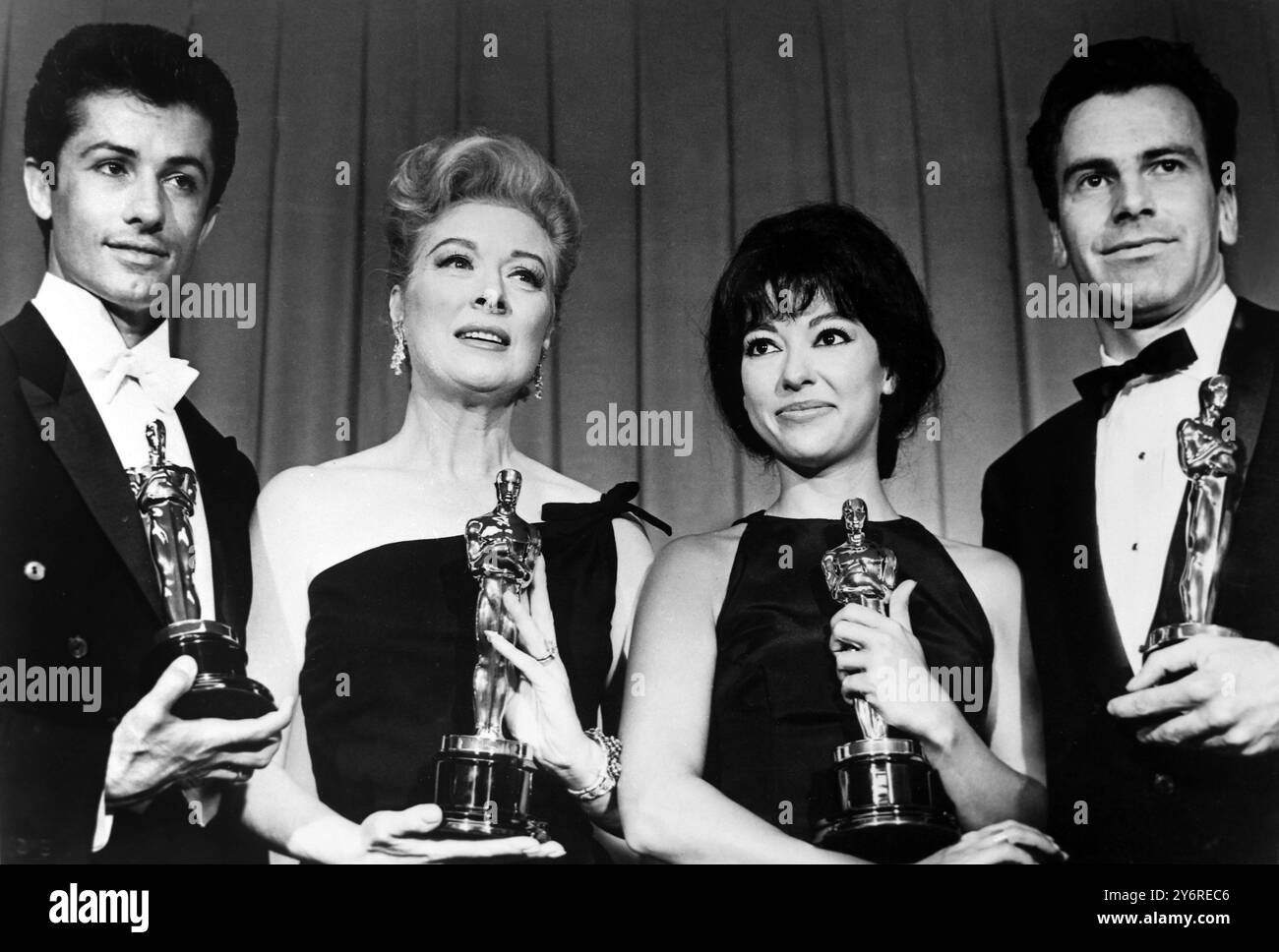
The film also swept the supporting acting categories. George Chakiris won Best Supporting Actor for his role as Bernardo, the leader of the Sharks, and Rita Moreno won Best Supporting Actress for her iconic portrayal of Anita. Moreno’s win was particularly historic as she became the first Latina actress to win an Academy Award, a legacy that continues to inspire performers in 2026.
Sophia Loren’s Historic Achievement
One of the most consequential moments of the 34th Academy Awards was the announcement of the Best Actress winner. Sophia Loren won for her harrowing performance in Vittorio De Sica’s Two Women (La ciociara). Before 1962, several foreign actors had been nominated for foreign-language roles, but the Academy had never awarded the top prize to a performance not delivered in English.
Loren was so convinced she wouldn't win that she didn't even attend the ceremony in California, staying home in Italy instead. When Greer Garson announced her name, it signaled a major shift in the Academy's global outlook. This win paved the way for future international stars and proved that the emotional resonance of a performance could transcend language barriers. Loren’s victory remains a benchmark for international cinema, often cited today as the moment the Oscars truly began to look beyond the borders of Hollywood.
The Battle for Best Actor: Maximilian Schell
While West Side Story took the most trophies, the dramatic powerhouse of the year was Judgment at Nuremberg. The film, which examined the complexities of the post-WWII legal trials in Germany, earned 11 nominations. Maximilian Schell won the award for Best Actor for his portrayal of defense counsel Hans Rolfe.
Schell’s win was notable because he had played the same role in a 1959 television production of the story. His transition to the big screen was so commanding that he beat out heavyweights like Spencer Tracy (his co-star in the same film), Paul Newman for The Hustler, and Burt Lancaster for Birdman of Alcatraz. Schell’s performance is often studied for its intensity and the way it managed to make a legal defense of war criminals humanly complex without being sympathetic.
Complete 1962 Oscar Winners List
The following table provides the full list of winners from the 34th Academy Awards across all competitive categories.
| Category | Winner | Film |
|---|---|---|
| Best Picture | Robert Wise (Producer) | West Side Story |
| Best Director | Robert Wise and Jerome Robbins | West Side Story |
| Best Actor | Maximilian Schell | Judgment at Nuremberg |
| Best Actress | Sophia Loren | Two Women |
| Best Supporting Actor | George Chakiris | West Side Story |
| Best Supporting Actress | Rita Moreno | West Side Story |
| Best Writing (Original Screenplay) | William Inge | Splendor in the Grass |
| Best Writing (Adapted Screenplay) | Abby Mann | Judgment at Nuremberg |
| Best Foreign Language Film | Ingmar Bergman (Director) | Through a Glass Darkly (Sweden) |
| Best Cinematography (B&W) | Eugen Schüfftan | The Hustler |
| Best Cinematography (Color) | Daniel L. Fapp | West Side Story |
| Best Art Direction (B&W) | Harry Horner; Gene Callahan | The Hustler |
| Best Art Direction (Color) | Boris Leven; Victor A. Gangelin | West Side Story |
| Best Costume Design (B&W) | Piero Gherardi | La Dolce Vita |
| Best Costume Design (Color) | Irene Sharaff | West Side Story |
| Best Sound | Fred Hynes; Gordon E. Sawyer | West Side Story |
| Best Film Editing | Thomas Stanford | West Side Story |
| Best Score (Dramatic or Comedy) | Henry Mancini | Breakfast at Tiffany's |
| Best Score (Musical) | Saul Chaplin, Johnny Green, Sid Ramin, Irwin Kostal | West Side Story |
| Best Original Song | "Moon River" (Mancini & Mercer) | Breakfast at Tiffany's |
| Best Documentary Feature | Arthur Cohn and René Lafuite | Sky Above and Mud Beneath |
| Best Documentary Short | Frank P. Bibas | Project Hope |
| Best Short Subject (Live Action) | Hilary Harris | Seawards the Great Ships |
| Best Short Subject (Cartoon) | Chuck Jones | Ersatz (The Substitute) |
| Best Special Effects | Bill Warrington; Vivian C. Greenham | The Guns of Navarone |
Key Facts and Trivia from the 1962 Ceremony
The 34th Academy Awards were not just about the awards themselves; several behind-the-scenes events and statistical anomalies make this year particularly interesting to historians.
The "Oscar Crasher" Incident
Long before the era of modern security, the 1962 ceremony featured a famous "gatecrasher." A New York taxi driver named Stan Berman managed to slip past security, get onto the stage, and interrupt Bob Hope. Berman attempted to present Hope with a homemade "trophy." Hope handled the situation with his trademark wit, but the incident led to a significant tightening of security protocols for future Academy Awards.
Ingmar Bergman’s Dominance
The win for Through a Glass Darkly marked the second consecutive year that Swedish director Ingmar Bergman won the Best Foreign Language Film Oscar, following his win for The Virgin Spring the previous year. This solidified Bergman’s status as the premier international director of the era and helped elevate the profile of the "Art House" cinema movement in the United States.
The Legacy of "Moon River"
The 1962 Oscars gave the world one of the most enduring pieces of film music: "Moon River." Composed by Henry Mancini with lyrics by Johnny Mercer for the film Breakfast at Tiffany's, the song won Best Original Song. Even in 2026, "Moon River" remains a standard in the American songbook, illustrating the Academy's ability to identify music that transcends the medium of film to become a cultural staple.
Technical Achievements in Cinematography
1962 was one of the final years where the Academy maintained strict separation between Black-and-White and Color categories for Cinematography, Art Direction, and Costume Design. The win for The Hustler in B&W Cinematography is often cited as a masterclass in using shadows and framing to create a gritty, noir-inspired atmosphere, contrasting sharply with the vibrant, Technicolor explosion of West Side Story.
How the 1962 Winners Influenced Modern Cinema
Looking back from the perspective of 2026, the 1962 winners represent the start of several industry-standard practices.
- The Rise of the Independent Spirit: While West Side Story was a big-budget production, films like The Hustler and Judgment at Nuremberg focused on character-driven narratives and moral ambiguity. This shifted the focus of the Academy away from "epic for the sake of epic" and toward storytelling with a harder edge.
- Global Integration: Sophia Loren's win was the first "crack in the glass ceiling" for non-English performances. Without her victory, it is unlikely we would have seen the later successes of films like Parasite or actors like Roberto Benigni and Marion Cotillard.
- The Musical as High Art: By awarding 10 Oscars to a musical that dealt with death and prejudice, the Academy acknowledged that the genre could be more than just escapist fluff. This paved the way for later "serious" musicals like Cabaret and Chicago.
Analyzing the Competition: What Didn't Win?
While West Side Story dominated, 1961 was a remarkably strong year for film, and many losers are now considered all-time classics. The Guns of Navarone, a massive war epic, only took home one Oscar for Special Effects despite seven nominations. La Dolce Vita, Federico Fellini's masterpiece, was nominated for several awards but only won for Costume Design (B&W).
The Hustler, despite its technical wins, saw Paul Newman lose the Best Actor race. Newman would eventually win decades later, but many critics argue his performance as "Fast Eddie" Felson was his finest work. The fact that such high-caliber films and performances were "runners-up" speaks to the extraordinary quality of the films released in 1961.
Viewing Recommendations for 1962 Winners
To truly appreciate the artistry of the 34th Academy Awards, modern viewers should focus on a "Big Three" viewing list:
- West Side Story: Essential for its choreography and use of color. Even with the 2021 remake by Steven Spielberg, the 1961 original remains a definitive piece of American culture.
- Judgment at Nuremberg: Essential for those interested in legal dramas and historical ethics. It remains one of the most powerful courtroom films ever made.
- Two Women (La ciociara): Essential to understand Sophia Loren's range and the power of Italian neorealism.
These films are widely available on 4K restoration and major streaming platforms as of 2026, often accompanied by documentaries explaining their production hurdles.
Frequently Asked Questions
Who hosted the 1962 Oscars?
The 34th Academy Awards were hosted by the legendary comedian Bob Hope. This was one of 19 times Hope served as the host (either alone or as a co-host), a record that remains unsurpassed in the history of the Oscars.
How many Oscars did West Side Story win in 1962?
West Side Story won 10 Academy Awards. It was nominated for 11 categories, losing only for Best Adapted Screenplay (which went to Judgment at Nuremberg).
Was the 1962 ceremony televised?
Yes, the ceremony was broadcast on the ABC network. By 1962, the Oscars had become a major television event, drawing millions of viewers and helping to cement the "Red Carpet" as a cultural phenomenon, although the 1962 red carpet was far less commercialized than the versions seen in the 21st century.
Why was Sophia Loren's win significant?
Loren's win was significant because she was the first person to win an acting Oscar for a non-English language performance. This opened the door for international cinema to be treated as equal to Hollywood productions in the eyes of the Academy voters.
What was the Best Picture winner in 1962?
The Best Picture winner was West Side Story. It beat out other nominees including Fanny, The Guns of Navarone, The Hustler, and Judgment at Nuremberg.
Summary of the 34th Academy Awards
The 1962 Oscar winners represent a high-water mark for the industry. From the technical brilliance of the musical format to the breaking of linguistic barriers in the acting categories, the 34th Academy Awards were a masterclass in cinematic excellence. For researchers and fans today, these winners offer a window into a time when Hollywood was beginning to confront serious social issues while still embracing the spectacle of the "Big Movie."
Whether you are studying the shared directing credit of Robert Wise and Jerome Robbins or the haunting melodies of Henry Mancini, the 1962 winners list provides a comprehensive map of what made 1961 one of the greatest years in film history. For the best experience, seek out the restored versions of these films to see the award-winning cinematography and art direction as they were intended to be seen.