The 25th Amendment to the United States Constitution establishes the formal procedures for replacing the president or vice president in the event of death, removal, resignation, or incapacitation. It provides a legal framework for both the voluntary and involuntary transfer of power to ensure executive stability during a leadership crisis.
Ratified in 1967, the 25th Amendment was born out of the Cold War era's anxieties regarding the "nuclear age" and the immediate need for a clear, undisputed chain of command. While the original Constitution provided a vague outline for succession, it left significant gaps—specifically regarding what should happen if a president were alive but unable to perform their duties. As we examine this amendment from our current vantage point in 2026, its relevance remains a cornerstone of American constitutional law, particularly following the heightened public discourse regarding executive fitness during the 2024 election cycle.
The Historical Genesis: Why the 25th Amendment Was Necessary
Before the 25th Amendment, the rules governing presidential disability and succession were dangerously ambiguous. Article II, Section 1, Clause 6 of the Constitution stated that in the case of the president’s "Inability to discharge the Powers and Duties of the said Office, the Same shall devolve on the Vice President." However, the text did not clarify whether the "Same" referred to the office itself or merely the powers and duties of the office.
This ambiguity led to the "Tyler Precedent" in 1841. When President William Henry Harrison died in office, Vice President John Tyler insisted on being sworn in as President, rather than serving as an "Acting President." While this established a practical precedent for death, it did nothing to solve the problem of disability. Throughout the 19th and early 20th centuries, several presidents suffered from debilitating illnesses while in office—most notably James A. Garfield (who lived for 80 days after being shot) and Woodrow Wilson (who suffered a massive stroke in 1919). In both cases, the nation was left without a functioning chief executive because there was no clear legal mechanism to transfer power temporarily.
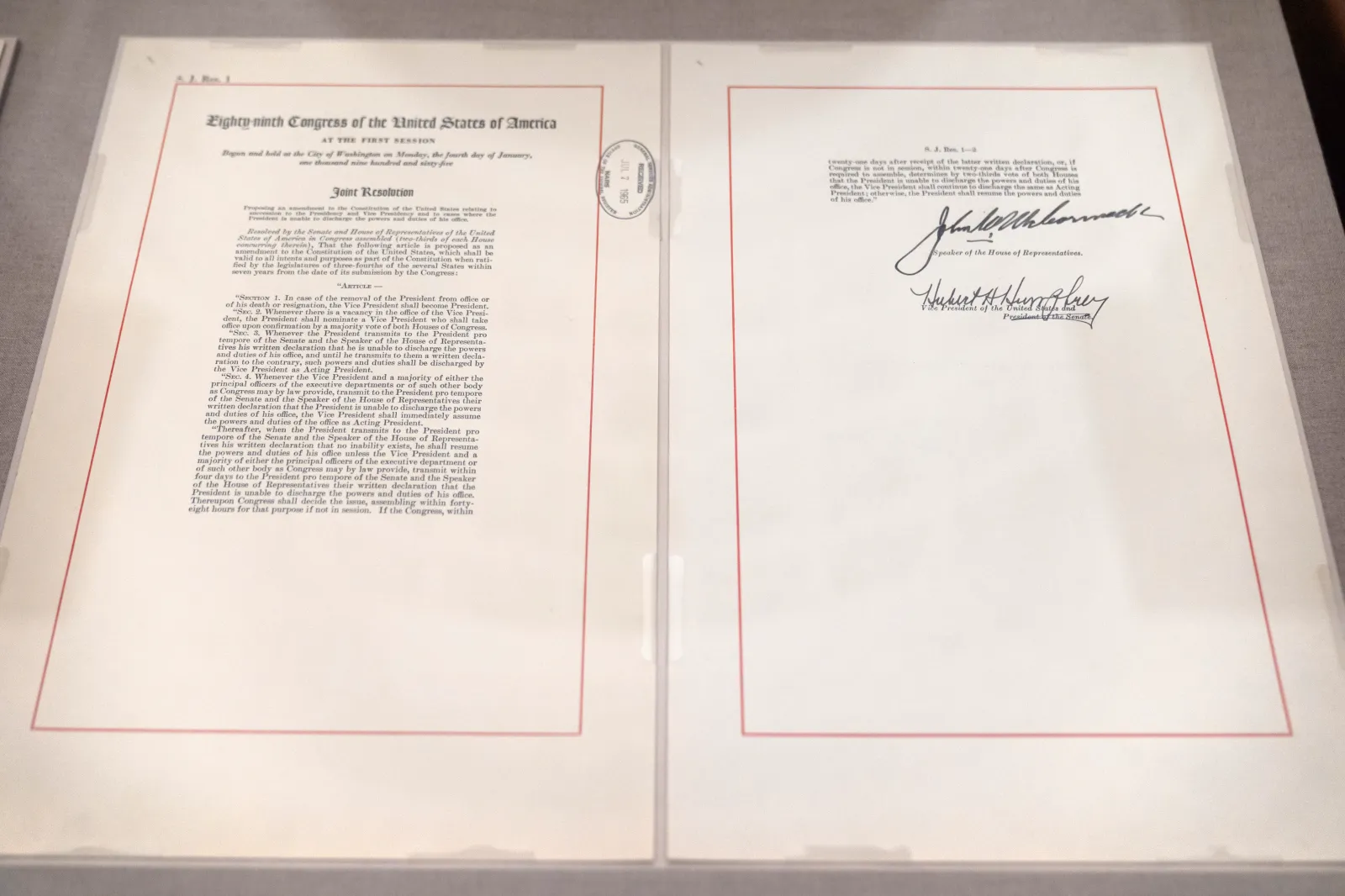
The assassination of John F. Kennedy in 1963 served as the final catalyst. In a world where nuclear decisions might need to be made in seconds, the prospect of a president being in a coma or otherwise incapacitated was a matter of national security. Congress proposed the 25th Amendment in 1965, and it was ratified by the required three-fourths of the states by February 10, 1967.
Section 1: Permanent Presidential Succession
Section 1 is the most straightforward part of the amendment. It codifies the Tyler Precedent by stating: "In case of the removal of the President from office or of his death or resignation, the Vice President shall become President."
This section ensures that there is never a vacancy in the presidency. The moment a president dies or their resignation is officially submitted, the Vice President immediately assumes the full title, powers, and responsibilities of the presidency. This is not a "temporary" or "acting" role; the Vice President becomes the President for the remainder of the term.
The most notable application of Section 1 occurred on August 9, 1974, when Richard Nixon resigned following the Watergate scandal. Gerald Ford immediately became the 38th President of the United States. Without Section 1, there might have been legal challenges regarding Ford's status or the legitimacy of his executive orders.
Section 2: Filling the Vice Presidential Vacancy
Historically, when a Vice President died in office or succeeded to the presidency, the vice presidency remained vacant until the next election. Before 1967, the office had been vacant 16 times for a combined total of nearly 38 years. Section 2 corrected this by providing a mechanism to fill the vacancy.
Under Section 2, whenever there is a vacancy in the office of the Vice President, the President nominates a successor. This nominee must then be confirmed by a majority vote of both Houses of Congress.
This process has been used twice in American history:
- 1973: After Vice President Spiro Agnew resigned due to criminal charges, President Nixon nominated Gerald Ford.
- 1974: After Gerald Ford became President upon Nixon's resignation, Ford nominated Nelson Rockefeller to be Vice President.
This section is unique because it is the only time the Vice President is chosen by a method other than the Electoral College. It requires a high degree of political consensus, as the nominee must pass through both the House of Representatives and the Senate.
Section 3: Voluntary Transfer of Power (Acting Presidents)
Section 3 allows a President to temporarily hand over their powers and duties to the Vice President. To trigger this, the President must transmit a written declaration to the President pro tempore of the Senate and the Speaker of the House of Representatives stating that they are "unable to discharge the powers and duties of his office."
During this period, the Vice President serves as Acting President. The President can reclaim their powers at any time by sending a second written declaration stating that the inability no longer exists.
Practical Applications of Section 3
This section is most commonly used for scheduled medical procedures involving general anesthesia. By using Section 3, the President ensures that there is always someone with the legal authority to command the military or respond to an emergency.
- Ronald Reagan (1985): Transferred power to George H.W. Bush for eight hours during colon surgery. (Notably, Reagan did not specifically cite the 25th Amendment in his letter to avoid setting a rigid precedent, but he followed the protocol.)
- George W. Bush (2002 & 2007): Formally invoked Section 3 twice for colonoscopies, transferring power to Dick Cheney.
- Joe Biden (2021): Temporarily transferred power to Kamala Harris during a routine medical procedure, making her the first woman to hold presidential powers in U.S. history.
Section 4: Involuntary Removal and the Fitness Debate
Section 4 is the most complex and controversial part of the amendment. It provides a process for the Vice President and the Cabinet to remove a President who is "unable to discharge the powers and duties of his office" but is unable or unwilling to step aside voluntarily.
The Invocation Process
To initiate Section 4, the Vice President and a majority of the "principal officers of the executive departments" (the Cabinet) must send a written declaration to the leaders of the House and Senate. Upon doing so, the Vice President immediately becomes Acting President.
The "principal officers" currently consist of the 15 heads of the executive departments, such as the Secretary of State, Secretary of Defense, and Attorney General. The Vice President’s participation is mandatory; Section 4 cannot be triggered by the Cabinet alone.
The Conflict Resolution Mechanism
If the President disagrees and issues a counter-declaration stating that no inability exists, they resume their powers. However, the Vice President and the Cabinet have four days to submit a second declaration. If they do, the issue moves to Congress:
- Congress must assemble within 48 hours if not in session.
- A decision must be made within 21 days.
- A two-thirds vote in both the House and the Senate is required to keep the Vice President as Acting President. If the vote fails to reach the two-thirds threshold in either chamber, the President resumes their duties.
Section 4 has never been invoked. It was designed as a "fail-safe" for extreme situations, such as a president being in a coma, suffering from advanced dementia, or having a mental breakdown that prevents them from recognizing their own incapacitation.
Comparing the 25th Amendment Sections
| Section | Subject | Primary Trigger | Final Authority |
|---|---|---|---|
| Section 1 | Permanent Succession | Death, Resignation, Removal | Constitution (Automatic) |
| Section 2 | VP Vacancy | Death or Resignation of VP | President (Nomination) & Congress (Confirmation) |
| Section 3 | Voluntary Disability | Written declaration by President | President (Self-declaration) |
| Section 4 | Involuntary Disability | Declaration by VP + Cabinet | Congress (2/3 Vote if contested) |
The 2024 Context and Modern Interpretation
In 2024, the 25th Amendment became a frequent topic of public debate and political rhetoric. As the U.S. moved through a high-stakes election cycle featuring aging candidates, legal scholars and the media scrutinized the threshold for "inability" under Section 4.
The primary debate centered on whether "inability" refers strictly to physical or mental health or if it could include a broader definition of "unfitness." The framers of the amendment intended for "inability" to be a factual determination, not a political one. They deliberately avoided a rigid medical definition to allow for flexibility, but they also included the two-thirds congressional vote requirement to prevent Section 4 from being used as a "backdoor impeachment."
As of 2026, the 25th Amendment remains interpreted through this lens of stability. It is viewed not as a tool for political removal (which is the purpose of the Impeachment Clause), but as a biological or psychological necessity to protect the executive branch's continuity.
Common Misconceptions About the 25th Amendment
To fully understand the amendment, it is necessary to dispel several common myths that often surface during periods of political tension:
- Myth 1: Section 4 is a "Coup" Mechanism. In reality, Section 4 is much harder to execute than impeachment. Impeachment requires a simple majority in the House and a two-thirds majority in the Senate. Section 4 requires the Vice President, a majority of the President's own hand-picked Cabinet, AND a two-thirds majority in both the House and the Senate.
- Myth 2: The Cabinet can act without the Vice President. The Vice President is the indispensable player in Section 4. Without the VP's signature, the Cabinet has no power to initiate the removal process.
- Myth 3: Being "Acting President" is the same as being "President." Under Sections 3 and 4, the Vice President only holds the powers and duties of the office. The disabled President retains the office itself. This is why the distinction of "Acting President" is legally significant.
- Myth 4: The 25th Amendment replaces Impeachment. Impeachment is for "High Crimes and Misdemeanors" (wrongdoing). The 25th Amendment is for "Inability" (incapacity). One is punitive; the other is protective.
Frequently Asked Questions
Who are the "principal officers of the executive departments" mentioned in Section 4?
The "principal officers" are the heads of the 15 executive departments: State, Treasury, Defense, Justice, Interior, Agriculture, Commerce, Labor, Health and Human Services, Housing and Urban Development, Transportation, Energy, Education, Veterans Affairs, and Homeland Security. While the President’s staff (like the Chief of Staff) or "Cabinet-level" officials (like the CIA Director) are important, they do not count toward the majority required by Section 4 unless they are heads of these 15 departments.
Can the 25th Amendment be used if the President is temporarily kidnapped or missing?
Yes. Legal scholars generally agree that if a President were kidnapped or unreachable during a crisis, Section 4 could be invoked to allow the Vice President to assume the powers of the Acting President until the President is safely recovered. This falls under the "inability to discharge the powers and duties" of the office.
What happens if the Vice President and the Cabinet disagree?
If the Vice President wants to invoke Section 4 but the Cabinet does not, or vice versa, the amendment cannot be triggered. It requires a consensus between the Vice President and a majority of the Cabinet. This serves as a system of checks and balances to ensure that no single person or small group can seize executive power without broad agreement within the administration.
Can the President fire the Cabinet to stop a Section 4 invocation?
Technically, the President has the power to fire Cabinet members. However, if a President attempted to fire the entire Cabinet while they were in the process of signing a Section 4 declaration, it would likely trigger a constitutional crisis. Most experts believe that the declaration would still be valid if signed by the officers before their dismissal was officially processed, or that Congress would intervene to recognize the acting authority of the Vice President.
How long does the Vice President remain Acting President under Section 4?
The Vice President remains Acting President until the President issues a counter-declaration stating they are fit. If the Vice President and Cabinet dispute this, the Vice President remains Acting President only until Congress votes. If Congress does not vote within the 21-day limit, or fails to achieve a two-thirds majority, the power immediately reverts to the President.
Next Steps for Legal Research and Action
For those seeking to monitor the application or legal evolution of the 25th Amendment, several resources provide real-time updates on executive procedures and constitutional law:
- Review the Original Text: The National Archives provides the definitive text of the 25th Amendment and historical notes on its ratification.
- Consult Congressional Research: The Library of Congress offers an annotated Constitution that tracks how the courts and Congress have interpreted "inability" and "principal officers."
- Monitor Executive Orders: Official presidential declarations regarding the temporary transfer of power are published by the Office of the Federal Register.
- Academic Analysis: Institutional bodies like the Fordham University School of Law maintain extensive archives on the amendment's history and potential future applications.
Understanding the 25th Amendment is essential for any citizen concerned with the continuity of the American government. It remains the primary safeguard against a leadership vacuum, ensuring that the transition of power remains governed by law rather than chaos.