The 2015 FIFA Women's World Cup Final between the United States and Japan delivered one of the most explosive and unforgettable starts in soccer history, highlighted by Carli Lloyd’s stunning hat-trick within the first sixteen minutes and a final score of 5-2 that secured the United States its third World Cup title.
The Context and Stakes of the 2015 Final
The 2015 FIFA Women's World Cup Final, hosted at BC Place in Vancouver, Canada, was much more than a championship match; it was a high-stakes rematch of the 2011 FIFA Women's World Cup Final. Four years prior in Frankfurt, Germany, Japan had broken American hearts by defeating the United States in a dramatic penalty shootout after a 2-2 draw. That defeat left a deep scar on the U.S. Women's National Team (USNT), driving a four-year cycle of preparation, tactical evolution, and roster reinvention under head coach Jill Ellis.
As the tournament in Canada progressed, the United States faced scrutiny for a pragmatic, sometimes conservative style of play during the group stage and early knockout rounds. However, the team shifted into an aggressive, high-tempo tactical shape by the semifinals against Germany. Japan, meanwhile, entered the final as the reigning champions, maintaining their signature possession-based, highly technical, and geometrically precise style of play under coach Norio Sasaki. They had navigated their path to the final with disciplined defense and clinical execution, setting up a fascinating tactical clash between American athleticism and transitional speed versus Japanese tactical intelligence and passing mastery.
First-Half Blitz: The Goals That Stunned the World
The match is remembered almost entirely for its frantic, goal-laden opening sixteen minutes. What was projected to be a tense, chess-like tactical battle erupted into a historic offensive masterclass by the United States.
Carli Lloyd and the Opening Salvo (Minutes 3 and 5)
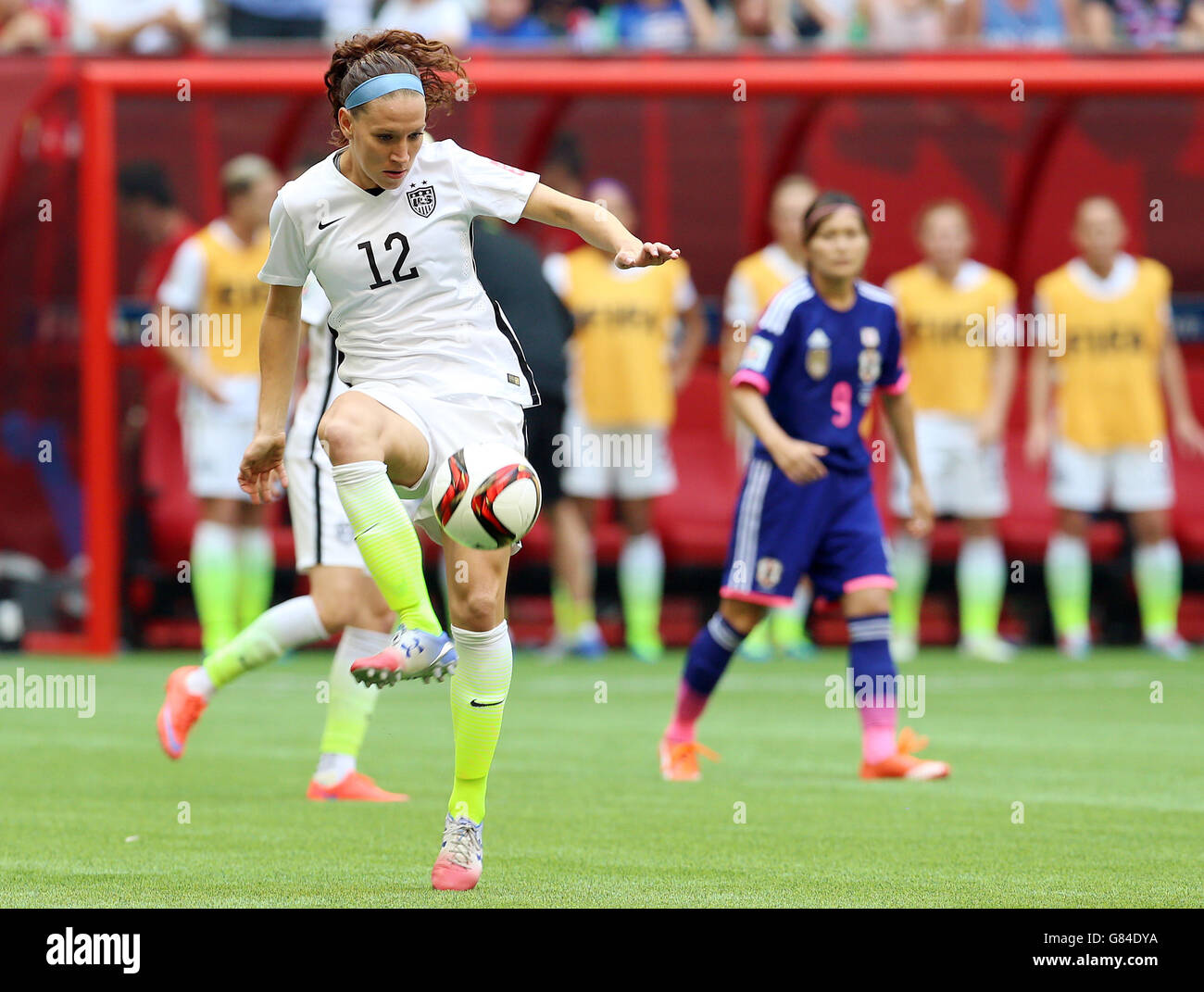
The scoring opened in just the 3rd minute. Megan Rapinoe delivered a sharp, out-swinging corner kick from the left flank directly toward the penalty spot. Carli Lloyd, making a brilliantly timed, unchecked run from deep, met the ball with a full-blooded sliding redirection that flashed past Japanese goalkeeper Ayumi Kaihori. It was 1-0 before many viewers had settled into their seats.
Just two minutes later, in the 5th minute, the United States struck again from a set piece. Lauren Holiday whipped a dangerous free kick from the right side into a crowded Japanese penalty box. The Japanese defense failed to clear cleanly, and the ball pinballed into the path of Carli Lloyd, who reacted quickest to poke home her second goal of the match from close range. The USWNT led 2-0, stunning the defending champions and completely upending Japan's defensive structure.
Lauren Holiday and the Volley Masterpiece (Minute 14)
Japan was still reeling from the double blow when the U.S. delivered a third strike in the 14th minute. Holiday pressured the Japanese defense high up the pitch, forcing an errant clearance that drifted high into the air near the top of the penalty area. Holiday didn't hesitate; she watched the dropping ball and unleashed a brilliant, first-time right-footed volley that skipped past Kaihori into the back of the net. The scoreline read 3-0, a margin no team had ever built in a Women's World Cup final.
Carli Lloyd’s Legendary Midfield Chip (Minute 16)
If the first three goals shocked the stadium, the fourth goal cemented the match into soccer folklore. In the 16th minute, Carli Lloyd gained possession near the halfway line. Glancing up, she noticed that Japanese goalkeeper Ayumi Kaihori was positioned unusually far off her line, anticipating a standard build-up play. Lloyd unleashed a breathtaking, audacious shot from over 50 yards out. Kaihori raced backward in desperation, managing to get a hand to the ball, but only succeeded in deflecting it onto the post and into her own net.
Completed in just sixteen minutes, Lloyd’s hat-trick remains the fastest hat-trick in World Cup history—men's or women's—and stands as one of the greatest individual performances in a global final.
Japan’s Response and Resilience
Trailing 4-0 inside twenty minutes would have broken most teams, but Japan demonstrated the poise and tactical discipline that made them world champions in 2011. Rather than panicking or abandoning their tactical principles, Japan gradually reasserted control over possession, stringing passes together and probing the flanks of the U.S. defense.
In the 27th minute, Japan's persistence paid off. Nahomi Kawasumi played a sharp, incisive pass into the feet of veteran striker Yuki Ogimi inside the U.S. penalty box. Ogimi executed a brilliant turn away from U.S. defender Julie Johnston, creating just enough separation to fire a left-footed shot past Hope Solo into the top corner. The goal narrowed the deficit to 4-1 and injected a flicker of hope into the Japanese squad as the teams headed into halftime.
The momentum continued into the second half. In the 52nd minute, Japan struck again. Aya Miyama delivered an inswinging free kick that caused confusion in the U.S. box. As Julie Johnston attempted to clear a bouncing cross, she inadvertently headed the ball past her own goalkeeper, Hope Solo, scoring an own goal. Suddenly, the score was 4-2, and the defending champions were within striking distance, threatening one of the most remarkable comebacks in tournament history.
The Dagger: Tobin Heath Restores Order
For a brief period following Japan’s second goal, the tension inside BC Place reached a fever pitch. Japan controlled possession, circulating the ball with crisp, one-touch passing, while the U.S. defense was forced into a series of crucial clearances and desperate blocks.
However, the U.S. response came in the 54th minute, effectively extinguishing any hopes of a Japanese miraculous comeback. Following a corner kick sequence, Morgan Brian recycled the ball out wide, and the U.S. maintained pressure in the attacking third. The ball fell to Tobin Heath positioned near the far post, completely unmarked due to a lapse in defensive tracking by the Japanese backline. Heath calmly swept the ball home from close range, restoring a three-goal advantage at 5-2.
The fifth goal acted as a psychological anchor for the United States, steadying their nerves and breaking the resolve of a tiring Japanese side.
| Match Minute | Goal Scorer | Team | Match Score | Description of Play |
|---|---|---|---|---|
| 3' | Carli Lloyd | USA | 1-0 | Sliding redirection off a sharp corner kick from Megan Rapinoe. |
| 5' | Carli Lloyd | USA | 2-0 | Quick-reaction finish inside a crowded box following a free kick. |
| 14' | Lauren Holiday | USA | 3-0 | Spectacular first-time volley from outside the box following a clearance. |
| 16' | Carli Lloyd | USA | 4-0 | Audacious, historic 50-yard chip over the goalkeeper from midfield. |
| 27' | Yuki Ogimi | Japan | 4-1 | Sharp turn and left-footed strike past Hope Solo inside the box. |
| 52' | Julie Johnston (OG) | Japan | 4-2 | Unfortunate headed own goal following a dangerous Japanese free kick. |
| 54' | Tobin Heath | USA | 5-2 | Calm finish at the far post following a recycled corner kick phase. |
Tactical and Historical Significance
The 2015 final was a watershed moment for women's football globally, showcasing unprecedented technical quality, athletic power, and tactical sophistication.
From a tactical perspective, Jill Ellis's decision to push Carli Lloyd into an advanced, free-roaming central midfield role proved to be the defining tactical masterstroke of the tournament. By granting Lloyd the freedom to crash the penalty box from deep, Japan’s defensive midfielders—Mizuho Sakaguchi and Rumi Utsugi—were consistently dragged out of position, unable to track her late runs.
Furthermore, the match marked the emotional international swan song for legendary figures of the U.S. program, most notably striker Abby Wambach, who entered the match as a second-half substitute and received the captain's armband from Lloyd. The victory served as redemption for the 2011 heartbreak and cemented a golden generation of American soccer players into permanent sports history.
Frequently Asked Questions
What was the final score of the 2015 FIFA Women's World Cup Final?
The United States defeated Japan with a final score of 5-2. The match is remembered for an explosive first half that saw seven total goals scored, establishing a record for the highest-scoring final in Women's World Cup history.
Who scored the goals in the 2015 World Cup Final?
For the United States, Carli Lloyd scored a hat-trick (3', 5', 16'), Lauren Holiday scored a volley (14'), and Tobin Heath scored from close range (54'). For Japan, Yuki Ogimi scored in the 27th minute, followed by an own goal from the U.S. defense in the 52nd minute.
What record did Carli Lloyd break during the match?
Carli Lloyd set the record for the fastest hat-trick in World Cup history, scoring her three goals within the first sixteen minutes of the match. Her third goal—a remarkable shot from midfield—is also widely regarded as one of the greatest goals ever scored in an international final.
How did the 2015 final compare to the 2011 World Cup Final between USA and Japan?
In 2011, Japan defeated the United States on penalties after a 2-2 draw, showcasing patient possession football. In 2015, the tactical dynamic flipped early on as the U.S. utilized an aggressive, high-pressing start and ruthless set-piece execution to overwhelm Japan before they could establish their rhythm.
Where was the 2015 FIFA Women's World Cup Final played?
The match was played at BC Place in Vancouver, British Columbia, Canada, in front of a heavily pro-American crowd of over 53,000 spectators on July 5, 2015.
Conclusion and Next Actions
To fully appreciate the historical weight of the 2015 final, viewers should watch the full match replay available via official FIFA archival platforms or explore tactical analysis breakdowns examining Jill Ellis's midfield formations. Understanding this match provides vital context for the broader evolution of the modern women's game, highlighting how high-intensity pressing and tactical flexibility reshaped international soccer.