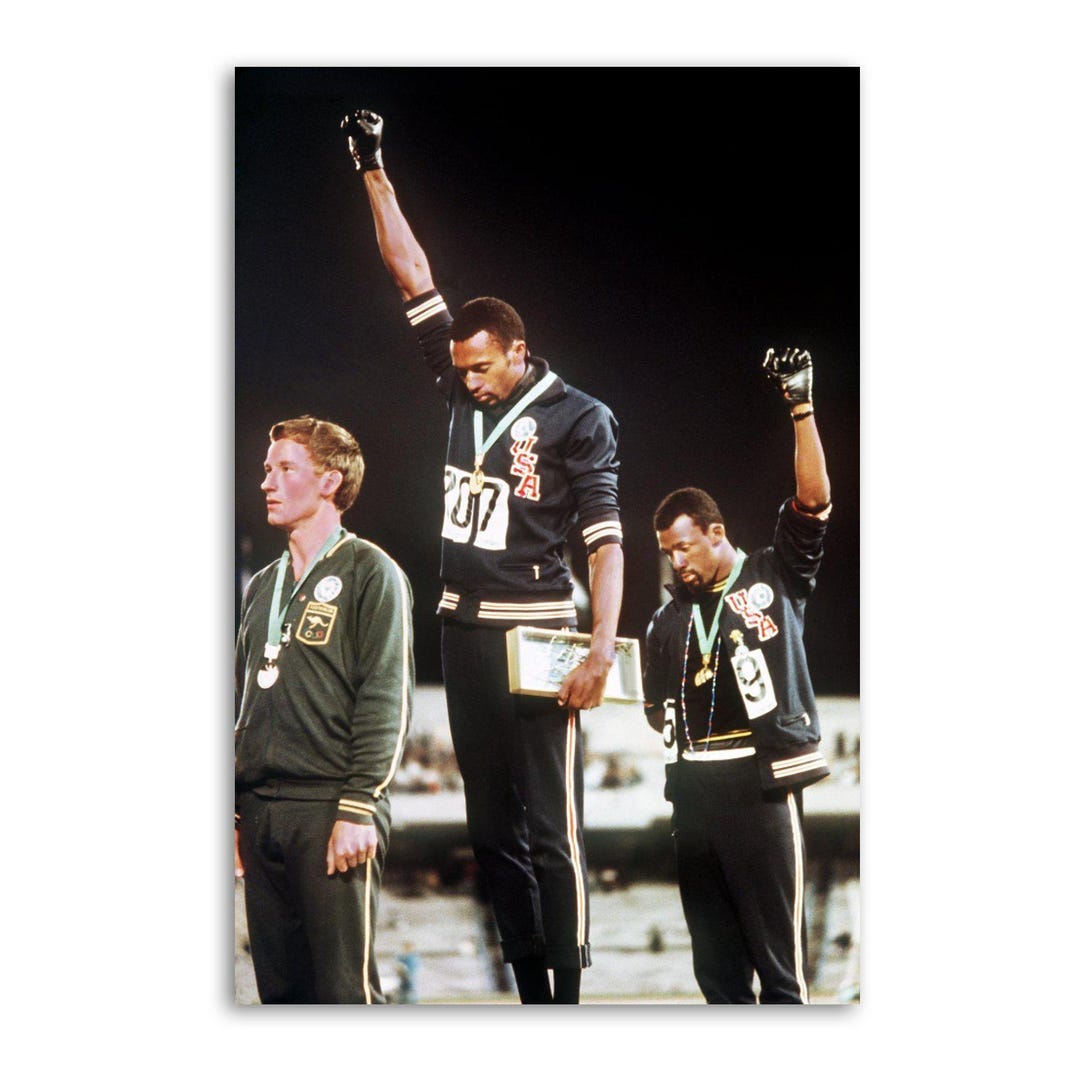
On October 16, 1968, American sprinters Tommie Smith and John Carlos staged one of the most iconic protests in history during the 200-meter medal ceremony at the Mexico City Olympics. By raising black-gloved fists during the U.S. national anthem, they transformed a sporting event into a global platform for civil rights and human justice.
The Volatile Atmosphere of 1968
To understand why the gesture of Tommie Smith and John Carlos resonated so powerfully, one must consider the global and domestic chaos of 1968. In the United States, the Civil Rights Movement was at a breaking point. Just months before the Summer Games, Dr. Martin Luther King Jr. was assassinated in Memphis, sparking riots in over 100 cities. In June, Senator Robert F. Kennedy was assassinated in Los Angeles. The Vietnam War was escalating, and anti-war protests were becoming increasingly militant.
Mexico City itself was not immune to the era's unrest. Only ten days before the Olympics began, the Tlatelolco Massacre occurred, where Mexican security forces killed hundreds of students and civilians protesting the government’s expenditure on the Games while social needs remained unmet. Within this pressure cooker of social upheaval, the International Olympic Committee (IOC) attempted to maintain a facade of "politics-free" sport—a stance that Smith and Carlos were determined to challenge.
The Olympic Project for Human Rights (OPHR)
The protest was not a spontaneous act of defiance but the culmination of organized activism. In late 1967, sociologist Harry Edwards, a professor at San Jose State University (where Smith and Carlos were students), founded the Olympic Project for Human Rights (OPHR). The group’s initial goal was to organize a total boycott of the 1968 Games by African American athletes.
The OPHR issued a set of specific demands, which included:
- The restoration of Muhammad Ali’s heavyweight boxing title (which had been stripped due to his refusal to serve in Vietnam).
- The removal of Avery Brundage as President of the IOC.
- The disinvitation of South Africa and Rhodesia from the Games due to their apartheid policies.
- The hiring of more African American assistant coaches.
While the full boycott never materialized—partly because athletes who had trained their entire lives were reluctant to forfeit their one chance at glory—the OPHR encouraged athletes to protest in ways that felt personally meaningful. Smith and Carlos decided that if they reached the podium, they would use that visibility to speak for those who had no voice.
The Race: A World Record Performance
Lost sometimes in the historical focus on the protest is the sheer athletic brilliance of the event. On the evening of October 16, Tommie Smith ran a spectacular race. Despite suffering a groin injury in the semifinals, Smith pulled away from the pack in the final 50 meters of the 200-meter dash. He crossed the finish line in 19.83 seconds, setting a new world record and becoming the first person to break the 20-second barrier legally.
John Carlos, who had led for much of the race, finished third with a time of 20.10 seconds, taking the bronze. Peter Norman, an Australian sprinter and a largely unknown factor at the time, delivered a stunning late surge to take the silver medal with a time of 20.06 seconds. The stage was set for the medal ceremony, and the world’s cameras were fixed on the three men.
Deciphering the Symbols of the "Silent Gesture"
As Smith and Carlos walked toward the podium, the crowd noticed they were not dressed in standard Olympic attire. Every element of their appearance was a calculated symbol designed to highlight the plight of Black Americans.
The Black Gloves
The most famous element of the protest—the raised fists—was nearly thwarted by a simple mistake. John Carlos had forgotten his pair of black gloves at the Olympic Village. It was the silver medalist, Peter Norman, who suggested that the two Americans share Smith’s pair. This is why Smith raised his right fist and Carlos raised his left. The raised fist was a symbol of Black power and unity, but the crossing of the two represented a broader strength.
Black Socks and No Shoes
Both Smith and Carlos took the podium wearing only black socks, leaving their shoes behind. This was a direct reference to the systemic poverty that afflicted millions of African Americans. By standing on a global stage without shoes, they brought the reality of the American ghetto to the pristine Olympic stadium.
The Scarf and the Beads
Tommie Smith wore a black scarf around his neck to represent Black pride. John Carlos wore a string of beads, which he later explained were a tribute to the victims of lynchings and the many Black individuals who had been killed in the struggle for civil rights, for whom no one had said a prayer.
The Unzipped Jacket
In a break from Olympic protocol, Carlos wore his track jacket unzipped. This was intended to show solidarity with blue-collar workers and the "working man" in the United States, further broadening the scope of the protest from racial justice to class struggle.
Peter Norman’s Role
Though often overlooked in early accounts, Peter Norman was a critical participant. A white Australian and a devout Salvationist, Norman abhorred the White Australia Policy of his home country. When Smith and Carlos told him of their plan, he asked how he could support them. He took an OPHR badge from another athlete and wore it prominently on his chest during the ceremony, signaling his solidarity with their cause.
The Immediate Backlash and Sanctions
The reaction from the Olympic establishment was swift and merciless. Avery Brundage, the IOC President, was incensed. Brundage, who had famously made no objection to the Nazi salutes during the 1936 Berlin Olympics, deemed the "silent gesture" a domestic political statement unfit for the apolitical forum of the Games.
Brundage ordered Smith and Carlos suspended from the U.S. team and expelled from the Olympic Village. When the U.S. Olympic Committee (USOC) initially refused, Brundage threatened to ban the entire U.S. track and field team. Under this extreme pressure, the USOC complied. Within 48 hours, the two fastest men in the world were sent home in disgrace.
The media coverage of the time was largely hostile. Time magazine replaced the Olympic logo's "Faster, Higher, Stronger" motto with "Angrier, Nastier, Uglier" in its coverage of the event. Brent Musburger, then a young journalist for the Chicago American, described the athletes as "black-skinned stormtroopers."
Life After Mexico City: The Long Road to Redemption
The years following the 1968 Olympics were grueling for both men. They received numerous death threats, and their families were harassed. Employment was difficult to find; Smith and Carlos both struggled to maintain stable careers for a decade. They both had brief stints in the National Football League (NFL)—Smith with the Cincinnati Bengals and Carlos with the Philadelphia Eagles—but neither found long-term success on the gridiron.
However, the tide of public opinion began to turn as the civil rights gains of the 1960s became part of the American fabric. By the late 1970s and 1980s, their gesture was increasingly viewed not as an act of treason, but as a courageous stand for human rights.
- Tommie Smith eventually became a professor of sociology and a track coach at Santa Monica College. He was inducted into the National Track and Field Hall of Fame in 1978.
- John Carlos worked as a counselor and coach at Palm Springs High School and served as a community liaison for the 1984 Los Angeles Olympics.
- Peter Norman faced the harshest long-term consequences in his home country. He was ostracized by the Australian sporting establishment, left off the 1972 Olympic team despite qualifying, and was not invited to participate in the 2000 Sydney Olympics. When Norman passed away in 2006, Smith and Carlos traveled to Australia to serve as his pallbearers.
Comparing the Elements of the 1968 Protest
| Element | Direct Representation | Broader Social Context |
|---|---|---|
| Raised Fist (Right/Left) | Black Power and Unity | A call for global human rights and dignity. |
| Black Socks (No Shoes) | Black Poverty | Highlighting economic inequality in the U.S. |
| Black Scarf | Black Pride | Affirmation of African American identity. |
| Beads | Victims of Lynchings | Memorializing those lost to racial violence. |
| Unzipped Jacket | Blue-Collar Workers | Solidarity with the labor movement and the poor. |
| OPHR Badge | Group Affiliation | The organized nature of the athlete-led movement. |
The Global Legacy in 2026
Standing in 2026, the moment in Mexico City is recognized as a foundational event in the history of athlete activism. It paved the way for future generations of athletes—from Muhammad Ali's continued stance against the draft to the modern era of social justice movements in the NBA, NFL, and international soccer.
In 2005, San Jose State University unveiled a 22-foot-tall statue of Smith and Carlos on the podium. Notably, the silver medalist's spot is vacant, allowing visitors to stand where Peter Norman stood and experience the moment from his perspective. In 2019, Smith and Carlos were finally inducted into the U.S. Olympic and Paralympic Hall of Fame, a move that formally signaled the USOC's apology for their 1968 expulsion.
The "moment that shook the world" remains a powerful reminder that sports do not exist in a vacuum. The bravery of Smith, Carlos, and Norman showed that the podium is not just a place for medals, but a platform for the conscience of humanity.
Frequently Asked Questions
Did Tommie Smith and John Carlos lose their medals?
No, Tommie Smith and John Carlos were never officially stripped of their medals by the International Olympic Committee. While they were suspended from the U.S. team and expelled from the Olympic Village, their 200-meter results and world records remained in the official record books. The physical medals remained in their possession.
Why did they only use two gloves between the two of them?
The use of two gloves was a result of a logistical mishap rather than a symbolic choice. John Carlos forgot his gloves at the Olympic Village. Peter Norman, the silver medalist, suggested that Smith and Carlos share Smith's pair. Consequently, Smith wore the right-hand glove and Carlos wore the left-hand glove, which is why Carlos raised his left arm instead of the traditional right arm used in the Black Power salute.
What happened to Peter Norman after the ceremony?
Peter Norman faced significant professional backlash in Australia. Despite being one of the fastest sprinters in the world, he was not selected for the 1972 Munich Olympics. He was largely ignored by the Australian Olympic Committee for decades. It wasn't until 2012, six years after his death, that the Australian Parliament issued a formal apology for the treatment he received and recognized his bravery in supporting Smith and Carlos.
What was the Olympic Project for Human Rights?
The Olympic Project for Human Rights (OPHR) was an organization founded by Harry Edwards in 1967. Its primary purpose was to protest racial segregation and the oppression of Black people globally. While it is most famous for the 1968 Olympic protest, the group originally aimed to organize a boycott of the Games to demand better treatment for Black athletes and social changes in the United States and abroad.
Was the protest considered a "Black Power" salute at the time?
Yes, the media and the public largely labeled it a "Black Power" salute. However, Tommie Smith later described it in his autobiography as a "Human Rights Salute." While the gesture certainly drew from the imagery of the Black Power movement, the athletes intended it to be a broader statement against all forms of human rights violations and systemic inequality.
Practical Recommendation: Understanding the History of Activism
For those interested in the intersection of sports and social justice, the 1968 protest serves as a primary case study. Researchers and students should look toward the official archives of the International Olympic Committee and the Smithsonian National Museum of African American History and Culture for primary source documents, including the original OPHR manifestos.
Visiting the San Jose State University memorial or viewing the documentary Salute (2008), directed by Peter Norman’s nephew Matt Norman, provides deep personal insights into the motivations of all three men. In 2026, the legacy of this event is more relevant than ever as athletes continue to navigate their roles as both competitors and citizens on the global stage.