The 2019 March Madness tournament concluded with the University of Virginia winning its first NCAA Division I Men’s Basketball Championship, defeating Texas Tech 85–77 in an overtime thriller. This tournament is best remembered for Virginia’s historic "redemption arc" following their 2018 loss to a No. 16 seed and the cultural phenomenon surrounding Duke's Zion Williamson.
The Narrative of Redemption: Virginia’s Path to Glory
To understand the weight of the 2019 March Madness tournament, one must look back at the 2018 event. A year prior, the Virginia Cavaliers entered the tournament as the overall number-one seed, only to become the first top seed in history to lose to a No. 16 seed, UMBC. That loss hung over the program for an entire calendar year, defining the stakes for their 2019 campaign.
Head coach Tony Bennett utilized that failure as a foundational teaching tool. Entering the 2019 tournament as a No. 1 seed in the South Region, Virginia faced immediate pressure to avoid another early exit. Their journey was anything but easy. Throughout the tournament, they survived multiple "near-death" experiences on the court, including a frantic comeback against Gardner-Webb in the first round and a miracle buzzer-beater against Purdue in the Elite Eight.
The 2019 championship was a testament to the "Five Pillars" of Bennett’s program: Humility, Passion, Unity, Servanthood, and Thankfulness. By the time the final whistle blew in Minneapolis, the Cavaliers had completed one of the most compelling turnaround stories in the history of American sports.
The Selection Sunday Landscape
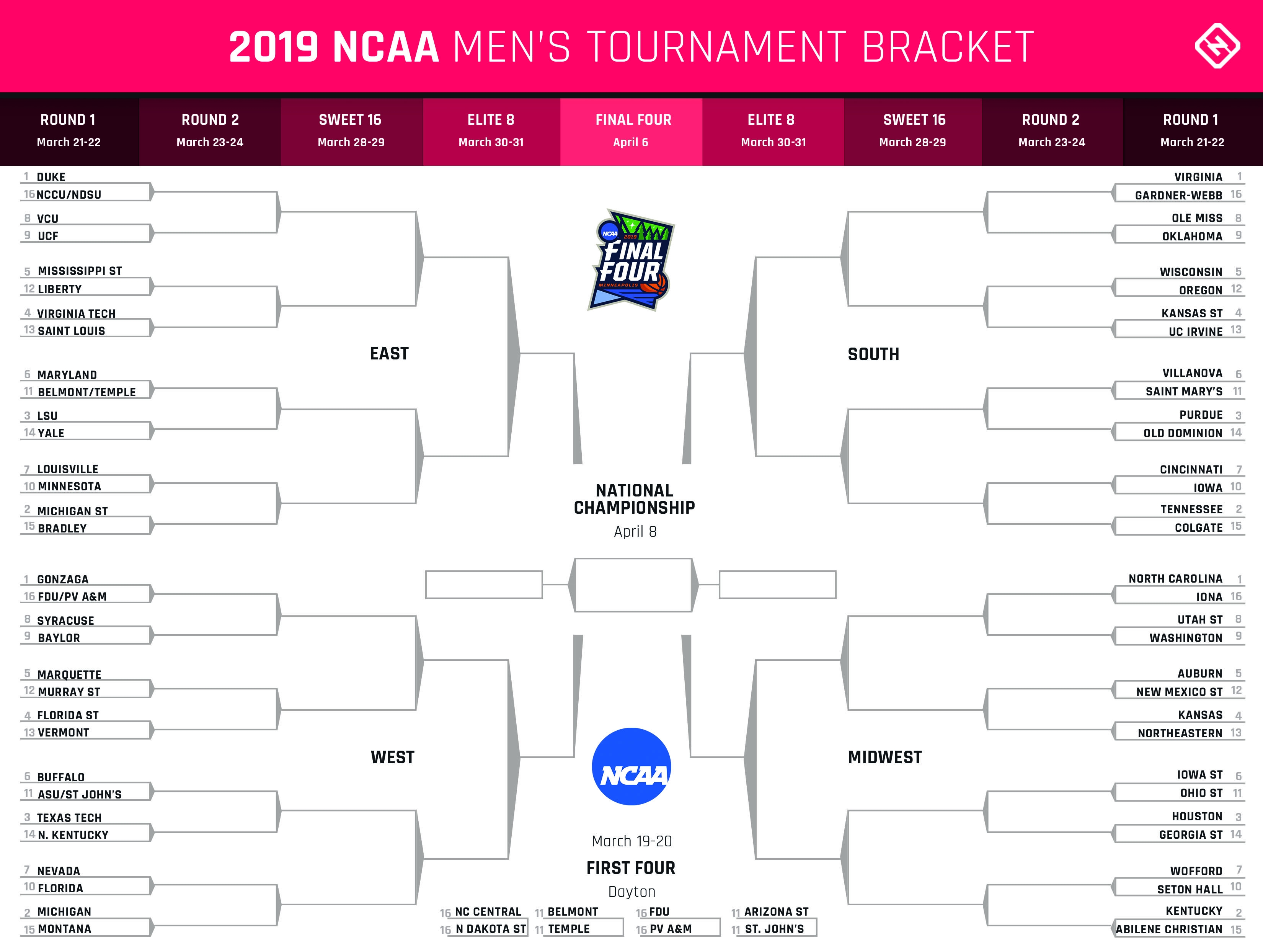
Selection Sunday took place on March 17, 2019. The Selection Committee revealed a field that was top-heavy with talent, particularly from the Atlantic Coast Conference (ACC). For the first time in history, three of the four No. 1 seeds came from the same conference: Duke, Virginia, and North Carolina. Gonzaga, representing the West Coast Conference, claimed the fourth No. 1 seed.
The Number 1 Seeds and Their Regions
- East Region: Duke Blue Devils (Overall #1 Seed)
- South Region: Virginia Cavaliers
- Midwest Region: North Carolina Tar Heels
- West Region: Gonzaga Bulldogs
The bracket was noted for its relative lack of "bid-stealers" during the conference tournament week, meaning most of the high-major teams expected to make the field did so without issue. However, the inclusion of teams like Belmont and Arizona State in the First Four sparked the usual debates regarding mid-major versus power-conference "bubble" teams.
The Zion Williamson Phenomenon
While Virginia eventually won the title, the early weeks of 2019 March Madness were dominated by a single individual: Duke freshman Zion Williamson. Williamson entered the tournament as arguably the most hyped prospect since LeBron James. His combination of size (285 lbs) and elite vertical athleticism made Duke the "must-watch" team of the season.
Duke’s journey through the East Region was a high-wire act. In the second round, they faced No. 9 seed UCF, led by 7-foot-6 center Tacko Fall. The game came down to the final seconds, with Duke narrowly escaping 77–76 after UCF missed two point-blank shots at the rim. In the Sweet 16, they survived another one-possession game against Virginia Tech. Ultimately, the Duke "super-team" fell one point short in the Elite Eight against Michigan State, ending the Zion Williamson era in college basketball just short of the Final Four.
Key Statistical Comparison of Final Four Teams
The 2019 Final Four featured a diverse mix of programs, from blue-bloods like Michigan State to first-timers like Auburn and Texas Tech.
| Team | Seed | Conference | Record Entering FF | Key Player |
|---|---|---|---|---|
| Virginia | 1 | ACC | 33–3 | Kyle Guy |
| Texas Tech | 3 | Big 12 | 30–6 | Jarrett Culver |
| Auburn | 5 | SEC | 30–9 | Jared Harper |
| Michigan State | 2 | Big Ten | 32–6 | Cassius Winston |
The "Cinderella" Stories and Early Round Upsets
No March Madness is complete without the upsets that give the tournament its name. While 2019 was relatively stable for the top seeds, several lower-seeded teams made significant noise:
- Auburn’s Historic Run: Seeded 5th in the Midwest, Bruce Pearl’s Auburn Tigers went on a tear, defeating college basketball royalty in consecutive games. They beat No. 4 Kansas, No. 1 North Carolina, and No. 2 Kentucky to reach their first Final Four in school history. Their "live by the three, die by the three" philosophy made them the tournament's most explosive team.
- UC Irvine over Kansas State: The No. 13 seed Anteaters provided one of the biggest first-round shocks by taking down the No. 4 seed Wildcats. It was a classic "giant-killer" moment that busted millions of brackets in the first 48 hours.
- Oregon’s Defensive Surge: As a No. 12 seed, Oregon used a matchup zone defense to stifle No. 5 Wisconsin and No. 13 UC Irvine to reach the Sweet 16. Their length and athleticism made them one of the most dangerous double-digit seeds in recent memory.
The Elite Eight: A Weekend of Classics
The Regional Finals of 2019 are often cited by analysts as some of the highest-quality basketball games in tournament history.
- Virginia vs. Purdue: This game featured an all-time individual performance by Purdue’s Carsen Edwards, who scored 42 points and made 10 three-pointers. Despite his brilliance, Virginia forced overtime after Mamadi Diakite hit a jumper at the buzzer following a intentional missed free throw and a scramble for the ball. Virginia eventually prevailed 80–75 in overtime.
- Michigan State vs. Duke: In a battle of coaching giants, Tom Izzo’s Spartans neutralized Duke’s transition game. Junior guard Cassius Winston outmaneuvered Duke’s star-studded roster, leading Michigan State to a 68–67 victory and denying the world a Zion Williamson Final Four appearance.
- Texas Tech vs. Gonzaga: Texas Tech’s "no-middle" defense, engineered by Chris Beard, proved to be the kryptonite for Gonzaga’s top-ranked offense. The Red Raiders’ ability to switch everything and force turnovers led them to a 75–69 win, securing their first-ever Final Four berth.
The Final Four in Minneapolis
The 2019 Final Four was held at U.S. Bank Stadium in Minneapolis, Minnesota. The semi-final matchups featured a contrast in styles: Virginia’s methodical pace against Auburn’s speed, and Texas Tech’s stifling defense against Michigan State’s disciplined execution.
Virginia vs. Auburn: The Controversy
The first semi-final ended in one of the most debated finishes in tournament history. Auburn held a two-point lead with less than a second remaining. Virginia’s Kyle Guy attempted a corner three-pointer as time expired and was fouled by Auburn’s Samir Doughty. Guy, under immense pressure, sank all three free throws to give Virginia a 63–62 win. The game was also notable for a missed double-dribble call on Virginia's Ty Jerome moments earlier, which fueled post-game discussions for years.
Texas Tech vs. Michigan State
Texas Tech continued its defensive masterclass against the Spartans. They held Michigan State to just 51 points, their lowest total of the season. Matt Mooney emerged as an unlikely hero for the Red Raiders, scoring 22 points, while Jarrett Culver provided the steady playmaking needed to secure a 61–51 victory.
The National Championship: A Battle of Wills
The championship game on April 8, 2019, was a matchup between the two best defensive teams in the country. Many expected a low-scoring, "ugly" game, but the contest evolved into a high-level display of shot-making and tactical adjustments.
Virginia took a 10-point lead in the second half, but Texas Tech’s resilient defense sparked a comeback. The Red Raiders took a 68–65 lead with just 12 seconds remaining in regulation. However, Virginia’s De'Andre Hunter—who would later become a top NBA draft pick—hit a massive three-pointer from the corner to tie the game.
In overtime, Virginia’s poise took over. They outscored Texas Tech 17–9 in the extra period. Kyle Guy and Ty Jerome were perfect from the free-throw line, and Hunter finished with a career-high 27 points. The 85–77 final score reflected a game that was much tighter than the margin suggested. Kyle Guy was named the tournament's Most Outstanding Player (MOP), completing his journey from the face of the 2018 loss to the hero of the 2019 title.
Technical Analysis: The "No-Middle" Defense and Pack-Line
The 2019 tournament was a tactical clinic for basketball purists. Two specific defensive systems dominated the conversation:
- The Pack-Line Defense (Virginia): Developed by Dick Bennett and refined by Tony Bennett, this system prioritizes protecting the paint (the "pack") and forcing teams to beat them with contested outside shots. It requires extreme discipline and communication, as defenders must constantly rotate to "close out" on shooters without giving up driving lanes.
- The No-Middle Defense (Texas Tech): Chris Beard’s system was designed to force ball-handlers toward the sidelines and corners, effectively using the boundary lines as extra defenders. By denying any penetration to the "middle" of the floor, Texas Tech disrupted the spacing of traditional offenses.
The fact that both teams reached the final served as a validation for coaches who prioritize defensive identity over high-scoring, fast-paced offensive schemes.
Frequently Asked Questions
Who won the 2019 March Madness tournament?
The Virginia Cavaliers won the 2019 NCAA Division I Men’s Basketball Tournament. They defeated the Texas Tech Red Raiders in the championship game with a score of 85–77 in overtime. This was the first national title in the history of the Virginia men's basketball program.
Who was the Most Outstanding Player (MOP) of the 2019 tournament?
Kyle Guy, a junior guard for Virginia, was named the Most Outstanding Player. Guy was instrumental in the Final Four, notably hitting three clutch free throws with 0.6 seconds left to beat Auburn in the semi-finals and scoring 24 points in the championship game against Texas Tech.
What was the biggest upset of the 2019 tournament?
Statistically, the biggest upset in terms of seed differential was No. 13 seed UC Irvine defeating No. 4 seed Kansas State in the first round (South Region). Additionally, No. 12 seed Liberty defeated No. 5 seed Mississippi State, and No. 12 seed Oregon defeated No. 5 seed Wisconsin.
How many teams from the ACC made the 2019 Final Four?
Only one team from the ACC made the Final Four: the Virginia Cavaliers. Despite the conference having three No. 1 seeds (Duke, North Carolina, and Virginia), Duke lost in the Elite Eight to Michigan State, and North Carolina lost in the Sweet 16 to Auburn.
What happened to Zion Williamson in the 2019 tournament?
Zion Williamson and the Duke Blue Devils reached the Elite Eight (Regional Final). They were the overall No. 1 seed but were eliminated by the No. 2 seed Michigan State Spartans in a 68–67 thriller. Williamson performed exceptionally well individually, averaging 26 points and 8.5 rebounds over four tournament games.
Practical Legacy and Next Actions
For those looking to study the 2019 tournament further, the game film from the Virginia vs. Purdue and Virginia vs. Texas Tech matchups remains a staple for coaching clinics focusing on end-of-game execution and defensive rotations. The 2019 event also marked a shift in how the Selection Committee values "NET Rankings" (NCAA Evaluation Tool), which replaced the RPI (Ratings Percentage Index) for the first time that season.
If you are a student of the game, reviewing the 2019 tournament provides a masterclass in psychological resilience. The "Virginia Model" of rebounding from a historic failure to a historic success is frequently cited in leadership and sports psychology curricula. You can access archived box scores and official play-by-play data through the NCAA's official digital library.