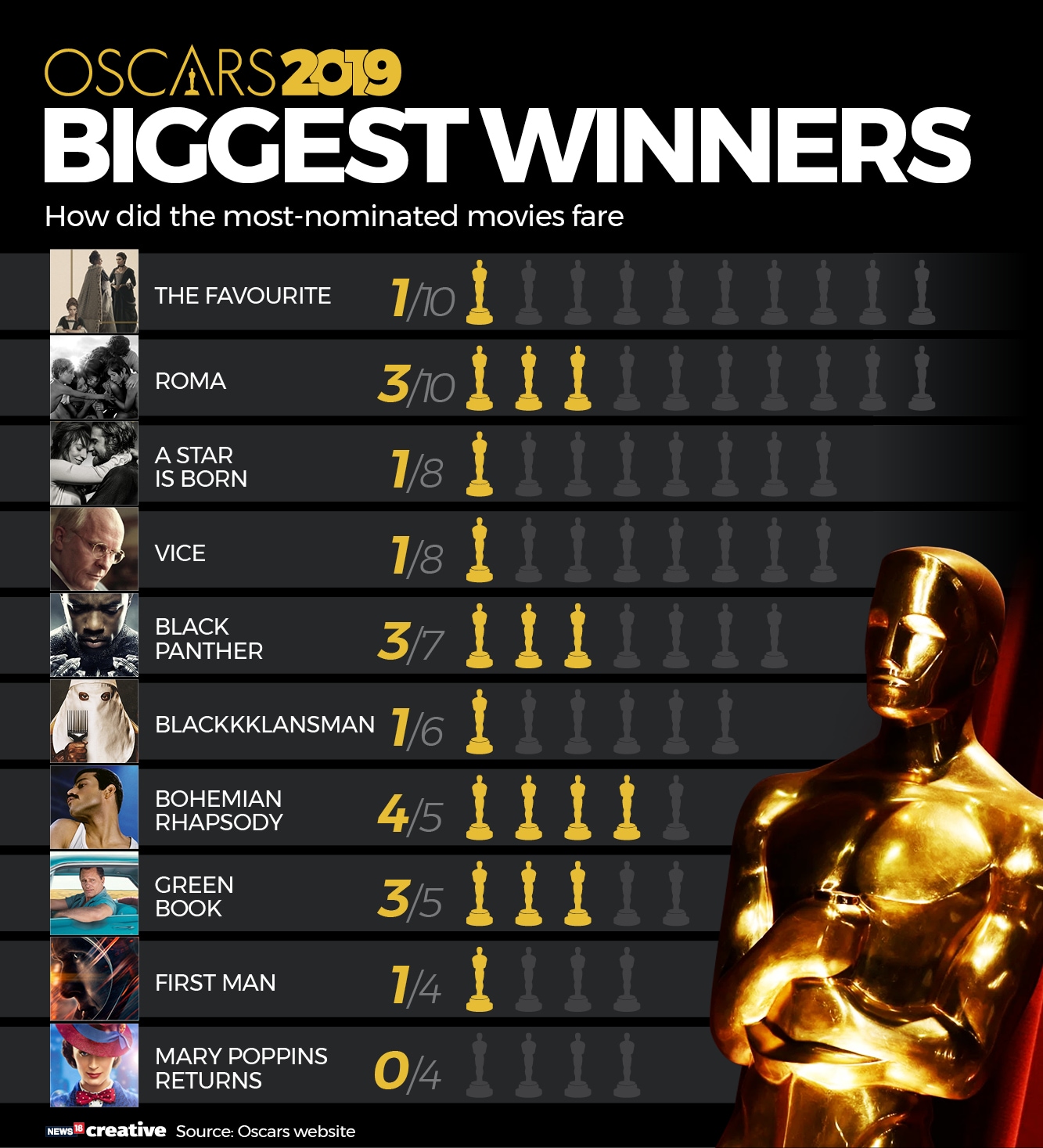
At the 91st Academy Awards, held on February 24, 2019, Rami Malek won the Oscar for Best Actor for his portrayal of Freddie Mercury in Bohemian Rhapsody. He defeated fellow nominees Christian Bale (Vice), Bradley Cooper (A Star Is Born), Willem Dafoe (At Eternity’s Gate), and Viggo Mortensen (Green Book).
The 2019 race for Best Actor was one of the most competitive in recent memory, defined largely by transformative performances in biographical dramas. Four out of the five nominees portrayed real-life historical figures, ranging from rock icons and politicians to legendary painters and bouncers. As we evaluate these performances from the perspective of 2026, the 91st Academy Awards remain a significant benchmark for how the Academy values physical transformation and the "biopic" genre.
The 91st Academy Awards: A Year of Transition
The 2019 Oscars were historic for several reasons beyond the acting categories. It was the first ceremony in 30 years to proceed without a formal host after a controversy led to Kevin Hart’s withdrawal from the position. This "hostless" format changed the pacing of the evening, placing a heavier emphasis on the presenters and the films themselves.
In the Best Actor category, the narrative throughout the 2018-2019 awards season was a fluctuating battle between "The Chameleon" (Christian Bale) and "The Breakthrough" (Rami Malek). While the Academy had traditionally favored veteran actors with long-standing resumes, the 2019 selection showcased a mix of established legends like Willem Dafoe and rising stars making their mark on cinema history.
The Winner: Rami Malek (Bohemian Rhapsody)
Rami Malek’s victory for his role as Queen frontman Freddie Mercury in Bohemian Rhapsody was the culmination of a dominant awards season run. Malek’s performance was praised not just for his vocal mimicry, but for his ability to capture the internal loneliness and public flamboyance of one of music’s most enigmatic figures.
The Preparation and Transformation
Malek’s dedication to the role was exhaustive. To achieve Mercury’s distinct look, he wore prosthetic teeth for months before filming began to get used to speaking and singing with them. He also worked extensively with movement coach Polly Bennett. Rather than traditional choreography, Bennett and Malek focused on Mercury’s "mannerisms"—the way he held a microphone, the way he turned his head, and his idiosyncratic stage presence during the iconic 1985 Live Aid performance.
Critical and Peer Recognition
While Bohemian Rhapsody received mixed reviews from critics regarding its narrative structure, Malek’s performance was almost universally lauded. His win at the Oscars followed victories at the Golden Globes, the Screen Actors Guild (SAG) Awards, and the BAFTAs. In his acceptance speech, Malek highlighted his status as a first-generation American and the son of immigrants from Egypt, drawing a parallel between his own story and Mercury’s identity as a Parsi-Indian immigrant to the UK.
The Full List of 2019 Best Actor Nominees
The following table provides a concise breakdown of the five men nominated for Performance by an Actor in a Leading Role at the 91st Academy Awards.
| Nominee | Film | Role | Outcome |
|---|---|---|---|
| Rami Malek | Bohemian Rhapsody | Freddie Mercury | Winner |
| Christian Bale | Vice | Dick Cheney | Nominee |
| Bradley Cooper | A Star Is Born | Jackson Maine | Nominee |
| Willem Dafoe | At Eternity's Gate | Vincent van Gogh | Nominee |
| Viggo Mortensen | Green Book | Frank "Tony Lip" Vallelonga | Nominee |
Detailed Profiles of the 2019 Nominees
Christian Bale (Vice)
Christian Bale, known for his extreme physical transformations, took on the role of former U.S. Vice President Dick Cheney in Adam McKay’s Vice. Bale gained roughly 40 pounds, shaved his head, and bleached his eyebrows to inhabit the role. Beyond the physical, Bale’s performance was a masterclass in subtlety, capturing Cheney’s quiet power and calculated political maneuvering.
Bale’s win at the Golden Globes (where he famously thanked Satan for inspiration) positioned him as the early frontrunner. Many critics argued that Bale’s performance was the most technically difficult of the year, as he had to portray Cheney across several decades, showing the character's aging process through voice modulation and posture.
Bradley Cooper (A Star Is Born)
Bradley Cooper’s nomination for A Star Is Born was notable because he also directed the film, co-wrote the screenplay, and contributed to the music. In playing Jackson Maine, a seasoned country-rock star struggling with addiction and hearing loss, Cooper underwent a different kind of transformation. He spent 18 months in vocal training to lower his speaking voice by an entire octave, seeking to emulate the rugged grit of co-star Sam Elliott.
Cooper’s performance was praised for its raw vulnerability, particularly in the scenes depicting Maine’s descent into alcoholism. Despite the film's massive commercial success and critical acclaim, Cooper was famously "snubbed" in the Best Director category, which many believe increased the sympathy and support for his Best Actor bid.
Willem Dafoe (At Eternity's Gate)
Willem Dafoe’s nomination for At Eternity’s Gate represented the "indie" or "artistic" slot in the 2019 race. Directed by Julian Schnabel, the film is a sensory exploration of Vincent van Gogh’s final years in Arles and Auvers-sur-Oise. Dafoe, who was 62 at the time of filming (Van Gogh died at 37), managed to transcend the age gap through a performance that felt deeply spiritual and tortured.
Dafoe actually learned to paint for the role, and many of the scenes in the film show him working on canvases in real-time. His nomination was a testament to his longevity in the industry and his ability to carry a film that relied more on atmosphere and internal monologue than traditional plot points.
Viggo Mortensen (Green Book)
Viggo Mortensen played Frank "Tony Lip" Vallelonga in Green Book, a film that eventually won Best Picture. Mortensen, a sophisticated actor often associated with intense or intellectual roles, transformed into a working-class Italian-American bouncer from the Bronx. He gained weight for the role and worked with the real-life Vallelonga family to perfect the accent and mannerisms.
Mortensen’s performance was the "heart" of the film, providing a comedic yet touching foil to Mahershala Ali’s Dr. Don Shirley. While the film faced criticism for its "white savior" narrative, Mortensen’s individual acting was consistently highlighted as a career-best, earning him his third Academy Award nomination for acting.
Technical Analysis: The "Biopic" Trend of 2019
The 2019 Best Actor category was a textbook example of the Academy's affinity for biographical roles. To understand why Rami Malek emerged victorious, one must look at the technical requirements of the "Academy-style" performance:
- Physical Transmutation: The use of prosthetics (Bale, Malek) or significant weight changes (Bale, Mortensen) often signals to the Actors Branch of the Academy that the performer has "sacrificed" their own identity for the role.
- Public Persona Comparison: When an actor plays someone as famous as Freddie Mercury or Dick Cheney, the audience has a built-in baseline for comparison. This makes the "mimicry" more impressive to voters.
- The "Live" Factor: Malek and Cooper both performed musical numbers. In Malek's case, while he utilized Mercury’s original vocals, his physical performance of the songs was considered a feat of endurance and precision.
In contrast, Willem Dafoe’s performance was the only one in the group not based on a person with extensive video footage available for comparison. This made his work more interpretive and less "impersonation-heavy," which often appeals to critics but can be a harder sell for the broad voting base of the Academy.
The Path to the Win: Precursor Awards
In the lead-up to the 91st Oscars, the race was incredibly tight. Here is how the precursor awards influenced the final outcome:
- Golden Globes: Split into two categories. Rami Malek won Best Actor (Drama), and Christian Bale won Best Actor (Comedy/Musical). This set up the head-to-head battle for the Oscar.
- SAG Awards: Rami Malek won. This was the turning point. Since the SAG Awards are voted on by other actors (the same group that makes up the largest branch of the Academy), a SAG win is the strongest predictor of an Oscar victory.
- BAFTA: Rami Malek won. This confirmed his international support and solidified his status as the favorite going into the Dolby Theatre.
- Critics' Choice: Christian Bale won. This showed that while the industry was leaning toward Malek, the critics still favored Bale’s technical transformation.
Legacy of the 2019 Best Actor Race
Looking back from 2026, the 2019 Best Actor race is remembered as the moment Rami Malek transitioned from a respected television actor (Mr. Robot) to a global superstar. It also sparked ongoing debates about the "Biopic Fatigue" in Hollywood. Since 2019, the Academy has seen a continued influx of biographical winners (such as Will Smith in 2022 and Cillian Murphy in 2024), leading to discussions about whether original characters are being overlooked in favor of historical recreations.
Furthermore, Bradley Cooper’s loss in 2019 began a narrative regarding his "search for an Oscar," which continued through his later projects like Maestro. For Willem Dafoe, the 2019 nomination cemented his status as one of the greatest living character actors, capable of leading a film with immense gravitas.
Frequently Asked Questions
Who won Best Actor at the 2019 Oscars?
Rami Malek won the Best Actor Oscar in 2019 for his role as Freddie Mercury in the biopic Bohemian Rhapsody.
Did Bradley Cooper win an Oscar for A Star Is Born?
No. While Bradley Cooper was nominated for Best Actor, Best Adapted Screenplay, and Best Picture, he did not win in those categories. The film did win Best Original Song for "Shallow."
How many of the 2019 Best Actor nominees played real people?
Four out of the five nominees played real-life figures: Rami Malek (Freddie Mercury), Christian Bale (Dick Cheney), Willem Dafoe (Vincent van Gogh), and Viggo Mortensen (Tony Lip). Bradley Cooper's Jackson Maine was a fictional character, though influenced by previous versions of the film and real musicians.
Why was Christian Bale considered the frontrunner over Rami Malek?
Christian Bale was initially the frontrunner due to the sheer scale of his physical transformation for Vice and his win at the Golden Globes. However, Malek gained momentum after winning the SAG Award and the BAFTA.
Who were the biggest snubs for Best Actor in 2019?
Many film critics and fans felt that Ethan Hawke was snubbed for his performance in First Reformed. Other notable mentions included John David Washington for BlacKkKlansman and Ryan Gosling for First Man.
Final Recommendation for Film Students
For those studying the craft of acting, the 2019 Best Actor nominees offer a diverse curriculum. To understand Physicality and Movement, study Rami Malek in Bohemian Rhapsody. For Subtle Character Architecture, analyze Christian Bale in Vice. For Emotional Vulnerability and Vocal Work, watch Bradley Cooper in A Star Is Born. Each of these performances demonstrates a different entry point into the "Leading Man" archetype and remains essential viewing for understanding the modern landscape of the Academy Awards.