The Beatles redefined the landscape of popular music through a combination of revolutionary songwriting, groundbreaking studio techniques, and an unprecedented cultural impact. From their early days in the clubs of Hamburg to their final rooftop performance in London, the "Fab Four" established a legacy that remains the gold standard for musical excellence as of 2026.
The Evolution of the Fab Four: From Liverpool to the World
To understand the magnitude of The Beatles, one must look beyond the catchy melodies and into the complex machinery of their career. The band—consisting of John Lennon, Paul McCartney, George Harrison, and Ringo Starr—did not become an overnight success by accident. It was the result of thousands of hours of practice, a series of fortunate (and unfortunate) events, and a willingness to break every established rule in the recording industry.
Even decades after their official dissolution, new generations continue to discover their catalog. In 2026, with the help of modern restorative technology, their music sounds as crisp as the day it was recorded, but the stories behind the songs remain the true hook for fans and historians alike.
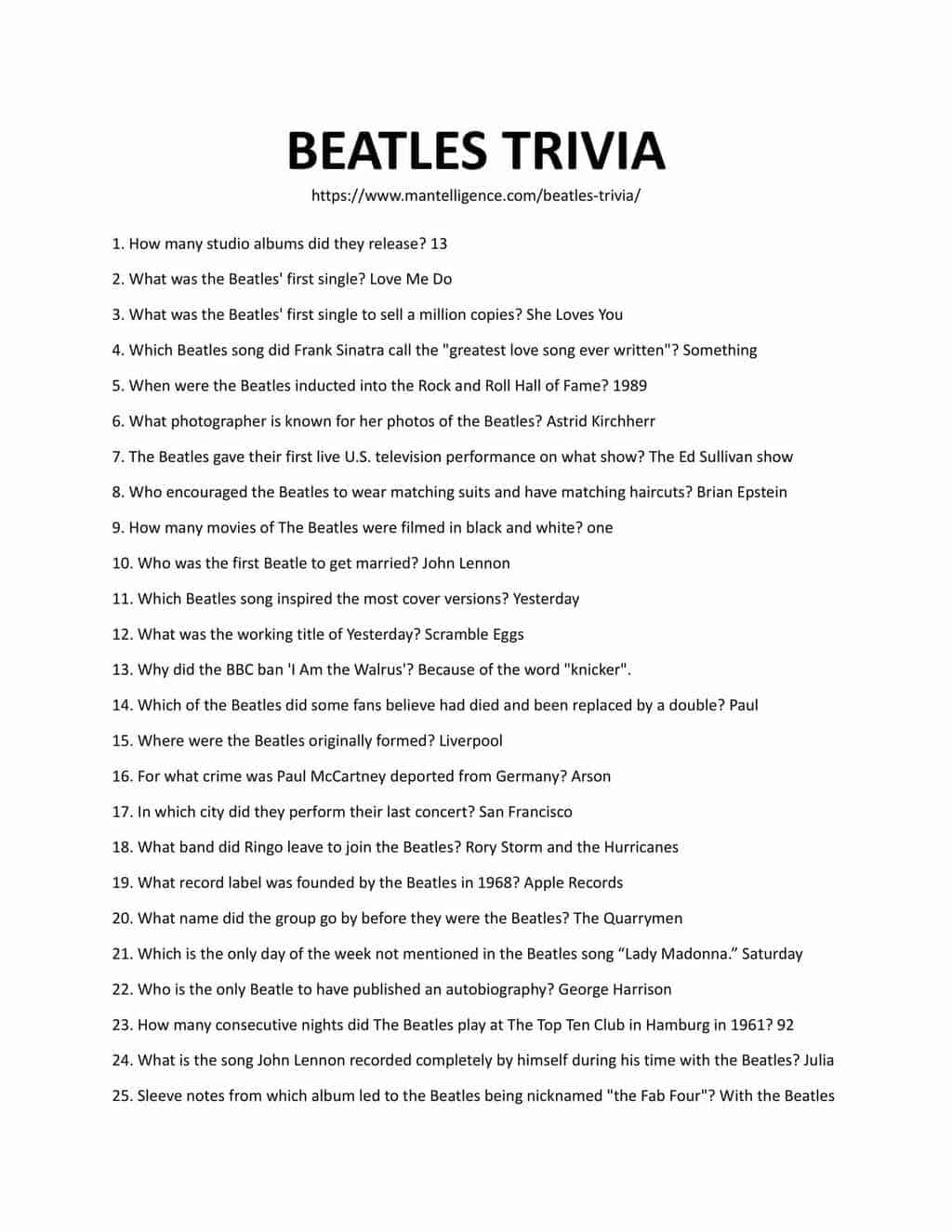
25 Fascinating Beatles Facts and Legendary Trivia
1. The Origin of the Name "Beatles"
The band’s name was a deliberate play on words. Inspired by Buddy Holly’s band, The Crickets, original bassist Stuart Sutcliffe suggested "The Beetles." John Lennon later added a twist by changing the "e" to an "a," creating a pun that referenced "beat" music. For a short time, they were known as the Silver Beetles before finally settling on the iconic name we know today.
2. The Grueling Hamburg Residencies
Before they were stars, The Beatles were musical laborers. Between 1960 and 1962, they performed in Hamburg, Germany, often playing for up to eight hours a night, seven days a week. This "trial by fire" forced them to expand their repertoire and tightened their live performance skills to a level few other bands could match.
3. The Infamous Decca Rejection
In one of the most cited blunders in music history, Decca Records rejected The Beatles in 1962 after an audition. The executive, Dick Rowe, reportedly told their manager, Brian Epstein, that "guitar groups are on the way out" and that "The Beatles have no future in show business." They signed with EMI’s Parlophone label shortly thereafter.
4. "Yesterday" and the Dream Melody
Paul McCartney famously composed the melody for "Yesterday" in a dream. When he woke up, he rushed to a piano to play it so he wouldn't forget. For weeks, he checked with music industry friends to ensure he hadn't subconsciously plagiarized it. The working title for the song was actually "Scrambled Eggs," with the opening lyrics being "Scrambled eggs, oh my baby, how I love your legs."
5. The Mystery of "Lucy in the Sky with Diamonds"
While many fans assumed the song title was a coded reference to LSD, John Lennon consistently maintained that it was inspired by a drawing his son, Julian, brought home from school. Julian had drawn a classmate named Lucy O'Donnell, and when asked what it was, he replied, "It's Lucy in the sky with diamonds."
6. The First Major Stadium Concert
The Beatles pioneered the concept of the stadium tour. Their 1965 performance at Shea Stadium in New York was the first time a rock band played in a major outdoor sports arena. The 55,000 fans created such a deafening roar that the band members couldn't hear their own instruments through the primitive PA system of the time.
7. Inventing the Music Video
Because they could not be in multiple places at once to promote their singles, The Beatles began filming "promotional films." Clips for "Paperback Writer" and "Rain" in 1966 are widely considered the ancestors of the modern music video, allowing the band to reach global audiences without traveling.
8. Ringo Starr's "Pete Forever" Controversy
When Ringo Starr replaced the original drummer Pete Best in 1962, the transition was not smooth. Best was highly popular in Liverpool, and at early Ringo-era gigs, fans would chant "Pete forever, Ringo never!" Ringo eventually won them over with his unique "backbeat" style and undeniable charm.
9. George Harrison’s Growth as a Songwriter
Initially overshadowed by the Lennon-McCartney powerhouse, George Harrison eventually emerged as a master songwriter in his own right. His track "Something" from the Abbey Road album was described by Frank Sinatra as "the greatest love song of the past 50 years."
10. The "Bigger than Jesus" Controversy
In 1966, John Lennon remarked in an interview that Christianity was in decline and that The Beatles were "more popular than Jesus now." While the comment was meant as a critique of modern society's obsession with celebrity, it sparked massive protests and record burnings in the United States, particularly in the Bible Belt.
11. Sgt. Pepper’s Iconic Cover
The cover of Sgt. Pepper’s Lonely Hearts Club Band features a collage of over 70 historical figures and celebrities. The band had to seek permission (or their estates did) for many of the likenesses used. Notably, John Lennon wanted to include Adolf Hitler and Jesus Christ, but both were ultimately omitted to avoid further controversy.
12. The "Paul is Dead" Urban Legend
One of the most famous conspiracy theories in rock history claimed that Paul McCartney died in a car crash in 1966 and was replaced by a lookalike. Fans looked for "clues" in album art and lyrics, such as Paul being barefoot on the Abbey Road cover (symbolizing a corpse in some cultures) and backmasked messages in songs like "Revolution 9."
13. The Final Rooftop Concert
The band’s last public performance took place on January 30, 1969, on the roof of their Apple Corps headquarters in London. The impromptu 42-minute set was eventually shut down by the police after complaints about the noise, providing a fittingly rebellious end to their live career.
14. First Band to Use Feedback Intentionally
The opening note of "I Feel Fine" (1964) features a distinct buzz of guitar feedback. While feedback was usually considered a mistake or a technical flaw in recordings at the time, John Lennon and the band liked the sound and insisted on keeping it, marking the first time feedback was used as a deliberate musical element on a pop record.
15. The Inclusion of Eric Clapton
On "While My Guitar Gently Weeps," George Harrison invited his friend Eric Clapton to play the lead guitar solo. This was unusual because The Beatles rarely used outside musicians for lead roles on their albums. Clapton’s presence reportedly made the other band members "be on their best behavior."
16. The Experimental "A Day in the Life"
To create the massive orchestral swells in "A Day in the Life," the band hired 40 orchestral musicians and told them to start at their lowest note and move to their highest note over a specific number of bars, independently of one another. The result was a chaotic, avant-garde soundscape that remains a high-water mark of psychedelic rock.
17. The Creation of Apple Corps
The Beatles founded Apple Corps in 1968 as a multimedia corporation. It included Apple Records, Apple Films, and even a retail boutique. While the business side was often chaotic, the label allowed the band to sign and promote other artists they admired, such as James Taylor and Mary Hopkin.
18. "Helter Skelter" and the Birth of Heavy Metal
Paul McCartney wrote "Helter Skelter" after reading a review of a song by The Who that claimed they had created the "loudest, rawest, dirtiest" song ever. Paul wanted to top it. The result was a distorted, aggressive track that many musicologists cite as a precursor to heavy metal.
19. The Only Group Songwriting Credits
While most Beatles songs are credited to Lennon-McCartney, a few tracks list all four members as writers. "Flying" from Magical Mystery Tour and "Dig It" from Let It Be are rare examples where Ringo and George received equal billing with John and Paul.
20. The First Satellite Broadcast
In 1967, The Beatles represented the United Kingdom in the first-ever live global satellite television program, Our World. They performed "All You Need Is Love" to an estimated audience of 400 million people across 25 countries.
21. Disney and The Jungle Book
Disney originally wanted The Beatles to voice the four vultures in the 1967 animated film The Jungle Book. The characters were even designed to look like the band. However, John Lennon vetoed the idea, leading the filmmakers to hire voice actors who mimicked Liverpudlian accents instead.
22. Hidden "Her Majesty"
The song "Her Majesty" at the end of Abbey Road is the first "hidden track" in rock history. It was originally placed between other songs in the medley, but Paul McCartney asked for it to be cut. The engineer didn't want to throw it away, so he tacked it onto the end of the master tape after 20 seconds of silence.
23. Strawberry Field and Penny Lane
Both "Strawberry Fields Forever" and "Penny Lane" were inspired by real locations in Liverpool from the band members' childhoods. Strawberry Field was a Salvation Army children’s home where John Lennon used to play, while Penny Lane was a major bus hub where Paul and John would often meet.
24. Recording "Please Please Me" in a Single Day
Their debut album, Please Please Me, was recorded in one marathon 13-hour session on February 11, 1963. John Lennon was suffering from a severe cold, which is why his vocals on the final track, "Twist and Shout," sound famously shredded and raw.
25. The 2023 "Now and Then" Release
In late 2023, the "last" Beatles song, "Now and Then," was released. Using AI-assisted audio restoration (the same technology used in Peter Jackson's Get Back documentary), Paul McCartney and Ringo Starr were able to isolate John Lennon’s voice from a 1970s demo tape and finish the track with George Harrison's guitar parts from the 1990s. As of 2026, it stands as the final chapter in their recording history.
Historical Milestones and Technical Achievements
The following table highlights the progression of The Beatles' career, focusing on their shift from a touring "mop-top" band to a studio-bound experimental force.
| Era | Primary Focus | Key Album | Technical Innovation |
|---|---|---|---|
| Early (1962–1964) | Live Performance / Touring | Please Please Me | Twin-track recording; high-energy vocal harmonies. |
| Middle (1965–1966) | Transition to Studio Artistry | Revolver | Use of sitars, tape loops, and backwards recording. |
| Psychedelic (1967) | Concept Albums / World Impact | Sgt. Pepper | Multi-track bouncing; orchestral "walls of sound." |
| Late (1968–1970) | Individualism / Raw Production | The White Album | Stripped-back arrangements; diverse genre-hopping. |
| Posthumous (2023–2026) | Preservation / AI Restoration | Now and Then (Single) | MAL (Machine Audio Learning) for vocal isolation. |
Why The Beatles Remain Relevant in 2026
The endurance of The Beatles can be attributed to their "all-killer, no-filler" approach to songwriting. Unlike many of their contemporaries, their albums were not just built around one or two hit singles. They treated the Long Play (LP) record as a cohesive piece of art.
Furthermore, their influence on recording technology cannot be overstated. Working with producer George Martin (often called the "Fifth Beatle"), they turned the recording studio into an instrument. They were among the first to use ADT (Artificial Double Tracking), flange, and varying tape speeds to create sounds that did not exist in nature. In 2026, these techniques remain the foundation for modern digital audio workstations (DAWs).
Frequently Asked Questions
Who was the "Fifth Beatle"?
The title "Fifth Beatle" has been applied to several people, but the most common claimants are George Martin (their producer), Brian Epstein (their manager), and Billy Preston (who played keyboards on Let It Be). George Martin is generally considered the strongest candidate due to his massive influence on their musical arrangements.
Why did The Beatles stop touring in 1966?
The band stopped touring because their music had become too complex to perform live with the technology of the 1960s. Additionally, the hysteria of "Beatlemania" made touring dangerous and exhausting, and they could no longer hear themselves play over the screaming fans.
Did The Beatles actually use AI for their last song?
Yes, but with a caveat. They did not use AI to "generate" or "fake" John Lennon's voice. Instead, they used a "de-mixing" software called MAL to isolate John's voice from a low-quality cassette demo recorded in the late 70s. This allowed Paul and Ringo to build a high-quality studio track around his original vocal performance.
Which Beatle had the most successful solo career?
This is subjective. Paul McCartney had the most commercial success with the band Wings and his solo tours. John Lennon's solo work was highly influential and critically acclaimed before his death in 1980. George Harrison was the first to have a number-one solo single ("My Sweet Lord"), and Ringo Starr maintained a steady career with his "All-Starr Band."
What is the best-selling Beatles album?
Historically, Sgt. Pepper’s Lonely Hearts Club Band and the compilation album 1 have fought for the top spot. Globally, the compilation album 1 has often seen higher sales figures in the digital age due to its collection of number-one hits.
Final Recommendation for Music Enthusiasts
To truly appreciate the depth of The Beatles' history, listeners should move beyond the "Greatest Hits" collections. Start by listening to Revolver and Abbey Road from start to finish. These albums represent the pinnacle of their studio innovation and songwriting maturity. For those interested in the human element behind the legends, the Get Back documentary series remains essential viewing in 2026 for its intimate look at their creative process during their final year.