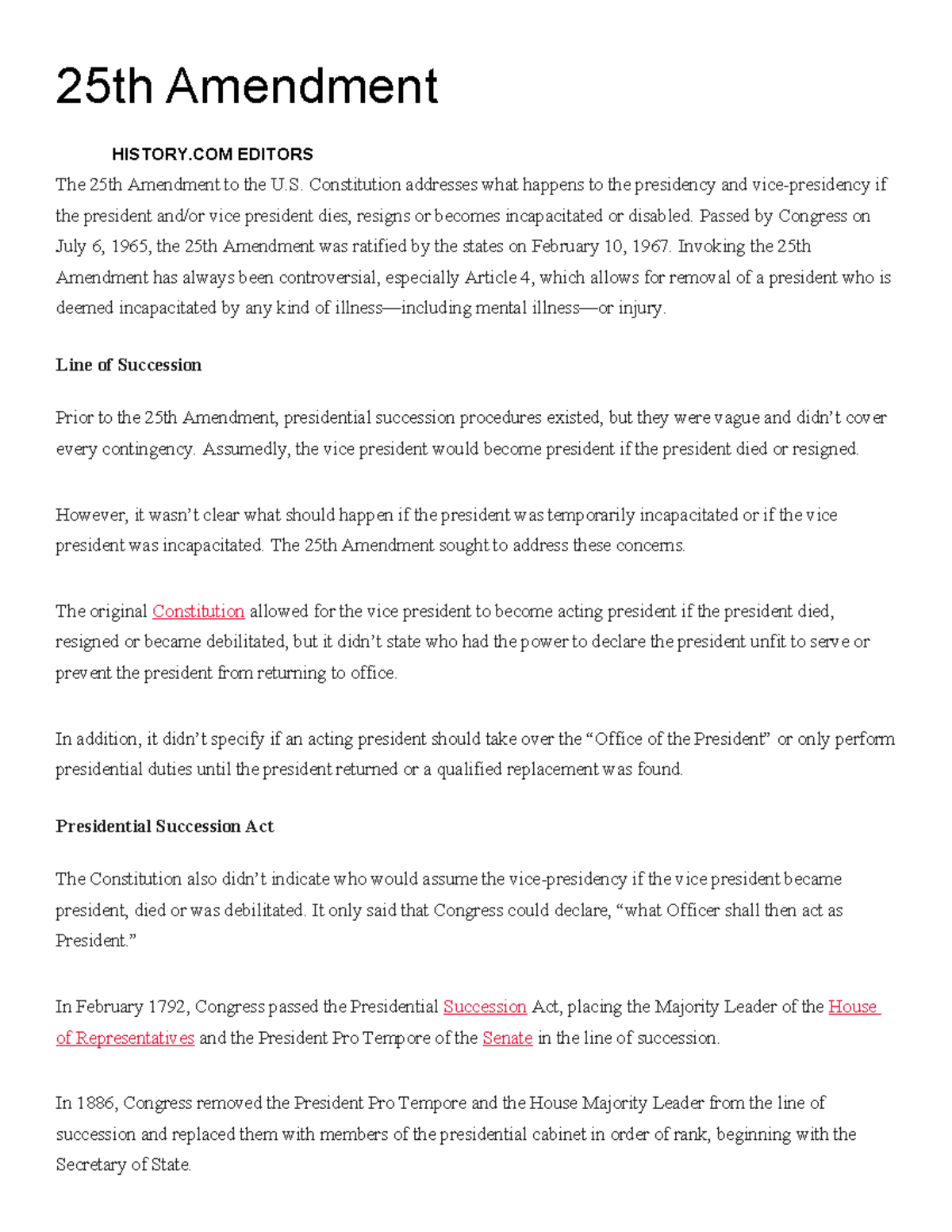
The 25th Amendment to the United States Constitution establishes the legal framework for presidential succession and disability. It provides clear procedures for the Vice President to assume the presidency if the President dies, resigns, or becomes incapacitated, and outlines how a vacancy in the Vice Presidency is filled and how power is temporarily transferred during medical emergencies.
For much of American history, the transfer of power during a presidential crisis was a murky, often dangerous legal gray area. Before 1967, the Constitution was notoriously vague about what happened if a president was alive but unable to perform their duties. This ambiguity led to "insane" periods where the country was effectively leaderless, governed by spouses in secret, or left vulnerable during the height of the Cold War. As of 2026, the 25th Amendment remains the primary safeguard against such chaos, ensuring that the gears of government continue to turn even when the person at the top cannot.
The Chaos Before the 25th Amendment
To understand why the 25th Amendment was necessary, one must look at the historical "incidents" that preceded it. Article II, Section 1 of the Constitution originally stated that in the case of the "Inability to discharge the Powers and Duties of the said Office, the Same shall devolve on the Vice President." However, it didn't specify what "the same" meant. Did the Vice President become the President, or merely an "Acting President" until the original officeholder recovered?
The Case of Woodrow Wilson (1919–1921)
Perhaps the most dramatic example of the need for the 25th Amendment occurred in 1919. President Woodrow Wilson suffered a massive stroke that left him partially paralyzed and mentally fatigued. For the remaining 17 months of his term, his wife, Edith Wilson, essentially served as the "steward" of the presidency. She screened all communications, decided which matters were important enough to bring to her husband, and kept the true extent of his disability hidden from the Cabinet and the public. This period is often cited by historians as a "secret presidency," highlighting the terrifying lack of a formal mechanism to transfer power.
Eisenhower’s Health Scares
Decades later, President Dwight D. Eisenhower faced several health crises, including a heart attack in 1955 and a stroke in 1957. Recognizing the danger of a power vacuum, Eisenhower entered into informal "gentleman’s agreements" with Vice President Richard Nixon. These agreements stated that Nixon would serve as Acting President if Eisenhower were unable to do so. However, these were private arrangements with no legal standing under the Constitution. If Nixon had tried to exercise power, his authority could have been legally challenged, leading to a constitutional crisis.
The JFK Catalyst: A Turning Point in 1963
The assassination of John F. Kennedy on November 22, 1963, provided the final, tragic impetus for reform. While the transfer of power to Lyndon B. Johnson was immediate because Kennedy had died, the event forced the nation to grapple with a terrifying "what if." What if Kennedy had survived but been left in a permanent vegetative state?
In the immediate aftermath of the assassination, there was no Vice President (the office remained vacant for over a year until the 1964 election). The next in line were the Speaker of the House, John McCormack (then 71), and the President pro tempore of the Senate, Carl Hayden (then 86). The Cold War was at its peak; the thought of a leaderless nation or an elderly, unelected successor managing a nuclear standoff with the Soviet Union was untenable. Senator Birch Bayh led the charge in Congress to draft an amendment that would provide a permanent, structured solution to these problems.
Breaking Down the Four Sections of the 25th Amendment
The 25th Amendment was ratified on February 10, 1967. It consists of four distinct sections, each designed to handle a specific type of leadership crisis.
Section 1: Presidential Successor
This section codified what had been standard practice since John Tyler took office after William Henry Harrison's death: if the President dies or resigns, the Vice President becomes the President. It removed the "Acting President" ambiguity once and for all.
Section 2: Filling a Vice Presidential Vacancy
Before 1967, if the Vice Presidency became vacant, it stayed vacant until the next election. Section 2 allows the President to nominate a new Vice President, who must then be confirmed by a majority vote in both the House of Representatives and the Senate.
Section 3: Voluntary Transfer of Power
This section allows a President to voluntarily transfer power to the Vice President by sending a written declaration to the President pro tempore of the Senate and the Speaker of the House. The Vice President becomes "Acting President" until the President sends a second declaration stating they are ready to resume their duties. This is most commonly used for scheduled medical procedures involving general anesthesia.
Section 4: Involuntary Transfer of Power
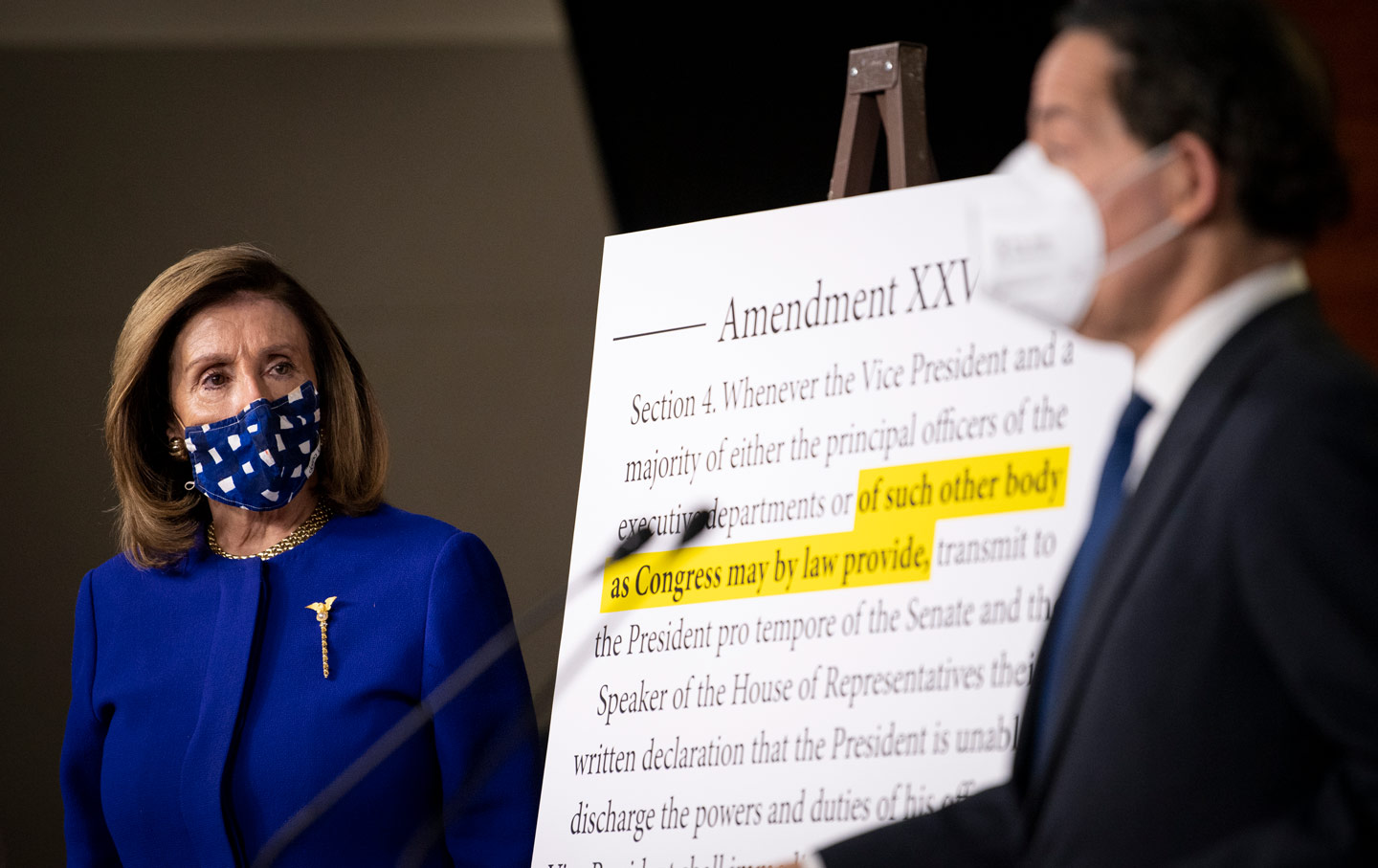
This is the most controversial and complex part of the amendment. It allows the Vice President and a majority of the Cabinet (or a body established by Congress) to declare the President "unable to discharge the powers and duties of his office." If the President contests this, the issue goes to Congress. A two-thirds vote in both chambers is required to keep the Vice President in power against the President’s will.
The "Insane" Reality of the Ford Era
The 25th Amendment had its most rigorous test during the 1970s. In a span of less than a year, both the Vice President and the President resigned, a sequence of events that would have likely broken the government without the 25th Amendment.
- Spiro Agnew Resigns (1973): Vice President Agnew resigned due to corruption charges. President Richard Nixon used Section 2 to nominate Gerald Ford as the new Vice President.
- Richard Nixon Resigns (1974): Under the weight of the Watergate scandal, Nixon resigned. Under Section 1, Gerald Ford became the President.
- Ford Nominates Rockefeller: With the Vice Presidency now vacant again, Ford used Section 2 to nominate Nelson Rockefeller.
Because of the 25th Amendment, the United States successfully navigated a period where the President and Vice President were both individuals who had never been elected to those offices by the national electorate, yet the transition was legally sound and peaceful.
Historical Applications of Section 3: The Acting Presidents
While Section 4 has never been invoked, Section 3 has been used several times, primarily for medical reasons. These moments represent the only times in U.S. history where the title of "Acting President" was formally and legally held.
| Date | President | Acting President | Reason | Duration |
|---|---|---|---|---|
| July 13, 1985 | Ronald Reagan | George H.W. Bush | Colon Surgery | 7 hours, 54 minutes |
| June 29, 2002 | George W. Bush | Dick Cheney | Colonoscopy | 2 hours, 5 minutes |
| July 21, 2007 | George W. Bush | Dick Cheney | Colonoscopy | 2 hours, 5 minutes |
| Nov 19, 2021 | Joe Biden | Kamala Harris | Colonoscopy | 1 hour, 25 minutes |
In 1985, Ronald Reagan was somewhat hesitant to explicitly cite the 25th Amendment in his letter, fearing he might set a restrictive precedent or appear weak. However, his legal counsel ensured the letter followed the amendment's requirements perfectly. By the time George W. Bush and Joe Biden used it, the process had become a standard, almost routine administrative procedure to ensure the commander-in-chief's powers were always in the hands of someone conscious and capable.
The Controversy of Section 4: The "Nuclear Option"
Section 4 is often referred to as the "nuclear option" of constitutional law. It was designed to handle a situation where a president is incapacitated—perhaps by a stroke or a mental breakdown—but refuses to step aside or is unable to realize they are impaired.
The bar for Section 4 is intentionally high to prevent it from being used as a tool for a "palace coup." To successfully remove a president's powers, the Vice President must be on board. Without the Vice President's signature, Section 4 cannot be triggered. Furthermore, the requirement of a two-thirds majority in both houses of Congress to override a president’s objection is a higher threshold than even impeachment (which requires a simple majority in the House and two-thirds in the Senate).
In the late 2010s and early 2020s, public discourse frequently touched upon Section 4 regarding various political tensions. However, legal scholars emphasize that Section 4 is about capacity, not competence or popularity. It is meant for medical or neurological emergencies, not political disagreements.
Practical Guidance: How the Transfer Happens Today
In 2026, the protocols for the 25th Amendment are deeply embedded in the White House Counsel's office. The process for a Section 3 transfer involves several key steps:
- Drafting the Letters: Two identical letters are prepared, addressed to the Speaker of the House and the President pro tempore of the Senate.
- The Signature: The President signs the letters before undergoing any procedure that involves losing consciousness.
- Transmission: The letters are transmitted electronically or by hand. The moment they are received, the Vice President becomes the Acting President.
- The Resumption: Once the President is awake and alert, they sign a second set of letters stating they are able to resume their duties. Power reverts back to the President instantly upon receipt of these letters.
For Section 4, the process is much more fraught. It requires the Vice President and eight members of the 15-member Cabinet (the "majority of the principal officers of the executive departments") to sign a declaration. While this has never happened, the existence of the rule serves as a deterrent against a disabled leader clinging to power.
Frequently Asked Questions
Does the 25th Amendment remove a President permanently? Not necessarily. Section 3 is always temporary. Even under Section 4, the President can attempt to regain power by declaring that no inability exists. It only becomes "permanent" (for the remainder of the term) if Congress backs the Vice President by a two-thirds vote or if the President dies or resigns.
Who is in the "Cabinet" for the purposes of Section 4? Legally, it refers to the heads of the 15 executive departments (State, Treasury, Defense, Justice, etc.). Acting secretaries' votes have been a subject of legal debate, but generally, the 15 confirmed heads are the "principal officers."
Can the Vice President act alone to remove the President? No. Under Section 4, the Vice President must have the support of a majority of the Cabinet. Conversely, the Cabinet cannot act without the Vice President. It is a dual-key system designed to ensure consensus.
Has Section 4 ever been officially invoked? No. As of 2026, Section 4 has never been triggered. There have been internal discussions at various points in history—most notably during the final days of the Nixon administration and during the Reagan administration after the 1981 assassination attempt—but no formal declaration was ever signed.
What is the difference between the 25th Amendment and Impeachment? Impeachment is a political and legal process to remove a president for "high crimes and misdemeanors." The 25th Amendment is a procedural and medical process to handle "inability." Impeachment is a punishment for wrongdoing; the 25th Amendment is a solution for incapacity.
Recommendation for Further Study
To truly appreciate the stability the 25th Amendment provides, citizens should review the official text of the Amendment at the National Archives. Understanding the difference between political "unfitness" and constitutional "inability" is vital for any informed voter. In an era of rapid technological and geopolitical change, the 25th Amendment remains a cornerstone of American continuity, ensuring that the nuclear codes and executive authority are never left in a state of uncertainty.