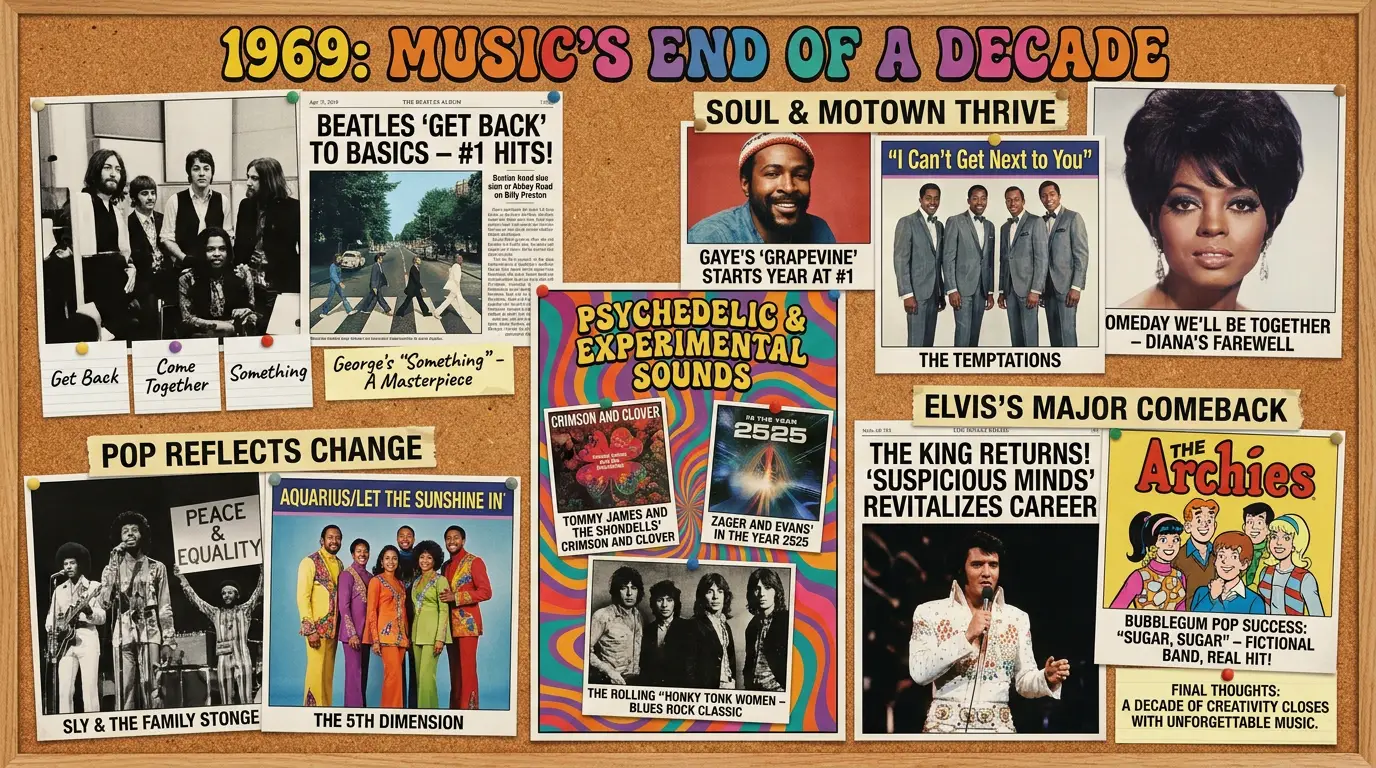
In the history of modern sound, 1969 music represents the definitive peak of the counterculture era, acting as a bridge between the psychedelic experimentation of the mid-60s and the hard rock and progressive movements of the 1970s. This landmark year produced era-defining festivals like Woodstock, witnessed the final public performance of The Beatles, and saw the birth of heavy metal and jazz fusion through the debuts of Led Zeppelin and the experimental shifts of Miles Davis.
The Cultural Significance of 1969 Music
To understand the music of 1969, one must first recognize the volatile social landscape from which it emerged. As the decade drew to a close, the optimism of the "Summer of Love" had largely been replaced by the grit of the Vietnam War and the tension of the Civil Rights Movement. Music was no longer just entertainment; it was a primary vehicle for political protest, social commentary, and spiritual exploration. From the perspective of 2026, historians view this year as the moment when rock music fully matured into a complex art form capable of sustaining high-concept narratives and technical virtuosity.
The music of this year was characterized by a push toward extremes. On one hand, there was a drive toward massive, loud, and heavy sounds—exemplified by the rise of the Marshall stack amplifier and the distorted blues of British rock. On the other hand, there was a move toward introspection and acoustic purity, as seen in the burgeoning singer-songwriter movement. The sheer volume of classic albums released in these twelve months remains unparalleled, making 1969 a perennial subject of study for musicologists and audiophiles alike.
The Year of the Great Festivals: Woodstock and Beyond
No discussion of 1969 music is complete without analyzing the outdoor festival phenomenon, which reached its zenith and its nadir within months of each other. These events transformed the way music was consumed, shifting the focus from intimate club settings to massive, communal experiences.
Woodstock: Three Days of Peace and Music
Held in August 1969 on Max Yasgur’s dairy farm in Bethel, New York, the Woodstock Music & Art Fair became the defining moment of a generation. Despite logistical failures, including food shortages and torrential rain, the event hosted over 400,000 people. Performances by Jimi Hendrix, Janis Joplin, Santana, and The Who became legendary. Hendrix’s distorted, feedback-laden rendition of "The Star-Spangled Banner" remains perhaps the most iconic sonic representation of the era’s political turmoil. More than just a concert, Woodstock proved that the "youth market" was a formidable cultural and economic force.
The Harlem Cultural Festival
Often referred to as the "Summer of Soul," the Harlem Cultural Festival took place over six weeks in 1969. While Woodstock dominated the mainstream narrative for decades, the Harlem festival featured powerhouse performances from Nina Simone, Stevie Wonder, and Sly and the Family Stone. It highlighted the intersection of gospel, soul, and the Black Power movement. The 2021 documentary Summer of Soul brought this event back into the global spotlight, cementing its place as a crucial pillar of 1969’s musical heritage.
Altamont: The End of the Innocence
If Woodstock represented the peak of hippie idealism, the Altamont Free Concert in December 1969 represented its collapse. Headlined by The Rolling Stones, the event was marred by violence and the tragic death of Meredith Hunter. This shift in atmosphere signaled a darker turn for rock music as it entered the 1970s, moving away from "flower power" and toward the more cynical and aggressive tones of the coming decade.
| Festival | Primary Location | Key Headliners | Estimated Attendance | Cultural Impact |
|---|---|---|---|---|
| Woodstock | Bethel, NY | Hendrix, The Who, Santana | 400,000+ | Defined the 60s counterculture. |
| Harlem Cultural Festival | New York City, NY | Stevie Wonder, Nina Simone | 300,000 | Celebrated Black pride and soul music. |
| Altamont Free Concert | Tracy, CA | The Rolling Stones, Jefferson Airplane | 300,000 | Viewed as the "death" of the hippie era. |
| Atlanta Pop Festival | Hampton, GA | Led Zeppelin, Janis Joplin | 150,000 | Proved the massive demand for rock in the South. |
Landmark Albums and the Evolution of the Long Play (LP)
By 1969, the "album" had replaced the "single" as the primary medium for artistic expression. Artists began utilizing the studio as an instrument itself, leading to some of the most influential recordings in history.
The Beatles: Abbey Road and the Rooftop Concert
Though Let It Bleed and Led Zeppelin II were massive, 1969 was arguably the most bittersweet year for The Beatles. In January, they performed their final live set on the roof of Apple Corps headquarters. Later that year, they released Abbey Road. Despite internal fracturing, the album was a masterpiece of production, featuring the "Medley" on Side B and George Harrison’s finest compositions, "Something" and "Here Comes the Sun." It was the last time all four members recorded together, serving as a sophisticated swan song for the world's most famous band.
The Birth of Hard Rock: Led Zeppelin
Led Zeppelin released both their self-titled debut and Led Zeppelin II in 1969. These records redefined the "heavy" sound, blending American Delta blues with high-volume amplification and intricate drumming. Jimmy Page’s production techniques—such as placing microphones further away from the drums to capture the "room sound"—changed rock recording forever. Songs like "Whole Lotta Love" provided the blueprint for the heavy metal genre that would explode in the 1970s.
Progressive Rock and Jazz Fusion
1969 saw the release of King Crimson’s In the Court of the Crimson King, an album often cited as the definitive birth of progressive rock. It abandoned blues structures in favor of orchestral arrangements, jazz-inflected drumming, and Mellotron-heavy textures. Simultaneously, Miles Davis was shattering the boundaries of jazz with In a Silent Way and the recording sessions for Bitches Brew. By incorporating electric instruments and rock rhythms, Davis created "jazz fusion," a genre that alienated purists but expanded the possibilities of improvisational music.
Technical Innovations in 1969 Sound Production
The "sound" of 1969 was dictated by significant leaps in recording technology. As we look back from 2026, the warm, saturated tones of these recordings are still highly sought after by modern producers.
- The Rise of 16-Track Recording: Before 1969, 4-track and 8-track machines were the standard. The introduction of 16-track tape machines allowed artists like Frank Zappa and The Beatles to layer sounds with unprecedented complexity without losing audio fidelity through "bouncing" tracks.
- The Moog Synthesizer: While synthesizers existed earlier, 1969 was the year they entered the mainstream. The Beatles used the Moog extensively on Abbey Road (notably on "Maxwell's Silver Hammer" and "Because"), introducing audiences to electronic textures that didn't sound like "sound effects" but like melodic instruments.
- Solid State Amplification: While tube amps remained the favorite for tone, the development of more reliable solid-state equipment allowed for larger PA systems, which were essential for the massive crowds at festivals like Woodstock.
The Soul and Funk Revolution
While rock was dominating the airwaves, R&B and Soul were undergoing a radical transformation. Motown began moving away from its "charm school" image toward "Psych-Soul." The Temptations released "Cloud Nine," which dealt with drug use and poverty, reflecting a new social realism.
Meanwhile, Isaac Hayes released Hot Buttered Soul, an album that broke the three-minute radio mold with sprawling, orchestral soul tracks that lasted over ten minutes. Sly and the Family Stone’s Stand! blended funk, rock, and soul into a politically charged, danceable hybrid that influenced everyone from Prince to Miles Davis. This era marked the transition from the polished soul of the early 60s to the raw, rhythmic "funk" that would define the 70s.
Essential 1969 Music Frequently Asked Questions
Why is 1969 considered one of the best years in music history?
It is considered a "perfect storm" of creative freedom, technical advancement, and cultural urgency. Major genres—including heavy metal, progressive rock, and jazz fusion—either began or were perfected in 1969. Furthermore, the year hosted Woodstock, which remains the symbolic peak of the 20th-century music festival movement.
What was the best-selling album of 1969?
While several albums vied for the top spot, The Beatles' Abbey Road was a massive commercial success, spending 17 weeks at number one on the UK charts and 11 weeks at number one in the US. Other top sellers included Led Zeppelin II and Blood, Sweat & Tears.
Who were the most influential artists of 1969?
The Beatles, Led Zeppelin, Jimi Hendrix, and Sly and the Family Stone are often cited as the most influential. However, Miles Davis’s shift toward electric instruments and King Crimson’s debut were equally pivotal for the future of jazz and rock, respectively.
How did the events of 1969 change how music is recorded?
The shift to 16-track recording allowed for greater experimentation and "overdubbing." Additionally, the 1969 trend of recording in unconventional locations or focusing on the "live room sound" (pioneered by Jimmy Page and Glyn Johns) led to the powerful, immersive audio profiles we still associate with classic rock today.
What is the "Summer of Soul"?
The "Summer of Soul" refers to the Harlem Cultural Festival held in 1969. It was a series of free concerts in Mount Morris Park that celebrated African American music and culture. It is now recognized as a historical equal to Woodstock in terms of its musical and social importance.
Accessing and Preserving the 1969 Legacy
For listeners in 2026, the music of 1969 is more accessible than ever through high-resolution streaming services and the continued "vinyl revival." To truly appreciate the depth of this year, listeners are encouraged to seek out remastered versions of the key albums, many of which utilize modern technology to clean up tape hiss without losing the original analog warmth.
The Rock and Roll Hall of Fame and the Library of Congress National Recording Registry maintain extensive archives of 1969 recordings, ensuring that these cultural artifacts are preserved for future generations. Whether through the lens of a historian or the ears of a casual listener, the music of 1969 stands as a testament to a time when art and society were inextricably linked, creating a sound that has yet to be silenced.