In 1963, Yellowstone National Park underwent a fundamental shift in its management philosophy, transitioning from a focus on visitor entertainment to a rigorous standard of ecological preservation. This year is primarily defined by the release of the Leopold Report, which revolutionized how the National Park Service (NPS) handled wildlife and natural resources, alongside the continued expansion of modern infrastructure under the Mission 66 initiative.
Yellowstone National Park in 1963 represents a pivotal crossroads between the "Old West" style of park management and the modern era of conservation biology. To understand Yellowstone today, in 2026, one must look back at the events of 1963 as the moment the park’s administrators began to prioritize the integrity of the ecosystem over the convenience of the tourist experience. This overview details the historical context, the policy shifts, and the physical transformations that occurred during this landmark year.
The Leopold Report: A Paradigm Shift in Management
The most significant event of 1963 for Yellowstone—and indeed for the entire National Park System—was the publication of the Wildlife Management in the National Parks report, better known as the Leopold Report. Authored by a committee of scientists led by A. Starker Leopold, the report was commissioned by Secretary of the Interior Stewart Udall.
The "Vignette of Primitive America" Concept
The Leopold Report proposed that National Parks should represent a "vignette of primitive America." Before 1963, park management was often reactive and focused on maintaining a visual "garden" for visitors. The report argued that parks should be managed as integrated ecosystems where natural processes, including fire and predation, were allowed to function with minimal human interference.
In 1963, this was a radical departure. It suggested that if a forest burned or an elk population fluctuated, these were natural occurrences that should be observed rather than "fixed." This document remains the foundational text for modern park management policies.
Impacts on Wildlife Policy
Specifically for Yellowstone, the report addressed the controversial issue of elk management. Since the early 20th century, the park had actively culled elk to prevent overgrazing. The Leopold Report suggested that while culling might be necessary, the ultimate goal should be a self-regulating system. This led to a decades-long debate that eventually culminated in the reintroduction of wolves in the 1990s—a direct intellectual descendant of the 1963 recommendations.
Mission 66: Modernizing the Wilderness
While scientists were rethinking ecology, engineers were busy reshaping the park's physical landscape. Mission 66 was a ten-year, billion-dollar program intended to dramatically upgrade National Park facilities in time for the NPS 50th anniversary in 1966. By 1963, many of these projects reached their peak or completion.
Modernist Architecture and New Facilities
Mission 66 introduced "Park Modern" architecture to Yellowstone, which stood in stark contrast to the rustic "Parkitecture" of the early 1900s. The goal was to accommodate the massive surge in post-war automobile tourism.
- Canyon Village: Although opened slightly earlier, 1963 saw the village in full swing as a "one-stop shop" for visitors, moving guest services away from the fragile rim of the Grand Canyon of the Yellowstone.
- Grant Village Construction: Significant planning and early construction phases were underway in 1963 for Grant Village on the shores of Yellowstone Lake.
- Road Improvements: Wide, paved loop roads were prioritized to handle the heavy station wagons and early campers of the era, fundamentally changing how visitors traversed the 2.2 million acres of the park.
The Shift in Visitor Services
The focus in 1963 was on centralization. By creating large hubs like Canyon Village, the NPS hoped to reduce the "footprint" of human habitation in other parts of the park. This period saw the decommissioning of smaller, older camps in favor of these modern, high-capacity facilities.
Wildlife and Research: The Craighead Era
In 1963, Yellowstone was the site of some of the most advanced wildlife research in the world. John and Frank Craighead were in the fifth year of their pioneering grizzly bear study.
Radiotelemetry and Bear Management
The Craigheads were among the first to use radio collars to track large mammals. In 1963, their data began to show exactly how much bears relied on human garbage in the park's open-pit dumps. At the time, "bear jams"—where dozens of cars stopped to watch bears beg for food on the roadside—were a daily occurrence.
The research conducted in 1963 eventually led to the controversial decision to close the dumps. While this caused a temporary increase in bear-human conflicts as the bears sought new food sources, it was a necessary step in returning the grizzly to a wild, self-sustaining state.
The State of the Northern Range Elk
The winter of 1962–1963 saw intense public scrutiny of the NPS elk reduction program. To protect the range from overgrazing, rangers would shoot elk and ship the meat to Native American reservations and charitable organizations. By 1963, public outery from hunters and animal welfare groups reached a fever pitch, forcing the NPS to look for non-lethal management alternatives, which were heavily influenced by the year's new ecological reports.
Geological Activity and Post-Quake Observations
The 1959 Hebgen Lake Earthquake (7.3 magnitude) had fundamentally altered Yellowstone’s hydrothermal systems. By 1963, geologists were still in a phase of intense observation to understand the long-term changes.
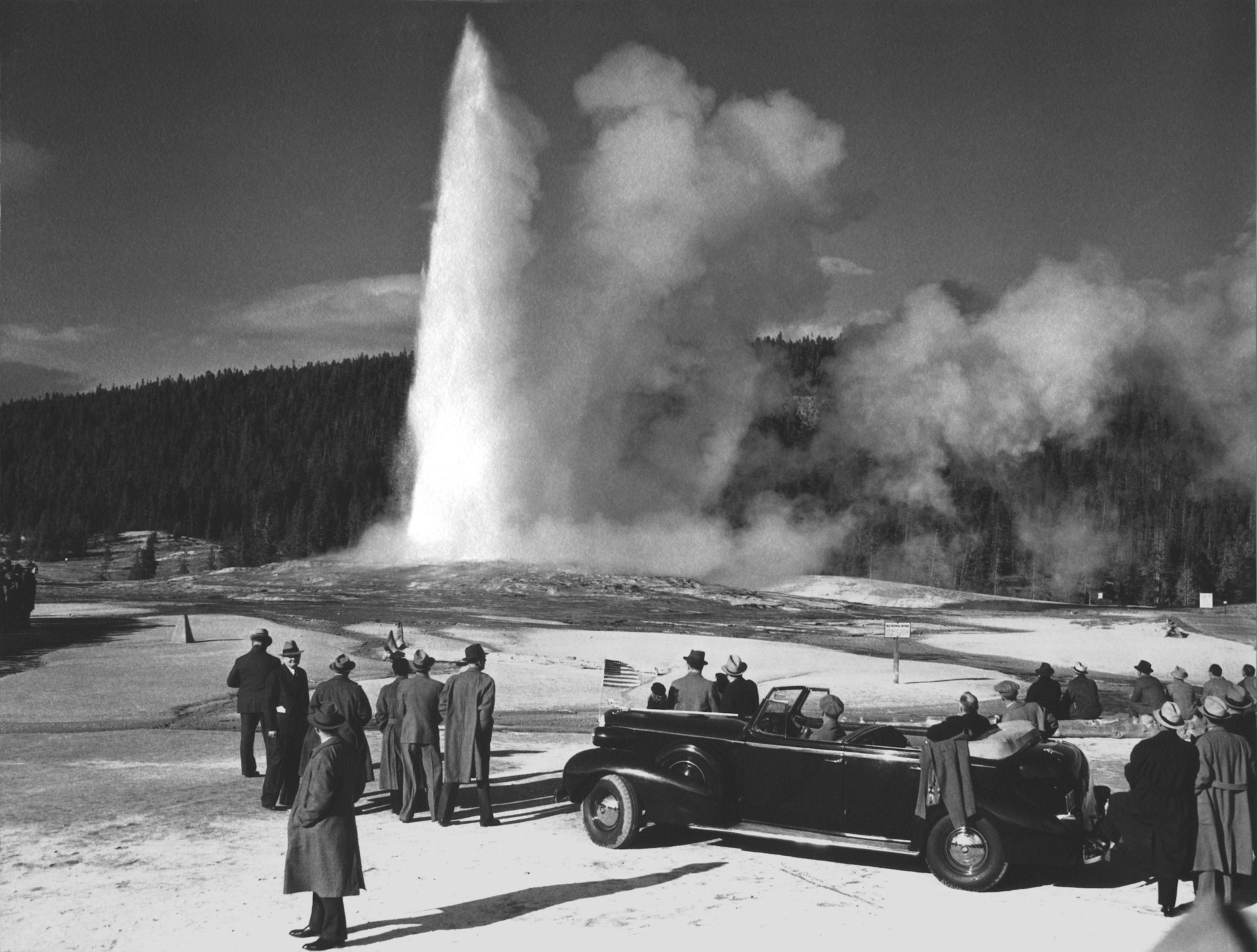
- Old Faithful: Following the quake, Old Faithful's average interval between eruptions increased. In 1963, researchers were documenting these new patterns to provide more accurate predictions for the growing crowds of tourists.
- New Geysers and Dormant Springs: Some dormant springs, like Sapphire Pool, had become violent eruptors following the quake. By 1963, some of this activity began to stabilize, providing scientists with a "real-time" look at how seismic events reshape geothermal plumbing.
Visitor Experience in 1963: A Snapshot
To visit Yellowstone in 1963 was to experience a park in transition. It was the height of the American road trip culture.
Costs and Logistics
In 1963, a 15-day vehicle permit for Yellowstone cost approximately $3.00 (which would be roughly $30.00–$35.00 in 2026 inflation-adjusted currency). Gasoline was cheap, and the "See America First" campaign encouraged families to pack their station wagons and head West.
1963 Yellowstone Statistics and Features
The following table summarizes the key metrics and status of the park during this period:
| Feature/Metric | 1963 Status/Detail | Significance |
|---|---|---|
| Annual Visitation | Approx. 1.8 to 1.9 Million | Record levels at the time, straining old infrastructure. |
| Primary Management Policy | The Leopold Report | Initiated the shift toward natural process management. |
| Major Construction | Mission 66 (Canyon & Grant Village) | Transition to modern, high-capacity visitor centers. |
| Entrance Fee | $3.00 (15-day pass) | Affordable access for the burgeoning middle class. |
| Wildlife Focus | Elk Culling & Grizzly Research | High controversy over herd reduction and dump feeding. |
| Key Publication | "The Yellowstone Story" (Revised Eds) | Standardized the park's history for the general public. |
The Significance of 1963 in the Long Arc of History
Why does 1963 stand out? It was the year Yellowstone stopped being treated like a giant zoo and started being treated like a complex laboratory.
- Administrative Courage: The decision to adopt the Leopold Report required the NPS to move away from "popular" management (like feeding bears and killing predators) toward "scientific" management.
- Infrastructure Legacy: The buildings and roads constructed or planned in 1963 still form the backbone of the visitor experience in 2026. While some Mission 66 buildings have since been critiqued for their aesthetic, they were essential in handling the millions of visitors that followed.
- The Birth of Modern Ecology: The studies on the Northern Range and the Craighead grizzly research established Yellowstone as the premier location for temperate-zone ecological study.
Challenges and Controversies of the Year
Despite the progress, 1963 was fraught with tension. The "beggar bears" were a significant safety risk. In 1963, injuries from bears were relatively common because the public did not yet understand the "Keep Wildlife Wild" ethos.
Furthermore, the NPS faced intense pressure from state game departments in Montana and Wyoming regarding the elk. The states wanted the park to allow public hunting inside the boundaries to manage the herd, a request the NPS firmly denied in 1963, asserting federal jurisdiction over park wildlife—a precedent that remains vital today.
Frequently Asked Questions
What was the Leopold Report of 1963?
The Leopold Report was a landmark document that argued National Parks should be managed as ecosystems rather than just scenery. It emphasized that the primary goal should be to maintain the "biotic associations" within the park in the condition that prevailed when the area was first visited by white men.
Was Old Faithful erupting differently in 1963?
Yes. Following the 1959 Hebgen Lake earthquake, the intervals between eruptions became less predictable and generally longer. By 1963, the average interval had shifted from about 63 minutes to over 67 minutes, a change that geologists monitored closely during that year.
Could you feed bears in Yellowstone in 1963?
While the NPS was beginning to discourage it, roadside feeding of black bears was still a common and largely tolerated practice by the public in 1963. It wasn't until the late 1960s and early 1970s that strict enforcement and the closure of garbage dumps ended this "beggar bear" era.
What was Mission 66's impact on Yellowstone in 1963?
Mission 66 was a massive funding program that modernized the park. In 1963, this meant the completion of new visitor centers, modernized employee housing, and improved road systems designed to accommodate the nearly 2 million visitors the park was then receiving annually.
Did they hunt elk in Yellowstone in 1963?
The public was not allowed to hunt elk inside the park, but NPS rangers did perform "reductions" (culling) to protect the habitat. This was highly controversial in 1963 and led to a change in policy that eventually moved away from direct killing by rangers.
Final Recommendations for Historical Researchers
For those studying the history of Yellowstone, 1963 is a goldmine of archival material. To gain a deeper understanding of this period, researchers should consult the National Park Service History e-Library for the full text of the Leopold Report. Additionally, the Yellowstone Research Library contains specific 1963 superintendent reports that detail day-to-day operations and the specific challenges of that season.
Understanding 1963 is essential for anyone looking to comprehend the current state of Yellowstone in 2026, as the policies and infrastructure established then continue to dictate how we interact with the world’s first National Park.