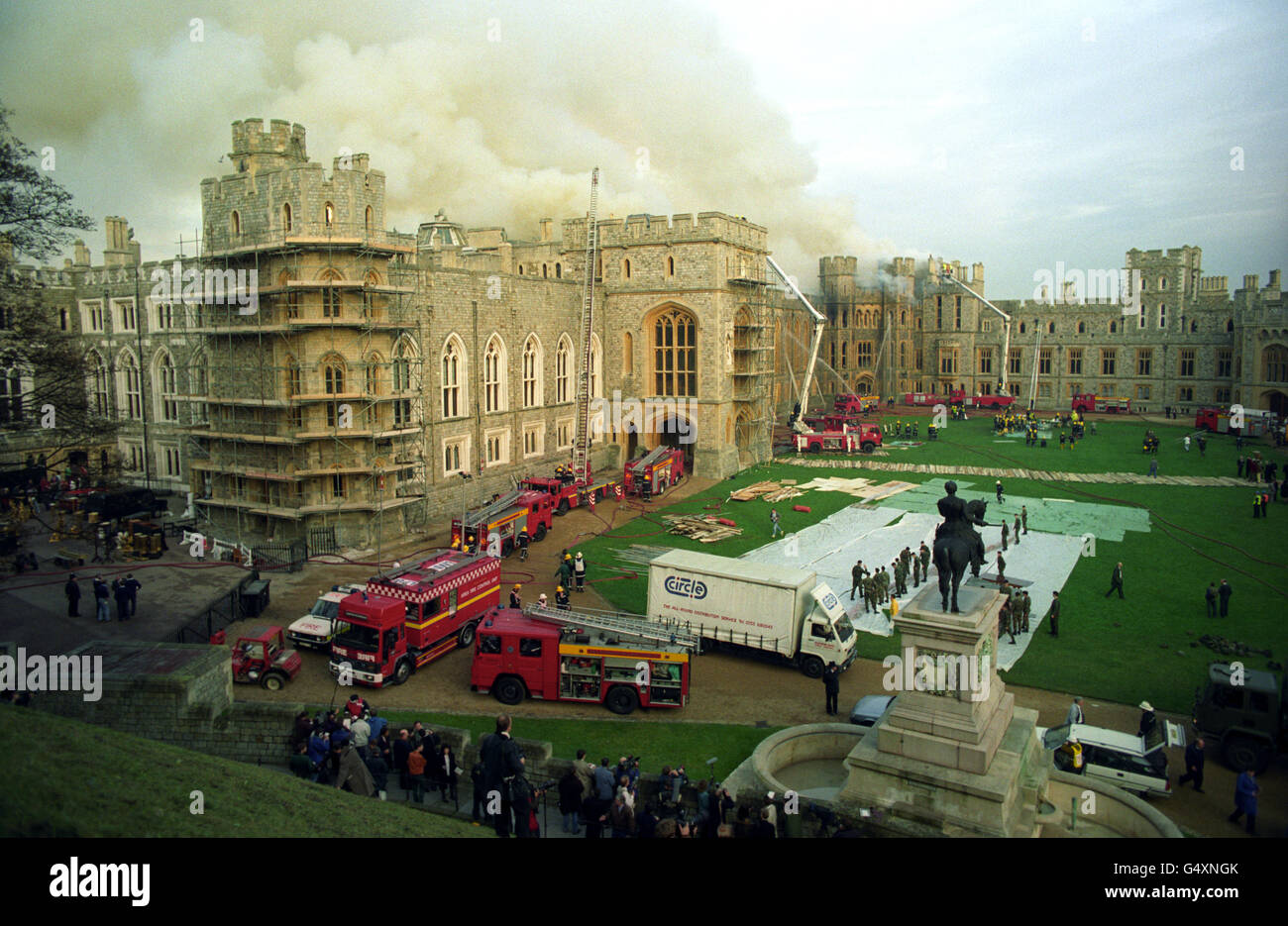
The 1992 Windsor Castle fire was a devastating 15-hour blaze on November 20, 1992, that severely damaged over 100 rooms across one acre of the historic royal residence. Sparked by a faulty spotlight touching a curtain in Queen Victoria's Private Chapel, the disaster mobilized over 200 firefighters, prompted widespread public debate over heritage funding, and catalyzed a massive five-year restoration project that fundamentally changed how historic British properties are protected and insured.
Introduction: The Day the Monarchy's Oldest Home Burned
On the morning of November 20, 1992, Windsor Castle—the oldest and largest inhabited castle in the world and a foundational symbol of British sovereignty—became the site of one of the most destructive architectural fires in modern British history. What began as a routine maintenance accident quickly escalated into a catastrophic structural emergency that threatened centuries of priceless royal history, fine art, and irreplaceable architecture.
The incident occurred during the Ruby Anniversary of Queen Elizabeth II and the Duke of Edinburgh, a period later famously described by the monarch as her annus horribilis due to a convergence of family scandals and this monumental property disaster. The fire not only exposed the severe vulnerabilities inherent in ancient, sprawling historic structures but also triggered a profound national debate regarding heritage conservation, the financing of royal repairs, and the transparency of the British state in managing public assets.
Chronology of the Disaster: How the Fire Unfolded
Understanding the severity of the 1992 Windsor Castle fire requires examining the rapid, escalating timeline of the event. The blaze moved swiftly through combustible historic timber frames, defying initial containment efforts and challenging the limits of mid-1992 firefighting technology and water pressure systems.
- [11:37 AM] Faulty spotlight ignites curtain in Queen Victoria's Private Chapel
- [12:15 PM] First alarm raised as smoke is detected by castle staff
- [3:30 PM] Fire breaches the roof of St George's Hall, creating a major inferno
- [6:30 PM] Over 200 firefighters deployed; water pressure issues complicate defense
- [3:00 AM, Nov 21] Main fire officially brought under control after 15 hours
The Initial Ignition
The fire started at approximately 11:37 AM in Queen Victoria’s Private Chapel. A contractor working on the renovation of the Chester Room had placed a 1,000-watt spotlight too close to a dark-green curtain. The intense radiant heat ignited the fabric. Although workers attempted to use fire extinguishers, the flames spread rapidly up the wall, catching the highly flammable dry timber, ancient paneling, and historic ceiling structures hidden behind the decorative interior finishes.
The Spread Through State Apartments
Because many of Windsor Castle's medieval and Georgian rooms featured interconnected, drafty wooden roof voids and open architectural spaces without modern fire-break walls, the fire traveled unchecked. Within hours, the blaze reached the historic St George’s Hall and the Brunswick Tower. The intense heat caused the roof of St George's Hall to collapse entirely at roughly 3:30 PM, creating a towering column of smoke visible for miles across Berkshire.
The Emergency Response
The Royal Berkshire Fire and Rescue Service responded with overwhelming force, ultimately deploying 39 fire appliances and over 200 firefighters at the height of the crisis. Compounding the challenge was the castle’s complex labyrinthine layout and a critical shortage of high-pressure water mains near the historic structure. Firefighters had to pump millions of gallons of water directly from the nearby River Thames and swimming pools on the estate, forming human chains alongside castle staff, royal guards, and members of the public to salvage priceless paintings, tapestries, and historical documents before the flames reached them.
Scale of Destruction and Salvage Efforts
The human-led salvage operation was one of the most remarkable aspects of the disaster. While firefighters battled the seat of the inferno, an organized brigade of staff, soldiers from the Grenadier Guards, and royal family members—including Prince Andrew—rushed into burning and smoke-filled rooms to rescue artifacts.
| Room / Area Affected | Extent of Damage | Key Salvage Status |
|---|---|---|
| Queen Victoria's Private Chapel | Completely destroyed | Most movable liturgical items saved |
| St George's Hall | Roof collapsed, interior gutted | Large historical portraits and furniture rescued |
| The Brunswick Tower | Severely fire-damaged | Structural shell preserved; contents evacuated |
| The Crimson Drawing Room | Heavy smoke and water damage | Restored to pre-fire appearance |
| The Green Drawing Room | Moderate-to-heavy water damage | Most fine art and porcelain successfully removed |
Despite the ferocity of the blaze, the loss of life or severe injury was miraculously zero, largely due to daytime occurrence and swift evacuation protocols. Furthermore, due to the heroism of the salvage teams, the vast majority of the Royal Collection’s most priceless masterpieces—including works by Rubens, Van Dyck, and Canaletto—were saved, though many sustained smoke and water damage.
The Financial Controversy and Public Debate
The aftermath of the fire triggered an intense political and constitutional debate that would reshape how royal properties are funded, maintained, and insured. At the time, Windsor Castle was categorized as a royal palace maintained by the state via the Department of the Environment, meaning British taxpayers traditionally shouldered the financial burden of repairs for occupied royal residences.
The Shift to Self-Funding
Estimates placed the total cost of repairing Windsor Castle at approximately £36.5 million (equivalent to over £70 million adjusted for inflation). Public outcry was swift and fierce; citizens and Members of Parliament questioned why taxpayers should fund repairs for a billionaire monarch when commercial insurance was not held on the property.
To resolve the public relations and financial crisis, Buckingham Palace announced a historic compromise in early 1993:
- Opening Buckingham Palace: For the first time in history, the State Rooms at Buckingham Palace would be opened to the public during the summer months, with admission fees directly funding the Windsor restoration.
- Tax Status of the Monarch: Queen Elizabeth II voluntarily agreed to start paying income tax and capital gains tax on her private income, bridging the gap between public expectation and royal accountability.
- The Sovereign Grant: The financing model eventually laid the groundwork for modernizing how royal finances are structured through the transition from the Civil List to the Sovereign Grant.
The Five-Year Restoration Project (1992–1997)
The restoration of Windsor Castle stands as a triumph of modern British craftsmanship, architectural conservation, and engineering. Led by architect Donald Insall and master builder Sid Clibbon, the project was completed in November 1997—ahead of schedule and under budget at a final cost of £37 million.
Philosophical Approach: Authentic Reconstruction vs. Modern Innovation
The restoration committee faced a crucial design dilemma: should the burned rooms be rebuilt precisely as they were, or should they incorporate modern architectural styles? Ultimately, the decision was made to restore the historic shell and major rooms (like St George's Hall and the Private Chapel) to their original appearance, but with subtle, modern upgrades hidden from view.
- Fire Safety Integration: Modern sprinkler systems, fire-resistant barriers, automated heat sensors, and compartmentalized fire doors were installed throughout the roof voids and historic chambers to prevent future disasters.
- Gothic Revival Mastery: For St George's Hall, architect Giles Quarme and interior designer Sidney Simion designed a magnificent new hammerbeam roof made from green oak sourced from English forests, utilizing traditional medieval carpentry techniques without modern metal fasteners.
- Contemporary Touches: In the Private Chapel and Lantern Lobby, contemporary designer Vernonipt introduced clean, modern stonework and understated stained glass, blending 20th-century design seamlessly with 14th-century Gothic architecture.
Long-Term Legacy and Lessons for Heritage Conservation
The 1992 Windsor Castle fire left a permanent imprint on heritage management, building regulations, and historic preservation standards globally. It exposed the extreme vulnerability of ancient buildings to modern construction hazards, particularly during hot-work operations like welding, soldering, and spotlight usage.
Regulatory and Operational Reforms
- Strict Hot-Work Protocols: Historic property managers worldwide adopted rigorous permitting systems for any maintenance involving open flames or high-heat electrical equipment near combustible materials.
- Risk Management in Historic Structures: Heritage agencies such as English Heritage (now Historic England) and the National Trust revised their emergency response plans, ensuring that local fire services possess pre-incident tactical plans for every major historic landmark.
- Insurance and Asset Protection: The fire underscored the necessity of comprehensive risk assessments and updated asset inventories for cultural institutions housing irreplaceable artifacts.
Frequently Asked Questions
What caused the 1992 Windsor Castle fire?
The fire was caused by a high-intensity 1,000-watt spotlight accidentally left too close to a curtain in Queen Victoria's Private Chapel by a contractor performing renovation work. The radiant heat ignited the fabric, spreading rapidly into the structural roof voids.
How much did the restoration cost and who paid for it?
The total restoration cost reached £37 million. Rather than relying entirely on taxpayer funds, the cost was covered by opening Buckingham Palace to paying summer visitors for the first time and through the Queen's voluntary contribution of income tax on her private funds.
Were any lives lost during the fire?
No. Because the fire broke out during the day and prompt evacuation protocols were enacted by castle staff and emergency responders, there were zero fatalities or serious injuries recorded among residents, staff, or firefighters.
Were any historic artworks destroyed?
While the architectural structures of several rooms—most notably St George's Hall and the Private Chapel—were severely gutted, the vast majority of movable art, furniture, and historical artifacts were successfully rescued by a coordinated salvage team of staff, guardsmen, and royal family members.
How long did it take to repair Windsor Castle?
The restoration project began immediately after the fire in 1992 and was completed exactly five years later in November 1997, finishing ahead of schedule and slightly under the initial budget projections.
Conclusion and Next Actions
The 1992 Windsor Castle fire remains a watershed moment in the history of British heritage conservation, demonstrating both the fragility of ancient architecture and the resilience of modern engineering and craftsmanship. For property owners, historians, and heritage professionals, studying this disaster highlights the critical importance of rigorous fire-safety protocols during maintenance, effective emergency planning, and proactive asset protection. When visiting historic properties or managing heritage assets, always verify that active fire containment systems, clear evacuation routes, and strict hot-work safety procedures are fully implemented and regularly audited.