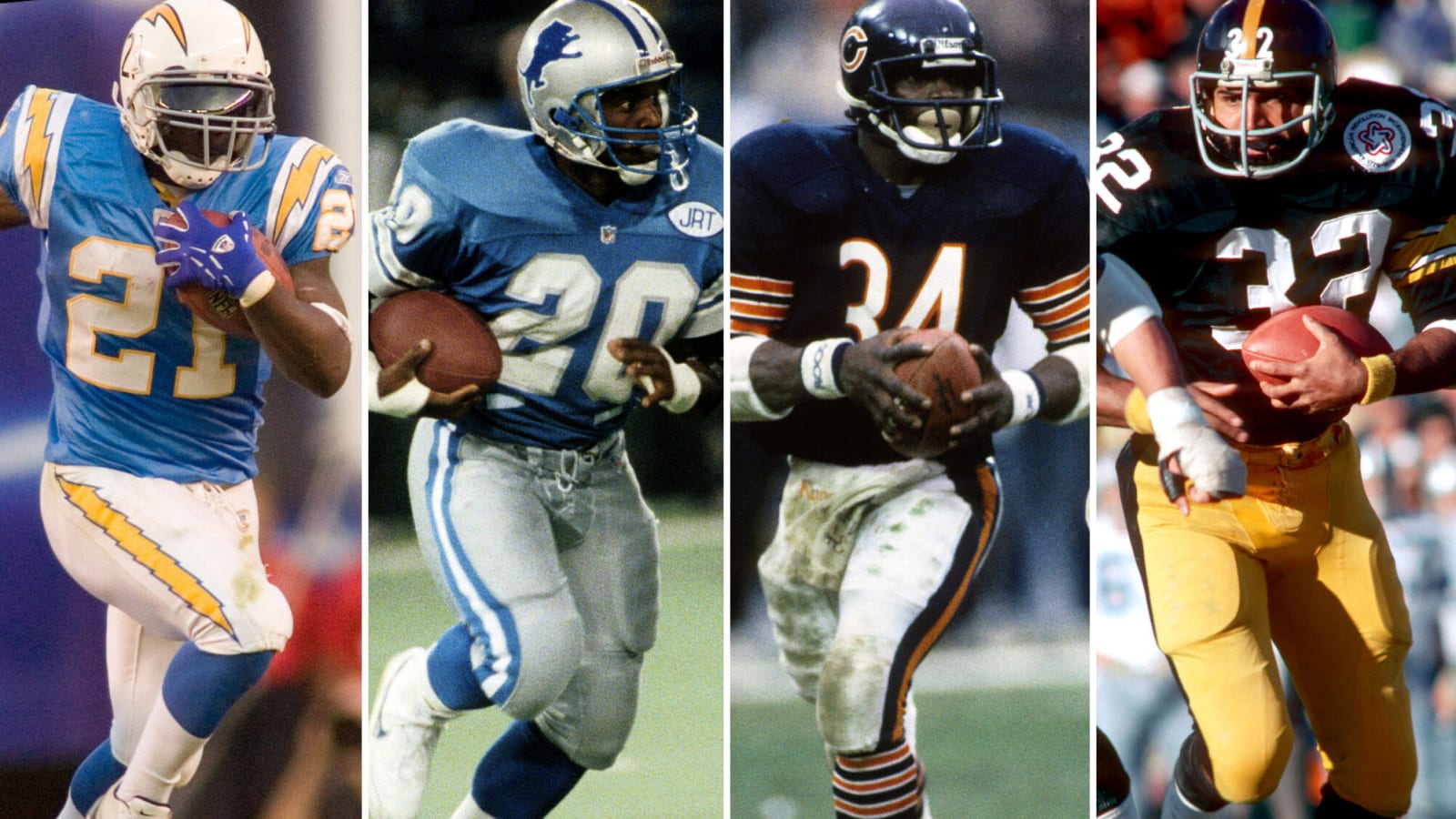
The fastest running backs in NFL history are defined by a combination of elite sprinting mechanics and the ability to translate that raw velocity into sustained statistical dominance. As of 2026, Chris Johnson remains the benchmark for this balance, pairing a 4.24-second 40-yard dash with a 2,000-yard rushing season. Other legends like Bo Jackson, Jamaal Charles, and Eric Dickerson round out a list where world-class track speed meets Hall of Fame-caliber production.
The Intersection of Velocity and Value: Defining the Elite
In professional football, speed is often measured in two ways: the controlled environment of the 40-yard dash and the chaotic reality of "game speed," now tracked via GPS as miles per hour (MPH). However, speed alone does not make a great running back. Many of the fastest players to ever participate in the NFL Scouting Combine failed to translate their physical gifts into meaningful yardage.
To rank the top 10 fastest running backs of all time, we must look at the "Speed-Production Index." This involves analyzing:
- Verified Speed: 40-yard dash times, Next Gen Stats (NGS) peak velocity, and collegiate track backgrounds.
- Efficiency: Yards per carry (YPC) and the ability to generate "explosive plays" (runs of 20+ yards).
- Longevity and Output: Total career rushing yards and touchdowns, ensuring the player wasn't just a "one-hit wonder."
As we evaluate these athletes from the perspective of 2026, we see a clear evolution from the long-striders of the 1980s to the high-frequency "twitch" runners of the modern era.
1. Chris Johnson (CJ2K)
Chris Johnson is the gold standard for this list. At the 2008 NFL Combine, Johnson's 4.24-second 40-yard dash shattered records and stood as the official laser-timed mark for nearly a decade. Unlike many speedsters, Johnson’s speed was functional and durable.
In 2009, Johnson produced one of the most remarkable seasons in NFL history, rushing for 2,006 yards and setting the then-record for total yards from scrimmage (2,509). His ability to hit the "home run" was unmatched; he is the only player in history with six touchdown runs of over 80 yards. Johnson didn't just run fast in a straight line; he maintained his velocity through cuts, making him a nightmare for safety angles.
2. Bo Jackson
Bo Jackson is often described as a "freak of nature" because of his unprecedented combination of 230-pound size and world-class speed. While his 4.12-second 40-yard dash at the 1986 regional combine is the stuff of legend (and likely hand-timed), his performance on the field validated the hype.
Jackson was a legitimate Olympic-caliber sprinter who qualified for the NCAA championships in the 100-meter dash. In the NFL, his production was limited by his dual-sport career and a catastrophic hip injury, yet he averaged a staggering 5.4 yards per carry over his career. His 91-yard touchdown run against the Seahawks remains one of the fastest sustained sprints ever captured on film.
3. Jamaal Charles
Jamaal Charles is perhaps the most efficient speedster to ever play the position. A standout track star at the University of Texas, Charles brought a 4.38-second 40-yard dash to the NFL. While that number is slower than Johnson's, Charles’s game speed was arguably superior.
Charles holds the NFL record for the highest career yards per carry average (5.4) for a running back with at least 1,000 attempts. His speed allowed him to turn routine draws into 70-yard scores. His 2012 season, where he rushed for over 1,500 yards coming off an ACL tear, solidified his status as an elite producer whose speed was a weapon of mass destruction for opposing defenses.
4. Eric Dickerson
Standing 6'3", Eric Dickerson was an anomaly. Most speed backs are shorter with a low center of gravity, but Dickerson was a "glider" with a massive stride length. He ran a 4.4-second 40-yard dash, but his upright style allowed him to maintain top-end speed longer than almost anyone in history.
Dickerson’s production is the stuff of legend. He still holds the NFL single-season rushing record with 2,105 yards set in 1984. His ability to outrun defensive backs in the open field, despite his large frame, changed how scouts evaluated tall running backs. He finished his career with over 13,000 rushing yards, proving that elite speed could be a foundational trait for a Hall of Fame career.
5. Barry Sanders
Barry Sanders represents a different kind of speed: "short-area quickness" and "stop-start" velocity. While Sanders' top-end speed was high (estimated 4.37 in the 40), his production was driven by his ability to reach that top speed in just two steps.
Sanders is the only player to have 1,500 yards in five consecutive seasons. His speed was defensive-scheme-breaking because he could change direction without losing momentum. By the time a linebacker reacted to his first move, Sanders was already at his peak velocity, heading toward the end zone. He retired with 15,269 rushing yards, the most by any player on this list.
6. Adrian Peterson
Known as "All Day," Adrian Peterson utilized a violent, high-knees running style that generated immense power and speed. Peterson’s 4.40 combine time belied his true game speed. Once he cleared the first level of the defense, he was rarely caught from behind.
Peterson’s 2012 MVP season, where he rushed for 2,097 yards just months after major reconstructive knee surgery, is one of the greatest feats of athletic production in history. He combined the breakaway speed of a sprinter with the finishing power of a fullback. His longevity—playing well into his 30s while maintaining a high YPC—is a testament to his physical gifts.
7. Derrick Henry
As we look back from 2026, Derrick Henry’s career stands as a defiance of physics. Weighing nearly 250 pounds, Henry has repeatedly clocked in at over 21.5 MPH on NFL Next Gen Stats.
Henry’s production is defined by "closing speed" in reverse; the further he runs, the faster he seems to get. His 2,027-yard season in 2020 was fueled by long-distance touchdowns where he outran cornerbacks who weighed 60 pounds less than him. Henry proved that "big-man speed" is often more dangerous than "small-man speed" because of the sheer kinetic energy involved in the collision.
8. Raheem Mostert
Raheem Mostert is a pure speed specialist who found the perfect scheme to showcase his talents. A former track star at Purdue, Mostert consistently recorded the highest MPH figures in the NFL during the early 2020s. In 2020, he hit 23.09 MPH and 22.73 MPH, the two fastest speeds recorded by any player that year.
While Mostert lacked the career-long volume of a Dickerson or Sanders, his production per touch was astronomical. During the San Francisco 49ers' 2019 playoff run, he rushed for 220 yards and four touchdowns in a single game (NFC Championship). His ability to hit the edge before a linebacker could scrape over the top made him the most dangerous home-run threat of his era.
9. Gale Sayers
The "Kansas Comet" was the original speed merchant. In an era of muddy fields and heavy equipment, Sayers moved at a different frequency than his peers. His speed was fluid and effortless.
In his 1965 rookie season, Sayers scored an NFL-record 22 touchdowns. He was a threat as a runner, receiver, and returner. Though his career was shortened by knee injuries, his peak production—averaging 5.0 yards per carry—was driven by a level of acceleration that the league had never seen before. He remains the youngest player ever inducted into the Pro Football Hall of Fame.
10. De'Von Achane
By 2026, De'Von Achane has solidified his place as the modern representative of elite speed. Entering the league with a 4.32-second 40-yard dash, Achane’s early career production was historic, averaging nearly 8 yards per carry in his debut season.
Achane represents the "track-to-gridiron" pipeline perfected. His small frame allows him to hide behind offensive linemen before exploding into the secondary with track-star mechanics. His presence on this list is a nod to the increasing importance of "explosive rate" over traditional "grind-it-out" rushing totals.
Comparison of Speed and Career Production
The following table compares the verified or reported speed metrics against the career production of these legendary backs.
| Player | Reported 40-Yard Dash | Career Rushing Yards | Career Yards Per Carry | Peak Season Achievement |
|---|---|---|---|---|
| Chris Johnson | 4.24 | 9,651 | 4.5 | 2,006 Yards (2009) |
| Bo Jackson | 4.12 (Hand-timed) | 2,782 | 5.4 | 4x Pro Bowl Talent |
| Jamaal Charles | 4.38 | 7,563 | 5.4 | 1,509 Yards (2012) |
| Eric Dickerson | 4.40 | 13,259 | 4.4 | 2,105 Yards (1984) |
| Barry Sanders | 4.37 | 15,269 | 5.0 | 2,053 Yards (1997) |
| Adrian Peterson | 4.40 | 14,918 | 4.6 | 2,097 Yards (2012) |
| Derrick Henry | 4.54 | 10,000+ | 4.7 | 2,027 Yards (2020) |
| Raheem Mostert | 4.34 | 5,500+ | 5.0+ | 18+ TDs (2023) |
| Gale Sayers | 4.40 (Est.) | 4,956 | 5.0 | 22 TDs (1965) |
| De'Von Achane | 4.32 | Active | 6.0+ | Elite YPC Leader |
The Evolution of Speed: 40-Yard Dash vs. Game Speed
It is essential to distinguish between a track environment and a football game. A player like Derrick Henry may have a "slow" 40-yard dash (4.54) compared to a cornerback, but his in-game speed is often higher because he takes longer to reach top gear due to his mass.
Next Gen Stats and MPH
Since the mid-2010s, the NFL has used Zebra Technologies to track players via chips in their shoulder pads. This has revealed that "fast" isn't just about the 40-yard dash. For example, Raheem Mostert and Tyreek Hill often hit higher MPH in full pads than players with faster combine times. This "functional speed" is what allows a running back to maintain their production even as they age.
The Physics of the Breakaway Run
Production is often a result of "burst"—the first 10 yards of a run. While top-end speed (30-60 yards) is what shows up on highlights, the "10-yard split" is what gets a running back through the hole. Players like Barry Sanders and Jamaal Charles had elite 10-yard splits, allowing them to reach the secondary before the defense could converge.
Factors That Influence Speed and Production
Several variables determine whether a fast player becomes a productive one:
- Vision: A fast player who runs into the back of his offensive line is useless. The "Greats" use their speed to "slow down" the game.
- Contact Balance: Speed is negated if a finger-tip tackle can bring the runner down. Adrian Peterson and Bo Jackson could maintain 90% of their speed even after taking a hit.
- Scheme Fit: A speed back in a "power" scheme often struggles. The rise of the "Outside Zone" scheme (pioneered by the Shanahan coaching tree) has maximized speedsters like Mostert and Achane by creating clear cut-back lanes.
Frequently Asked Questions
Who is the fastest running back ever measured in a game?
According to Next Gen Stats, Raheem Mostert holds some of the highest recorded speeds, hitting over 23 MPH. However, in terms of legendary status, Bo Jackson is widely considered the fastest "pure athlete" to play the position, given his track background and 100m dash times.
Does a faster 40-yard dash time guarantee NFL success?
No. Many players who ran sub-4.3 40s, such as Dri Archer or Rondale Moore (at RB/WR hybrid positions), did not achieve high rushing production. Production requires vision, durability, and the ability to break tackles, which are not measured in a track sprint.
How does artificial turf affect speed and production?
Modern turf allows for better traction, which theoretically increases speed and "twitchiness." However, legends like Gale Sayers and Eric Dickerson played on much harder, less forgiving surfaces, making their production even more impressive.
Why do running backs lose their speed so quickly?
Running backs experience more "micro-trauma" than any other position. Leg injuries (ACL, high ankle sprains) and the cumulative effect of hits reduce the elasticity in the muscles, which is vital for explosive speed. Most speed-dependent backs see a significant decline after age 28.
Is Derrick Henry actually fast, or just big?
Derrick Henry is objectively fast. He has consistently ranked in the top 5 for "Max Speed" on long touchdown runs. His height (6'3") gives him a massive stride length, meaning he covers more ground per step than smaller backs like Achane.
Final Recommendation for Students of the Game
If you are evaluating the impact of speed on the running back position, focus on yards after contact (YAC) and explosive play rate rather than just 40-yard dash times. Speed is a tool that enhances a runner's vision; it is not a replacement for it. For those looking to see the pinnacle of this combination, study the 2009 film of Chris Johnson or the 2012 film of Adrian Peterson. These seasons represent the absolute ceiling of what occurs when world-class velocity meets elite football IQ.