South Korea maintains a sophisticated defense posture centered on its "Three-Axis System" and a deep-rooted strategic alliance with the United States. In 2026, the nation’s defense strategy prioritizes high-tech indigenization, AI-driven "Defense Innovation 4.0," and a burgeoning export sector that has established the Republic of Korea as a top-tier global arms supplier.
The Geopolitical Context of South Korean National Security
The defense of the Republic of Korea (ROK) is dictated by its unique and precarious geographical position. Bordered by a nuclear-armed North Korea (DPRK) and situated at the intersection of major power interests—specifically China, Russia, and Japan—South Korea has transitioned from a recipient of security to a significant security provider in the Indo-Pacific.
As of 2026, the primary threat remains the North Korean missile and nuclear program. This has necessitated a shift from traditional conventional warfare readiness to a high-alert, multi-layered deterrent system. The ROK Ministry of National Defense (MND) has consistently increased its budget to accommodate the procurement of advanced stealth aircraft, nuclear-powered submarines (conceptually or in development), and sophisticated cyber-defense capabilities.
Beyond the peninsula, South Korea's defense outlook has expanded. The protection of sea lines of communication (SLOCs) in the South China Sea and the East China Sea is now viewed as vital to national survival, given the country’s dependence on energy imports and maritime trade. This has led to the "Blue Water Navy" initiative, aiming to project power well beyond coastal waters.
The Three-Axis System: The Core of ROK Deterrence
To counter the asymmetric threat from the North, South Korea has operationalized the Three-Axis System. This doctrine is designed to detect, intercept, and retaliate against any major provocation.
1. The Kill Chain
The Kill Chain is a preemptive strike system designed to identify and destroy North Korean nuclear and missile facilities before a launch can occur. In 2026, this system relies heavily on a combination of military reconnaissance satellites—including the "425 Project" constellation—and high-altitude long-endurance (HALE) unmanned aerial vehicles (UAVs) like the RQ-4 Global Hawk. The goal is to shrink the "sensor-to-shooter" window to less than 20 minutes.
2. Korea Air and Missile Defense (KAMD)
KAMD is a multi-layered terminal phase interception system. Unlike the U.S. Patriot system alone, KAMD integrates domestic technology to create a dense net of protection. Key components include:
- M-SAM (Cheongung II): Medium-range surface-to-air missiles optimized for intercepting aircraft and lower-altitude ballistic missiles.
- L-SAM (Long-range SAM): Often called the "Korean THAAD," this system is designed to intercept missiles at higher altitudes (40-60 km) in their terminal phase.
- Patriot (PAC-3 MSE): Integrated U.S. systems for point defense of critical infrastructure.
3. Korea Massive Punishment and Retaliation (KMPR)
KMPR is the "deterrence by punishment" pillar. If a nuclear attack is launched, South Korea’s doctrine dictates a massive strike against the enemy’s leadership and command-and-control nodes. This involves the use of high-yield conventional missiles, such as the Hyunmoo-4 and Hyunmoo-5, which are designed to penetrate deeply buried underground bunkers. It also involves the "Decapitation Unit," a specialized special forces brigade trained for high-value target neutralization.
The ROK-U.S. Alliance and the Washington Declaration
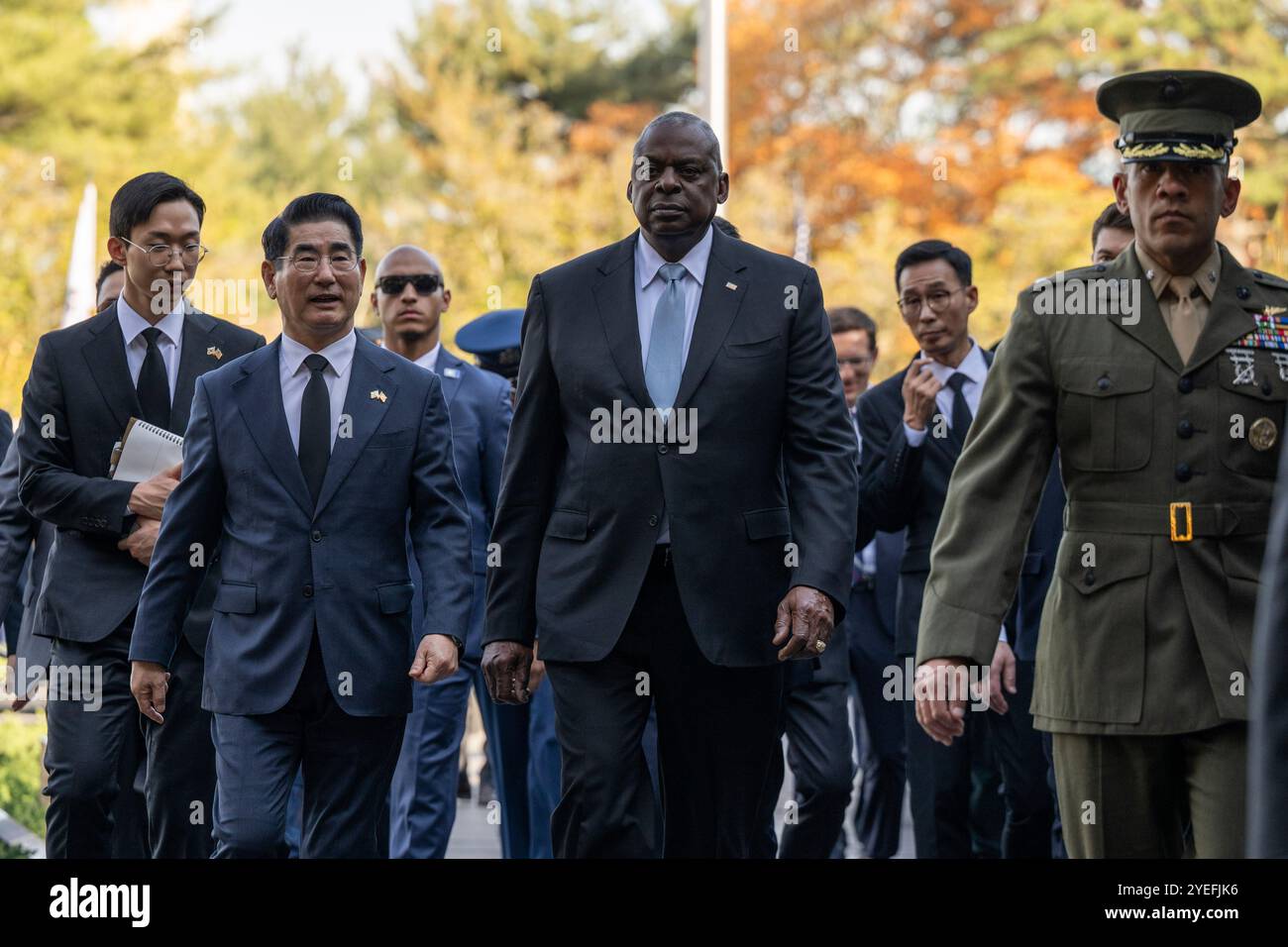
The Mutual Defense Treaty of 1953 remains the bedrock of South Korean security. However, the nature of this alliance has evolved significantly by 2026. Following the Washington Declaration of 2023, the establishment of the Nuclear Consultative Group (NCG) has integrated South Korea more deeply into U.S. nuclear planning.
This "extended deterrence" ensures that the U.S. nuclear umbrella remains credible. Regular deployments of strategic assets—such as SSBNs (ballistic missile submarines) and B-52 bombers—serve as visible reminders of this commitment. Simultaneously, the ROK military has moved closer to regaining Operational Control (OPCON) of its forces during wartime, a transition that requires South Korea to demonstrate its ability to lead a combined defense against a full-scale invasion.
The presence of United States Forces Korea (USFK), numbering approximately 28,500 personnel, provides a critical tripwire. Their presence is not merely about manpower but about the seamless integration of intelligence, surveillance, and reconnaissance (ISR) data that the U.S. provides to the ROK military.
The Rise of "K-Defense" as a Global Industry Powerhouse
One of the most remarkable shifts in the mid-2020s is South Korea’s emergence as the world’s fourth-largest arms exporter. The "K-Defense" brand is defined by three factors: cost-effectiveness, rapid delivery, and technological reliability.
Key Export Platforms
South Korean defense contractors like Hanwha Aerospace, Korea Aerospace Industries (KAI), and Hyundai Rotem have secured multi-billion dollar contracts globally.
- K9 Thunder Self-Propelled Howitzer: Dominating over 50% of the global tracked howitzer market, the K9 is prized for its high rate of fire and "shoot-and-scoot" capability.
- K2 Black Panther Main Battle Tank: Considered one of the most advanced tanks in the world, the K2 features an active protection system and hydropneumatic suspension, making it ideal for the mountainous terrain of both Korea and Eastern Europe.
- KF-21 Boramae: By 2026, the KF-21 4.5-generation fighter is transitioning into full-rate production. It offers a stealthy, high-performance alternative to more expensive 5th-generation platforms like the F-35, targeting nations that require advanced aerial combat capabilities at a lower lifecycle cost.
- FA-50 Light Combat Aircraft: A versatile and affordable supersonic jet that has seen massive success in Southeast Asia and Europe (Poland).
Comparative Hardware Specifications
| System | Category | Primary Feature | 2026 Status |
|---|---|---|---|
| K2 Black Panther | Main Battle Tank | 120mm/L55 smoothbore gun, auto-loader | Active Deployment / Export |
| K9 Thunder | Artillery | 155mm/52-caliber, 40km+ range | Global Market Leader |
| KF-21 Boramae | Multi-role Fighter | AESA Radar, semi-stealth design | Mass Production Phase |
| Dosan Ahn Changho | Submarine | 3,000-ton, VLS for cruise missiles | Operational / Batch II in progress |
| L-SAM | Missile Defense | Upper-tier interception (40-60km) | Final Testing / Initial Deployment |
Defense Innovation 4.0: AI and Unmanned Systems
To address the demographic challenge of a shrinking population, the ROK military has pivoted toward Defense Innovation 4.0. This initiative seeks to replace manpower-intensive units with technology-intensive ones.
In 2026, "Manned-Unmanned Teaming" (MUM-T) is a primary focus. This involves pilots controlling drone swarms from their cockpits and tank commanders using unmanned ground vehicles (UGVs) for reconnaissance and mine clearance. The South Korean Army is also implementing "Smart High-Tech Bases," which utilize AI-driven perimeter security and automated logistics to reduce the number of soldiers required for base maintenance.
The "Himang" (Hope) project in cyber-defense has also matured, using AI to identify and neutralize state-sponsored hacking attempts against South Korea's financial and energy grids, which have become frequent targets of asymmetric warfare.
Manpower and Societal Challenges
Despite its technological prowess, the ROK defense faces a structural crisis: the world’s lowest birth rate. The traditional model of a 500,000-strong conscript military is becoming unsustainable.
By 2026, the term of service remains approximately 18 to 21 months depending on the branch, but the pool of eligible conscripts is dwindling. This has led to several policy shifts:
- Increased Professionalization: Transitioning toward a higher percentage of non-commissioned officers (NCOs) and career soldiers.
- Warrant Officer Expansion: Creating more technical roles that offer competitive pay to retain talent in fields like cyber and electronics.
- Civilian Integration: Moving non-combat roles, such as maintenance and administration, to civilian contractors to keep more soldiers in "combat-ready" positions.
There is also an ongoing national debate regarding the potential for women's conscription or a transition to a fully volunteer military. While politically sensitive, these discussions are no longer peripheral but central to long-term defense planning.
Strategic Outlook and Recommendations
For those monitoring or interacting with the South Korean defense sector in 2026, several key trends are paramount. The nation is no longer just a "shield" for U.S. interests but a proactive "sword" that manufactures and exports high-end military technology.
Recommendations for Stakeholders
- For Defense Partners: Focus on co-development and technology transfer. South Korea is increasingly hesitant to be a "buy-off-the-shelf" customer; they prefer industrial partnerships that allow for domestic production and intellectual property sharing.
- For Policy Analysts: Watch the "Three-Axis" integration. The efficacy of South Korean defense in the late 2020s depends on the seamless real-time data link between their indigenous satellites and their missile batteries.
- For Regional Observers: Monitor the "K-Defense" influence in Europe and Southeast Asia. South Korea’s ability to deliver hardware quickly is reshaping regional balances of power far from the Korean Peninsula.
South Korea’s defense posture in 2026 represents a masterclass in adapting to extreme external threats while simultaneously leveraging military requirements to build a world-class industrial base. The challenge moving forward will be balancing the high cost of this high-tech military with the social and demographic realities of the 21st century.
Frequently Asked Questions
Is conscription still mandatory in South Korea in 2026?
Yes, conscription remains mandatory for all able-bodied men in South Korea. While the military is integrating more AI and robotics to reduce the need for manpower, the threat level from the North remains high enough that the government has maintained the draft to ensure a standing force capable of immediate response.
Can South Korea build its own nuclear weapons?
While South Korea possesses the technical capability and the fissile material potential to develop nuclear weapons quickly, it remains committed to the Nuclear Non-Proliferation Treaty (NPT). The 2023 Washington Declaration strengthened the U.S. nuclear guarantee, which has, for now, quelled the domestic political movement calling for an independent nuclear deterrent.
How does the KF-21 compare to the U.S. F-35?
The KF-21 Boramae is a 4.5-generation fighter, meaning it has many stealth characteristics but carries its weapons on external hardpoints in early versions (Block I). The F-35 is a full 5th-generation stealth fighter with internal weapon bays. The KF-21 is designed to be more affordable to operate and easier to maintain, serving as a complement to, rather than a total replacement for, 5th-generation assets.
What is the "Decapitation Unit"?
Formally known as the 13th Special Mission Brigade, this unit is tasked with the "Korea Massive Punishment and Retaliation" (KMPR) mission. Their specific role is to neutralize the North Korean command structure in the event of a nuclear strike or an imminent full-scale invasion, acting as a psychological and physical deterrent.
Why is Poland buying so much South Korean military equipment?
Poland has become a primary customer because South Korean manufacturers can deliver high-quality, NATO-compatible equipment significantly faster than most Western European or American firms. Following the invasion of Ukraine, Poland required immediate modernization, and the "K-Defense" industry's rapid production lines were able to meet that urgent timeline.