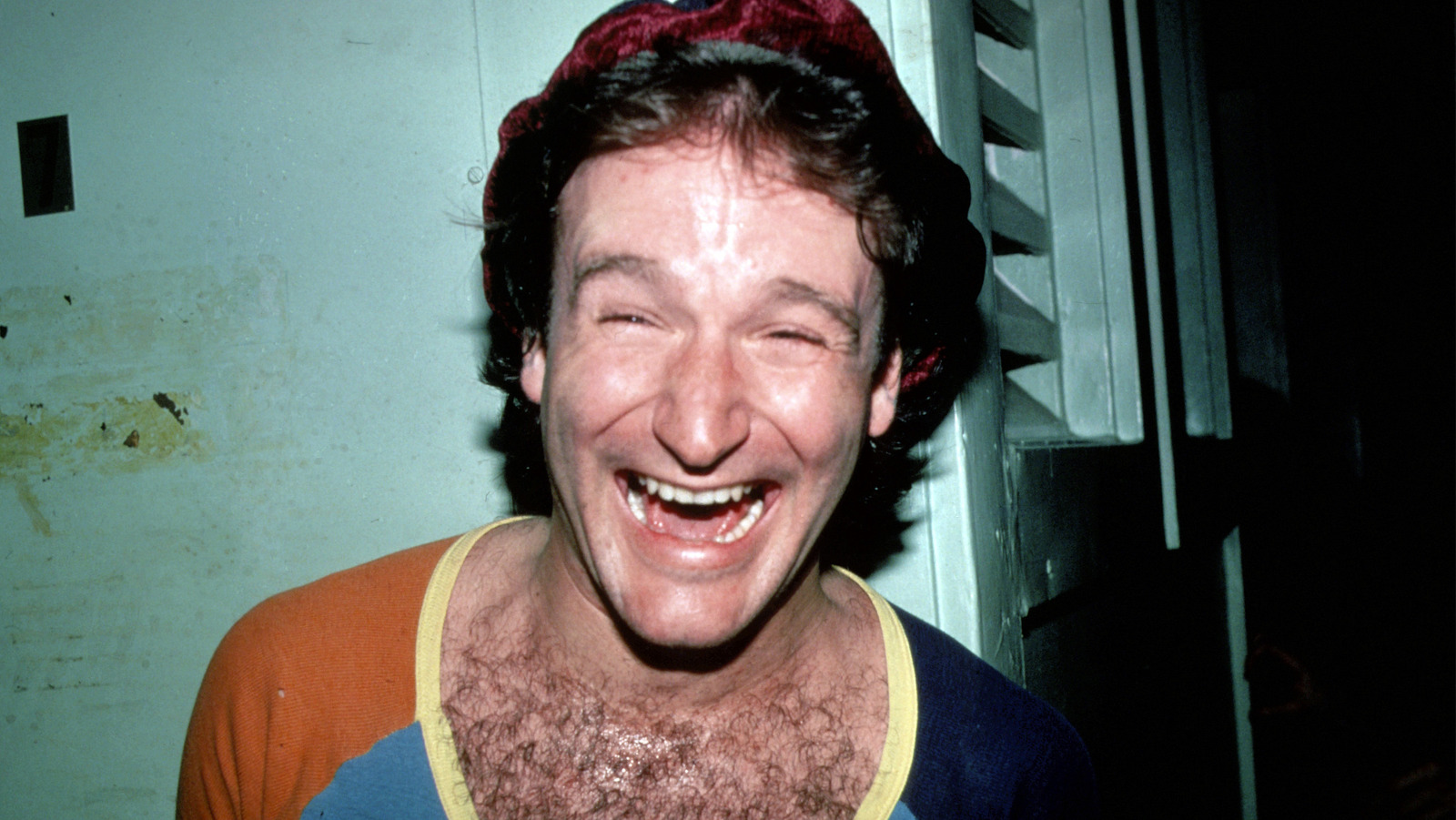
Robin Williams was one of the most prolific and beloved comedic and dramatic actors of the modern era, captivating global audiences through his hyper-energetic stand-up routines, unforgettable voice acting, and deeply moving cinematic performances. While his major films like Good Will Hunting, Mrs. Doubtfire, and Dead Poets Society are cultural touchstones, the private and professional life of the man behind these characters held many layers of complexity, generosity, unexpected hobbies, and surprising historical details.
Examining the lesser-known dimensions of his life reveals a classically trained actor who studied at Juilliard alongside Christopher Reeve, an avid and competitive collector of fine arts and video games, and a fiercely loyal friend who used his immense platform to support everyday individuals and veterans alike. Understanding these 15 fascinating facts adds profound context to a legendary career that defined decades of American entertainment.
1. A Lifelong Bond With Christopher Reeve Began at Juilliard
Long before they achieved international superstardom, Robin Williams and Christopher Reeve were classmates at the prestigious Juilliard School in New York City. Out of thousands of applicants, only two students were accepted into the advanced actor training program for that specific year under the direction of John Houseman: Williams and Reeve.
During their time at Juilliard, the two developed an immediate and unbreakable friendship, despite having entirely opposite personalities. Reeve was reserved, classical, and intensely focused, while Williams was an explosive, chaotic force of comedic nature. When Reeve suffered a tragic equestrian accident in 1995 that left him paralyzed, Williams was one of the first people to visit him in the hospital. Disguised in surgical scrubs and speaking in a thick Russian accent, Williams burst into the room pretending to be a proctologist, causing Reeve to laugh for the first time since his accident. Reeve later noted that in that moment, he knew his life was going to be okay.
2. He Insisted on Improvising Voice Acting for Aladdin
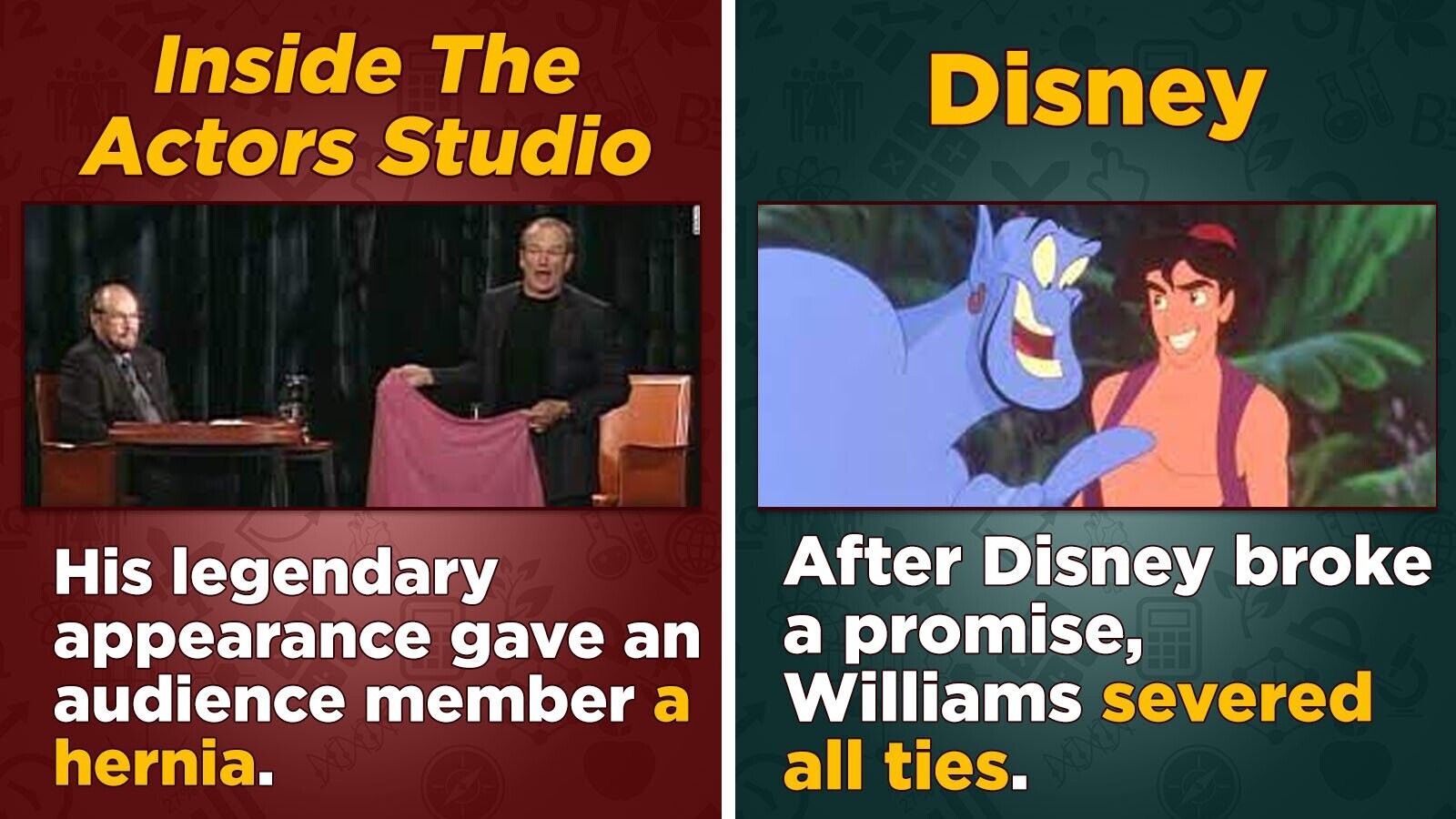
When Walt Disney Pictures cast Robin Williams as the Genie in the 1992 animated masterwork Aladdin, they did not fully anticipate the logistical challenge—and comedic goldmine—they were welcoming into the recording booth. Williams agreed to do the voice work for scale wages rather than his standard multi-million-dollar fee, provided Disney adhered to two strict conditions: his voice could not be used to sell merchandise, and his character could not take up primary space on the movie's theatrical posters. (Disney ultimately broke the marketing agreement, leading to a temporary rift between the actor and the studio).
Directors Ron Clements and John Musker wrote a script for the Genie, but Williams quickly abandoned it. He recorded upwards of 16 hours of audio for the film, utilizing his legendary capacity for rapid-fire pop-culture imitation, vocal shifting, and stream-of-consciousness improvisation. Animators had to build the Genie's visual transformations around Williams's ad-libs, drawing inspiration from dozens of distinct historical figures, cartoons, and politicians that Williams cycled through on the spot.
3. He Secretly Contracted Professional Kindness Clauses Into His Film Contracts
Beneath his manic comedic persona, Williams maintained a deeply empathetic worldview that manifested in an extraordinary behind-the-scenes practice. According to public accounts by media executive and former bodyguard Brian Lord, Williams maintained a standard requirement in his film production contracts that corporate employers must hire a specific number of homeless or economically disadvantaged individuals for local production jobs.
While Williams never publicized this philanthropy during his lifetime, production crews frequently found themselves employing unhoused people as production assistants, security runners, or catering support staff in various cities across the United States. This quiet gesture allowed marginalized individuals to earn a steady paycheck, gain valuable references, and experience a temporary bridge back into stable employment.
4. An Obsessive Passion for Competitive Video Gaming
Williams was an avid, highly knowledgeable gamer long before gaming culture achieved widespread mainstream acceptance. He was particularly obsessed with PC strategy titles, massively multiplayer online role-playing games (MMORPGs), and Nintendo consoles.
His enthusiasm for gaming was so intense that he named his daughter Zelda Williams after the iconic Princess Zelda from Nintendo’s legendary The Legend of Zelda franchise. He also played titles such as World of Warcraft, Half-Life, Day of Defeat, and Battlefield 2. In online gaming communities, Williams would often join random voice channels to play anonymously, though his unmistakable voice would occasionally give him away, leading to moments of utter disbelief among regular players who suddenly realized they were raiding a virtual dungeon alongside Mrs. Doubtfire.
5. Juilliard Mentor John Houseman Advised Him to Do Stand-Up
While Williams was widely regarded as a brilliant dramatic and classical actor by the faculty at Juilliard, his signature comedic energy often proved disruptive to traditional scene work. John Houseman, the legendary head of the acting program, recognized that Williams’s hyper-active mind and hyper-verbal style could not be neatly contained within standard theatrical frameworks.
Houseman famously pulled the young actor aside and advised him that classical theater might not be the ideal immediate outlet for his unique gifts. Instead, Houseman suggested that Williams explore stand-up comedy as a pressure valve for his boundless creativity. Williams took this advice to heart, dropping out of Juilliard during his senior year to move to San Francisco and Los Angeles, where he cut his teeth in the gritty club circuits of the 1970s.
6. He Won an Academy Award After Three Prior Nominations
Despite his immense global fame, Williams was initially viewed by the Hollywood establishment primarily as a manic comedian rather than a serious dramatic actor. This perception shifted across a series of critically acclaimed dramatic performances that earned him Academy Award nominations before he finally secured the golden statuette.
- Good Morning, Vietnam (1987): Nominated for Best Actor for his role as rebellious radio DJ Adrian Cronauer.
- Dead Poets Society (1989): Nominated for Best Actor for playing inspirational English teacher John Keating.
- The Fisher King (1991): Nominated for Best Actor for portraying a former professor struggling with trauma and homelessness.
- Good Will Hunting (1997): Won the Academy Award for Best Supporting Actor for his unforgettable portrayal of therapist Sean Maguire.
7. He Was an Expertly Trained Cellist Before Finding Acting
Before Williams discovered his passion for performance and comedy at Redwood High School in California, he was deeply immersed in classical music. He played the cello with high technical proficiency during his teenage years and seriously considered pursuing a career as a professional classical musician.
While his career path shifted drastically toward acting and stand-up, his deep appreciation for music remained a constant fixture of his personal life. He frequently incorporated musical theory, operatic vocalizations, and rhythmic cadences into his improvisational comedy routines, using his ear for pitch and timing to build comedic tension.
8. Generous Support for the United Service Organizations (USO)
Throughout his career, Williams was a tireless supporter of American military personnel stationed around the globe. He participated in numerous USO tours, traveling to dangerous conflict zones and remote outposts in Iraq, Afghanistan, the Persian Gulf, and the Balkans to perform live comedy shows for troops.
Unlike many celebrities who made brief, highly publicized visits to secure military bases, Williams routinely insisted on visiting smaller, forward-operating combat outposts where troops had limited access to entertainment or communication with home. He spent countless hours shaking hands, posing for photographs, and listening to personal stories from service members, viewing it as a vital duty to boost morale for individuals facing high-stress deployments.
9. He Gifted Steven Spielberg Laughter During Schindler's List Production
Directing the harrowing Holocaust drama Schindler’s List took an immense psychological and emotional toll on Steven Spielberg. Recognizing that his close friend was sinking into deep depression during the grueling shoot in Poland, Williams took it upon himself to deliver regular doses of joy to the director.
Spielberg revealed in later interviews that Williams would regularly call him on a speakerphone from Los Angeles, performing improvised comedy bits, impressions, and ridiculous stand-up routines for 15 to 20 minutes at a time. These spontaneous phone calls served as a vital emotional lifeline for Spielberg, helping him process the dark subject matter of the film without losing his psychological balance.
10. A Passionate Collector of Fine Art, Bicycles, and Memorabilia
Williams was an eclectic, highly focused collector with diverse and expensive tastes. Beyond his immense collection of video games and comic books, he was a noted connoisseur of fine art, modern sculpture, and high-end cycling equipment.
An avid road cyclist, Williams owned dozens of custom, ultra-lightweight racing bicycles, many of which were signed by legendary Tour de France champions. Following his passing, a portion of his extensive art and memorabilia collection—including works by major modern artists and personal props from his films—was put up for auction by his family, revealing a sophisticated aesthetic sensibility that spanned classical sculpture, pop art, and contemporary design.
11. He Was Originally Considered for Iconic Roles Like The Joker
Because of his astonishing range, Williams was frequently considered by major Hollywood studios for iconic cinematic roles that ultimately went to other actors. Most famously, Tim Burton and Warner Bros. aggressively pursued Williams to play the Joker in the 1989 blockbuster Batman.
Studio executives used Williams's name and interest to pressure Jack Nicholson into signing on for the role, a Hollywood maneuver that ultimately frustrated Williams. When Nicholson accepted the part, Williams gracefully stepped aside. Similarly, he was considered for the voice of Buzz Lightyear in Pixar's Toy Story (a role that went to Tim Allen) after expressing regret over how Disney handled the Aladdin marketing agreement.
12. Improvised Dialogue Defined His Most Iconic Cinematic Moments
Many of the most famous lines, monologues, and character ticks across Robin Williams’s filmography were not written in the original screenplays; they were spontaneous inventions captured during filming.
In Good Will Hunting, the famous scene where Sean Maguire (Williams) talks to Will (Matt Damon) about his late wife’s flatulence on a park bench was entirely improvised by Williams on the day of shooting. The sudden shift in tone caused the camera operator to physically shake with laughter, which explains why the camera wobbles noticeably during that specific shot. In Mrs. Doubtfire, when the prosthetic face catches fire on the stove, Williams improvised the frantic reaction and ad-libbed multiple takes that kept the crew laughing for hours.
13. He Auditioned for Star Wars Alongside Kurt Russell
In the mid-1970s, George Lucas held massive, simultaneous casting sessions in Los Angeles to cast the original space opera Star Wars: Episode IV - A New Hope. Williams auditioned for the role of Han Solo alongside actors like Kurt Russell, Sylvester Stallone, and Christopher Walken.
While Harrison Ford ultimately secured the iconic role of the cynical smuggler, Williams’s unique audition tape showcased his inimitable energy. While he was ultimately deemed a mismatched physical profile for Han Solo, Lucas maintained a lifelong professional admiration for Williams, cementing a relationship that spanned decades within the northern California film community.
14. A Relentless Impromptu Performer in Everyday Life
Williams did not turn off his comedic engine when the cameras stopped rolling. Friends, family members, and complete strangers frequently recounted instances where Williams would launch into full character performances in ordinary public settings, such as grocery stores, airports, and coffee shops.
If he noticed someone having a difficult day, he would often adopt a silly persona, imitate a celebrity, or launch into a rapid-fire bit simply to elicit a smile. This compulsion to entertain was rooted in a profound desire to forge emotional connections with people, using humor as a universal bridge across human suffering and social isolation.
15. The Legacy of the Dramatic Turning Point: One Hour Photo
While audiences largely associated Williams with heartwarming comedies and gentle dramas, he actively sought out unsettling, psychological thriller roles to challenge himself as an actor. One of his most daring performances occurred in Mark Romanek’s 2002 psychological thriller One Hour Photo.
Williams played Seymour "Sy" Parrish, a lonely, socially isolated photo lab technician who develops an unhealthy, obsessive fixation on a suburban family whose pictures he routinely develops. Stripped of his trademark manic warmth, hyper-verbal energy, and comedic styling, Williams delivered a chilling, quiet, and deeply sympathetic performance that demonstrated his capacity for nuanced psychological menace.
Comparative Overview of Major Career Milestones
| Film Title | Release Year | Primary Role Type | Accolades & Recognition |
|---|---|---|---|
| Good Morning, Vietnam | 1987 | Dramatic Comedy / Radio DJ | Academy Award Nomination (Best Actor) |
| Dead Poets Society | 1989 | Inspirational Drama / Teacher | Academy Award Nomination (Best Actor) |
| The Fisher King | 1991 | Tragi-Comedy / Homeless Historian | Academy Award Nomination (Best Actor) |
| Aladdin | 1992 | Animated Voice Acting / Genie | Special Golden Globe Award / AFI Recognition |
| Mrs. Doubtfire | 1993 | Family Comedy / Cross-Dressing Father | Golden Globe Award (Best Actor in a Musical or Comedy) |
| Good Will Hunting | 1997 | Psychological Drama / Therapist | Academy Award Winner (Best Supporting Actor) |
| One Hour Photo | 2002 | Psychological Thriller / Lab Technician | Saturn Award Winner (Best Actor) |
Frequently Asked Questions
What was Robin Williams's first major acting breakthrough?
Williams first achieved widespread mainstream fame starring as Mork, an eccentric extraterrestrial from the planet Ork, in the hit television sitcom Happy Days in 1978. His guest appearance generated such immense popularity that network executives immediately spun the character off into his own smash-hit series, Mork & Mindy, which ran from 1978 to 1982.
Did Robin Williams really write his own stand-up routines?
Yes, Williams wrote the vast majority of his stand-up material, though his performances were famous for relying heavily on real-time improvisation. He would construct a foundational framework of cultural observations, political commentary, and personal anecdotes, and then invite audience interaction to steer the direction of the set into entirely unscripted territory.
How did Robin Williams prepare for his dramatic roles?
Unlike his improvisational stand-up style, Williams approached dramatic roles with rigorous discipline. He studied historical documents, worked closely with dialogue coaches, shadowed professionals in fields such as therapy and education, and collaborated intensely with directors to understand the precise psychological motivations of his characters.
Why did Robin Williams voice the Genie in Aladdin for scale wages?
Williams accepted union scale wages for Aladdin primarily because he wanted to leave a legacy performance for his children and support the burgeoning artistic renaissance at Walt Disney Animation Studios. He viewed the project as a unique creative outlet rather than a standard commercial acting gig, which is why he explicitly requested that Disney avoid using his name and likeness as the central marketing engine for toys and box office merchandise.
Where can fans view Robin Williams’s personal memorabilia and collections?
Portions of Williams's extensive personal collections—ranging from contemporary art pieces and watches to cycling equipment and film props—were sold through major auction houses like Sotheby's following his passing, with proceeds distributed among his family and charitable foundations supported by the actor during his lifetime. Many items now reside in private collections, while his cinematic costumes and props occasionally appear in museum retrospectives dedicated to the history of American film.
Final Recommendation
To truly appreciate the incredible depth and artistic range of Robin Williams, skip the standard streaming algorithms and explore a double-feature pairing: watch Dead Poets Society to witness his capacity for profound inspirational mentorship, followed immediately by One Hour Photo to experience his chilling, understated mastery of psychological suspense. Examining these contrasting performances underscores why his artistic footprint remains unmatched in modern cinematic history.