The Mann Act was created in 1910 primarily to combat the interstate transportation of women and girls for prostitution, debauchery, or other immoral purposes, a practice commonly referred to at the time as "white slave traffic." Lawmakers designed the federal statute to dismantle organized criminal networks that coerced or lured women across state lines into forced labor and commercial sex.
Introduction to the White Slave Traffic Act of 1910
The early 20th century in the United States was a period of intense social anxiety, rapid industrialization, urbanization, and large-scale immigration. Amid these profound demographic shifts, moral reform movements gained significant traction. At the center of these reform efforts was a widespread public panic surrounding the commercial sex trade. Sensationalized newspaper reports, lurid novels, and reformist pamphlets warned of international syndicates kidnapping innocent young women and forcing them into brothels.
This environment of fear and moral urgency culminated in the passage of the White Slave Traffic Act, widely known as the Mann Act, enacted on June 25, 1910. Sponsored by Representative James Robert Mann of Illinois and strongly supported by President William Howard Taft, the legislation marked a major expansion of federal police powers into matters traditionally governed by individual states.
While proponents framed the law as a vital humanitarian measure to protect women and girls from exploitation, the broad and vague language of the statute opened the door to widespread overreach and selective prosecution. Over the decades, the Mann Act evolved from an instrument intended to dismantle human trafficking syndicates into a tool frequently weaponized to police personal morality, target political figures, and reinforce racial discrimination. Understanding why the Mann Act was created requires examining the social climate of the Progressive Era, the mechanics of the original statute, and the profound gap between its stated legislative intent and its historical application.
Social and Political Climate of the Progressive Era
To fully grasp why Congress passed the Mann Act, one must examine the socio-political landscape of the United States during the Progressive Era. Reformers sought to clean up urban centers, regulate industry, and protect vulnerable populations from the perceived moral decay accompanying modernization. Prostitution, euphemistically referred to as the "social evil," was viewed by many civic leaders, religious organizations, and public health officials as one of the most urgent threats to the moral fabric of the nation.
During this era, investigative journalists—often dubbed "muckrakers"—published numerous articles exposing the realities of commercialized vice. Concurrently, reform groups like the American Purity Federation and various vigilance committees campaigned aggressively against urban vice districts, such as Storyville in New Orleans or the Red Light District in Chicago.
The "White Slavery" Panic
The central narrative driving the legislative push was the concept of "white slavery." Despite the racially charged terminology, which primarily referred to Caucasian women and girls, contemporary reformers used the term to describe any female coerced, deceived, or forced into prostitution against her will.
Fears were amplified by sensationalized accounts claiming that innocent women were routinely drugged at train stations, abducted by shadowy syndicates, and imprisoned in brothels. Although modern historians and criminologists note that many women entered commercial sex due to severe economic desperation rather than abduction, the myth of the helpless victim captured the public imagination.
State and local authorities often struggled or proved unwilling to suppress urban vice due to widespread police corruption and political protectionism. Consequently, moral reformers and federal lawmakers argued that only the federal government possessed the jurisdictional reach necessary to disrupt interstate transportation networks trafficking women across state lines.
Legislative Mechanics and Intent of the Original Statute
Representative James R. Mann introduced the legislation to plug loopholes in existing state laws that ended at geographical boundaries. Because criminal syndicates routinely transported women across state lines to evade local law enforcement and jurisdictional limits, federal intervention was deemed necessary.
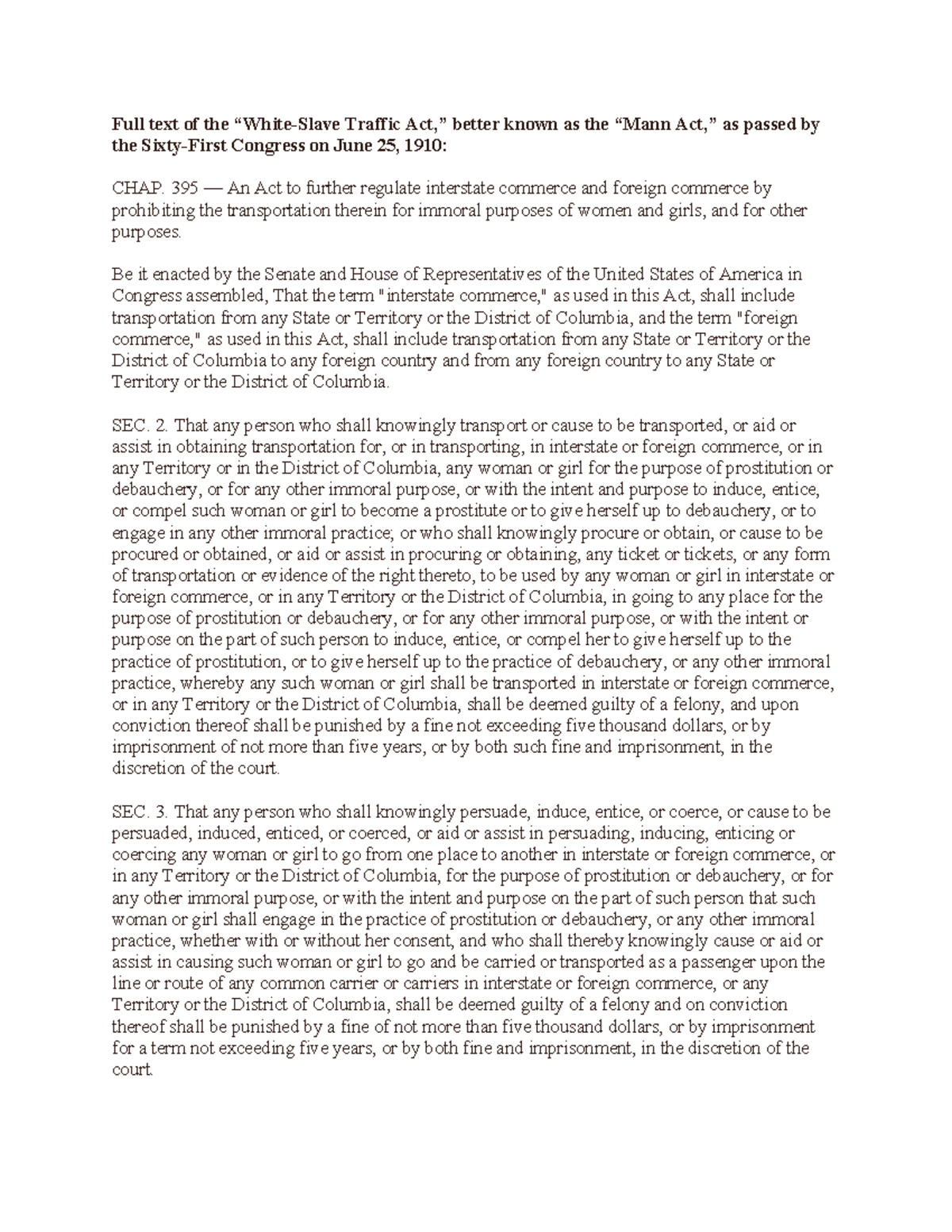
The original text of the Mann Act made it a felony to knowingly transport "any woman or girl for the purpose of prostitution or debauchery, or for any other immoral purpose" in interstate or foreign commerce. It also penalized anyone who aided, assisted, or persuaded a female to be transported for such purposes.
Key Provisions of the 1910 Act
- Interstate Commerce Clause: The constitutional justification for the law relied on the Commerce Clause of the U.S. Constitution, which grants Congress the power to regulate commerce among the several states. By tying the act of transportation to commercial transit across state lines, the federal government bypassed traditional state police powers.
- Severe Penalties: Violations carried hefty fines and prison sentences of up to five years, which were later increased for offenses involving minors or coercion.
- Broad and Vague Terminology: The inclusion of the phrase "or for any other immoral purpose" proved to be the most consequential and controversial aspect of the statute. Unlike "prostitution," the phrase "immoral purpose" was never explicitly defined within the text of the act.
This lack of precise statutory definition granted immense discretion to federal prosecutors, investigators, and judges, laying the groundwork for decades of controversial applications that extended far beyond the original intent of combating commercial trafficking.
Early Enforcement and High-Profile Prosecutions
Immediately following its passage, the Mann Act became a powerful weapon for the newly empowered Bureau of Investigation (later renamed the Federal Bureau of Investigation under J. Edgar Hoover). Federal agents targeted commercial brothel networks, interstate procurement rings, and pimps who lured women across state boundaries.
However, federal authorities quickly began applying the statute to non-commercial relationships, consensual affairs, and interracial couplings. Because the law did not explicitly require commercial gain or force, prosecutors used the phrase "immoral purpose" to target consensual sexual behavior outside of marriage.
The Jack Johnson Prosecution
The most infamous early application of the Mann Act involved the African American heavyweight boxing champion Jack Johnson. In 1913, Johnson was arrested under the Mann Act for traveling across state lines with Lucille Cameron, a white woman who later became his wife. Although the initial charges involving Cameron fell through, prosecutors successfully brought a second indictment regarding a different white woman, Belle Schreiber, with whom Johnson had a consensual relationship prior to his marriage.
An all-white jury convicted Johnson in 1913, resulting in a one-year prison sentence. Historians widely view the prosecution as a politically and racially motivated use of the Mann Act designed to punish Johnson for his athletic dominance, his wealth, and his high-profile relationships with white women, which defied prevailing racial taboos of the Jim Crow era.
| Defendant | Year | Circumstances | Outcome / Significance |
|---|---|---|---|
| Jack Johnson | 1913 | Traveled across state lines with a consensual romantic partner. | Convicted by an all-white jury; highlighted racial weaponization of the statute. Posthumously pardoned in 2018. |
| A. Caminetti | 1917 | Transported a mistress across state lines for non-commercial relations. | Supreme Court upheld broad interpretation in Caminetti v. United States, confirming the law applied to non-commercial acts. |
| Errol Flynn | 1942 | Accused of statutory rape involving underage girls across state lines. | Acquitted by a jury, but the trial severely damaged his reputation and highlighted moral policing trends. |
| Chuck Berry | 1959 | Transported a 14-year-old female employee across state lines. | Convicted and served time in prison; demonstrated continued application to minors and employment contexts. |
Judicial Interpretation and Expansion
The reach of the Mann Act was cemented by the United States Supreme Court in the landmark 1917 case Caminetti v. United States. The defendants in Caminetti argued that the statute was intended solely to combat commercialized "white slave traffic" (forced prostitution and human trafficking) and should not apply to men who transported their willing mistresses across state lines for consensual, non-commercial sexual relationships.
In a landmark decision, the Supreme Court ruled against the defendants, holding that the plain language of the statute—specifically the phrase "any other immoral purpose"—was unambiguous and applied to any non-commercial sexual immorality. This ruling validated decades of broad federal enforcement, confirming that the Mann Act was not merely an anti-trafficking law, but a sweeping federal statute regulating personal morality.
Following Caminetti, federal prosecutors routinely charged individuals in cases involving runaway teenagers, consensual adulterous affairs, and inter-state elopements where marriage was legally prohibited or socially discouraged. The law became an instrument for upholding traditional social mores, exposing countless citizens to criminal prosecution for private behavior.
Legislative Reforms and Modern Status
As societal standards regarding privacy, gender roles, and consensual adult relationships shifted dramatically during the latter half of the 20th century, criticism of the Mann Act intensified. Legal scholars, civil liberties advocates, and lawmakers argued that the statute's vague morality clauses infringed upon personal privacy and invited discriminatory enforcement.
Recognizing these profound flaws, Congress passed major amendments to the Mann Act in 1978 (Public Law 95-225). These reforms fundamentally reshaped the statute:
- Removal of Vague Language: Congress struck out the ambiguous phrase "or for any other immoral purpose," eliminating the statutory basis for prosecuting consensual non-commercial sexual behavior.
- Focus on Commercial Exploitation: The updated law explicitly narrowed its scope to target prostitution, commercial sex acts, and any sexual activity involving force, coercion, fraud, or individuals who are minors.
- Modern Alignment: The amendments effectively aligned the Mann Act with contemporary understandings of human trafficking, distancing federal law from historical moral policing.
Today, while the statutory framework of the Mann Act remains a part of federal criminal code (codified at 18 U.S.C. § 2421 et seq.), its application is strictly confined to human trafficking, commercial sexual exploitation, and the abuse of minors. Modern federal prosecutors rely heavily on updated statutes, such as the Trafficking Victims Protection Act (TVPA), to combat contemporary forms of human trafficking, leaving the historical Mann Act as a foundational yet deeply controversial milestone in American legal history.
Frequently Asked Questions
What was the primary purpose of the Mann Act when it was passed in 1910?
The primary purpose was to combat the interstate transportation of women and girls for prostitution, debauchery, and commercialized vice, specifically targeting organized criminal networks and procurement rings commonly referred to as "white slave traffic."
Did the Mann Act apply only to commercial prostitution?
Initially, no. While the legislative intent focused on commercial sex trafficking, the text included the vague phrase "or for any other immoral purpose." In the 1917 Supreme Court case Caminetti v. United States, the Court ruled that this phrase allowed prosecutors to apply the law to consensual, non-commercial sexual relationships across state lines.
When was the Mann Act reformed to remove vague moral provisions?
Congress amended the Mann Act in 1978. The reform removed the phrase "or for any other immoral purpose" and explicitly restricted the scope of the statute to commercial sex acts, prostitution, and offenses involving force, coercion, fraud, or minors.
How was the Mann Act used against Jack Johnson?
In 1913, federal prosecutors used the Mann Act to arrest and convict heavyweight boxing champion Jack Johnson for traveling across state lines with a white woman with whom he shared a consensual relationship. The prosecution is widely regarded by historians as a racially motivated abuse of the statute intended to punish Johnson for violating contemporary racial norms.
Is the Mann Act still used by modern law enforcement?
Yes, but its scope is entirely modernized. Today, federal prosecutors use the revised statute to combat human trafficking, commercial sexual exploitation, and offenses involving minors or coercion, operating in tandem with the Trafficking Victims Protection Act.
Conclusion and Next Actions
The Mann Act was created in 1910 as a well-intentioned legislative response to real anxieties regarding the commercial exploitation of women, yet its vague drafting enabled decades of selective prosecution and moral policing. For readers researching legal history, civil liberties, or the evolution of federal criminal law, examining original primary documents such as the 1910 Congressional debates and the Caminetti Supreme Court ruling provides valuable insight into the expansion of federal power during the Progressive Era. To explore further, review official legislative records housed by the National Archives or consult legal analyses on the evolution of modern human trafficking statutes.