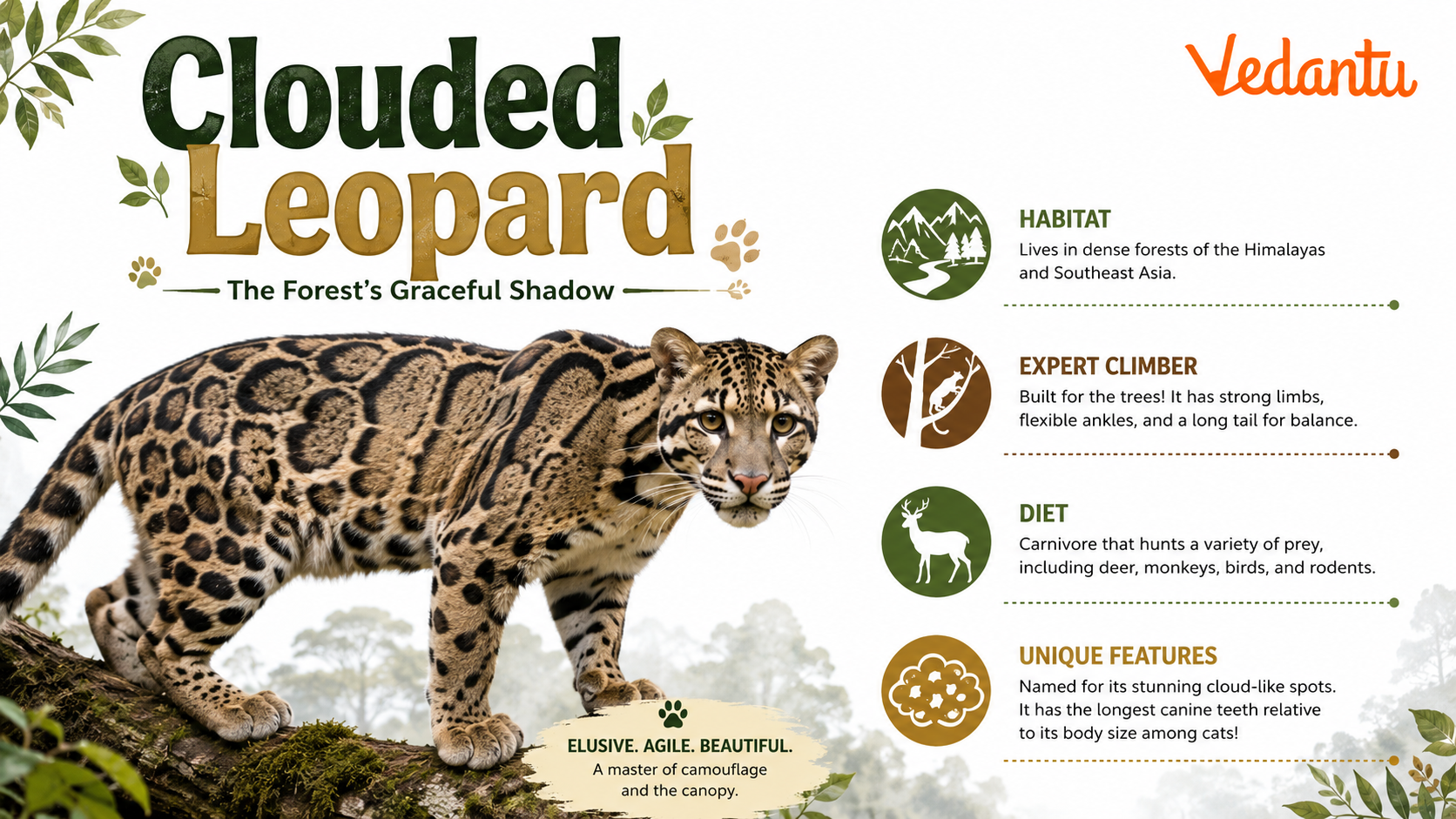
The clouded leopard (Neofelis) is a secretive, medium-sized wild cat native to the dense tropical and subtropical forests of South and Southeast Asia. Recognized for its cloud-patterned coat, flexible ankles for tree climbing, and exceptionally long canine teeth, the species holds a Vulnerable conservation status on the IUCN Red List due to habitat fragmentation and illegal poaching.
Disambiguation: Clouded Leopards vs. Leopard Cats
When researching Asian wild felids, common nomenclature often creates confusion between two distinct animals: the clouded leopard (Neofelis nebulosa and Neofelis diardi) and the leopard cat (Prionailurus bengalensis). While their common names sound similar, these species occupy vastly different ecological niches and taxonomic classifications.
Taxonomic Distinction:
- Genus Neofelis (Clouded Leopards)
- Neofelis nebulosa (Mainland Clouded Leopard)
- Neofelis diardi (Sunda Clouded Leopard)
- Genus Prionailurus (Leopard Cats)
- Prionailurus bengalensis (Mainland Leopard Cat)
The leopard cat is a small felid roughly the size of a domestic house cat (weighing between 2 and 4 kilograms). It has slender limbs, small round spots, and a wide distribution across East and South Asia. In contrast, the clouded leopard is a much larger, stockier predator weighing between 11 and 23 kilograms. It possesses broad, cloud-like blotches across its coat, an unusually long tail for balance, and specialized skull features that set it apart from all other living felines.
Taxonomists divided the clouded leopard into two distinct, extant species based on genetic and morphometric analyses:
- Mainland Clouded Leopard (Neofelis nebulosa): Inhabits continental Asia from the Himalayan foothills through Southeast Asia into southern China.
- Sunda Clouded Leopard (Neofelis diardi): Endemic to the Sunda Islands of Sumatra and Borneo, further split into two subspecies (N. d. diardi on Sumatra and N. d. borneensis on Borneo).
Evolutionary Anatomy and Key Biological Facts
Clouded leopards possess physical traits that make them unique among living felids. Often referred to as "modern saber-tooths," their cranial structure and musculoskeletal adaptations reflect an evolutionary design optimized for arboreal movement and powerful prey capture.
The Modern Saber-Tooth Configuration
Relative to its skull size, the clouded leopard has the longest canine teeth of any living carnivore. Its upper canines can reach 4 centimeters (1.6 inches) or longer, establishing a tooth-to-skull ratio comparable to extinct machairodontines (saber-toothed cats).
To utilize these elongated canines effectively, the clouded leopard can open its jaws to an angle of nearly 80 to 85 degrees. This gape angle is significantly wider than that of a domestic cat or a African lion. Their skull structure features an elongated snout and a shortened masseter muscle attachment, allowing deep, lethal bites to the back of the neck or throat of prey.
Anatomical Highlights:
- Relative Canine Length: Longest of any living felid relative to body size
- Maximum Jaw Gape: ~80–85 degrees
- Ankle Articulation: 180-degree hind-foot rotation for head-first descent
- Tail-to-Body Ratio: Tail length equals head-and-body length (up to 90 cm)
Specialized Locomotor Mechanics
Unlike most big cats, which are strictly terrestrial hunters, clouded leopards are highly adapted to life in the forest canopy. Their limbs are relatively short and stocky, lowering their center of gravity when moving across high branches. Their paws are exceptionally broad, fitted with specialized pads and retractable claws that provide a firm grip on wet bark.
A defining mechanical feature is the hyper-flexibility of their ankle joints. The hind ankles of a clouded leopard can rotate backward up to 180 degrees. This mobility allows the cat to:
- Descend vertical tree trunks head-first, similar to a squirrel.
- Hang upside-down from tree branches by its hind paws to strike prey below.
- Leap across gap distances in the forest canopy with high precision.
Its tail, which can measure up to 85 to 90 centimeters—nearly equal to the head-and-body length—acts as an essential counterweight during high-altitude balance maneuvers.
Pelage and Camouflage Mechanics
The striking coat pattern of the clouded leopard serves as disruptive camouflage within dappled forest light. The fur features large, dark-edged, dusky-grey or tawny blotches that resemble cloud formations. The interiors of these blotches are slightly darker than the background coat color, interspersed with small black spots along the legs, belly, and head.
In the Sunda species (Neofelis diardi), the coat is noticeably darker, with smaller, more tightly packed cloud patterns and darker central spots compared to its mainland relative.
Geographic Distribution and Preferred Habitat
Clouded leopards inhabit some of the most ecologically diverse yet threatened forest systems in Asia. Their historical range covered vast continuous forests, but contemporary distributions are increasingly fragmented.
Geographic Range Breakdown:
- Mainland Clouded Leopard (Neofelis nebulosa)
- South Asia: Nepal, Bhutan, Northeast India, Bangladesh
- Southeast Asia: Myanmar, Thailand, Laos, Cambodia, Vietnam, Southern China
- Sunda Clouded Leopard (Neofelis diardi)
- Sunda Islands: Sumatra, Borneo (Brunei, Indonesia, Malaysia)
Habitat Complexity and Elevation Ranges
Clouded leopards are habitat generalists within forested ecosystems, though they show a strong preference for dense, undisturbed primary vegetation. They occupy several distinct forest environments:
- Tropical Lowland Evergreen Rainforests: Primary habitat providing high canopy cover and abundant prey species.
- Montane Broadleaf and Coniferous Forests: Recorded at elevations exceeding 3,000 meters (9,800 feet) in the Himalayas of Nepal, Bhutan, and Northeast India.
- Secondary and Logged Forests: Capable of surviving in degraded or selectively logged forests if canopy connectivity and prey availability remain sufficient.
- Dry Deciduous and Scrub Forests: Found in drier areas of Thailand and Myanmar, though at significantly lower population densities.
- Coastal Mangrove Swamps: Frequently utilized in coastal regions of Borneo and Sumatra for hunting small mammals and aquatic prey.
Spatial Ecology and Home Ranges
Clouded leopards maintain large home ranges given their moderate body mass, reflecting their low density across landscapes. Radiotelemetry and camera-trap studies indicate home range sizes varying from 30 to over 100 square kilometers, depending on habitat quality and prey density. While highly arboreal for resting, hiding, and stalking, telemetry data demonstrates that clouded leopards perform much of their long-distance travel and hunting terrestrially along ridge lines, game trails, and abandoned logging roads.
Conservation Status and Population Trends
Both species of clouded leopard face persistent ecological pressures. According to global assessments by the IUCN Red List assessment for Neofelis nebulosa and the IUCN Red List assessment for Neofelis diardi, both wild cat species are classified as Vulnerable.
Conservation Metrics Summary:
- IUCN Status: Vulnerable (Neofelis nebulosa & Neofelis diardi)
- Global Adult Population: Estimated < 10,000 mature individuals per species
- Largest Single Subpopulation: < 1,000 mature adults
- CITES Status: Appendix I (International commercial trade prohibited)
- Overall Population Trend: Decreasing across all range states
Population Estimates and Fragmentation
Total global numbers are difficult to pinpoint due to the cat's secretive nature and dense habitat. However, wildlife researchers estimate that fewer than 10,000 mature individuals remain for either species worldwide. Crucially, no single subpopulation contains more than 1,000 mature adults, indicating severe genetic isolation and high vulnerability to local extinction events.
In Taiwan, the endemic subspecies (Neofelis nebulosa brachyura) was officially declared extinct after decades of extensive camera-trapping surveys failed to confirm a single living specimen.
Legal Protections
International frameworks strictly protect clouded leopards:
- CITES Appendix I: Listed under the CITES Appendices, which bans all international commercial trade in wild-caught specimens, skins, body parts, and derivatives.
- National Legislation: Fully protected under domestic wildlife laws across almost all range states, including India's Wildlife Protection Act, Malaysia's Wildlife Conservation Act, and Indonesia's Conservation Law. Enforcement capabilities, however, vary widely by region.
Comparative Analysis: Mainland vs. Sunda Clouded Leopard
The following table summarizes the key biological, geographic, and ecological differences between the two recognized species of clouded leopard:
| Feature / Metric | Mainland Clouded Leopard (Neofelis nebulosa) | Sunda Clouded Leopard (Neofelis diardi) |
|---|---|---|
| Geographic Range | South and Southeast Asian mainland (Nepal to Vietnam, south to Peninsular Malaysia) | Islands of Sumatra and Borneo |
| IUCN Red List Status | Vulnerable | Vulnerable |
| Coat Coloration & Pattern | Large, open, light-colored cloud blotches with pale yellow to tawny background | Smaller, darker, double-nested cloud blotches with dark grey/tawny background |
| Weight Range | 15–23 kg (33–50 lbs) | 12–26 kg (26–57 lbs) |
| Upper Canine Structure | Exceptionally long, laterally compressed, thin edges | Relatively shorter, thicker at base, rounded cross-section |
| Elevation Distribution | Sea level up to 3,500+ meters (Himalayan range) | Sea level up to ~2,000 meters (Sumatran Barisan range) |
| Primary Habitat | Primary broadleaf, evergreen, and montane forests | Lowland dipterocarp rainforests, peat swamps |
| Major Threats | Poaching for body parts, linear infrastructure, deforested agricultural land | Industrial palm oil conversion, commercial timber logging, forest fires |
Primary Threats to Clouded Leopard Survival
The continuous decline of clouded leopard populations stems from intersecting human activities. Addressing these threats requires coordinated conservation intervention across national borders.
Primary Survival Threats:
- Habitat Loss & Fragmentation (Palm oil, timber, agriculture)
- Targeted Illegal Wildlife Trade (Skins, bones, live pet trade)
- Prey Base Depletion (Human bushmeat hunting)
- Conflict & Infrastructure (Roadkill, retaliatory snaring)
Deforestation and Habitat Fragmentation
Forest destruction remains the most severe long-term threat to clouded leopards. In Southeast Asia, vast expanses of primary rainforest have been cleared for:
- Agricultural Expansion: Conversion of multi-layered natural forests into industrial monocultures, particularly oil palm and rubber plantations.
- Commercial Logging: Unsustainable timber extraction breaks continuous forest canopies, reducing cover and exposing cats to hunters.
- Linear Infrastructure: Highways, rail lines, and hydroelectric dams split continuous landscapes into small forest islands. Isolation prevents natural gene flow and increases vehicle collision mortalities.
When forest fragments shrink below a critical threshold, territorial requirements force felids into agricultural edges, bringing them into direct contact with human populations.
Illegal Wildlife Trade and Poaching
Clouded leopards are heavily targeted by commercial poaching operations supplying the illegal wildlife market.
- Pelts and Taxidermy: Their decorative skins command high prices on the black market for luxury decor and display items.
- Traditional Medicine: Bones, claws, and teeth are frequently traded as substitutes for tiger parts in traditional Asian medicinal preparations.
- Exotic Pet Trade: Cubs are occasionally captured illegally from killed mothers to supply unauthorized private collections and illegal exotic pet markets.
The widespread use of unselective wire snares set by poachers for bushmeat poses a severe passive threat, indiscriminate of species, maiming or killing clouded leopards traversing game trails.
Prey Base Depletion
Clouded leopards feed primarily on ungulates such as muntjac (barking deer), sambar deer, and chevrotains (mouse deer), as well as primates like macaques and langurs, and smaller mammals (beavers, porcupines, large rodents). Overhunting of wild ungulates by human communities for bushmeat starves predators out of otherwise suitable forest habitats, leading to lower reproduction rates and higher mortality.
Conservation Initiatives and Research Efforts
Protecting clouded leopards requires a mix of landscape-scale habitat protection, scientific monitoring, rigorous legal enforcement, and community integration.
Core Conservation Strategies:
- Protected Corridors (e.g., Heart of Borneo, Transboundary Asian Networks)
- Technological Monitoring (Camera trapping, acoustic sensing, DNA metabarcoding)
- Anti-Poaching Units (Snare sweeping, forest patrolling, border intercept)
- Certified Supply Chains (RSPO palm oil, FSC forestry standards)
Protected Area Networks and Landscape Corridors
Conservation organizations, including the World Wildlife Fund and national forest departments, focus on creating connected habitat corridors. Major initiatives include:
- Heart of Borneo Initiative: A transboundary conservation agreement between Brunei, Indonesia, and Malaysia designed to preserve 220,000 square kilometers of contiguous highland and lowland rainforest.
- Himalayan Eco-Corridors: Establishing protected forest corridors connecting reserves in Nepal, Bhutan, and Northeast India, allowing climate-induced altitude shifts and genetic migration.
Technological Advancements in Field Research
Because clouded leopards are elusive and nocturnal, traditional observation methods are ineffective. Researchers rely on advanced tools coordinated by institutions like the IUCN SSC Cat Specialist Group:
- Non-Invasive Camera Trapping: Automated motion-sensor cameras log spatial distribution, density estimates, and activity patterns without disturbing the animals.
- Environmental DNA (eDNA) and Scat Analysis: Field biologists collect fecal samples to analyze genetic diversity, dietary intake, and parasite loads.
- Satellite Telemetry: GPS collars attached to captured and released individuals map real-time movement corridors, identifying critical road crossings and human-use hot spots.
Field Monitoring Workflow:
- Camera Trap Deployment: Individual Identification via Pattern Recognition
- Non-Invasive Genetics: Fecal DNA Extraction & Population Profiling
- GPS Telemetry Tracking: Mapping Home Ranges & Landscape Corridors
Community Engagement and Snare Removal
Field programs increasingly emphasize local human involvement. Community patrol units, trained and funded by wildlife charities, conduct regular forest walks to locate and neutralize wire snares. Educational programs highlight the ecological role of clouded leopards as apex and mesopredators that control herbivore populations, keeping forest ecosystems healthy and balanced.
Actionable Steps for Wildlife Advocates and Supporters
Conserving threatened wild felids requires active participation from researchers, consumers, and conservation advocates globally.
Action Checklist:
- Verify Consumer Choices: Select RSPO-certified palm oil & FSC-certified timber
- Support Field Non-Profits: Donate directly to verified wild cat programs
- Advocate Policy Standards: Support global wildlife anti-trafficking laws
- Practice Responsible Ecotourism: Choose verified, community-led wildlife tours
- Demand Sustainable Sourcing: Reduce market drivers of deforestation by choosing products certified by the Roundtable on Sustainable Palm Oil (RSPO) and the Forest Stewardship Council (FSC).
- Directly Support Field Non-Profits: Support accredited felid conservation organizations that deploy anti-poaching patrols and restore natural corridors in range states.
- Promote Responsible Ecotourism: When visiting range countries (e.g., Sabah in Malaysian Borneo or national parks in Nepal), choose wildlife tour operators that employ local guides, respect animal welfare guidelines, and reinvest revenue directly into community conservation funds.
- Report Illegal Wildlife Goods: Never purchase real animal skins, teeth, or uncategorized bone products abroad, and report suspected illegal wildlife trade listings on digital platforms to local law enforcement or wildlife protection agencies.
Frequently Asked Questions
Are clouded leopards closely related to standard leopards?
Despite their shared common name, clouded leopards are not a subspecies or close genetic variant of the standard leopard (Panthera pardus). Standard leopards belong to the genus Panthera alongside lions, tigers, and jaguars. Clouded leopards belong to their own distinct evolutionary lineage, the genus Neofelis, which diverged from the ancestors of modern big cats over 6 million years ago.
How do clouded leopards climb down trees head-first?
Clouded leopards feature hyper-flexible hind ankle joints that can rotate backward up to 180 degrees. This unique skeletal articulation allows their hind paws to maintain a firm grip on tree trunks while their body faces downward, enabling them to walk down vertical trees head-first like a squirrel.
Why are clouded leopards called modern saber-toothed cats?
They earn this title because their upper canine teeth are exceptionally long relative to their skull size—longer than any other living cat species. Combined with an extraordinarily wide jaw gape of roughly 80 to 85 degrees, their cranial architecture mirrors adaptations seen in extinct saber-toothed cats like Smilodon.
What is the primary difference between a clouded leopard and a leopard cat?
The leopard cat (Prionailurus bengalensis) is a small wild cat roughly the size of a domestic cat (2–4 kg) with small dark spots. The clouded leopard (Neofelis) is a much larger predator (11–23 kg) defined by large, cloud-shaped blotches across its coat, an elongated skull, and exceptionally long canine teeth.
How many clouded leopards remain in the wild?
Exact numbers are difficult to count due to their camouflage and dense forest habitats, but experts estimate fewer than 10,000 mature adults remain for both Neofelis nebulosa and Neofelis diardi. No individual subpopulation contains more than 1,000 mature breeding individuals, contributing to their Vulnerable status on the IUCN Red List.
Recommended Next Steps for Research and Action
To deepen your understanding or actively participate in wild cat protection:
- Explore scientific publications and population status reports through the IUCN SSC Cat Specialist Group.
- Review field conservation updates and habitat preservation projects tracked by the World Wildlife Fund.
- Audit personal purchasing habits to eliminate uncertified forest products linked to Southeast Asian deforestation.