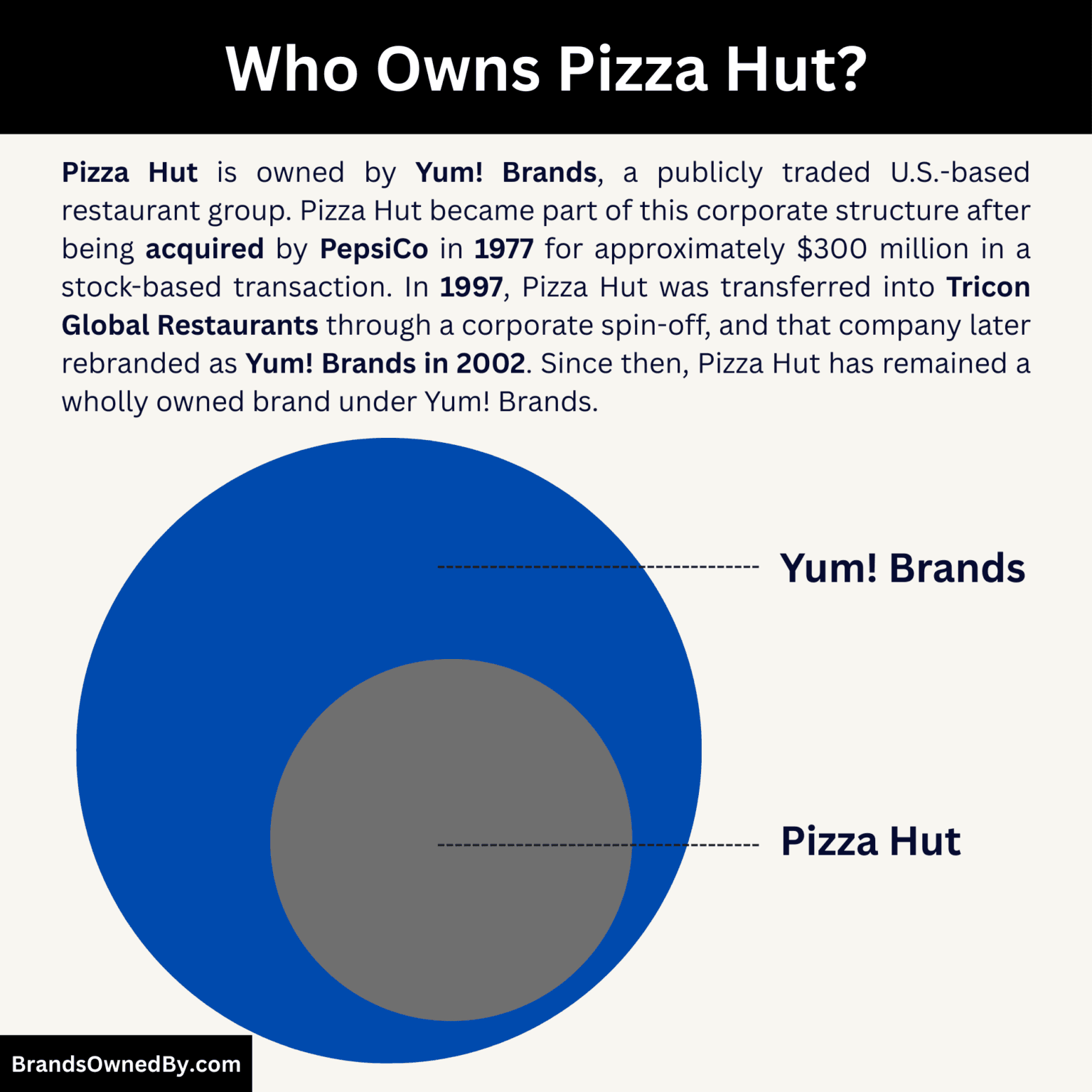
Pizza Hut is owned by Yum! Brands, Inc., a massive American multinational restaurant corporation that also operates other globally recognized fast-food chains including KFC, Taco Bell, and The Habit Burger Grill. Yum! Brands manages Pizza Hut as a subsidiary, overseeing its international franchising, corporate strategy, supply chain coordination, and overarching brand development across more than 100 countries.
Understanding the corporate architecture behind one of the world's largest pizza restaurant chains requires looking beyond the local storefronts. Most Pizza Hut locations are not owned directly by Yum! Brands; instead, they operate under complex franchise agreements managed by independent restaurant operators. This structure allows the parent company to focus on global marketing, intellectual property management, and corporate governance while delegating daily restaurant operations to specialized franchise groups.
The Parent Company: Yum! Brands, Inc.
The ultimate owner of Pizza Hut is Yum! Brands, Inc., a publicly traded corporation listed on the New York Stock Exchange under the ticker symbol YUM. Headquartered in Louisville, Kentucky, Yum! Brands ranks among the largest restaurant companies in the world by system sales and total unit count.
Yum! Brands was not always the corporate identity behind Pizza Hut. The chain's association with its current parent company stems from a historic corporate spin-off in the late 1990s. Today, Yum! Brands functions as an umbrella organization that provides financial backing, strategic direction, and technological infrastructure to its constituent brands while allowing each chain to maintain a distinct culinary identity and operational focus.
Brands Under the Yum! Umbrella
To understand the scale of ownership behind Pizza Hut, it is helpful to look at its corporate siblings. Yum! Brands manages a diverse portfolio of quick-service restaurant (QSR) concepts:
- KFC (Kentucky Fried Chicken): The world's leading chicken restaurant chain, specializing in fried chicken buckets, sandwiches, and sides.
- Pizza Hut: The global pizza restaurant and delivery chain known for its diverse crust styles and red-roof heritage.
- Taco Bell: A Mexican-inspired quick-service restaurant chain famous for tacos, burritos, and specialty items.
- The Habit Burger Grill: A fast-casual restaurant chain specializing in charbroiled burgers, acquired by Yum! Brands in 2020 to expand its footprint in the better-burger segment.
Historical Evolution: From Independent Start to Tricon and Yum!
Pizza Hut was founded in 1958 by two college students, brothers Dan and Frank Carney, in Wichita, Kansas. Armed with $600 borrowed from their mother, the pair opened a small, 25-seat restaurant that would eventually pioneer the modern pizza franchise model.
The PepsiCo Era (1977–1997)
As the brand expanded rapidly through franchising during the 1960s and early 1970s, the Carney brothers sought greater operational backing to fuel international growth. In 1977, PepsiCo, Inc. acquired Pizza Hut.
During the PepsiCo ownership era, Pizza Hut was grouped alongside other prominent acquisitions, including Taco Bell (acquired in 1978) and Kentucky Fried Chicken (acquired in 1986). PepsiCo's strategy at the time was to leverage its massive beverage distribution network to drive food sales across all three restaurant chains, securing captive accounts for Pepsi beverages.
Spin-Off into Tricon Global Restaurants (1997)
By the mid-1990s, managing a massive beverage empire alongside a sprawling restaurant portfolio proved strategically cumbersome. PepsiCo decided that the capital-intensive restaurant business required a separate, dedicated focus.
In October 1997, PepsiCo spun off its entire restaurant division into an independent, publicly traded company named Tricon Global Restaurants, Inc. This new corporate entity took ownership of Pizza Hut, Taco Bell, and KFC.
Rebranding to Yum! Brands (2002)
Tricon Global Restaurants officially changed its name to Yum! Brands, Inc. in May 2002, following its acquisition of Long John Silver's and A&W All-American Food Restaurants (both of which have since been sold off). The name change was designed to reflect a broader, more cohesive global corporate identity and to capitalize on the ticker symbol "YUM," which the company had used since its initial public offering.
Corporate Structure and Franchising Model
Yum! Brands does not directly operate the vast majority of Pizza Hut restaurants worldwide. Instead, it functions primarily as a franchisor. Understanding this distinction clarifies how corporate decisions translate into the customer experience at individual locations.
The Franchise System
Under the franchising model, Yum! Brands licenses the Pizza Hut brand, proprietary recipes, operational manuals, and marketing assets to independent business entities known as franchisees. In exchange, franchisees pay initial franchise fees, ongoing royalties (typically calculated as a percentage of gross sales), and contributions to national and regional advertising funds.
- Master Franchisees: In many international markets, Yum! Brands grants exclusive rights to large corporations or investment groups to develop and manage Pizza Hut restaurants across entire countries or regions.
- Domestic Franchise Groups: In the United States and other mature markets, large restaurant operating companies own and manage hundreds of individual Pizza Hut locations under portfolio agreements.
Operational Oversight by Yum! Brands
While franchisees manage day-to-day store-level operations, hiring, and local purchasing, Yum! Brands maintains strict quality control guidelines. The parent company dictates brand standards, food safety protocols, menu innovation pipelines, point-of-sale technology integrations, and national promotional campaigns.
| Corporate Entity / Level | Primary Responsibilities | Relationship to Pizza Hut |
|---|---|---|
| Yum! Brands, Inc. | Global strategy, trademark ownership, national marketing, R&D, corporate governance. | Ultimate Parent Corporation |
| Pizza Hut Division | Brand-specific management, culinary development, operational framework. | Direct Operating Subsidiary |
| Franchise Operators | Restaurant staffing, real estate leasing, local management, daily sales fulfillment. | Independent Licensees |
Major Franchise Partners: NPC International and Beyond
Because Pizza Hut relies heavily on large-scale franchisees, the financial health and corporate restructuring of these partner organizations directly impact the brand's footprint. A prime example is the history of NPC International.
For decades, NPC International operated as the largest franchisee of Pizza Hut in the United States, managing over 1,000 Pizza Hut restaurants across multiple states. However, changing consumer preferences, high debt loads, rising labor costs, and operational disruptions stemming from the COVID-19 pandemic placed severe financial pressure on the company.
In July 2020, NPC International filed for Chapter 11 bankruptcy protection. This development prompted Yum! Brands to step in with restructuring agreements and work alongside creditors and bankruptcy courts to ensure continuity. Ultimately, Yum! Brands and various independent investors facilitated the acquisition and re-franchising of NPC's Pizza Hut locations to new, well-capitalized restaurant operators. This event underscored the structural separation between Yum! Brands (the intellectual property owner) and its operating franchisees (the asset holders).
Financial Performance and Shareholder Structure
As a publicly traded corporation on the New York Stock Exchange (NYSE: YUM), Yum! Brands is owned by thousands of individual retail shareholders and large institutional investment firms. Major institutional shareholders—such as Vanguard Group, BlackRock, and State Street Corporation—collectively hold significant portions of the company's voting stock.
Revenue Streams
Yum! Brands generates revenue primarily through three channels across its brand portfolio:
- Franchise Fees and Royalties: Regular payments from franchisees for the right to use the Pizza Hut brand name and operational systems.
- Company-Owned Restaurant Sales: Revenue generated from the relatively small percentage of corporate-owned restaurants that Yum! Brands retains for testing new concepts and operational procedures.
- Property Leases: Income derived from owning or master-leasing real estate sites and subleasing them to franchisees.
Frequently Asked Questions
Does PepsiCo still own Pizza Hut?
No. While PepsiCo acquired Pizza Hut in 1977, it spun off its entire restaurant division in 1997 into an independent company called Tricon Global Restaurants, which later became Yum! Brands. However, PepsiCo maintains deep commercial relationships with Yum! Brands, supplying soft drinks to Pizza Hut locations worldwide through long-term pouring rights agreements.
Who founded Pizza Hut?
Pizza Hut was founded in June 1958 by brothers Dan and Frank Carney in Wichita, Kansas. The pair started the business with a borrowed $600 and expanded it into a global enterprise before selling it to PepsiCo in 1977.
Are all Pizza Hut restaurants owned by Yum! Brands?
No. Yum! Brands operates primarily as a franchisor. The vast majority of Pizza Hut locations worldwide are owned and operated by independent franchise businesses and large restaurant management groups under license agreements.
Where is the headquarters of Pizza Hut?
While Yum! Brands is headquartered in Louisville, Kentucky, Pizza Hut maintains its own dedicated brand headquarters in Plano, Texas, where its executive team, culinary development kitchen, and marketing divisions operate.
Can individuals buy a Pizza Hut franchise?
Yes, though entering the Pizza Hut franchise system requires meeting stringent financial qualifications, restaurant management experience, and capital requirements established by Yum! Brands. Due to the consolidation of large franchise groups, new single-unit franchise opportunities are often limited compared to multi-unit development agreements.
Summary and Next Actions
Pizza Hut is owned by Yum! Brands, Inc., a publicly traded global restaurant company that also manages KFC, Taco Bell, and The Habit Burger Grill. While Yum! Brands owns the intellectual property, recipes, and global brand strategy, daily operations are largely handled by independent franchise partners.
If you are researching Pizza Hut for investment analysis, reviewing the quarterly earnings reports and SEC filings of Yum! Brands (NYSE: YUM) provides official financial data regarding system-wide sales, unit growth, and profitability. For career inquiries, franchise applications, or customer service inquiries, consult the official corporate websites for Yum! Brands or Pizza Hut directly.