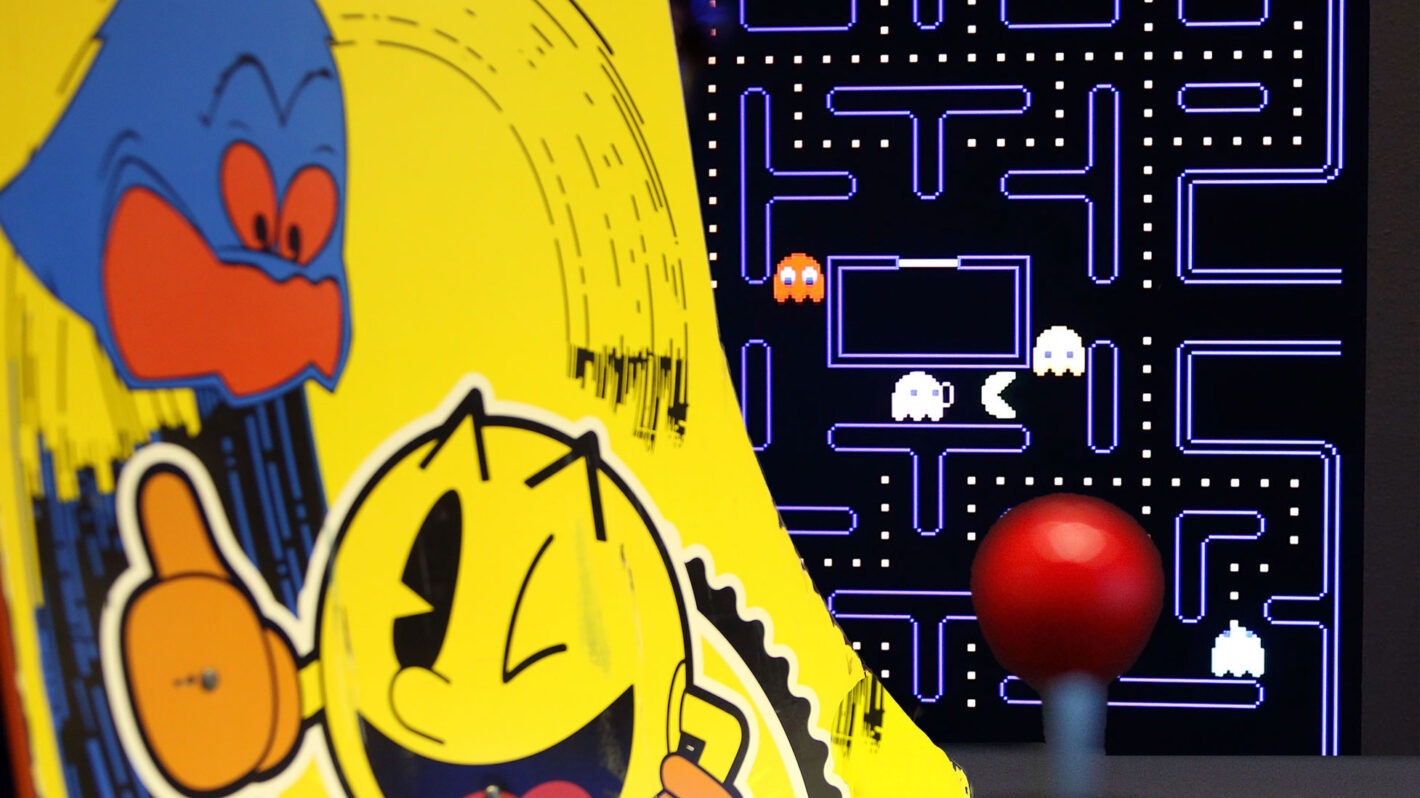
Toru Iwatani conceived Pac-Man to steer the arcade industry away from violent alien-shooting games toward a universally appealing experience centered around eating. Released by Namco in 1980, the game transformed popular culture through character-driven design, vibrant colors, and accessible mechanics that engaged both male and female players equally.
Introduction to the Golden Age of Arcades and the Genesis of Pac-Man
The coin-operated video game industry in the late 1970s and early 1980s was dominated by a singular genre: space combat. Following the monumental success of Taito's Space Invaders in 1978, arcades filled with dark, monochromatic, or low-color cabinets where players blasted descending hordes of aliens, asteroids, and enemy ships. While profitable, this environment fostered a distinct subculture. Arcades were frequently perceived as intimidating, smoke-filled spaces dominated by teenage boys.
Enter Toru Iwatani, a young game designer at Nakamura Manufacturing (later known as Namco) who envisioned a radically different type of interactive entertainment. Iwatani wanted to create a game that could be enjoyed by everyone—couples, children, and women who typically avoided the aggressive themes of shooters. His philosophy was rooted in the concepts of fashion, humor, and lifestyle rather than destruction.
The resulting creation, originally named Puck-Man before its international transition, defied every convention of its era. It featured no weapons, no score metrics tied to killing, and no villains with explicit malice. Instead, it introduced a vibrant yellow circle navigating a maze, consuming dots, and fleeing from colorful ghosts. This deliberate shift in design philosophy not only birthed an arcade legend but permanently altered the trajectory of interactive media.
Who Was Toru Iwatani? Background and Entry Into Namco
Toru Iwatani was born in Tokyo, Japan, in 1955. From an early age, he exhibited a keen fascination with design, mechanics, and amusement park attractions. Unlike many early game developers who transitioned from computer science or engineering backgrounds, Iwatani entered the industry with a focus on visual appeal and interactive psychology.
In 1977, at the age of 22, Iwatani joined Namco. At the time, Namco was transitioning from operating mechanical amusement rides and pinball machines to developing electronic video games. Iwatani's early projects at the company included pinball-style arcade titles and basic digital games, which allowed him to master the technical limitations and structural possibilities of early microprocessors.
Working during the nascent phase of video game development required designers to act as total creators. Iwatani conceptualized game rules, mapped out hardware logic, designed characters, and even considered cabinet aesthetics. This holistic approach gave him a rare understanding of how players interacted physically and emotionally with an arcade cabinet. By 1979, having gained confidence and industry experience, Iwatani set out to design a game that would break the mold of the prevailing shooter trend.
The Conception and Inspiration: Eating, Pizza, and Cultural Roots
The creative spark behind Pac-Man is one of the most famous anecdotes in video game history, though it is frequently oversimplified. The primary inspiration came from a fundamental human activity: eating. Iwatani observed that while shooting games appealed primarily to a niche demographic, concepts centered around eating, fashion, and relationships possessed universal appeal.
The iconic visual design of the protagonist was famously inspired by a pizza with a single slice removed. In Japanese, the concept of eating is expressed by the onomatopoeic word paku-paku, describing the sound of a mouth opening and closing. This linguistic foundation led to the game's original Japanese title, Puck-Man, derived from pakupaku taberu.
- Japanese Onomatopoeic: Paku-Paku
- Original Title: Puck-Man
- Global Release: Pac-Man
Beyond food, Iwatani drew inspiration from traditional maze structures and Tag-style children's playground games. He wanted to design a system where a single player could experience the thrill of being pursued while retaining clear escape routes. The objective was not to annihilate the pursuers, but to outsmart them through spatial awareness, pattern recognition, and tactical cornering.
Design Philosophy: Crafting a Game for Everyone
Iwatani’s core design pillar was universal accessibility. At a time when arcade games rewarded technical reflexes and violent execution, Pac-Man introduced a system built on three foundational pillars:
- Non-Violent Mechanics: The objective was consumption and survival, replacing explosions and casualties with cheerful sound effects and colorful graphical cues.
- Demographic Inclusivity: By focusing on bright, friendly visuals and straightforward controls—a single four-way directional joystick—the game welcomed players of all ages and genders.
- Strategic Depth Beneath Simplicity: While a child could understand the game within seconds, mastering the intricate movement patterns of the ghosts required high-level cognitive engagement.
This philosophy extended to the physical cabinet design. Namco and its international distributor, Bally Midway, manufactured upright cabinets with brightly colored side art that stood out in crowded arcades. The interface stripped away complex button layouts, ensuring that first-time players felt no intimidation when approaching the machine.
The Anatomy of the Game: Mazes, Dots, and the Four Ghosts
At its technical core, Pac-Man operates on a precise grid system powered by early 8-bit architecture. The playfield consists of a single continuous maze containing 240 small dots and four larger "Power Pellets." The primary objective is clearing the maze of dots while avoiding four distinct ghost characters.
Character Design and Artificial Intelligence
The ghosts are not mindless drones; each possesses a distinct algorithmic personality that dictates its movement through the maze. Iwatani deliberately programmed unique behaviors for each ghost to create a dynamic, unpredictable challenge without relying on raw random number generation.
- Binky (Red - Shadow): Aggressively pursues Pac-Man directly, tracking his coordinates across the maze.
- Pinky (Pink - Speedy): Attempts to anticipate Pac-Man's movements by targeting spaces ahead of his current direction.
- Inky (Cyan - Bashful): Utilizes a complex vector calculation based on both Pac-Man's position and the red ghost's location, making his movements appear erratic.
- Clyde (Orange - Pokey): Wanders toward Pac-Man when close, but retreats to his corner when he gets too near, acting with apparent cowardice.
| Ghost Name | Color & Traditional Nick | Behavioral Algorithm Summary |
|---|---|---|
| Blinky | Red (Shadow) | Direct pursuit of player position |
| Pinky | Pink (Speedy) | Ambushes ahead of player path |
| Inky | Cyan (Bashful) | Flanking movement using vectors |
| Clyde | Orange (Pokey) | Alternates pursuit and retreat |
When Pac-Man consumes a Power Pellet, the game state temporarily inverts. The ghosts turn blue, reverse direction, and become vulnerable to being eaten. This mechanic introduces a risk-reward dynamic, transforming the hunter into the hunted for a brief window.
The Global Phenomenon and Cultural Impact
Released in Japan in May 1980 and distributed internationally by Bally Midway later that year, Pac-Man rapidly transcended the arcade industry to become a defining cultural icon of the 20th century.
The game sparked "Pac-Mania," generating billions of dollars in revenue and permeating mainstream media. Within a few years, the character appeared on cereal boxes, lunchboxes, t-shirts, and television screens. A Saturday morning animated series produced by Hanna-Barbera debuted in 1982, further cementing the character's status in households that had never set foot in an arcade.
Furthermore, Pac-Man popularized the concept of video game merchandising. Prior to 1980, arcade games rarely spawned branded consumer goods outside of the cabinets themselves. Pac-Man proved that interactive characters could sustain a standalone entertainment brand, paving the way for future franchises like Mario, Sonic, and Pokémon.
Overcoming Challenges: From Puck-Man to Pac-Man
The journey to global success was not without friction. Most notably, the original title Puck-Man faced an immediate and obvious vulnerability upon its introduction to North American markets: vandalism.
Industry executives realized that replacing the letter "P" with an "F" on the marquee and cabinet bezel was an inevitability for mischievous arcade-goers. To prevent widespread obscenity in public arcades, Bally Midway requested a formal name change before the North American launch. Iwatani and Namco agreed to alter the name to Pac-Man, ensuring the title remained family-friendly while retaining its phonetic roots.
Additionally, technical constraints of the era required immense ingenuity. Iwatani and his small development team of roughly nine people had to optimize code to run within stringent memory limitations, utilizing custom hardware chips that Namco developed specifically to handle sprite movement and collision detection smoothly.
The Legendary "Split-Screen" Bug: Level 256
One of the most famous technical artifacts in arcade history is the Level 256 bug in the original Pac-Man. Because the game was programmed to handle up to 255 levels, reaching the 256th stage triggered an integer overflow error in the internal subroutine responsible for drawing the fruit counters at the bottom of the screen.
When the game attempted to render 256 items, the memory register corrupted the right half of the playfield into an incomprehensible jumble of random characters, numbers, and misplaced walls. This made completion of the level mathematically impossible under normal play conditions. For decades, arcade champions studied and attempted to beat "Split-Screen" Pac-Man, turning a software glitch into a legendary milestone of competitive gaming culture.
Toru Iwatani’s Later Career and Legacy
Following the release of Pac-Man, Toru Iwatani continued working at Namco for decades. He contributed to numerous other arcade titles, including Pole Position (providing advisory design support), Libble Rabble, and Ridge Racer. Despite creating one of the most lucrative entertainment properties in history, Iwatani remained a humble corporate employee, receiving a standard salary rather than royalty-based wealth during the peak of Pac-Man's arcade dominance.
In later years, Iwatani transitioned into academia. He joined Tokyo Polytechnic University as a professor, teaching game design, interactive theory, and digital media production to the next generation of developers. He formally announced his retirement from active game development in 2007, though he continues to lecture and participate in retrospective industry events worldwide.
Iwatani's legacy is defined by a singular realization: that video games could communicate warmth, humor, and universal joy. By abstracting human social dynamics into a simple maze of dots and ghosts, he crafted an enduring masterpiece that remains as playable and culturally resonant today as it was in 1980.
Frequently Asked Questions
Why did Toru Iwatani design Pac-Man to be non-violent?
Iwatani wanted to create a game that appealed to a broader demographic than the male-dominated shooter audience of the late 1970s. By centering the gameplay on eating, exploration, and evasion rather than military destruction or alien combat, he built an experience that welcomed women, couples, and children into arcades.
What was the original name of Pac-Man before its release in North America?
The game was originally titled Puck-Man in Japan, derived from the Japanese onomatopoeic term paku-paku, which describes the sound of a mouth opening and closing. The name was changed for North American distribution by Bally Midway to prevent easy vandalism of the cabinet marquees.
How do the four ghosts in Pac-Man move?
Each ghost—Blinky, Pinky, Inky, and Clyde—runs on a distinct software algorithm. Rather than moving randomly, they each utilize unique behavioral rules regarding target tracking, spatial anticipation, and flanking vectors to challenge the player cooperatively.
What causes the Level 256 bug in Pac-Man?
The bug is caused by an 8-bit integer overflow. The game's memory counter for storing the current level number could only count up to 255. When a player reached level 256, the routine responsible for drawing fruit icons overloaded the display memory, rendering the right side of the screen an unplayable glitch.
Did Toru Iwatani become a billionaire from creating Pac-Man?
No. Iwatani was a salaried employee at Namco when he created Pac-Man. While he received internal recognition and career advancement within the company, he did not receive direct individual royalties from the massive global merchandise and arcade revenue generated by the game.