The 25th Amendment to the United States Constitution establishes the formal procedures for replacing the President or Vice President in the event of death, resignation, removal, or incapacitation. Ratified in 1967, it clarifies that the Vice President becomes President upon a vacancy and provides a mechanism for filling a Vice Presidential opening while defining how to manage a President’s inability to serve.
For nearly two centuries, the United States operated under a constitutional ambiguity regarding what precisely happened when a President could no longer fulfill their duties. While Article II, Section 1, Clause 6 of the Constitution provided a vague framework for succession, it failed to specify whether the Vice President became the "President" in title or merely an "Acting President." Furthermore, it offered no guidance on what to do if a President was alive but mentally or physically unable to govern. The 25th Amendment was designed to resolve these dangerous uncertainties, ensuring the continuity of government during times of national crisis.
The Historical Necessity of the 25th Amendment
To understand the 25th Amendment, one must look at the historical "crises of succession" that preceded its ratification. Before 1967, the Vice Presidency remained vacant 16 times because there was no constitutional mechanism to fill the office between elections. When William Henry Harrison died in 1841, John Tyler asserted that he was the President, not merely an interim administrator. While this "Tyler Precedent" held, it was never codified into law, leading to recurring debates during subsequent presidential deaths.
The most pressing concern, however, was presidential disability. In 1881, James A. Garfield lingered for 80 days after being shot before succumbed to his wounds; during this time, the government was largely leaderless. In 1919, Woodrow Wilson suffered a massive stroke that left him incapacitated for the remainder of his term, during which his wife and doctors effectively managed the executive branch without constitutional authority. Later, Dwight D. Eisenhower’s various health scares in the 1950s prompted informal agreements with Vice President Richard Nixon, but these lacked the force of law.
The assassination of John F. Kennedy in 1963 served as the final catalyst. With the advancement of the Cold War and the reality of nuclear weapons, the prospect of a President being alive but unable to make split-second decisions became an unacceptable risk. Congress proposed the 25th Amendment in 1965, and it was ratified by the states on February 10, 1967.
Section 1: Presidential Succession
Section 1 is the most straightforward portion of the amendment. It states: "In case of the removal of the President from office or of his death or resignation, the Vice President shall become President."
This section formally codified the Tyler Precedent. It removed any legal doubt that the Vice President does not just take over the "powers and duties" of the office but actually assumes the title of President of the United States. This distinction is vital for the legitimacy of executive orders, the signing of legislation, and the commander-in-chief's authority over the military.
In 2026, looking back at the application of Section 1, the most notable instance remains the 1974 resignation of Richard Nixon. Upon Nixon's departure, Gerald Ford was immediately sworn in as the 38th President. This transition demonstrated the amendment’s power to provide a seamless transfer of authority without a national election or a legislative vacuum.
Section 2: Filling a Vice Presidential Vacancy
Before the 25th Amendment, if a Vice President died or moved up to the Presidency, the Vice Presidency stayed empty until the next general election. Section 2 addresses this by stating: "Whenever there is a vacancy in the office of the Vice President, the President shall nominate a Vice President who shall take office upon confirmation by a majority vote of both Houses of Congress."
This section ensures that the line of succession remains robust. It requires a two-step process:
- Presidential Appointment: The President selects a nominee.
- Bicameral Confirmation: Unlike most presidential appointments which only require Senate approval, a new Vice President must be confirmed by a majority in both the House of Representatives and the Senate.
This procedure has been used twice. First, in 1973, when Vice President Spiro Agnew resigned, President Nixon nominated Gerald Ford. Second, when Ford became President in 1974, he nominated Nelson Rockefeller to be his Vice President. This remains a critical check and balance, ensuring that a person who was not elected to the executive branch by the people still receives the mandate of the people's representatives in Congress.
Section 3: Voluntary Transfer of Power
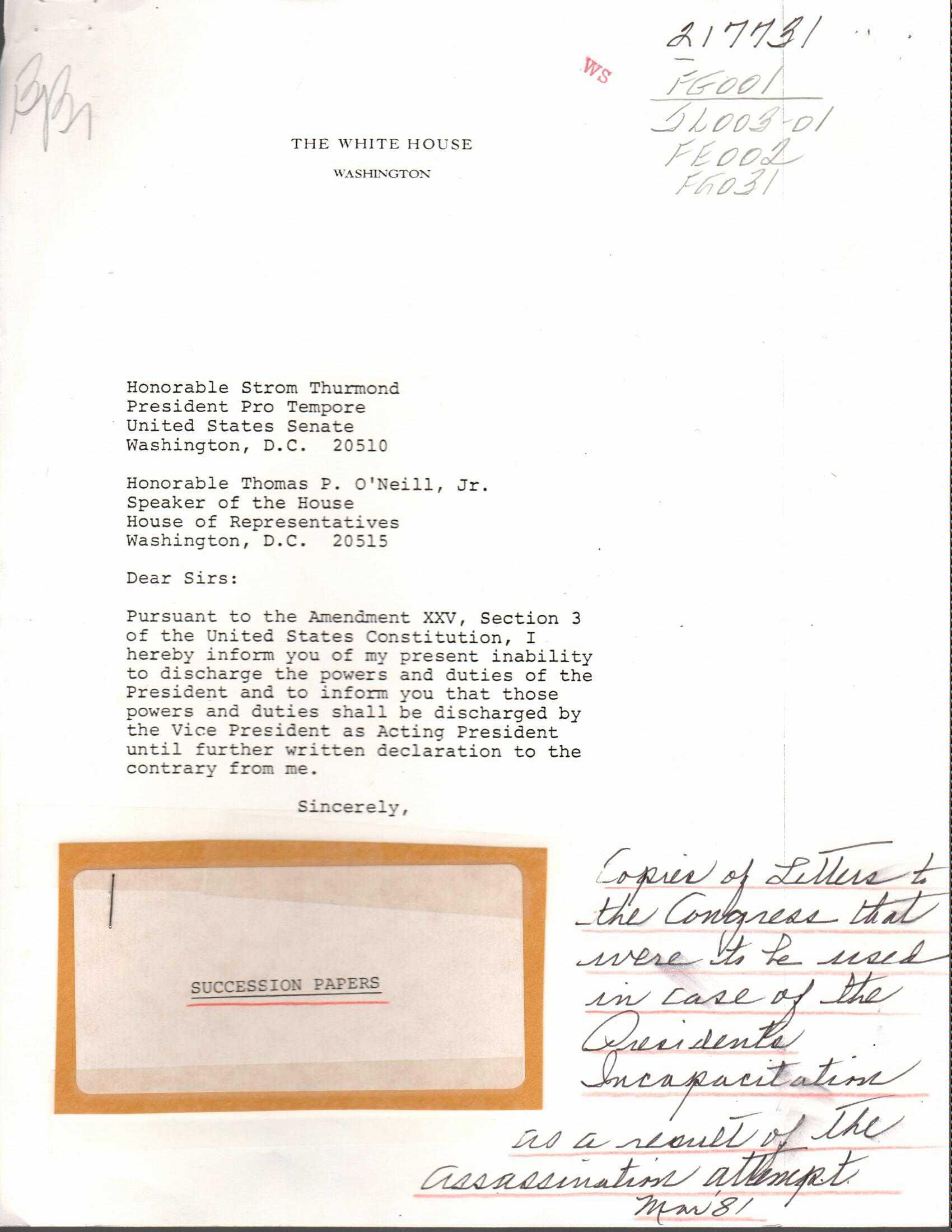
Section 3 provides a mechanism for the President to voluntarily and temporarily relinquish power. This usually occurs when a President undergoes a medical procedure involving anesthesia or any condition that impairs their cognitive function.
The Process for Voluntary Transfer:
- The President sends a written declaration to the President pro tempore of the Senate and the Speaker of the House of Representatives.
- The declaration states that the President is unable to discharge the powers and duties of the office.
- The Vice President immediately becomes Acting President.
- When the President is ready to resume duties, they send a second written declaration to the same congressional leaders.
This section has been invoked several times for routine medical reasons. For example, President Ronald Reagan invoked it in 1985 for colon surgery, and President George W. Bush invoked it twice (2002 and 2007) for colonoscopies. In 2021, President Joe Biden briefly transferred power to Vice President Kamala Harris while undergoing a medical procedure. These instances show the amendment's practical utility in maintaining a clear chain of command even for short durations.
Section 4: Involuntary Transfer of Power and Disability
Section 4 is the most complex and controversial part of the 25th Amendment. It has never been fully invoked, but it serves as the ultimate "safety valve" if a President is unable or unwilling to acknowledge their own incapacity.
The Initiation Process
Power can be transferred involuntarily if the Vice President and a majority of the "principal officers of the executive departments" (the Cabinet) notify the leaders of Congress in writing that the President is "unable to discharge the powers and duties of his office." Upon this notification, the Vice President immediately becomes Acting President.
The Dispute Mechanism
The 25th Amendment allows the President to contest the finding of disability. If the President issues a written declaration stating that no disability exists, they resume their powers. However, the Vice President and the Cabinet then have four days to submit a counter-declaration.
If a counter-declaration is submitted, the issue moves to Congress:
- The Timeline: Congress must assemble within 48 hours if not in session.
- The Vote: Congress has 21 days to decide the issue.
- The Threshold: A two-thirds vote in both the House and the Senate is required to maintain the Vice President as Acting President. If the vote fails to reach this supermajority, the President resumes their duties.
Section 4 is designed to be difficult to execute to prevent it from being used as a "legal coup" or a political tool to remove a President for unpopularity rather than actual disability. The high bar of a two-thirds vote—higher than the simple majority required for impeachment in the House—reflects the gravity of overturning an election result.
Comparison of 25th Amendment Procedures
The following table summarizes the different applications of the 25th Amendment to help clarify when each section is relevant.
| Feature | Section 1 | Section 2 | Section 3 | Section 4 |
|---|---|---|---|---|
| Primary Trigger | President dies, resigns, or is removed. | Vice Presidency becomes vacant. | President voluntarily declares disability. | VP and Cabinet declare President disabled. |
| Immediate Result | VP becomes President. | President nominates a new VP. | VP becomes Acting President. | VP becomes Acting President. |
| Role of Congress | No immediate role; automatic. | Confirmation by majority in both Houses. | Notification only (Speaker/Pro Tem). | Adjudication if the President disagrees (2/3 vote). |
| Status of President | Office is permanently vacated. | President remains in office. | President is temporarily "Acting" out of power. | President is temporarily "Acting" out of power. |
| Resumption of Power | N/A (New President takes over). | N/A | President sends written notice of recovery. | President sends notice; VP/Cabinet can dispute. |
Legal and Ethical Considerations
The 25th Amendment is often discussed in the context of "incapacity," but the Constitution does not define what that term means. This ambiguity is intentional, allowing for flexibility in the face of varying medical or psychological conditions. Legal scholars generally agree that "inability" covers physical illness, mental health crises, or even a scenario where the President is kidnapped or missing.
However, Section 4 remains a point of intense debate. Because it relies on the "principal officers of the executive departments," there is a question of who exactly qualifies. Generally, this refers to the 15 heads of the executive departments (e.g., State, Treasury, Defense). If the President were to fire the Cabinet before they could sign the declaration, a constitutional crisis could ensue. Furthermore, the amendment allows Congress to designate an "other body" by law to replace the Cabinet in this process, though Congress has never done so.
Frequently Asked Questions
Can the 25th Amendment be used to remove a President for "unfitness"?
Technically, the amendment is about "inability," not "unfitness." While political opponents may argue that poor decision-making constitutes unfitness, the legislative history of the amendment suggests it was intended for medical, mental, or physical incapacity. Removing a President for policy reasons or political disagreements is the purpose of the impeachment process (Article I), not the 25th Amendment.
Who is the "Other Body" mentioned in Section 4?
Section 4 mentions that the Vice President can act with the Cabinet or "such other body as Congress may by law provide." Congress has the power to create a permanent commission—perhaps made up of medical experts or former officials—to determine presidential disability. Although several bills have been introduced over the decades to establish such a body, none have become law.
How does the 25th Amendment differ from the Presidential Succession Act?
The 25th Amendment deals specifically with the Vice President’s role and filling the Vice Presidency. The Presidential Succession Act of 1947 establishes the line of succession after the Vice President, starting with the Speaker of the House, then the President pro tempore of the Senate, and then the Cabinet secretaries in the order their departments were created.
Can the Vice President be removed using the 25th Amendment?
No. The 25th Amendment provides for the filling of a Vice Presidential vacancy, but it does not provide a mechanism for the President to "fire" or remove a Vice President for disability. A Vice President can only be removed from office through impeachment by the House and conviction by the Senate.
Has Section 4 ever been used?
No, Section 4 has never been formally invoked. There were discussions about its use during the Reagan administration following the 1981 assassination attempt and during the final days of various administrations experiencing political turmoil, but the high legal threshold and the requirement for Vice Presidential participation have prevented its application.
Professional Guidance and Next Actions
The 25th Amendment is a vital component of American constitutional law, ensuring that the United States never faces a period of "headless" government. For students of law, political science, or civic history, the next step is to examine the specific congressional records from 1965 to understand the intent of the framers, particularly Senator Birch Bayh, who was the primary architect of the amendment.
If you are researching the legal stability of the executive branch, it is also recommended to study the Office of Legal Counsel (OLC) opinions regarding presidential disability. These documents provide the executive branch's internal interpretations of how these procedures would be carried out in a real-time crisis. Understanding the interplay between the 25th Amendment and the 20th Amendment (which covers the start of terms and death before inauguration) provides a complete picture of American executive continuity.