The 2013 MTV Video Music Awards performance featuring Miley Cyrus and Robin Thicke stands as one of the most culturally disruptive, widely discussed, and heavily analyzed pop culture events of the 21st century. Held on August 25, 2013, at the Barclays Center in Brooklyn, New York, the collaborative medley of "We Can't Stop" and "Blurred Lines" triggered an immediate, massive surge in global digital engagement, redefining the trajectory of pop music aesthetics and media commentary.
Introduction to the 2013 MTV Video Music Awards Cultural Phenomenon
To understand why the 2013 MTV Video Music Awards (VMAs) remain etched in modern entertainment history, one must examine the intersection of career reinvention, live television, and the nascent era of rapid social media virality. For years, Miley Cyrus had been universally recognized as the wholesome star of the Disney Channel series Hannah Montana. By 2013, at the age of 20, she was actively orchestrating a radical, high-stakes transition into an independent adult recording artist, anchored by her upcoming fourth studio album, Bangerz.
The VMAs served as the ultimate canvas for this transformation. What transpired on stage over a span of approximately four minutes was not merely a pop music medley, but a carefully engineered spectacle that divided public opinion, overwhelmed Twitter servers, and sparked intense academic, feminist, and media critiques. This examination explores the anatomy of that evening, breaking down the specific moments that captured the world's attention, the cultural reactions that followed, and the lasting legacy of a performance that changed how the music industry approaches live television events.
The Lead-Up: Transitioning from Disney Icon to Independent Pop Force
The foundation for the 2013 VMA performance was laid months in advance through strategic musical and visual choices. In May 2013, Cyrus released "We Can't Stop," a trap-pop and R&B-infused single produced by Mike Will Made-It. The track signaled an abrupt departure from her country-pop and mainstream pop roots, embracing themes of hedonism, youth counterculture, and personal autonomy.
Timeline of Cyrus's 2013 Transition: 1. May 2013: Release of "We Can't Stop" single and controversial music video. 2. August 2013: Announcement of performance lineup for the 2013 MTV VMAs in Brooklyn. 3. August 25, 2013: Live broadcast of the VMAs performance featuring Robin Thicke. 4. August–October 2013: Global media fallout, social media records, and album rollout for "Bangerz".
Concurrently, Robin Thicke’s "Blurred Lines" was dominating global music charts as the song of the summer, holding the number one spot on the Billboard Hot 100. Pairing Cyrus with Thicke for a collaborative segment at the VMAs seemed like a standard mainstream pop pairing on paper, but the execution bypassed conventional pop tropes entirely, leaning heavily into provocation and avant-garde performance art aesthetics.
Anatomy of the Performance: Key Moments on Stage
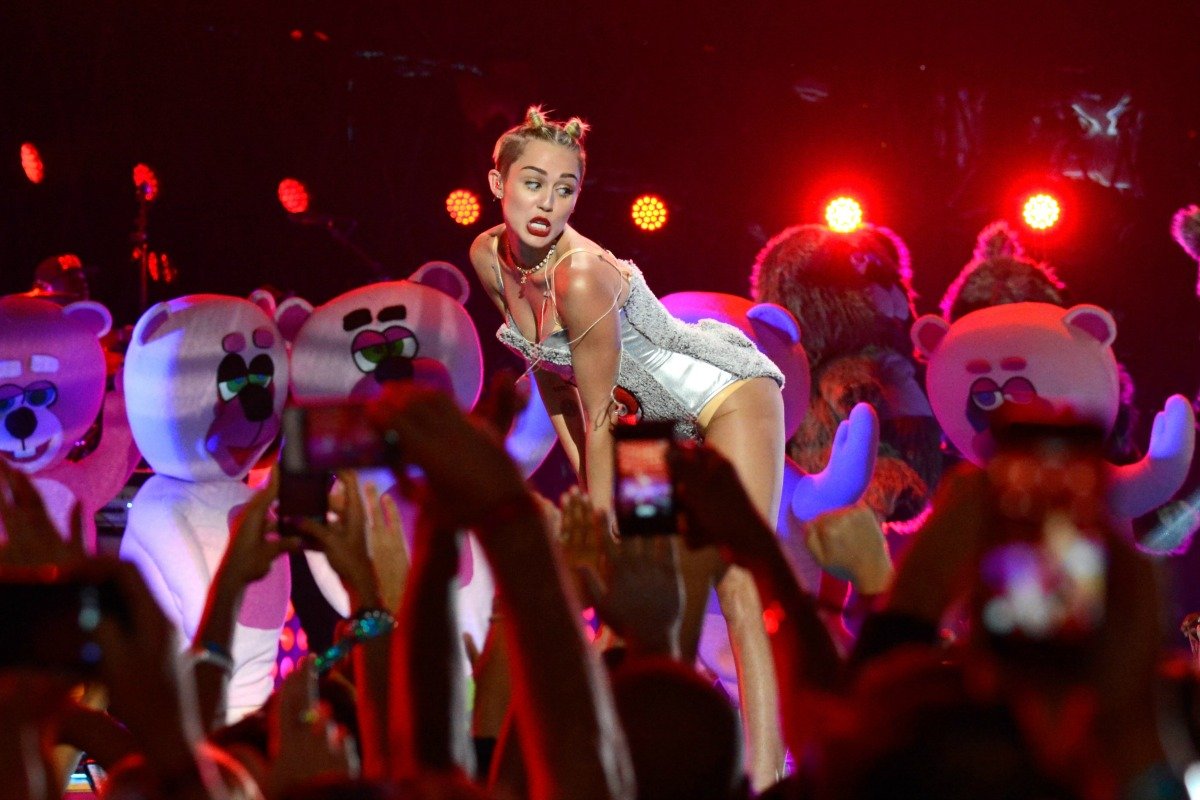
The segment began with Cyrus rising from a stage prop shaped like a giant, grinning teddy bear, wearing a furry, cartoon-bear-themed one-piece leotard. As she sang "We Can't Stop," she stripped down to a flesh-toned, two-piece latex bikini, altering her visual presentation from playful childhood nostalgia to provocative adult materiality.
The performance evolved through several distinct phases:
- The Solo Intro: Cyrus performed "We Can't Stop" alongside a troupe of background dancers dressed as oversized teddy bears and cartoon characters, utilizing exaggerated props, hand gestures, and dance styles derived in part from the underground "twerking" subculture.
- The Transition: As the music shifted into Robin Thicke’s "Blurred Lines," Thicke entered the stage wearing a striped suit reminiscent of Beetlejuice. The interaction between Thicke and Cyrus immediately shifted the dynamic of the stage.
- The Prop Integration: Cyrus utilized a giant foam finger, engaging in suggestive choreography with Thicke that played heavily on contrasting aesthetics—Thicke's slicked-back, lounge-singer persona versus Cyrus's uninhibited, punk-pop physicality.
- The Climax: The performance concluded with Cyrus continuing her high-energy choreography alongside her dancers while Thicke interacted with the audience and remaining cast members, leaving the live studio audience and millions of viewers at home in a state of visible shock.
Immediate Cultural Fallout and Digital Metrics
The immediate reaction to the broadcast was unprecedented in the history of social media analytics. According to data released by Twitter (now X), the performance generated a peak rate of 306,100 tweets per minute, breaking the platform's previous records for live event engagement.
Mainstream media outlets, cultural commentators, and celebrity peers offered starkly contrasting views. Some critics dismissed the performance as desperate, hyper-sexualized, and chaotic, while others viewed it as a masterclass in drawing attention, dismantling childhood stardom, and forcing conversations around female bodily autonomy, race, and pop culture appropriation.
| Metric / Aspect | Recorded Data / Observation | Primary Source Reference |
|---|---|---|
| Peak Twitter Rate | 306,100 tweets per minute | Twitter Official Data (August 2013) |
| Primary Songs Performed | "We Can't Stop" / "Blurred Lines" | MTV VMA Broadcast Records |
| Venue | Barclays Center, Brooklyn, NY | MTV / ViacomCBS Archives |
| Target Audience Reaction | Polarized (Celebrity shock vs. viral praise) | Live audience and media roundups |
Critical Perspectives: Feminism, Race, and Appropriation
Beyond the surface-level shock value, the 2013 VMA performance became a case study in media criticism, touching on complex socio-cultural debates.
Feminist Interpretations
Feminist scholars and writers were deeply divided over Cyrus’s actions. One school of thought argued that Cyrus was exercising radical agency, subverting the patriarchal expectations placed on former child stars, and taking total control of her own sexuality and marketability. Conversely, counter-critiques suggested that her performance relied on objectification and reinforced male-centric gaze dynamics, noting that Robin Thicke remained fully clothed while Cyrus was stripped down to minimal latex attire.
Cultural Appropriation Debates
A significant portion of the critique focused on Cyrus's utilization of hip-hop culture, specifically black dance styles such as twerking and the casting of Black background dancers as aesthetic props. Critics argued that the performance exemplified cultural appropriation—borrowing marginalized subcultural elements for shock value and career advancement without acknowledging their origins. This debate established a recurring theme in Cyrus’s Bangerz era, prompting ongoing discourse within pop music journalism regarding race and authenticity.
Comparison of Pop Music Shock Value Eras
To contextualize the 2013 VMA performance, it helps to compare it against other defining moments of pop music subversion on live television.
| Artist & Event | Core Provocative Element | Industry Impact | Long-Term Career Result |
|---|---|---|---|
| Madonna (1984 VMAs) | Wedding dress, rolling on stage, singing "Like a Virgin" | Established the VMA stage as a platform for subversion. | Cemented Madonna as a boundary-pushing pop icon. |
| Britney Spears, Christina Aguilera, Madonna (2003 VMAs) | The triple-threat stage kiss | Generated massive television ratings and tabloid dominance. | Boosted ongoing album cycles and pop dominance. |
| Miley Cyrus (2013 VMAs) | Foam finger, teddy bear costumes, twerking with Robin Thicke | Shattered social media engagement records; redefined viral media. | Successfully severed ties with Disney; launched the Bangerz era. |
| Beyoncé (2014 VMAs) | Feminist visual art backdrop ("FEMINIST" sign) | Shifted the VMA performance into a high-art political statement. | Elevated album sales and cultural authority. |
The Aftermath and Long-Term Legacy for Miley Cyrus
Despite the intense scrutiny and immediate public backlash, the strategic gamble paid dividends for Cyrus's commercial viability. Her album Bangerz, released in October 2013, debuted at number one on the US Billboard 200 chart, supported by the massive commercial success of singles like "Wrecking Ball." The accompanying music video for "Wrecking Ball"—directed by Terry Richardson—further fueled the media firestorm, but also demonstrated Cyrus's ability to command global attention at will.
In subsequent years, Cyrus evolved past the shock-value tactics of the Bangerz era, exploring country-rock, psychedelic pop, and classic rock covers. However, looking back from the vantage point of 2026, the 2013 VMAs remain the watershed moment that allowed Cyrus to shed her Disney constraints permanently. It proved that in the modern digital ecosystem, generating extreme polarization is often more commercially potent than seeking universal approval.
Frequently Asked Questions
What songs did Miley Cyrus perform at the 2013 VMAs?
Miley Cyrus performed a medley consisting of her own hit single "We Can't Stop," transitioning seamlessly into a collaborative performance of Robin Thicke's chart-topping summer anthem "Blurred Lines."
Why was the 2013 Miley Cyrus VMA performance so controversial?
The performance sparked controversy due to its abrupt departure from Cyrus's wholesome Disney background, the use of provocative and suggestive choreography involving a foam finger and Robin Thicke, the utilization of oversized teddy bear costumes, and broader cultural debates regarding race, dance origins, and female agency.
How did social media react to the performance in real-time?
The performance broke platform records for Twitter at the time, generating a peak rate of over 306,100 tweets per minute as viewers, celebrities, and media outlets expressed shock, amusement, and criticism.
Did the performance hurt Miley Cyrus's career?
Commercially, the performance acted as a powerful catalyst. It propelled her singles and her subsequent album, Bangerz, to the top of the charts, permanently severing her association with children's entertainment and establishing her as an independent adult pop star.
Who was on stage with Miley Cyrus during the performance?
Aside from her troupe of human dancers dressed in teddy bear costumes, singer Robin Thicke joined Cyrus on stage during the second half of the performance to sing "Blurred Lines."
Practical Next Actions for Pop Culture Researchers
For those examining the evolution of modern media, music marketing, and viral culture:
- Review the Primary Broadcast: Watch the unedited 2013 VMA performance on official MTV archives to observe the staging, crowd reactions, and camera work firsthand.
- Analyze Digital Metrics: Consult archival reports from Twitter and Billboard regarding social media velocity during live broadcast events.
- Read Academic Critiques: Explore media studies journals focusing on 2010s pop culture, focusing on articles discussing gender performativity and cultural appropriation in music videos.