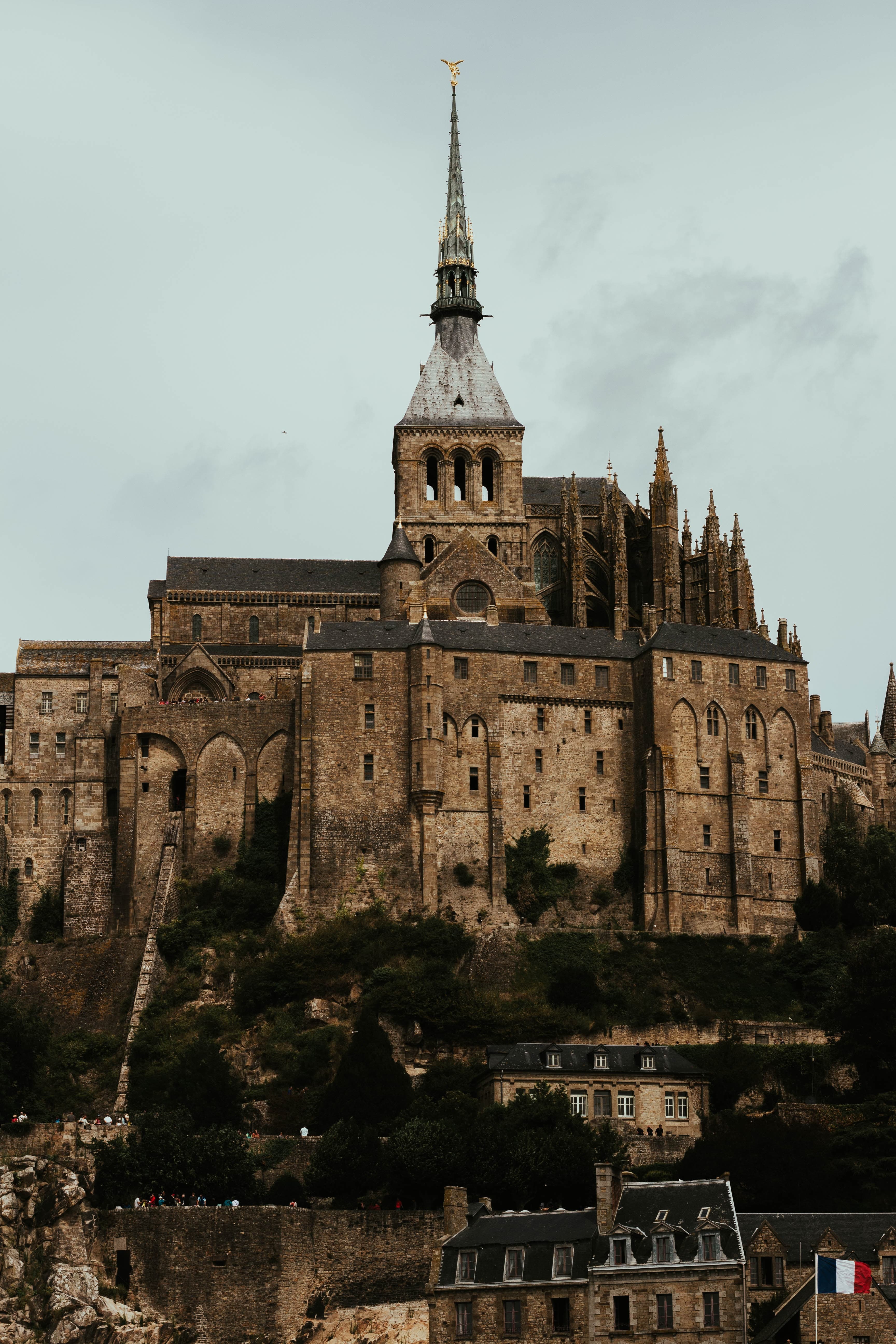
Mont Saint-Michel is a UNESCO World Heritage tidal island situated in Normandy, France, renowned for its gravity-defying Benedictine abbey, dramatic 14-meter tidal variations, and 1,300-year history. Rising 156 meters above sea level, this medieval engineering marvel evolved from an 8th-century sanctuary and fortified stronghold into a French Revolution prison and global cultural icon.
Geographic and Tidal Phenomena
1. Home to Continental Europe's Highest Tides
The Bay of Mont Saint-Michel experiences the highest tidal differential in continental Europe, with water levels fluctuating up to 14 meters (46 feet) between low and high water. During spring tides, the sea recedes roughly 15 kilometers (9.3 miles) from the shore before returning rapidly.
2. Tidal Speed: Fact vs. Folklore
Popular tradition claims the incoming tide arrives "at the speed of a galloping horse." In reality, the tide advances across the flat bay floor at approximately 6 kilometers per hour (3.7 mph). However, strong sea breezes can accelerate the water's advance, making it faster than a walking human and posing serious risks to unwary visitors.
3. Reclaimed Island Status via Engineering
For decades, a causeway built in 1879 accumulated silt and threatened to permanently attach the mount to the French mainland. A major €200 million hydraulic restoration project completed in 2015 removed the causeway, replacing it with a raised pedestrian bridge designed by architect Dietmar Feichtinger. This elevated structure allows seawater to flow freely around the granite rock, preserving its island status.
4. The Boundary Dispute Between Normandy and Brittany
While located in Normandy, Mont Saint-Michel sits directly on the historic border with Brittany. The Couesnon River acts as the geographic divider. Local folklore quips, "The Couesnon in its madness placed the Mount in Normandy." Historically, both regions claimed sovereignty over the site.
- Normandy
- Couesnon River (Historic Border)
- Mont Saint-Michel
- Brittany
- Mont Saint-Michel
- Couesnon River (Historic Border)
5. Hazardous Quicksand Surrounding the Mount
The sediment surrounding the mount consists of fine sand mixed with water and silt, creating dangerous patches of quicksand (lise). Crossing the bay without an accredited local guide is dangerous, as the shifting sands can trap hikers before the incoming tide arrives.
6. The Rare "Tide of the Century" Phenomenon
Every 18 years, a celestial alignment of the Sun, Moon, and Earth produces a "supertide" or "Tide of the Century" (La Marée du Siècle). During these events, the tidal coefficient exceeds 118 out of 120, submerging the access bridge completely and turning Mont Saint-Michel into an isolated island for several hours.
7. The Tidal Bore Wave (Le Mascaret)
When the incoming tide collides with the outward flow of the Couesnon River, it forms a tidal bore—a visible wave known locally as Le Mascaret. Kayakers and spectators gather along the bay to watch this natural wave travel upstream ahead of the main tide.
8. A Designated Marine Wildlife Sanctuary
The surrounding tidal estuary belongs to a protected maritime ecosystem home to harbor seals and over 100 species of migratory birds. The bay also hosts one of Europe’s largest resident populations of bottlenose dolphins, which frequently hunt in the deeper coastal channels.
9. Ancient Granitic Geology
The mount is an outcrop of leucogranite formed roughly 520 million years ago during the Neoproterozoic era. Unlike the soft silt surrounding it, this hard igneous rock survived millions of years of coastal erosion, providing a natural foundation for medieval construction.
10. The Legend of the Submerging Forest
Local legends maintain that before the 8th century, the mount stood in the middle of the dense Scissy Forest. According to tradition, a catastrophic storm and tidal surge in 709 AD inundated the forest, submerging the land and leaving only the granite mount standing above the bay.
Historical Origins and Legendary Lore
11. Visionary Origins by Saint Aubert
According to legend, Archangel Michael appeared in a vision in 708 AD to Aubert, Bishop of Avranches, commanding him to build a sanctuary on the rock, then called Mont-Tombe. Aubert ignored the vision twice until the archangel pressed his finger into the bishop's forehead, leaving a physical impression.
12. The Perforated Skull Relic
The skull of Saint Aubert is preserved at the Saint-Gervais Basilica in Avranches. The skull features a distinct hole near the parietal bone. While early believers attributed the cavity to the archangel's touch, modern forensic analysis suggests it represents an ancient trepanation procedure that healed prior to death.
13. Unconquered During the Hundred Years' War
Despite prolonged English sieges lasting over 30 years during the Hundred Years' War, Mont Saint-Michel never fell. A garrison of 119 French knights successfully defended the fortress against repeated assaults, turning the site into a national symbol of French resistance.
14. The "Bastille of the Sea" Era
Following the French Revolution, the abbey was closed and converted into a state prison holding political dissidents, priest non-jurors, and common criminals. Between 1793 and 1863, more than 14,000 prisoners were held in cramped underground cells under harsh conditions, earning the mount its nickname, the "Bastille of the Sea."
- 708 AD: Sacred Sanctuary Founded
- 966 AD: Benedictine Monastery Established
- 14th–15th Century: Unconquered Medieval Fortress
- 1793–1863: French Revolution State Prison
- 1874: Designated Historic Monument
- 1979: Recognized as UNESCO World Heritage Site
15. Birthplace of the Order of Saint Michael
In 1469, King Louis XI of France founded the Military Order of Saint Michael (Ordre de Saint-Michel) in the abbey's royal halls. It served as the highest chivalric order in France for generations, designed to secure the loyalty of powerful French nobles.
16. Benedictine Monastic Establishment in 966 AD
At the request of Richard I, Duke of Normandy, Benedictine monks settled on the rock in 966 AD. They transformed the sanctuary into an intellectual hub, producing, copying, and preserving illuminated manuscripts throughout the Middle Ages.
17. Revolutionary Dispersal of Sacred Treasures
During the turmoil of 1791, the remaining Benedictine monks were driven out by revolutionary forces. The abbey’s extensive library was transferred to Avranches, and sacred gold relics were melted down or sold to fund revolutionary military efforts.
18. Victor Hugo’s Campaign for Restoration
By the mid-19th century, the abbey had fallen into severe disrepair due to its use as a prison. Writer Victor Hugo spearheaded a public campaign to preserve the landmark, describing it as a "pyramid in the ocean" that required protection. His efforts pushed the French state to shut down the prison in 1863 and classify the site as an official historic monument in 1874.
19. WWII German Occupation Without Destruction
During World War II, German forces occupied Mont Saint-Michel from 1940 to 1944, using the abbey spire as an anti-aircraft observation post. Allied forces liberated Normandy in June 1944, leaving the medieval structure unharmed by artillery or bombings.
20. Revival of Daily Monastic Life
Spiritual practice returned to the mount in 1966 to mark its monastic millenary. Since 2001, brothers and sisters from the Monastic Fraternities of Jerusalem have resided in the abbey, conducting daily worship services and preserving its religious heritage.
Architectural Engineering and Underground Secrets
21. "La Merveille" Gothic Masterpiece
The northern section of the abbey complex is known as La Merveille ("The Marvel"). Constructed in the early 13th century after King Philip II Augustus financed repairs following a fire, this three-story Gothic complex represents a remarkable engineering achievement built into the sheer face of the granite cliff.
- Tier 3: Cloister & Refectory
- Tier 2: Knights' Hall & Guest Hall
- Tier 1: Almonry & Cellar
- Granite Rock Foundation
22. Architectural Hierarchy Mirroring Feudal Society
The vertical structure of La Merveille directly mirrors medieval social order:
- Top Level: The cloister and refectory, dedicated to God and monastic reflection.
- Middle Level: The Guest Hall (Salle des Hôtes) and Knights' Hall (Salle des Chevaliers), allocated to nobility and ruling elites.
- Bottom Level: The Almonry (Aumônerie) and Cellar (Cellier), built to serve common pilgrims and store essential provisions.
23. A Suspended Cloister Garden
Built at the apex of La Merveille, the abbey's open-air cloister does not rest on solid rock. Instead, it is supported by the massive stone vaults of the Knights' Hall directly beneath it, creating a suspended courtyard surrounded by 220 carved granite columns arranged in a double-staggered row.
24. Crypt of the Great Pillars
To support the heavy Flamboyant Gothic choir built above after a 1421 collapse, medieval masons constructed the Crypt of the Great Pillars (Crypte des Gros Piliers). The subterranean hall features ten massive cylindrical pillars, each measuring over 5 meters in circumference, built without central mortar joints.
25. The Human Treadwheel Crane
During the prison era, inmates operated a massive wooden treadwheel crane installed in the former monastic ossuary. Up to six prisoners walked inside the wheel like hamsters, powering a wooden pulley system that hauled heavy supplies up an inclined ramp along the cliffside.
- Supplies Delivered at Base
- Inclined Ramp along Cliff
- Wooden Wagon Pulled by Rope
- Massive Wooden Treadwheel (Powered by 6 Walking Inmates)
26. The Golden Archangel Lightning Rod
A gilded copper statue of Archangel Michael slaying a dragon tops the abbey spire at an elevation of 156 meters (512 feet). Sculpted by Emmanuel Frémiet in 1897, the statue functions as a lightning rod connected directly to the abbey's grounding system. In 2016, a helicopter lifted the 520-kilogram statue off the spire for full restoration and re-gilding with 22-carat gold leaf.
- 156m: Gilded Statue of St. Michael
- Abbey Spire & Gothic Choir
- La Merveille (3 Tiers)
- Medieval Ramparts & Village
- Granite Rock (80m Elevation)
- Sea Level
27. A Blend of Architectural Styles
The abbey features two distinct architectural styles. The nave displays sturdy, thick-walled 11th-century Romanesque design with rounded arches, while the choir rebuilt in the 15th century showcases delicate Flamboyant Gothic architecture filled with tall traceried windows.
28. Subterranean Chapels and Crypts
Beneath the main abbey floor lies a series of underground chapels designed to level out the uneven peak of the rock. Notable structures include the Romanesque Crypt of Saint Martin, built with a solid 9-meter vault, and the ancient Notre-Dame-Sous-Terre chapel incorporated directly into the early foundation.
29. Medieval Fires and Restorations
Lightning strikes, military sieges, and structural collapses triggered major fires at the abbey in 922, 1103, 1204, 1776, and 1834. Masons adapted to these setbacks by adding buttresses, vaults, and fire-resistant granite masonry across generations.
30. Rebuilding the Choir Collapse
In 1421, during the height of the Hundred Years' War, the original Romanesque choir collapsed. Due to political instability and wartime strain, reconstruction was delayed for decades. Work resumed in 1448 and finished in 1521, replacing the ruined hall with a light-filled Flamboyant Gothic structure.
Cultural Heritage, Pop Culture, and Gastronomy
31. The Legendary Fluffy Omelet of La Mère Poulard
In 1888, Annette Poulard opened an inn on the mount to serve travelers arriving at erratic hours due to incoming tides. She developed a technique of whipping eggs briskly in copper bowls over an open wood fire, creating a fluffy souffle-like omelet. The restaurant La Mère Poulard continues to serve this signature dish today using her original technique.
32. Inspiration for Tolkien's Minas Tirith
Peter Jackson’s production design team for The Lord of the Rings film trilogy drew direct aesthetic inspiration from Mont Saint-Michel when designing the multi-tiered city of Minas Tirith. The concentric fortified ring walls rising to a central tower mirror the layout of the island abbey.
33. Disney’s Model for Rapunzel’s Kingdom
In Disney’s 2010 animated feature Tangled, artists modeled the Kingdom of Corona after Mont Saint-Michel. Executive producer Laurent Le Guernec noted that the site’s isolated coastal setting provided the ideal dramatic look for Rapunzel’s royal home.
- Mont Saint-Michel Architectural Design
- Minas Tirith (The Lord of the Rings)
- Kingdom of Corona (Disney's Tangled)
34. The Historic Pilgrimage Routes (Les Chemins de Saint-Michel)
For over a millennium, pilgrims known as Miquelots walked across Western Europe along dedicated routes to reach the shrine. Today, the non-profit Association Les Chemins du Mont-Saint-Michel maintains these historic trails, enabling modern hikers to traverse restored pilgrimage paths across France.
35. Distinctive Salt-Marsh Lamb (Agneau de Pré-Salé)
Sheep that graze in the salt marshes (schorre) surrounding the bay feed on vegetation naturally rich in salt and iodine, such as glasswort and sea lavender. This specialized diet imparts a distinct tender texture and flavor to the meat, protected by French Appellation d'Origine Protégée (AOP) certification.
36. Video Game Recreations
Mont Saint-Michel serves as a central setting in popular culture, notably appearing as an interactive map in Assassin’s Creed: Brotherhood and Civilization VI, where players can construct the abbey as a World Wonder providing faith and culture bonuses.
37. A Renowned Medieval Scriptorium
During the 11th and 12th centuries, the abbey’s scriptorium produced over 200 illuminated manuscripts. Monks created their own parchment, iron gall ink, and mineral pigments. Today, these surviving texts are preserved and displayed in Avranches at the Scriptorial Museum.
38. Summer Night Illuminations (Les Nocturnes)
During July and August, the Centre des Monuments Nationaux hosts light-and-sound shows inside the abbey after sunset. Known as Les Nocturnes, these displays use laser projections, ambient soundscapes, and visual effects to highlight the medieval stonework.
39. The Narrowest Alley: Ruelle des Cocus
The medieval village built at the base of the rock features extremely narrow stone passages designed to restrict enemy movement. Among these is the Ruelle des Cocus ("Cuckolds' Alley"), a walkway so narrow that two adults cannot pass each other side-by-side.
40. Top Tourist Destination Outside Paris
Attracting between 2.5 and 3 million visitors annually, Mont Saint-Michel stands alongside the Palace of Versailles and the Château de Chambord as one of the most visited cultural monuments in France outside the Greater Paris region.
Visitor Realities, Modern Management, and Access
41. A Microscopic Permanent Resident Population
While millions visit the site each year, Mont Saint-Michel maintains a tiny permanent population. Fewer than 30 residents live within its historic walls, a group composed of Benedictine monks, nuns, local merchants, and municipal employees.
42. Strict Zero-Vehicle Policy
Private vehicles are banned from entering the elevated bridge and medieval village. All personal cars, tour buses, and motorcycles must park in designated mainland parking lots situated 2.5 kilometers (1.5 miles) inland, preserving the historical ambiance and fragile ecosystem of the bay.
43. The "Passeur" Electric Shuttle Fleet
To transport travelers from the parking lots to the mount, a shuttle system operates daily. The zero-emission electric shuttles, named Le Passeur, run continuously throughout the day, dropping visitors off 450 meters short of the main gate to maintain clear views of the rock.
- Mainland Parking Lot (2.5 km away)
- Passeur Electric Shuttle OR Guided Bay Walking Tour
- Elevated Pedestrian Bridge (450m Drop-Off Point)
- King's Gate & Medieval Village Access
44. Year-Round 365-Day Accessibility
The village of Mont Saint-Michel remains open to the public 365 days a year without entrance fees. However, visiting the abbey atop the rock requires an admission ticket managed by the Centre des Monuments Nationaux, which closes on January 1st, May 1st, and December 25th.
45. Strategic Overtourism Management
To counter seasonal crowding during peak summer hours, local authorities implemented smart ticketing, real-time parking monitoring, and incentivized evening visits. Travelers who visit during off-peak morning or late afternoon hours enjoy shorter queue times and clearer pathways.
46. The Couesnon Hydraulic Dam Mechanism
Constructed in 2009, the Couesnon hydraulic dam uses eight water gates to store sea water during high tides and release it during low tides. This controlled flushing process washes sediment away from the mount out to sea, preventing silt accumulation without disturbing local marine life.
47. Pedestrian Bridge Architecture
Designed by Dietmar Feichtinger, the 760-meter elevated pedestrian walkway features thin steel pillars spaced far apart. This layout minimizes water flow disruption, allowing 80% of tidal currents to pass underneath without dropping sediment.
48. Free Village Access vs. Abbey Entry
While walking through the medieval village streets, ramparts, and outer gates is free, entering the abbey requires a paid admission ticket. Visitors should reserve timed-entry tickets online in advance to skip the main ticketing lines at the summit.
49. Weather Extremes on the Rock
Due to its exposed position in the Gulf of Saint-Malo, Mont Saint-Michel frequently experiences sudden weather shifts, Atlantic gales, and dense coastal fog. Wind speeds at the abbey ramparts can exceed 100 kilometers per hour during winter storms.
50. Defensive Double-Wall Architecture
The entrance to the village features three fortified gates: the Porte de l'Avancée, the Porte du Boulevard, and the Porte du Roi. Built during the 15th century, these entrances feature drawbridges, portcullises, and machicolations designed to trap invading forces in narrow kill zones between double walls.
Mont Saint-Michel Visiting Conditions
| Planning Factor | High Tide / Spring Tide (Coeff > 110) | Low Tide / Standard Day |
|---|---|---|
| Bridge Accessibility | Temporarily submerged at peak high tide; access restricted for 1–2 hours. | Fully accessible by pedestrian bridge and shuttle 24/7. |
| Bay Walking Risk | High; tidal currents make bay walking dangerous. | Permitted, but only with an accredited certified guide. |
| Visual Atmosphere | Dramatic full-water isolation; historic reflection views. | Expansive mudflats, quicksand pools, and distant horizon views. |
| Photographic Lighting | Optimal at sunrise/sunset with high water reflections. | Best for wide panos and historical architectural details. |
| Crowd Density | Very High; draws crowds gathered along ramparts. | Moderate; crowds fluctuate around midday shuttle arrivals. |
Essential Visitor Planning and Safety Guide
Visiting Mont Saint-Michel requires planning, especially regarding tide schedules and walking conditions.
Access and Transportation
Parking: Leave your car at the official mainland parking terminal (Centre d'Information Touristique).
Shuttle Service: Board Le Passeur shuttle (included in the parking fee) or walk 30 minutes across the scenic bridge.
Footwear: Wear sturdy walking shoes with strong traction. The village consists of steep, uneven granite cobblestones and slippery medieval staircases.
Step 1: Check Tide Schedule online before booking travel.
Step 2: Reserve timed-entry Abbey Tickets via CMN.
Step 3: Park at Mainland Hub & Board "Passeur" Shuttle.
Step 4: Walk the Ramparts to avoid central village congestion.
Step 5: Visit Abbey during early morning or late afternoon.
Safety Rules in the Bay
Never walk into the bay sand alone. The combination of rapid tidal surges, fog, and deep quicksand poses real hazards. If you want to explore the mudflats surrounding the rock, book a tour with a licensed bay guide (guide attesté) who carries safety equipment and monitors local tide tables.
Frequently Asked Questions
What is the best time of year to visit Mont Saint-Michel?
May, September, and October offer comfortable weather, long daylight hours, and manageable crowd levels. Visiting during winter provides peaceful views with fewer crowds, though weather conditions can be cold and windy.
How much time should I plan to spend at Mont Saint-Michel?
Plan to spend at least 4 to 6 hours to explore the site fully. This allows enough time to take the shuttle across the bridge, walk up through the medieval village, tour the abbey interior, walk along the defensive ramparts, and enjoy a meal.
Is Mont Saint-Michel accessible for visitors with limited mobility?
The medieval village features steep cobblestone incline paths and over 350 steps to reach the abbey summit, making full wheelchair access difficult. However, reduced-mobility shuttle transport is available from the parking terminal, and adapted access vehicles can carry eligible visitors directly to the main entrance gate upon request.
Can you stay overnight on Mont Saint-Michel?
Yes, a handful of small historic hotels operate within the village walls, such as Auberge Saint-Pierre and La Mère Poulard. Staying overnight lets travelers experience the illuminated medieval streets and quiet morning hours after day-trip crowds have departed.
Strategic Next Actions for Visitors
To plan a smooth trip to Mont Saint-Michel:
- Consult Official Tide Tables: Check the French Hydrographic Office (SHOM) or the local tourist board's tide schedules to confirm high-water times before setting your dates.
- Book Timed Abbey Tickets: Reserve your entry slots directly on the Centre des Monuments Nationaux portal to bypass queue lines at the summit entrance.
- Hire an Accredited Bay Guide: If you plan to hike across the mudflats, book a certified guide through the official tourist office to ensure a safe, informative excursion across the sands.