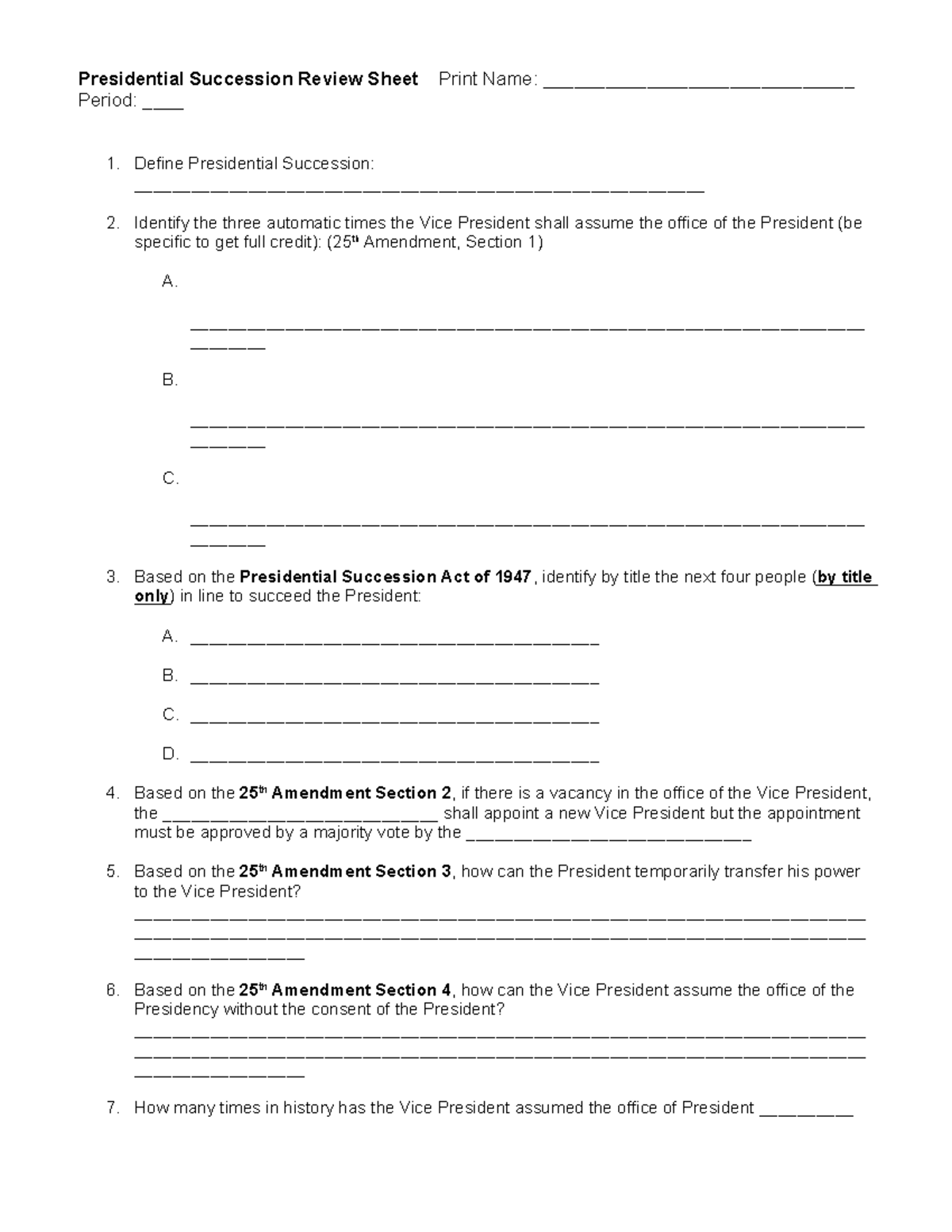
The 25th Amendment to the United States Constitution provides the definitive legal framework for handling presidential vacancies, vice-presidential openings, and instances of presidential inability. It clarifies that the Vice President becomes President upon the death, resignation, or removal of the chief executive and establishes formal procedures for both voluntary and involuntary transfers of power to ensure the continuity of government.
Ratified in 1967, the 25th Amendment remains one of the most critical components of American constitutional law regarding the executive branch. As of 2026, it serves as the primary mechanism for maintaining stability within the federal government during times of crisis or medical emergency. While the original Constitution and the Presidential Succession Act of 1947 provided some guidance, they left dangerous ambiguities that the 25th Amendment was specifically designed to resolve.
The Historical Necessity of the 25th Amendment
To understand the 25th Amendment, one must first understand the "Tyler Precedent" and the gaps left by the Founding Fathers. Article II, Section 1, Clause 6 of the original Constitution stated that in the case of the President's "Inability to discharge the Powers and Duties of the said Office, the Same shall devolve on the Vice President." However, it was unclear whether the office itself devolved (meaning the Vice President became President) or if only the powers and duties devolved (meaning the Vice President was merely an "Acting President").
When William Henry Harrison died in 1841, Vice President John Tyler insisted on being sworn in as President, not just an acting official. While his precedent held, it was never formally codified in the Constitution until 1967. More pressingly, the mid-20th century brought new challenges. President Dwight D. Eisenhower suffered multiple health crises, including a heart attack and a stroke, leaving the nation without a clear process for a temporary transfer of power.
The assassination of John F. Kennedy in 1963 was the final catalyst. Had Kennedy survived in a persistent vegetative state, the nation would have faced a constitutional nightmare: no legal way to empower the Vice President while the President was technically alive but incapacitated. The 25th Amendment was proposed to solve these specific vulnerabilities in the nuclear age, where immediate and clear leadership is a matter of national survival.
Section 1: Permanent Presidential Succession
Section 1 is the most straightforward part of the amendment. It codifies the Tyler Precedent into law, stating: "In case of the removal of the President from office or of his death or resignation, the Vice President shall become President."
This section removes any ambiguity about the status of the Vice President. They do not "act" as President; they are the President for the remainder of the term. This provides immediate legitimacy to the successor, ensuring that the chain of command remains unbroken during a national tragedy or a political resignation, such as that of Richard Nixon in 1974.
Section 2: Filling a Vice Presidential Vacancy
Before the 25th Amendment, if the Vice Presidency became vacant, it remained vacant until the next general election. This happened 16 times before 1967 due to death, resignation, or the Vice President succeeding to the Presidency.
Section 2 provides a mechanism to fill this vacancy: "Whenever there is a vacancy in the office of the Vice President, the President shall nominate a Vice President who shall take office upon confirmation by a majority vote of both Houses of Congress."
Historical Application of Section 2
This section has been used twice in American history:
- 1973: After Vice President Spiro Agnew resigned, President Richard Nixon nominated Gerald Ford. Ford was confirmed by Congress.
- 1974: When Nixon resigned and Ford became President, the Vice Presidency became vacant again. Ford nominated Nelson Rockefeller, who was then confirmed by Congress.
In 2026, this remains the standard procedure. It ensures that the executive branch always has a second-in-command, which is vital for the line of succession.
Section 3: Voluntary Transfer of Power (Temporary Inability)
Section 3 allows a President to voluntarily and temporarily relinquish their powers. This is typically used for scheduled medical procedures involving general anesthesia.
The Process:
- The President sends a written declaration to the President pro tempore of the Senate and the Speaker of the House of Representatives.
- The declaration states that the President is "unable to discharge the powers and duties of his office."
- The Vice President immediately becomes "Acting President."
- When the President is ready to resume power, they send a second written declaration stating they are once again able to perform their duties.
This section has been invoked several times. In 1985, Ronald Reagan used it for eight hours during colon surgery (though he did not specifically cite the amendment, he followed its protocol). George W. Bush invoked it twice (2002 and 2007) for colonoscopies. Most recently, in 2021, Joe Biden briefly transferred power to Kamala Harris during a medical procedure.
Section 4: Involuntary Transfer of Power
Section 4 is the most complex and controversial part of the 25th Amendment. It has never been invoked. It addresses the scenario where a President is unable to discharge their duties but is either unwilling or unable (e.g., in a coma) to declare their own inability.
The Triggering Mechanism
For Section 4 to be activated, the Vice President and a majority of "the principal officers of the executive departments" (the Cabinet) must send a written declaration to the Speaker of the House and the President pro tempore of the Senate. This declaration states that the President is unable to perform their duties. At that moment, the Vice President immediately becomes Acting President.
The Congressional "Other Body"
The amendment allows for "such other body as Congress may by law provide" to replace the Cabinet in this process. However, as of 2026, Congress has never established such a body, meaning the power remains with the Vice President and the Cabinet.
The Dispute Process
If the President recovers and wishes to resume power, they must submit a written declaration to Congress. However, if the Vice President and the Cabinet still believe the President is incapacitated, they have four days to submit a counter-declaration.
In this event, Congress must decide the issue:
- Congress must assemble within 48 hours.
- They have 21 days to vote.
- A two-thirds majority in both the House and the Senate is required to keep the Vice President as Acting President.
- If the two-thirds threshold is not met, the President resumes their powers.
Comparative Summary of the 25th Amendment Sections
| Section | Subject Matter | Action Required | Historical Precedent |
|---|---|---|---|
| Section 1 | Permanent Vacancy | VP becomes President automatically upon death/resignation. | Lyndon B. Johnson (1963), Gerald Ford (1974). |
| Section 2 | VP Vacancy | President nominates; Majority of House and Senate confirms. | Gerald Ford (1973), Nelson Rockefeller (1974). |
| Section 3 | Voluntary Disability | President notifies Congress in writing; VP becomes Acting President. | Reagan (1985), Bush (2002/2007), Biden (2021). |
| Section 4 | Involuntary Disability | VP + Cabinet notify Congress; VP becomes Acting President. | Never formally invoked. |
25th Amendment vs. Impeachment
A common misconception is that the 25th Amendment is an alternative to impeachment. Legally and practically, they serve entirely different purposes:
- Intent: Impeachment (Article I and II) is a punitive and political process for "High Crimes and Misdemeanors." The 25th Amendment is a functional process for "Inability."
- Permanence: Impeachment results in permanent removal. Section 3 and 4 of the 25th Amendment are designed to be temporary, though they can last for the remainder of a term.
- Threshold: Impeachment requires a simple majority in the House and two-thirds in the Senate. A contested Section 4 return requires two-thirds in both chambers to keep the President sidelined.
- Origin: Impeachment begins in the House of Representatives. The 25th Amendment (Section 4) must begin within the Executive Branch (the Vice President).
For further legal reading on these distinctions, the Congressional Research Service provides detailed analysis on the separation of powers.
Legal Requirements and "Principal Officers"
One area of technical debate involves who constitutes the "principal officers of the executive departments" mentioned in Section 4. The consensus among legal scholars and the Department of Justice is that this refers to the 15 heads of the executive departments (State, Treasury, Defense, etc.) who make up the President's Cabinet.
"Acting" cabinet members are generally considered to have the same authority as confirmed members for the purposes of the 25th Amendment, although this has never been tested in court. The Vice President’s role is indispensable; without the Vice President’s signature, Section 4 cannot be triggered, regardless of how many Cabinet members agree.
Practical Guidance: How the Amendment Protects the Republic
The 25th Amendment is not a "trap door" for removing an unpopular President. It is a safeguard against a "headless" government. In the modern era, the President must be able to make split-second decisions regarding national security, the economy, and nuclear command.
Next Actions for Researchers and Students:
- Review Official Text: Read the full text of the amendment at the National Archives.
- Analyze Legislative History: Examine the Bayh-Celler debates of the 1960s to understand the original intent of the framers.
- Monitor Current Protocols: Understand that the White House Medical Unit keeps standing protocols for Section 3 transfers during any presidential surgery.
Frequently Asked Questions
Can the 25th Amendment be used to remove a President for being "unfit"?
The term "unable" in the amendment is not strictly defined, but the legislative history suggests it refers to a physical or mental inability to perform duties, not political unfitness or unpopularity. Using it for political reasons would likely face extreme resistance in Congress, given the two-thirds voting requirement for a contested removal.
Who is the "Other Body" mentioned in Section 4?
The Constitution allows Congress to pass a law designating a group other than the Cabinet to determine presidential inability (such as a panel of medical experts). However, as of 2026, no such law has been enacted. The Vice President and the Cabinet remain the only entities with the power to initiate Section 4.
What happens if the Vice President and the President both become incapacitated?
The 25th Amendment does not directly address a double vacancy. In that case, the Presidential Succession Act of 1947 applies, placing the Speaker of the House next in line, followed by the President pro tempore of the Senate and the Cabinet members in order of their department's creation.
How long can a Vice President serve as Acting President?
Under Section 3 or 4, a Vice President can serve as Acting President for as long as the disability lasts, up until the end of the current presidential term. There is no set time limit, but the process for the President to reclaim their power is designed to be relatively swift (within 21 days if contested).
Is the Vice President required to take a new oath when becoming Acting President?
No. Under Section 3 and 4, the Vice President does not take the Presidential Oath of Office because they are only "acting." However, under Section 1, where the Vice President becomes the President permanently, they must take the oath as prescribed in Article II.
Summary of Next Steps
For those seeking to understand the current status of executive succession in 2026, it is vital to distinguish between the various sections of the 25th Amendment. Section 1 and 2 handle vacancies, while Sections 3 and 4 handle disability. For legal professionals and students of constitutional law, the Cornell Law School Legal Information Institute offers an excellent annotated version of the amendment that tracks judicial interpretations and historical applications.
Understanding these protocols ensures a clear view of how the United States maintains a stable executive branch, regardless of the health or status of the individual currently holding the office.