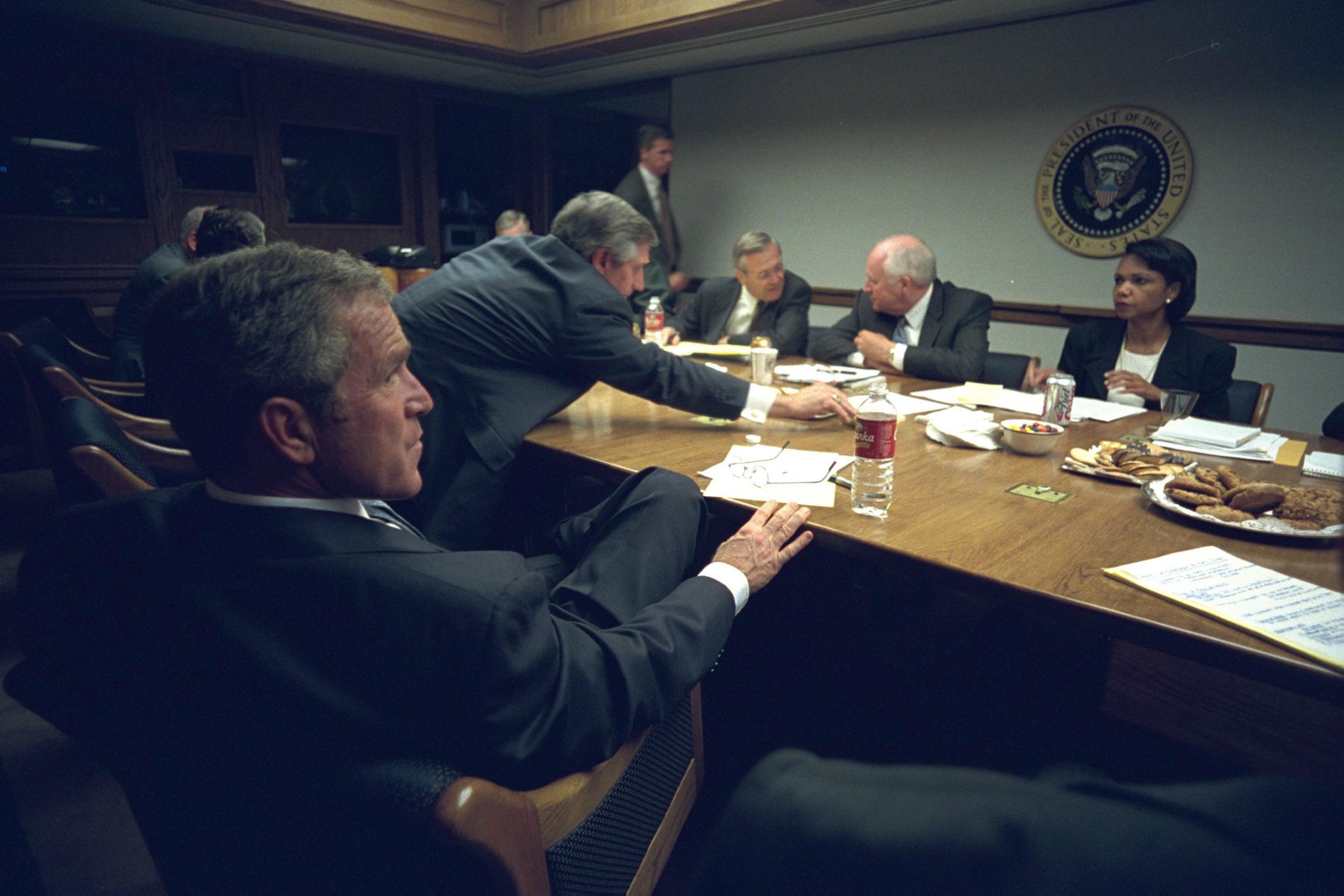
In the immediate aftermath of the September 11 terrorist attacks, the administration of President George W. Bush executed a sweeping series of financial and security interventions designed to stabilize the United States economy, restructure the federal bureaucracy, and establish aggressive new protocols for domestic and international counterterrorism. These actions permanently reshaped the scope of executive authority, the regulation of global financial flows, and the everyday operations of national security institutions.
The Immediate Economic Shock and Fiscal Stabilization
The terrorist attacks of September 11, 2001, delivered an unprecedented shock to the United States and global financial systems. Markets were closed for four trading days—the longest shutdown since the outbreak of World War I—and upon reopening, the Dow Jones Industrial Average suffered its largest single-point drop in history up to that point, losing over 14 percent of its value in a single week. Critical physical infrastructure in Lower Manhattan, including the World Trade Center complex and surrounding financial district hubs, was destroyed or severely damaged, displacing thousands of financial services firms, clearinghouses, and telecommunications nodes.
To prevent a total systemic collapse, the federal government acted swiftly through a coordinated effort involving the White House, the Department of the Treasury, and the Federal Reserve. The Federal Reserve, led then by Chairman Alan Greenspan, injected over $100 billion in liquidity into the banking system through massive overnight loans and aggressive open-market operations. This ensured that commercial banks had sufficient cash reserves to meet demands and maintain the interbank lending market.
Simultaneously, President Bush worked with a bipartisan coalition in Congress to pass emergency fiscal legislation. On September 18, 2001, the Emergency Supplemental Appropriations Act for Recovery from and Response to Terrorist Attacks on the United States was signed into law, allocating $40 billion for emergency response, victim compensation, and infrastructure repair. Furthermore, recognizing the catastrophic losses sustained by the commercial aviation sector, Congress passed and the President signed the Air Transportation Safety and System Stabilization Act on September 22, 2001. This statute provided $15 billion in financial assistance, direct grants, and loan guarantees to commercial airlines, shielding them from immediate bankruptcy while establishing a federal victim compensation fund to manage liability claims arising from the attacks.
Disrupting Terrorist Financing and International Monetary Controls
Beyond domestic market stabilization, the Bush administration recognized that dismantling transnational terrorist networks required choking off their access to capital. Traditional banking secrecy laws, informal hawala remittance networks, and charitable fronts allowed groups like al-Qaeda to move millions of dollars across international borders undetected.
On September 24, 2001, President Bush signed Executive Order 13224, invoking the International Emergency Economic Powers Act (IEEPA), the National Emergencies Act, and the United Nations Participation Act. This executive order blocked the assets of 27 specific individuals and entities designated as terrorists, terrorist organizations, or front groups, and granted the Secretary of the Treasury broad authority to freeze the assets of any foreign individual or institution determined to support acts of international terrorism.
To operationalize these mandates, the Department of the Treasury established Operation Green Quest, a multi-agency initiative led by the U.S. Customs Service, the Secret Service, and the Internal Revenue Service. Operation Green Quest targeted alternative financing mechanisms, trade-based money laundering, and illicit charities that diverted humanitarian donations to extremist organizations.
On a legislative front, the administration worked closely with Congress to pass the USA PATRIOT Act in October 2001. Title III of the PATRIOT Act—formally known as the International Money Laundering Abatement and Financial Anti-Terrorism Act of 2001—strengthened anti-money laundering (AML) regulations. It imposed strict due diligence requirements on U.S. financial institutions regarding correspondent accounts held for foreign banks, prohibited U.S. banks from maintaining relationships with foreign shell banks, and expanded the Treasury's authority to target jurisdictions of primary money laundering concern.
Overhauling National Security and Establishing the Department of Homeland Security
The security landscape shifted dramatically as intelligence agencies and policymakers confronted the failure of domestic and foreign intelligence agencies to connect disparate threat indicators before September 11. President Bush’s security response was characterized by a massive centralization of federal authority and the creation of entirely new bureaucratic entities designed to protect the homeland.
Initially, on October 8, 2001, President Bush established the Office of Homeland Security (OHS) by executive order, appointing Pennsylvania Governor Tom Ridge as the Director. However, as the legislative branch pushed for statutory oversight and administrative consolidation, the administration supported the creation of a cabinet-level department. On November 25, 2002, the Homeland Security Act of 2002 was signed into law, establishing the Department of Homeland Security (DHS). DHS merged 22 distinct federal agencies—including the Immigration and Naturalization Service, the U.S. Customs Service, the Federal Emergency Management Agency (FEMA), and the newly formed Transportation Security Administration (TSA)—into a single executive department charged with coordinating national defense against terrorist threats.
The creation of the TSA under the Aviation and Transportation Security Act of November 2001 represented a monumental shift in civil aviation. Before 9/11, airport security screening was handled by private security contractors hired by individual airlines, operating under minimal federal regulation. The new law federalized airport security screening, established rigorous federal standards for baggage inspection, mandated reinforced cockpit doors on commercial aircraft, and deployed armed federal air marshals to commercial flights on an unprecedented scale.
Intelligence Reform and the Expansion of Executive Surveillance
To address the intelligence failures highlighted by the bipartisan 9/11 Commission, the Bush administration restructured the intelligence apparatus to improve cross-agency information sharing. The Intelligence Reform and Terrorism Prevention Act of 2004 (IRTPA) created the position of the Director of National Intelligence (DNI) to oversee and coordinate the foreign and domestic activities of the entire Intelligence Community, separating the head of the intelligence apparatus from direct command of the Central Intelligence Agency (CIA).
Concurrently, the administration authorized covert and domestic surveillance programs aimed at intercepting communications involving suspected terrorists. In late 2001, President Bush secretly authorized the National Security Agency (NSA) to conduct warrantless wiretapping of international communications originating from or terminating in the United States where one party was suspected of having links to al-Qaeda. Known publicly as the Terrorist Surveillance Program, this initiative bypassed the traditional framework of the Foreign Intelligence Surveillance Act (FISA) of 1978, sparking significant legal and constitutional debates regarding executive power and civil liberties during wartime.
| Action / Policy | Core Purpose | Key Legislation / Authority | Primary Impact |
|---|---|---|---|
| Airline Stabilization | Prevent commercial aviation bankruptcy and manage liability. | Air Transportation Safety and System Stabilization Act | Provided $15B in aid, created victim compensation fund. |
| Asset Freezing | Disrupt global funding channels for extremist groups. | Executive Order 13224 (IEEPA) | Blocked assets of designated terrorists and financial fronts. |
| PATRIOT Act (Title III) | Enhance anti-money laundering and banking compliance. | USA PATRIOT Act of 2001 | Increased due diligence, targeted foreign shell banks. |
| Creation of DHS | Consolidate domestic security and disaster response agencies. | Homeland Security Act of 2002 | Merged 22 federal agencies into a single cabinet department. |
| Federalization of Screening | Secure commercial aviation against hijacking. | Aviation and Transportation Security Act | Created the TSA and centralized airport security operations. |
| Intelligence Restructuring | Improve coordination across federal intelligence bodies. | Intelligence Reform and Terrorism Prevention Act of 2004 | Established the Director of National Intelligence (DNI). |
Long-Term Implications and Legal Controversies
The financial and security actions initiated by the Bush administration following the September 11 attacks established precedents that continue to govern American public policy and national security operations. The integration of international banking regulations into counterterrorism strategy demonstrated that financial institutions and regulatory bodies were frontline defenses against non-state actors. The Financial Action Task Force (FATF), an international standard-setting body, dramatically expanded its mandate to enforce global anti-money laundering and counter-terrorist financing (AML/CFT) standards, transforming international banking compliance practices permanently.
At the same time, the rapid expansion of federal surveillance and executive power generated lasting friction between national security imperatives and civil liberties. Provisions of the USA PATRIOT Act, particularly those concerning roving wiretaps, searches of business records, and the collection of telephony metadata, became subjects of intense judicial scrutiny and legislative reform in subsequent decades. The balance between maintaining an open, fluid financial and travel infrastructure and enforcing rigorous security screening remains a central challenge for modern statecraft.
Frequently Asked Questions
What was the immediate financial impact of the September 11 attacks on the U.S. economy?
The attacks caused a four-day market closure, a 14 percent drop in the Dow Jones Industrial Average upon reopening, and severe disruption to Lower Manhattan's commercial center. In response, the Federal Reserve injected over $100 billion in liquidity, and Congress passed emergency appropriations and airline stabilization legislation to prevent systemic failure.
How did the Bush administration target terrorist financing after 9/11?
The administration utilized Executive Order 13224 to freeze assets of designated terrorist organizations and front groups. Additionally, Title III of the USA PATRIOT Act strengthened anti-money laundering laws, increased oversight of correspondent banking accounts, and banned transactions with foreign shell banks to choke off illegal capital flows.
What role did the USA PATRIOT Act play in post-9/11 security?
Signed into law in October 2001, the PATRIOT Act expanded law enforcement and intelligence gathering authorities. It broke down legal barriers that previously restricted information sharing between intelligence agencies and criminal investigators, while updating wiretap and surveillance authorities to address modern communication technologies.
Why was the Department of Homeland Security created?
The Department of Homeland Security (DHS) was established via the Homeland Security Act of 2002 to unify fragmented domestic security functions. By consolidating 22 disparate federal agencies—such as the Immigration and Naturalization Service, FEMA, and the newly formed TSA—into one cabinet department, the federal government aimed to streamline threat analysis, border protection, and emergency preparedness.
What changes were made to airport security following the terrorist attacks?
Under the Aviation and Transportation Security Act of 2001, airport security screening was federalized through the creation of the Transportation Security Administration (TSA). Private security firms were replaced by federal screening personnel, baggage inspection standards were elevated, cockpit doors were reinforced, and federal air marshals were deployed to safeguard commercial flights.
Practical Next Steps for Researchers and Analysts
For researchers, historians, and policy analysts examining the federal response to the 2001 attacks, consulting primary source documentation provides the most accurate view of executive and legislative decisions. Reviewing official publications from the Department of the Treasury's Financial Crimes Enforcement Network (FinCEN), the bipartisan 9/11 Commission Report, and legislative archives hosted by the Library of Congress offers comprehensive insight into the mechanics of post-9/11 financial controls and security restructuring.