The 2026 FIFA World Cup marks a historic turning point in international soccer, serving as the first tournament co-hosted by three nations—Canada, Mexico, and the United States—and featuring an expanded 48-team format designed to broaden global participation and economic reach.
Introduction to the 2026 FIFA World Cup
The 2026 FIFA World Cup represents the 23rd edition of the quadrennial international men's soccer championship contested by the senior national teams of the member associations of FIFA. Operating under the official governance of the Fédération Internationale de Football Association, this tournament introduces structural modifications that fundamentally alter the scale, logistics, and competitive landscape of world soccer.
For the first time in tournament history, the hosting duties are distributed across three distinct North American countries: Canada, Mexico, and the United States. This tripartite arrangement leverages existing world-class infrastructure across 16 host cities while uniting three distinct football cultures under a single continental umbrella. Furthermore, the tournament expands from the 32-team format utilized since 1998 to a sprawling 48-team constellation, significantly increasing the total number of matches and introducing a new tournament phase to accommodate the larger pool of competitors.
Understanding the mechanics of the 2026 FIFA World Cup requires examining its multi-nation organizational framework, the intricacies of the expanded match schedule, the qualification pathways for global confederations, and the economic and operational preparations undertaken by the host nations.
Expanded Tournament Format and Match Schedule
The transition from a 32-team tournament to a 48-team tournament is the most consequential structural change in the modern history of the World Cup. This expansion alters how teams progress from the initial group stage to the knockout rounds, creating a longer tournament window and a higher volume of total fixtures.
Group Stage and Knockout Progression
Under the 48-team model, the tournament groups are structured to accommodate more participants without bloating the individual group workload for players. The participating nations are divided into 12 groups, each containing four teams.
Following a round-robin schedule within each group where every team plays three matches:
- The top two teams from each of the 12 groups advance directly to the knockout rounds.
- The eight best third-place finishers across all groups also secure advancement, completing a 32-team knockout bracket.
This addition of a Round of 32 means that successful teams must play a maximum of eight matches to lift the trophy, matching the previous maximum of seven matches for finalists under the 32-team system, provided they contest the third-place playoff. The inclusion of the Round of 32 introduces a high-stakes preliminary knockout tier that immediately winnows the field by half after the group phase concludes.
Total Match Count and Tournament Duration
The expansion increases the total number of matches from 64 (in the previous 32-team format) to 104 matches across the tournament. To accommodate this schedule safely while respecting player welfare and club release agreements, the tournament window is structured to span approximately six weeks. FIFA coordinates closely with domestic leagues globally to ensure adequate preparation and recovery time, though the dense scheduling places significant logistical and physical demands on participating squads.
Host Nations and Venue Distribution
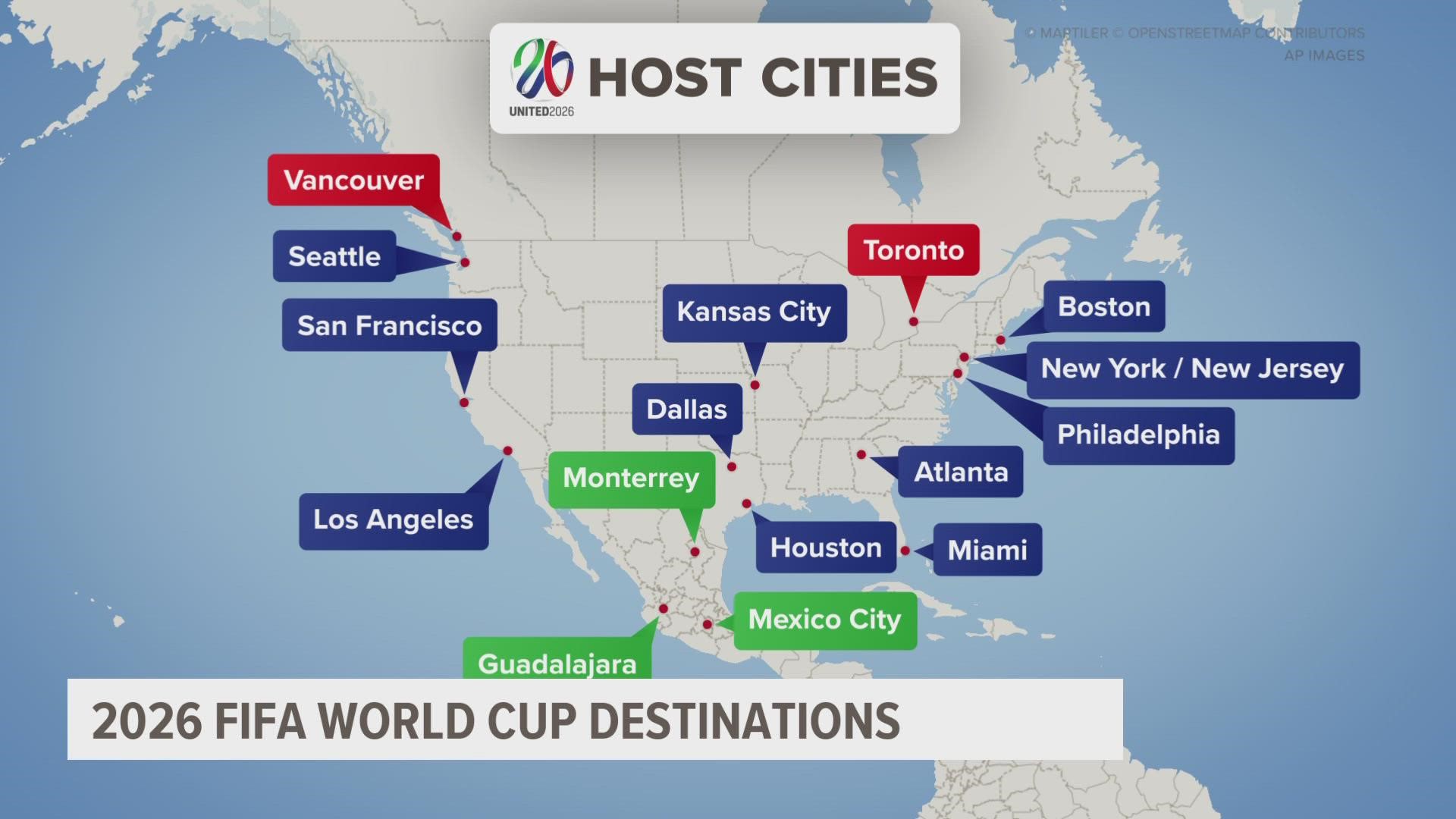
The 2026 tournament distributes its 104 matches across 16 host cities located within Canada, Mexico, and the United States. This geographic dispersion makes it the most geographically expansive World Cup in history, requiring teams and fans to navigate significant travel distances across North American time zones.
Host Cities by Country
The host allocation reflects the relative size and infrastructure capacity of the three participating countries, with the vast majority of matches hosted in the United States, complemented by key fixtures in established Mexican and Canadian football hubs.
- Canada (2 Cities): Vancouver (BC Place) and Toronto (BMO Field).
- Mexico (3 Cities): Mexico City (Estadio Azteca), Guadalajara (Estadio Akron), and Monterrey (Estadio BBVA).
- United States (11 Cities): Atlanta (Mercedes-Benz Stadium), Boston (Gillette Stadium), Dallas (AT&T Stadium), Houston (NRG Stadium), Kansas City (Arrowhead Stadium), Los Angeles (SoFi Stadium), Miami (Hard Rock Stadium), New York/New Jersey (MetLife Stadium), Philadelphia (Lincoln Financial Field), San Francisco Bay Area (Levi's Stadium), and Seattle (Lumen Field).
Venue Characteristics and Historical Significance
The selected venues represent state-of-the-art American football and soccer stadiums, alongside historic cathedrals of the sport. Notably, Mexico City's Estadio Azteca achieves unprecedented historical status by hosting matches in a third World Cup, having previously served as a primary venue for the 1970 and 1986 tournaments.
Most venues utilize artificial turf surfaces for domestic club competitions (such as NFL or MLS matches) but are mandated by FIFA to install high-grade natural grass playing surfaces ahead of the tournament to meet international standards.
| Host Country | Host Cities | Key Venues | Matches Hosted |
|---|---|---|---|
| Canada | Vancouver, Toronto | BC Place, BMO Field | Group and early knockout rounds |
| Mexico | Mexico City, Guadalajara, Monterrey | Estadio Azteca, Estadio Akron, Estadio BBVA | Opening match, group, and knockout rounds |
| United States | Atlanta, Boston, Dallas, Houston, Kansas City, Los Angeles, Miami, NY/NJ, Philadelphia, SF Bay Area, Seattle | MetLife Stadium, SoFi Stadium, AT&T Stadium, etc. | Group, knockout rounds, and the Final |
Qualification Pathways by Confederation
With the expansion to 48 teams, the allocation of tournament slots across FIFA's six continental confederations underwent a corresponding recalculation to ensure fair representation and reflect the global balance of the sport.
Slot Allocation Breakdown
The distribution of the 48 available berths is determined by the FIFA Council based on sporting merit and regional representation:
- AFC (Asia): 8 direct slots (up from 4.5)
- CAF (Africa): 9 direct slots (up from 5)
- Concacaf (North/Central America and Caribbean): 6 direct slots, including the automatic berths for the three co-hosts (Canada, Mexico, and the United States)
- CONMEBOL (South America): 6 direct slots (up from 4.5)
- OFC (Oceania): 1 direct slot (up from 0.5, guaranteeing an Oceanian representative in the group stage for the first time)
- UEFA (Europe): 16 direct slots (up from 13)
- Inter-confederation Play-off Tournament: 2 additional slots determined via a mini-tournament involving six teams from all confederations except UEFA.
The Inter-Confederation Play-off Tournament
To fill the final two spots in the 48-team lineup, FIFA organizes a multi-nation playoff tournament featuring one team from each confederation (excluding UEFA) plus an additional team from the host confederation (Concacaf). This mini-tournament serves as a high-stakes prelude to the main event, giving developing football nations an additional pathway to secure qualification.
Operational, Economic, and Logistical Considerations
Hosting a 48-team tournament spread across three distinct sovereign nations presents unprecedented logistical challenges in transportation, security, immigration, and environmental sustainability.
Regional Clustering and Travel Mitigation
To mitigate the massive carbon footprint and the physical toll of cross-continental travel, FIFA implements regional clustering for the group stage where feasible. Teams are assigned to specific geographic zones (such as a Western, Central, or Eastern region) for their group matches, reducing the necessity for exhaustive cross-continental flights during the opening two weeks of competition. Nevertheless, as teams advance into the knockout rounds, long-haul travel between venues in Vancouver, Miami, or Mexico City remains an operational reality for players and traveling supporters.
Infrastructure Upgrades and Sustainability
Host cities undertake significant capital improvement projects, focusing primarily on public transit connectivity, stadium modernization, and fan festival zones. FIFA and local organizing committees emphasize environmental stewardship frameworks, aiming to measure, reduce, and offset the carbon emissions generated by the expanded travel footprint of teams, officials, and international spectators.
Frequently Asked Questions
How many teams will participate in the 2026 World Cup?
A total of 48 national teams will participate in the 2026 tournament, marking an increase from the 32-team format used between 1998 and 2022. This expansion allows more nations from every global confederation to compete on the world stage.
Which countries are hosting the 2026 World Cup?
The tournament is co-hosted by three North American nations: Canada, Mexico, and the United States. Matches are distributed across 16 designated host cities within these three countries.
How does the new tournament format work?
The 48 teams are divided into 12 groups of four. The top two teams from each group, along with the eight best third-place finishers, advance to a newly introduced Round of 32 knockout phase, leading down to the final match.
How many matches will be played in total?
The tournament features 104 matches in total. This is an increase from the 64 matches played in previous editions, driven by the larger group stage and the addition of the Round of 32 knockout round.
How did the host nations qualify for the tournament?
As the co-hosts of the 2026 FIFA World Cup, Canada, Mexico, and the United States received automatic qualification berths, which were deducted from the total allocation assigned to the Concacaf confederation.
What is the significance of Estadio Azteca in 2026?
Located in Mexico City, Estadio Azteca makes history by hosting matches in its third World Cup tournament, having previously hosted games during the legendary 1970 and 1986 editions of the global competition.
Plan your tournament engagement by reviewing official ticketing portals through FIFA and monitoring travel visa requirements well in advance for entry into Canada, Mexico, and the United States.