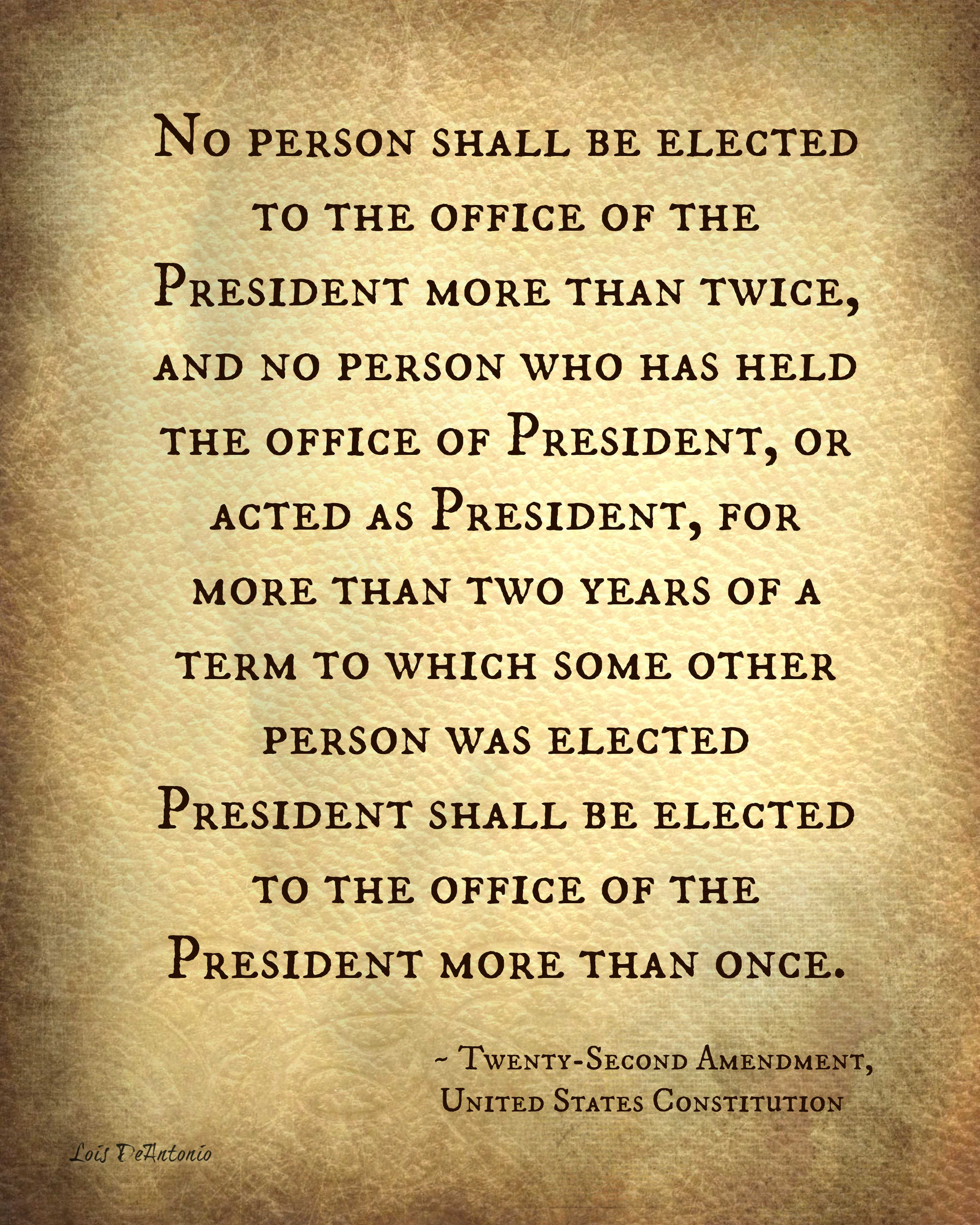
The 22nd Amendment to the United States Constitution establishes that no person shall be elected to the office of the President more than twice. It further restricts individuals who have served more than two years of a term to which someone else was elected from being elected more than once themselves.
In 2026, as the United States approaches its next major election cycle, the 22nd Amendment remains a cornerstone of the American executive structure. This constitutional mandate represents a formalization of a long-standing "unwritten rule" that governed the early Republic, and its existence ensures a regular rotation of executive leadership. While the amendment appears straightforward, its historical origins, legal nuances, and impact on presidential power are complex. To understand the current landscape of American governance, one must look at how this amendment came to be, how it functions in practice, and the debates that continue to surround it.
The Historical Precedent of George Washington
For the first 150 years of the United States, presidential term limits were a matter of tradition rather than law. George Washington, the nation’s first president, famously declined to seek a third term in 1796. His decision was not based on a legal requirement but on a desire to demonstrate that the presidency was not a lifetime appointment or a monarchy in disguise. Washington’s "Farewell Address" set a precedent that his successors, including Thomas Jefferson, James Madison, and James Monroe, felt compelled to follow.
Thomas Jefferson, in particular, was vocal about the necessity of rotation in office. He argued that if a president could be re-elected indefinitely, the office would eventually become a "for life" position, leading to corruption and the erosion of democratic principles. This "two-term tradition" became so deeply ingrained in the American political psyche that it was rarely challenged throughout the 19th and early 20th centuries. Presidents like Ulysses S. Grant and Theodore Roosevelt explored the possibility of a third term, but their efforts were either rebuffed by their parties or the electorate, reinforcing the idea that two terms were the maximum acceptable limit for a single individual.
The Catalyst: Franklin D. Roosevelt’s Four Terms
The two-term tradition remained intact until the extraordinary circumstances of the mid-20th century. Franklin D. Roosevelt (FDR) was first elected in 1932 during the depths of the Great Depression. After serving two terms, Roosevelt broke the long-standing precedent by running for a third term in 1940. He argued that the instability of the burgeoning World War II required experienced and consistent leadership. The American electorate agreed, granting him a third, and eventually a fourth, term in 1944.
Roosevelt’s departure from tradition sparked significant political controversy. While his supporters viewed his extended tenure as a necessary response to global crises, his critics viewed it as a dangerous expansion of executive power. Upon FDR’s death in 1945, shortly after beginning his fourth term, there was a swift and bipartisan movement in Congress to ensure that no future president could hold the office for such an extended period. The fear was that a charismatic leader could effectively become a "president-for-life," undermining the checks and balances essential to a federal republic.
The Legislative Journey and Ratification
The 80th Congress, which convened in 1947 with a Republican majority, made the proposal of a term-limit amendment a high priority. House Joint Resolution 27 was introduced to limit the presidency to two terms. The debate in Congress was not merely about Roosevelt's legacy but about the fundamental nature of executive power. Supporters argued that term limits were a "guard against the risks of executive ambition," while opponents argued that the people should have the right to elect whoever they chose, especially during times of national emergency.
The amendment was passed by Congress on March 21, 1947, and sent to the states for ratification. The process took nearly four years. On February 27, 1951, Minnesota became the 36th state to ratify the amendment, making it the 22nd Amendment to the U.S. Constitution. It is important to note that the amendment included a "grandfather clause" that exempted the sitting president at the time, Harry S. Truman. Although Truman was eligible to run for another term in 1952, he ultimately chose not to, further solidifying the new legal standard.
Technical Mechanics: The "Two-Year" Rule
The text of the 22nd Amendment is precise regarding how partial terms are calculated. This is particularly relevant in cases where a Vice President succeeds to the presidency due to the death, resignation, or removal of the incumbent.
- Direct Election: A person can be elected to the office of President only twice.
- Succession Rule: If an individual succeeds to the presidency and serves more than two years of the remaining term, they can only be elected to the presidency once in their own right.
- Maximum Tenure: If an individual succeeds to the presidency and serves two years or less of the remaining term, they can still be elected to two full terms.
This means that the absolute maximum time a person can serve as President is technically ten years (two years of a predecessor's term plus two elected four-year terms). This nuance ensures that a Vice President who takes over very early in a term cannot maintain power for nearly twelve years, which was a specific concern for the framers of the amendment.
Comparison of Presidential Eligibility Under the 22nd Amendment
| Scenario | Time Served as Successor | Remaining Elected Eligibility | Total Potential Years |
|---|---|---|---|
| Standard Election | 0 years | 2 Full Terms | 8 Years |
| Early Succession | 3 years (More than 2) | 1 Full Term | 7 Years |
| Late Succession | 1.5 years (2 or less) | 2 Full Terms | 9.5 Years |
| Maximum Possible | Exactly 2 years | 2 Full Terms | 10 Years |
Impact on Executive Power: The "Lame Duck" Phenomenon
One of the most significant consequences of the 22nd Amendment is the creation of the "lame duck" period. Because a second-term president cannot seek re-election, their political influence often diminishes as their term nears its end. Members of Congress, foreign leaders, and even the president's own cabinet may begin to look toward the next administration, making it more difficult for the sitting president to enact major policy shifts or pass significant legislation in their final years.
However, some historians argue that the 22nd Amendment actually empowers a second-term president. Freed from the pressures of campaigning and the need to appease donors or specific voting blocs for re-election, a president may be more willing to take bold, controversial actions that they believe are in the long-term interest of the country. This tension between diminished legislative leverage and increased political independence is a recurring theme in modern two-term presidencies.
Arguments for and Against the Amendment
Since its ratification, the 22nd Amendment has been the subject of ongoing debate. While there is no significant movement to repeal it in 2026, the arguments for and against it provide insight into American democratic theory.
The Case for Term Limits
- Prevention of Tyranny: Limits the possibility of an individual consolidating power to the point of becoming a dictator or "king."
- Fresh Perspectives: Forces a rotation in leadership, bringing new ideas and energy into the executive branch.
- Prevents Stagnation: Reduces the likelihood of a permanent political class forming around a single long-term executive.
The Case Against Term Limits
- Undemocratic Restraint: Limits the choice of the voters. If the people want to re-elect a successful president, the amendment prevents them from doing so.
- Loss of Experience: During times of crisis, the nation may be forced to replace an experienced, proven leader with an unproven one simply because of a "calendar" requirement.
- Lame Duck Status: As mentioned, it can weaken the president’s ability to govern effectively in their final years.
Modern Application and Legal Stability
In the context of 2026, the 22nd Amendment is viewed as a settled point of constitutional law. While political figures occasionally suggest its repeal—often during a popular president’s second term—such efforts have never gained the two-thirds majority in Congress or the three-fourths majority of state legislatures required for a new amendment.
The 22nd Amendment also interacts with the 12th Amendment, which governs the election of the President and Vice President. Some legal scholars have debated whether a two-term president could serve as Vice President. The 12th Amendment states that "no person constitutionally ineligible to the office of President shall be eligible to that of Vice-President of the United States." Because the 22nd Amendment makes a two-term president ineligible to be elected to the presidency, many argue they are also ineligible to serve as Vice President, though this has never been tested in court. For more detailed constitutional interpretations, the National Constitution Center provides extensive scholar-led analysis.
Summary of Ratification and Legal Standing
The 22nd Amendment was born out of a desire to codify tradition and protect the democratic process from the perceived dangers of indefinite executive tenure. Its ratification was a direct response to the unique presidency of Franklin D. Roosevelt and reflected a post-war consensus on the need for limits on state power.
- Proposed by Congress: March 21, 1947.
- Ratified by States: February 27, 1951.
- Primary Effect: Two-term limit for the presidency.
- Key Source: National Archives - The Constitution of the United States
Frequently Asked Questions
Can a former president be elected to a third term if there is a gap between terms?
No. The 22nd Amendment states that "No person shall be elected to the office of the President more than twice." It does not specify that the terms must be consecutive. Therefore, a person who has served two terms, whether consecutively or with a break in between (like Grover Cleveland), cannot be elected a third time.
Does the 22nd Amendment apply to the Vice President?
The 22nd Amendment specifically limits the "office of the President." It does not place term limits on the Vice Presidency. A person could theoretically serve as Vice President for an indefinite number of terms, provided they are not also seeking the presidency after having already served two terms.
What happens if a President dies and the Vice President takes over?
The "two-year rule" applies. If the Vice President serves more than two years of the remaining term, they can only be elected to the presidency once more. If they serve two years or less, they can still be elected to two of their own four-year terms.
Why was Harry Truman exempt from the 22nd Amendment?
The amendment included a specific clause stating it would not apply to "any person holding the office of President when this Article was proposed by the Congress." This was done to ensure the amendment was not seen as a personal attack on the sitting president, Harry Truman, even though he was the one serving out the remainder of FDR's fourth term.
Has any president served more than eight years since 1951?
No. While several presidents have served two full terms (8 years), none have exceeded that since the amendment was ratified. Lyndon B. Johnson was eligible to run for a second full term in 1968 because he had served less than two years of John F. Kennedy's term, but he chose to withdraw from the race.
Practical Recommendations for Students and Researchers
For those studying the 22nd Amendment or executive power, it is essential to look beyond the text of the law and examine the political climate of the late 1940s. Understanding the transition from the Great Depression and World War II into the Cold War provides the necessary context for why the 80th Congress felt so strongly about limiting presidential terms.
If you are researching the legal boundaries of the amendment, consult the Constitution Annotated (CONAN) provided by the Library of Congress. This resource offers the most authoritative legal analysis used by the judicial branch and legal professionals to interpret the amendment’s application in various hypothetical scenarios.