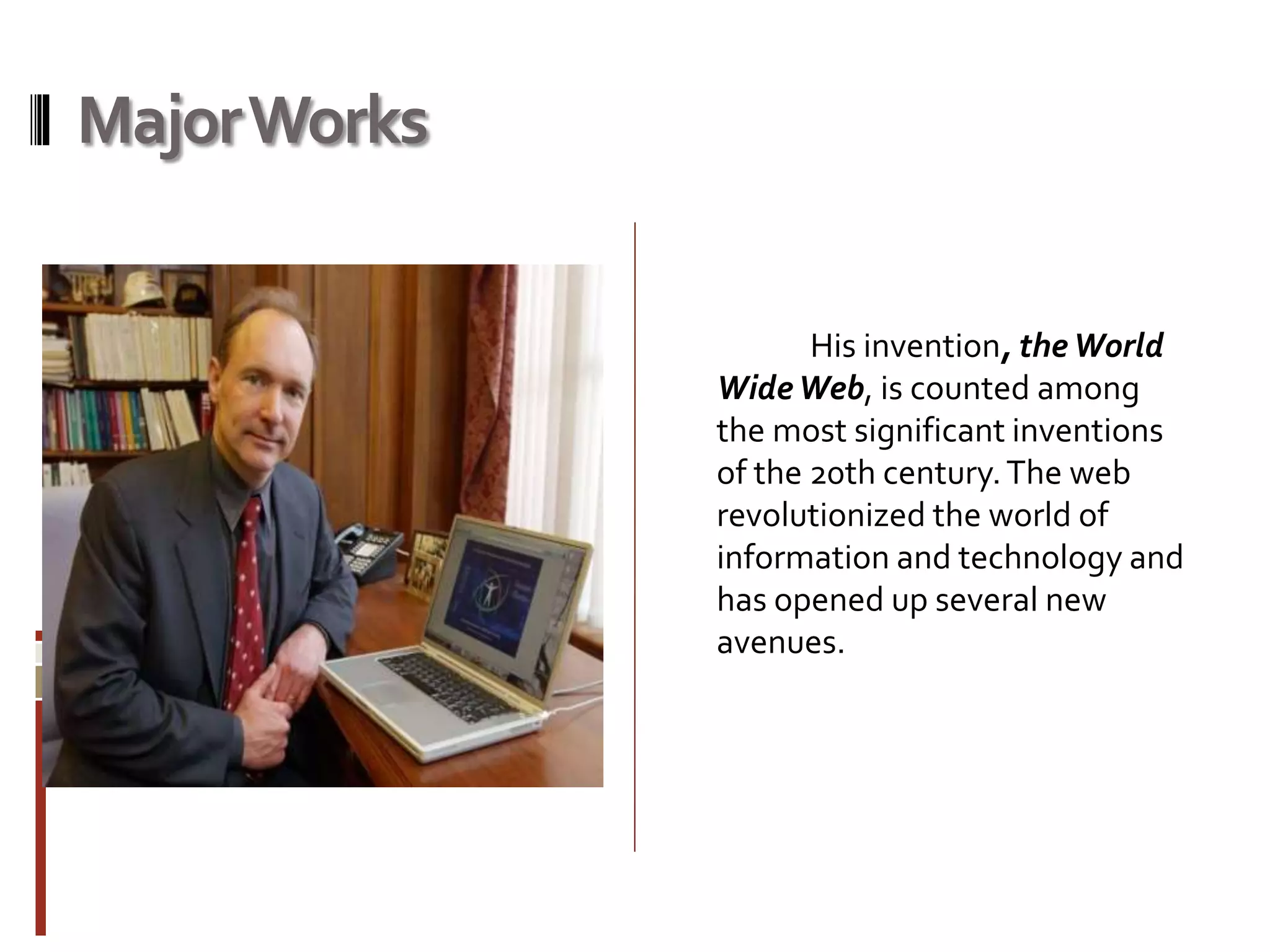
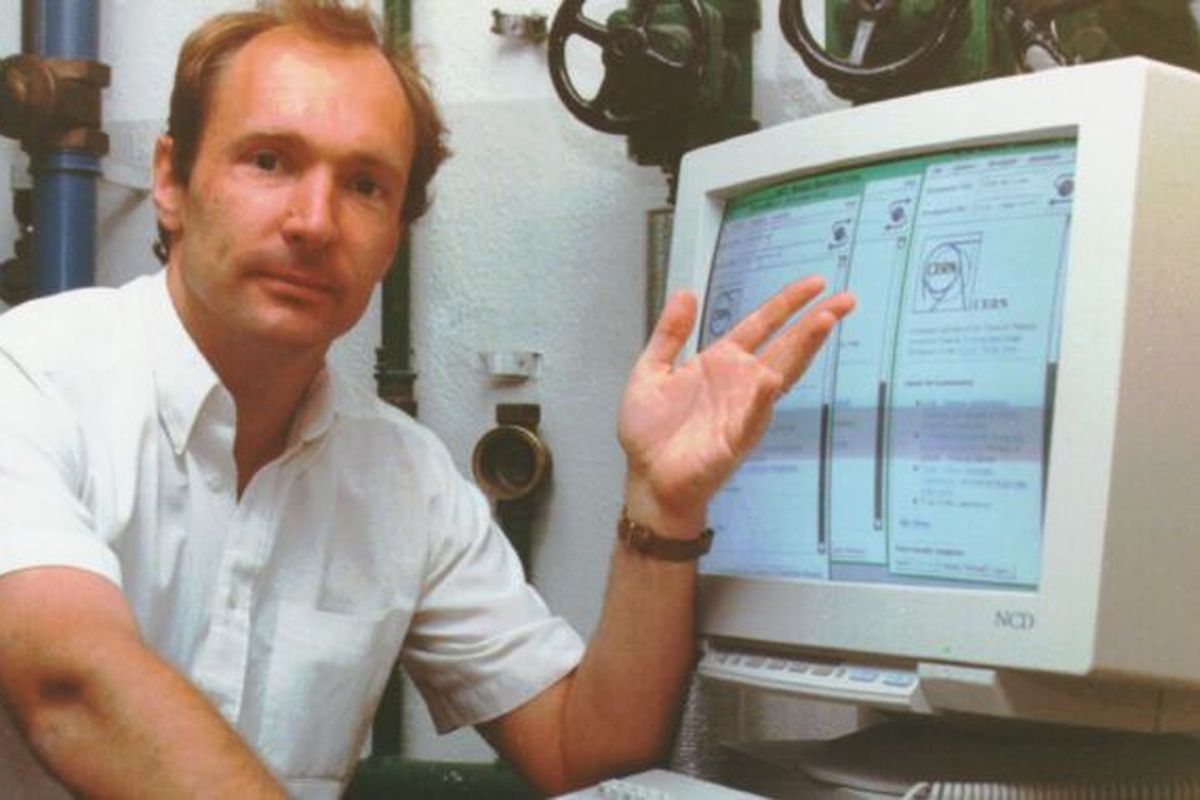
Sir Tim Berners-Lee invented the World Wide Web in 1989 while working at CERN, fundamentally transforming global communication, commerce, and culture by introducing the first web browser, server, and core protocols that made digital information universally accessible to the public.
Introduction to a Digital Pioneer
The digital landscape we navigate every single day—our access to instant communication, global marketplaces, cloud-based data, and endless information—rests upon a single foundational invention. While many computer scientists built the underlying hardware and packet-switched networking infrastructure of the early internet, Sir Tim Berners-Lee created the World Wide Web. Far from being a corporate product or a government-funded commercial enterprise, the Web began as an elegant solution to a messy information-management problem at a European physics laboratory.
Understanding the man behind the invention requires looking past the standard biographical outlines. Berners-Lee’s journey encompasses early tinkering with electronics, brilliant academic foundations, a profound commitment to open access, and an ongoing crusade to keep the internet decentralized and safe for humanity. This comprehensive exploration examines ten fascinating facts about the father of the web, shedding light on his technical achievements, his philosophical ideals, and his enduring legacy.
1. He Invented the World Wide Web While Working at CERN
In March 1989, a young software engineer named Tim Berners-Lee submitted a proposal to his management at CERN (the European Organization for Nuclear Research) titled Information Management: A Proposal. CERN was a massive, highly collaborative scientific environment with thousands of visiting researchers constantly rotating through facilities, changing offices, and losing vital project documentation across incompatible computer systems.
Berners-Lee envisioned a universal linked information system that would allow researchers to pool their knowledge across disparate networks. Initially titled "Mesh," his proposal combined hypertext concepts with the emerging internet to create a seamless way to navigate documents. His supervisor, Mike Sendall, famously annotated the proposal with the phrase, "Vague, but exciting," and gave Berners-Lee permission to develop it on a NeXT workstation during his spare time. By late 1990, he had successfully written the core components that brought the Web to life.
2. He Wrote the First Web Browser and Web Server
When people discuss the birth of the Web, they often conflate it with the broader internet, which had existed for decades in the form of ARPANET and specialized academic networks. However, the Web itself required entirely new software layers to function. Berners-Lee did not just conceptualize these layers; he built them single-handedly.
Running on his NeXT computer, he built WorldWideWeb, the very first web browser and WYSIWYG (What You See Is What You Get) editor. Crucially, the application allowed users not only to read web pages but also to write and edit them directly within the same interface. Simultaneously, he wrote the first web server software and established the foundational protocols that allowed client-server communication:
- URI (Uniform Resource Identifier): A unique string of characters used to identify a resource.
- HTTP (Hypertext Transfer Protocol): The set of rules for transferring files across the network.
- HTML (Hypertext Markup Language): The formatting language used to structure documents on the Web.
3. He Decided Not to Patent His Invention
One of the most consequential decisions in human history was financial restraint rooted in scientific idealism. Berners-Lee could have easily patented his protocols, web browser, and server architecture in the early 1990s, positioning himself to become one of the wealthiest individuals on the planet as the dot-com boom accelerated.
Instead, in 1993, CERN—acting on Berners-Lee’s strong recommendation—made the software available on a royalty-free basis, releasing the code into the public domain. This historic choice ensured that no single corporation or individual could control, gatekeep, or charge tolls for navigating the Web. By removing economic barriers to entry, Berners-Lee catalyzed explosive global adoption, allowing entrepreneurs, academics, and everyday citizens to build upon open web standards without legal friction.
4. He Founded the World Wide Web Consortium (W3C)
As the Web expanded beyond academic circles into commercial markets in the mid-1990s, a major threat emerged: fragmentation. Different software companies, most notably Netscape and Microsoft during the famous browser wars, began introducing proprietary extensions to HTML. If left unchecked, this trend threatened to fracture the Web into incompatible walled gardens.
To prevent this digital Balkanization, Berners-Lee left CERN in 1994 and moved to the Massachusetts Institute of Technology (MIT), where he founded the World Wide Web Consortium (W3C). Serving as the international standards organization for the World Wide Web, the W3C brings together member organizations, full-time staff, and the public to develop interoperable technologies, specifications, and guidelines that ensure the Web remains open, accessible, and unified for everyone.
5. He Was Knighted by Queen Elizabeth II
In recognition of his monumental contributions to global society, Berners-Lee has received numerous high-profile international honors, awards, and honorary degrees. Among the most prestigious of these is his knighthood.
In 2004, Queen Elizabeth II appointed him a Knight Commander of the Order of the British Empire (KBE) in the Queen’s New Year Honours list for his pioneering work on the World Wide Web. Years later, in 2007, he was further honored with admission to the Order of Merit, an extremely exclusive order limited to just 24 living members chosen for their exceptionally eminent service to the armed forces, science, literature, art, or public life.
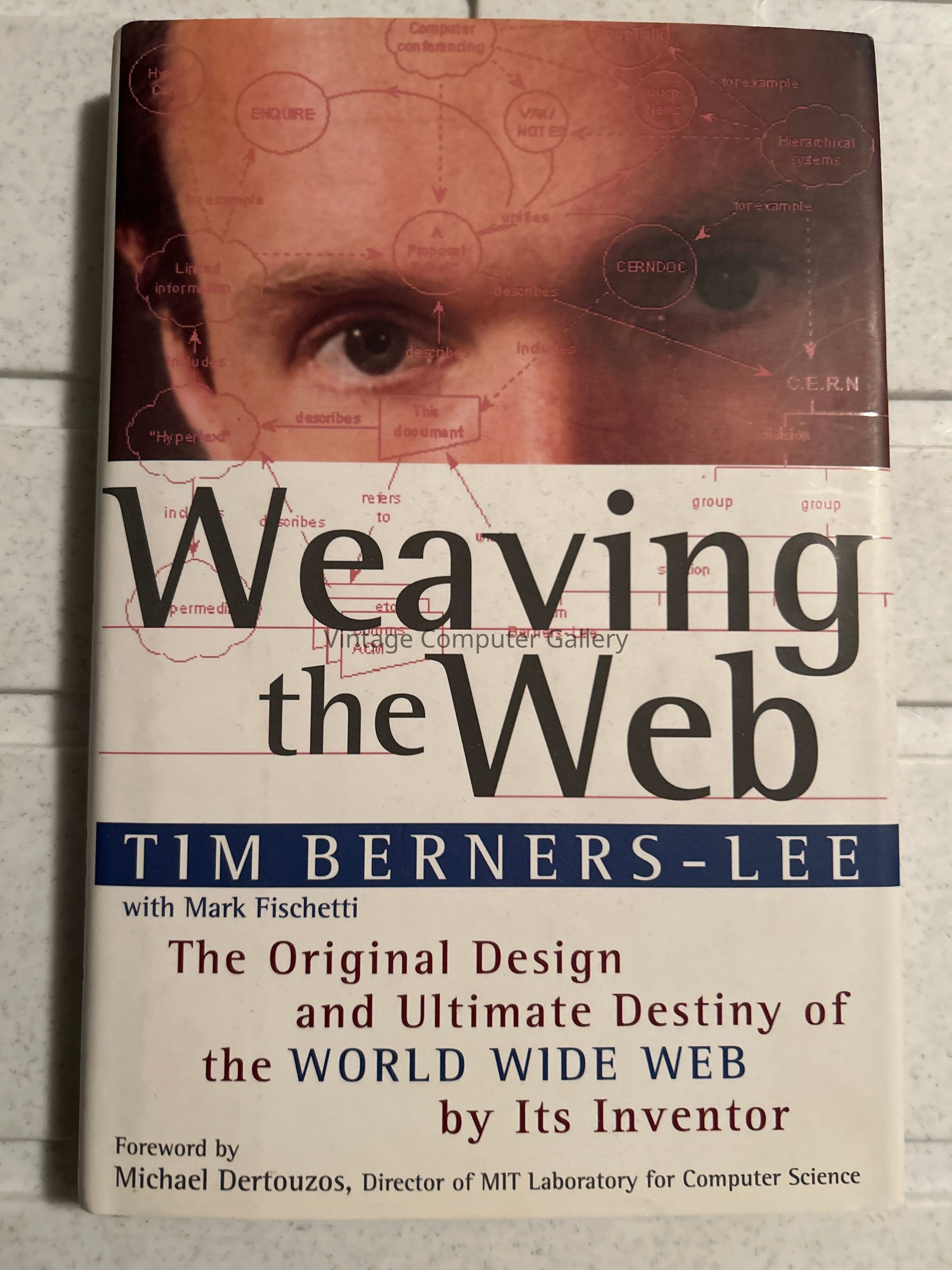
6. He Co-Authored the Iconic 1999 Book Weaving the Web
While Berners-Lee spent decades writing code and technical specifications, he also documented his philosophy and the turbulent history of the Web's early years in print. In 1999, he published his definitive book, Weaving the Web: The Original Design and Ultimate Destiny of the World Wide Web by Its Inventor (co-authored with Mark Fischetti).
In the book, Berners-Lee details his original vision for the Web as a collaborative, interactive medium where users could act as both creators and consumers. He expresses his anxieties regarding corporate centralization, the erosion of privacy, and the commercial pressures that threatened to subvert his original democratic design. The book remains essential reading for anyone seeking to understand the socio-political motivations behind modern web architecture.
7. He Won the Turing Award in 2016
Often described as the "Nobel Prize of computing," the A.M. Turing Award is presented annually by the Association for Computing Machinery (ACM) to individuals for major contributions of lasting technical importance to the computer field.
In 2016, Berners-Lee was awarded the Turing Award "for inventing the World Wide Web, the first web browser, and the fundamental protocols and algorithms allowing the Web to scale." The award cemented his status not only as a visionary evangelist of digital culture but as a world-class computer scientist whose engineering breakthroughs altered the trajectory of human technology.
8. He Participated in the 2012 London Olympics Opening Ceremony
Few computer scientists achieve mainstream pop-culture icon status, but Berners-Lee found himself center stage before a billion television viewers during the global spectacle of the 2012 Summer Olympics opening ceremony in London.
Sitting at a vintage NeXT computer in the middle of a stadium-sized recreation of a British NHS hospital ward, he tapped out a live message that was instantly broadcasted across the stadium's massive screen and beamed worldwide: "This is for everyone." The poignant moment encapsulated his lifelong crusade to ensure that the Web remains a public good, designed to empower every human being on the planet rather than a privileged elite.
9. He Created the "Contract for the Web" to Fix the Internet
As the Web evolved past its open academic roots into an ecosystem dominated by massive surveillance capitalism, misinformation, algorithmic polarization, and privacy scandals, Berners-Lee grew deeply concerned about the health of his creation.
In response, he launched the Contract for the Web in 2019 through the World Wide Web Foundation. The global action plan calls upon governments, companies, and citizens to commit to specific principles that protect human rights online. The contract outlines concrete responsibilities for governments (ensuring everyone can connect to the internet), companies (making the internet affordable and respecting privacy), and citizens (building respectful online communities) to safeguard the digital future.
10. He Is Actively Developing Solid to Decentralize Data
Rather than merely critiquing the current state of tech monopolies, Berners-Lee has dedicated his recent years to engineering a technical solution: Solid (derived from "social linked data").
Solid is a decentralized web architecture project aimed at radically changing how web applications work today. Currently, platforms like social media giants and cloud services store user data in massive proprietary silos. Solid decouples data from applications, allowing individuals to store their personal data in secure, decentralized personal online data stores called "Pods." Users retain absolute ownership and granular control over who can access their data, paving the way for a privacy-first web ecosystem that strips power away from data brokers and restores agency to the individual user.
Core Milestones in Web History
| Year | Milestone | Description |
|---|---|---|
| 1989 | The Initial Proposal | Submits the foundational hypertext document management proposal at CERN. |
| 1990 | First Browser & Server | Writes the WorldWideWeb browser and server software on a NeXT computer. |
| 1993 | Public Domain Release | CERN releases web technology into the public domain, guaranteeing royalty-free access. |
| 1994 | Founding of W3C | Moves to MIT and establishes the World Wide Web Consortium to standardize web protocols. |
| 2016 | ACM Turing Award | Receives computing's highest honor for inventing the Web and its core scaling algorithms. |
| 2019 | Contract for the Web | Launches a global initiative to combat online abuse, misinformation, and privacy violations. |
Frequently Asked Questions
Did Tim Berners-Lee invent the internet?
No. The internet is a vast network of interconnected hardware and communication protocols developed by researchers, academics, and the U.S. Department of Defense (via ARPANET) starting in the 1960s. Tim Berners-Lee invented the World Wide Web in 1989, which is an information-sharing model that runs on top of the internet using browsers, URLs, HTML, and HTTP.
Why didn't Tim Berners-Lee get rich from the Web?
He deliberately chose not to patent his web technologies or charge licensing fees. With the backing of CERN, he released the code into the public domain in 1993 to ensure that the Web would be universally accessible, spurring global growth, innovation, and open commercial enterprise without legal barriers.
What is Tim Berners-Lee working on today?
He is currently focused on Solid, an open-source project designed to decentralize the Web. Solid allows users to store their personal data in secure, user-controlled vaults ("Pods"), breaking up corporate data monopolies and giving individuals complete ownership over their digital identity and privacy.
What was the first-ever website?
The world's first website was info.cern.ch, hosted on Berners-Lee's NeXT computer at CERN. It went live on August 6, 1991, serving as a basic directory explaining what the World Wide Web project was and how users could set up their own servers and browsers.
Final Recommendation and Next Actions
To truly appreciate the scope of Sir Tim Berners-Lee's contributions, start by exploring the archived pages of the original 1991 website hosted at CERN to see how humble the origins of modern digital life really were. If you are concerned about data privacy and the future of online decentralization, investigate the open-source Solid project to understand how next-generation web protocols aim to return data ownership to individual users.