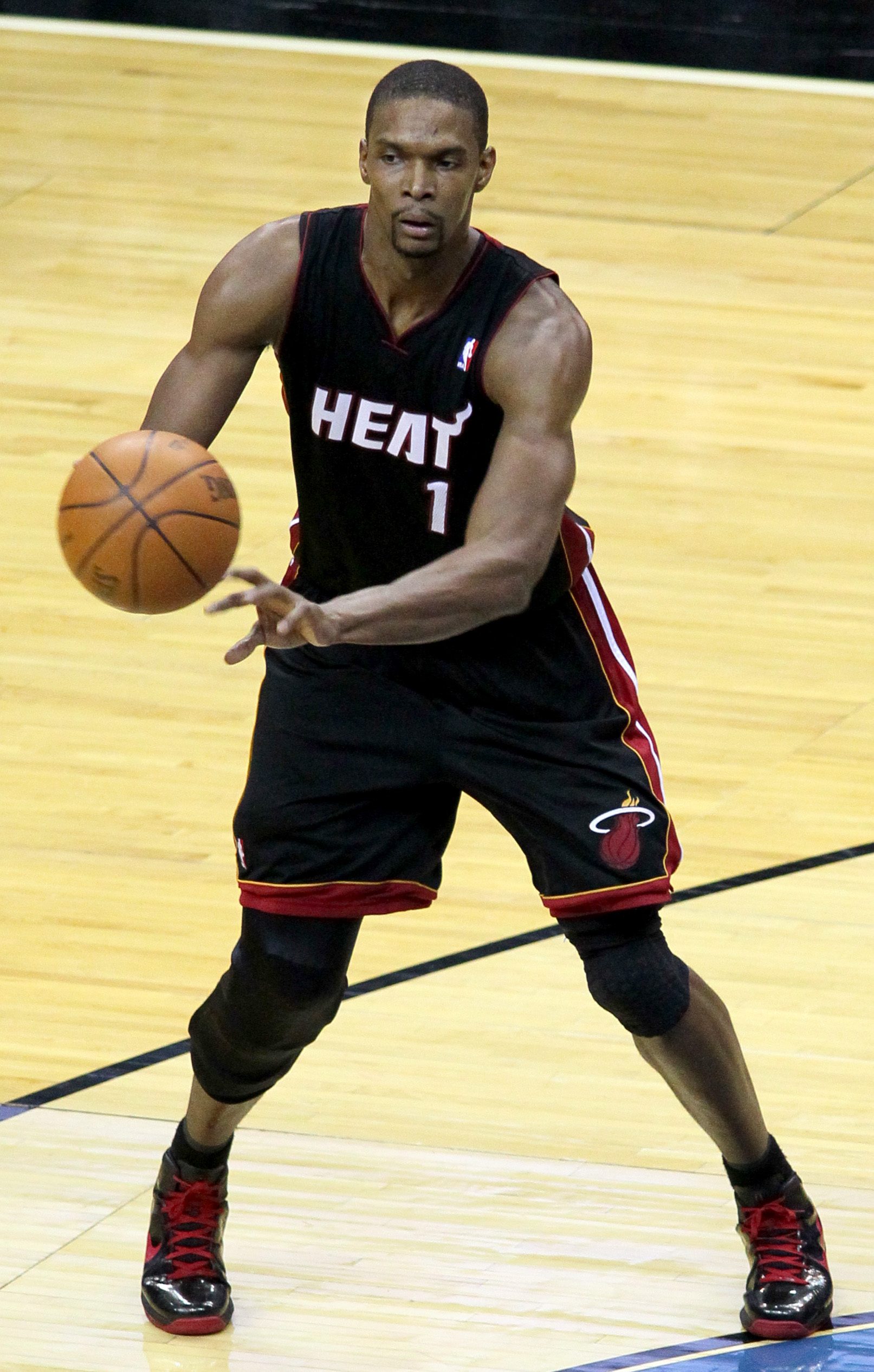
Chris Bosh is a Naismith Memorial Basketball Hall of Fame inductee, an 11-time NBA All-Star, and a two-time NBA Champion whose career redefined the role of the modern power forward. Best known for his pivotal role in the Miami Heat’s "Big Three" era and his franchise-leading years with the Toronto Raptors, Bosh combined elite athleticism with a cerebral approach to the game.
The Early Foundation: From Dallas to Georgia Tech
Born Christopher Wesson Bosh on March 24, 1984, in Dallas, Texas, his journey to basketball superstardom was rooted in a combination of academic discipline and athletic rigor. Raised in Hutchins, Texas, Bosh was a standout student, frequently participating in the Association of Computing Machinery and the National Society of Black Engineers. This intellectual curiosity would later manifest on the court as an "IQ-first" playing style.
At Lincoln High School in Dallas, Bosh led his team to a 40–0 record and a Class 4A state title, while being named the Basketball America National Player of the Year. His decision to attend Georgia Tech was driven by the school’s academic reputation and its competitive ACC basketball program. During his lone season with the Yellow Jackets (2002–2003), Bosh led the ACC in field goal percentage and blocks, proving he was ready for the professional stage after just one year.
The Toronto Raptors Era: Becoming "CB4"
Selected fourth overall in the legendary 2003 NBA Draft—a class that included LeBron James, Dwyane Wade, and Carmelo Anthony—Bosh arrived in Toronto during a period of transition. Following the departure of Vince Carter, the Raptors needed a new face for the franchise. Bosh stepped into that vacuum with a quiet confidence that eventually earned him the nickname "CB4."
In Toronto, Bosh developed into a double-double machine. Standing 6'11" with a lean frame, he possessed a quick first step that allowed him to blow past traditional, slower-footed centers. His mid-range jumper became one of the most reliable weapons in the league. By the 2005-2006 season, Bosh was an All-Star, and by 2007, he had led the Raptors to their first-ever Atlantic Division title.
During his seven seasons in Toronto, Bosh became the franchise’s all-time leader in points, rebounds, and blocks. However, despite individual brilliance, deep playoff runs remained elusive. This frustration eventually led to the seismic shift of the 2010 offseason, a moment that would change NBA history forever.
The Miami Heat and the Art of Sacrifice
In July 2010, Chris Bosh joined LeBron James and Dwyane Wade in Miami, forming the most scrutinized "Superteam" in sports history. While James and Wade garnered most of the headlines, basketball analysts often noted that Bosh was the "most important" piece of the puzzle because his unique skill set allowed the other two to flourish.
To make the "Big Three" work, Bosh had to fundamentally alter his game. He transitioned from being the primary offensive option in Toronto to a "third star" who specialized in floor spacing and elite defensive mobility.
Defensive Transformation and Positionless Basketball
Bosh became the anchor of the Heat’s "swarming" defense. His ability to defend the pick-and-roll was revolutionary; he could "show" or "hedge" out to the perimeter to stop a guard and then recover quickly to the paint. This versatility was the engine behind Miami's consecutive championships in 2012 and 2013. He sacrificed his individual statistics—dropping from a 24-point-per-game scorer in Toronto to roughly 18 points per game in Miami—for the sake of team chemistry and winning.
The 2013 Finals: The Greatest Rebound in History
Perhaps the most iconic moment of Bosh’s career occurred in Game 6 of the 2013 NBA Finals against the San Antonio Spurs. With the Heat trailing by three points in the closing seconds, LeBron James missed a three-pointer. Bosh soared over several Spurs players to grab the offensive rebound and immediately zipped a pass to Ray Allen in the corner. Allen hit the game-tying three, and the Heat went on to win the game in overtime and the series in Game 7. Without Bosh’s instinctual rebound and poise, the Miami Heat legacy would look vastly different today.
Technical Analysis: The Prototype for the "Stretch 4"
Long before the "three-and-D" big man was a standard requirement in the NBA, Chris Bosh was perfecting the archetype. His evolution as a shooter was a response to the league's changing geometry.
- Floor Spacing: In his early years, Bosh lived in the low post and the mid-range. By his final seasons, he had extended his range to the three-point line, shooting 36.5% from deep in 2015-16. This forced opposing centers to leave the paint, opening driving lanes for teammates.
- Pick-and-Roll Versatility: Bosh was equally dangerous as a "roller" (diving to the basket) or a "popper" (staying out for a jumper).
- Lateral Agility: His light feet allowed him to switch onto smaller guards during defensive rotations, a trait that is now the gold standard for modern NBA centers like Bam Adebayo or Anthony Davis.
Health Challenges and Forced Retirement
The most tragic chapter of Bosh’s career began in February 2015, when he was hospitalized with a blood clot in his lung (pulmonary embolism). The condition was life-threatening and sidelined him for the remainder of the season.
He made a courageous return for the 2015-16 season, playing at an All-Star level and proving his game had not diminished. However, during the 2016 All-Star break, a second clot was discovered, this time in his leg (deep vein thrombosis). This development was catastrophic for his professional career. Medical experts and the NBA’s fitness-to-play panel determined that the blood-thinning medication required to manage his condition made the physical contact of professional basketball too dangerous.
Bosh spent the next three years fighting to return, seeking alternative medical opinions and training rigorously. However, in 2019, the Miami Heat officially retired his No. 1 jersey, and Bosh formally announced his retirement. While his career was cut short at age 31, his impact was already solidified.
Career Statistics and Accolades
The following table summarizes the statistical highlights of Bosh’s 13-season NBA career.
| Category | Toronto Raptors (2003–2010) | Miami Heat (2010–2016) | Career Total/Average |
|---|---|---|---|
| Games Played | 509 | 384 | 893 |
| Points Per Game | 20.2 | 18.0 | 19.2 |
| Rebounds Per Game | 9.4 | 7.3 | 8.5 |
| Blocks Per Game | 1.2 | 0.9 | 1.0 |
| Field Goal % | 49.2% | 49.6% | 49.4% |
| All-Star Selections | 5 | 6 | 11 |
| NBA Championships | 0 | 2 | 2 |
Life in 2026: The Renaissance Man
As of 2026, Chris Bosh has successfully transitioned from an elite athlete to a multifaceted creator and entrepreneur. He has embraced the title of "Renaissance Man," involving himself in various intellectual and artistic pursuits that mirror his early interests in Dallas.
Literature and Advocacy
Bosh published his acclaimed book, Letters to a Young Athlete, which serves as a psychological roadmap for navigating the highs and lows of professional sports. He frequently speaks at universities and corporate events about the "art of the pivot"—how to find purpose when one’s primary identity is suddenly stripped away.
Music and Technology
An accomplished guitar player and producer, Bosh has spent his retirement years in the studio. He founded a record label and has collaborated with several high-profile artists, blending his love for blues and hip-hop. Additionally, his early interest in coding led him to invest in several EdTech (educational technology) startups, specifically those aimed at teaching computer science to underprivileged youth.
Family and Legacy
Bosh remains a devoted father to his five children. His social media presence often highlights the importance of fatherhood and the balance between professional ambition and domestic life. In the basketball world, he is a frequent consultant for teams looking to develop versatile big men, and he remains an ambassador for the NBA Cares program.
Why Chris Bosh Matters: The Final Verdict
History has been kind to Chris Bosh. While he was sometimes overshadowed by the flashier playstyles of his contemporaries, the "analytics revolution" in basketball has highlighted just how ahead of his time he truly was. Coaches today look for "the next Chris Bosh"—a player who can defend five positions, shoot the three, and prioritize winning over personal glory.
His induction into the Naismith Memorial Basketball Hall of Fame in 2021 was a validation of his unique path. He proved that greatness isn't always about being the loudest voice in the room; sometimes, it’s about being the smartest and most adaptable.
Frequently Asked Questions
Why did Chris Bosh have to retire early?
Chris Bosh was forced to retire due to recurring blood clots (pulmonary embolism and deep vein thrombosis). Because these conditions require the use of blood thinners, the risk of internal bleeding or fatal injury during the high-impact environment of an NBA game was deemed too high by medical professionals and the league.
Is Chris Bosh in the Hall of Fame?
Yes, Chris Bosh was officially inducted into the Naismith Memorial Basketball Hall of Fame as part of the Class of 2021. This honor recognized his 11 All-Star appearances, two NBA titles, and his Olympic Gold Medal with the 2008 "Redeem Team."
What were Chris Bosh's career-high stats?
Bosh’s career-high for points in a single game was 44, achieved against the Milwaukee Bucks in 2010. His career-high for rebounds was 22, recorded against the Philadelphia 76ers in 2005.
What does Chris Bosh do now in 2026?
As of 2026, Bosh is a successful author, music producer, and tech investor. He also works as a mentor for young athletes and is a prominent advocate for health awareness, specifically regarding blood clot prevention.
Did the Toronto Raptors retire Chris Bosh's jersey?
While his No. 1 jersey was retired by the Miami Heat in 2019, the Toronto Raptors have had ongoing discussions regarding a similar honor. Bosh remains the franchise's all-time leader in several categories, and his impact on Canadian basketball is widely celebrated.
Final Recommendation
For those looking to understand the mechanics of modern basketball, studying Chris Bosh’s Miami Heat tape from 2011–2014 is essential. Beyond the court, his book Letters to a Young Athlete is a must-read for anyone facing a forced career transition. Bosh’s life teaches us that while we cannot always control the circumstances that end our primary passions, we have full control over the grace and intelligence with which we build our second act.