Frida Kahlo remains one of history’s most recognizable and revered artistic figures, celebrated worldwide for her uncompromising self-portraits, vibrant use of color, and fierce independence. Beyond the iconic unibrow, floral crowns, and Mexican folk attire lies a complex life defined by profound physical suffering, political radicalism, and a deeply passionate existence. Understanding the truth behind the myth requires looking past commercialized imagery to examine her actual writings, medical history, and artistic evolution.
Introduction to the Legend and the Reality
The global fascination with Magdalena Carmen Frida Kahlo y Calderón has grown exponentially in the decades following her death in 1954. Popular culture often reduces her to a bohemian martyr or a tragic romantic figure, overshadowing her intellectual rigor, sharp wit, and revolutionary artistic vision.
Born in Coyoacán, Mexico, in 1907, Kahlo constructed her identity just as meticulously as she painted her canvases. By separating historical documentation from romanticized folklore, art historians and biographers have uncovered a far more dynamic picture. This examination explores ten defining facts that strip away the mythology to reveal the genuine human being and pioneering artist who changed modern art forever.
1. She Contracted Polio at Age Six
Long before her catastrophic bus accident, Kahlo's resilience was tested in childhood. At the age of six, she contracted polio, a viral disease that left her right leg significantly thinner and shorter than her left.
To cope with the bullying of neighborhood children, young Frida engaged in rigorous physical activities—such as boxing, soccer, and wrestling—which were highly unconventional for girls in early 20th-century Mexico. This early bout with illness not only forged her characteristic determination but also introduced her to long periods of bed rest and isolation, planting the seeds for her inward-looking artistic perspective. To camouflage the lasting physical disparity caused by the disease, she later adopted the voluminous traditional Tehuana skirts that became her signature fashion statement.
2. Her Artistic Career Began While Recovering From a Near-Fatal Bus Accident
On September 17, 1925, Kahlo's life changed forever when the wooden bus she was riding collided with a streetcar. The injuries she sustained were catastrophic: an iron handrail pierced her abdomen and pelvis, fracturing her spine, collarbone, ribs, and pelvis in multiple places, while fracturing her right leg and foot in eleven places.
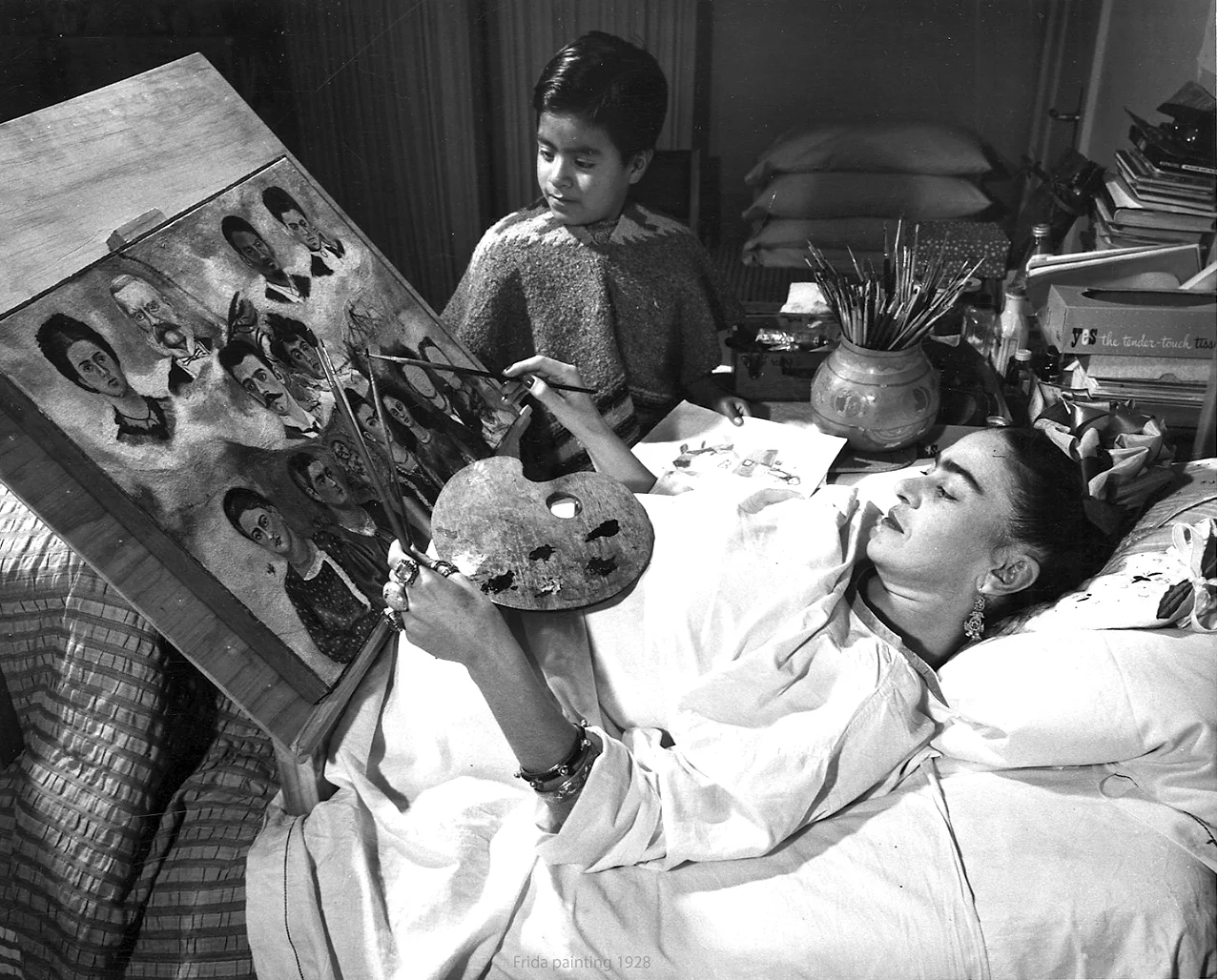
Confined to a bed for months in a body cast, Kahlo turned to painting to pass the time and process her trauma. Her mother had a special easel constructed that allowed her to paint while lying flat on her back, and a mirror was placed under the canopy of her bed so she could study her own reflection. What began as a coping mechanism during grueling rehabilitation ultimately birthed an artistic vocation that would define the rest of her life.
3. She Originally Studied Medicine, Not Fine Arts
Before the streetcar accident derailed her academic trajectory, Kahlo had no intention of becoming a professional painter. In 1922, she entered the prestigious National Preparatory School (Escuela Nacional Preparatoria) in Mexico City as one of only a small fraction of female students admitted.
Her ambition was to become a physician, reflecting her deep fascination with science, anatomy, and the natural world. This early scientific training profoundly influenced her later artistic style. Many of her most famous works incorporate anatomical cross-sections, bleeding hearts, surgical tools, and exposed nervous systems, blending clinical precision with deeply emotional symbolism.
4. Her Marriage to Diego Rivera Was a Tempestuous Partnership
Kahlo’s relationship with renowned muralist Diego Rivera is one of the most famous and turbulent romances in art history. They married in 1929 when she was 22 and he was 43. Rivera, a towering figure in the Mexican muralism movement, recognized her immense talent early on, famously declaring her work authentic and powerful.
However, their marriage was plagued by infidelity on both sides, explosive arguments, and a brief divorce in 1939 before remarrying in 1940. Despite their tumultuous dynamic, they remained each other's greatest artistic critics and emotional anchors. Kahlo famously remarked that being married to Rivera was like living with an erratic, brilliant ogre, yet she remained fiercely loyal to him until her death.
5. She Was an Active Political Radical and Marxist
While her artwork often focuses on intimate, personal trauma, Kahlo was deeply engaged in the geopolitical struggles of the 20th century. She and Diego Rivera were committed Marxists and active members of the Mexican Communist Party.
In 1937, the couple famously used their political influence to petition the Mexican government to grant political asylum to Leon Trotsky, a leader of the Russian Revolution who had been exiled by Joseph Stalin. Trotsky and his wife lived with Kahlo and Rivera at the Casa Azul for several months, and Kahlo even had a brief romantic affair with the revolutionary leader. Throughout her life, her art and personal philosophy aligned closely with anti-imperialism, labor rights, and the celebration of indigenous Mexican culture (indigenismo).
6. She Achieved Her First Solo Exhibition in Mexico Just Before Her Death
Despite gaining international renown later in life, Kahlo struggled for decades to establish herself as an independent artist outside of Rivera’s massive shadow. While her work was exhibited in New York and Paris during the 1930s and 1940s, she did not receive a solo exhibition in her home country until 1953, near the very end of her life.
By this time, her health had deteriorated to such an extent that her doctors ordered strict bed rest. Refusing to miss the opening at the Galería de Arte Contemporáneo in Mexico City, Kahlo arrived at the gallery via an ambulance. She was carried into the exhibition on a hospital bed, which was placed in the center of the gallery. She spent the evening smoking, drinking, and singing traditional songs with the attendees, turning her medical confinement into a defiant theatrical performance.
7. Her Right Leg Was Amputated Due to Gangrene
The chronic pain that shadowed Kahlo's entire adult life culminated in severe medical crises during her final years. By 1953, the complications from her spinal surgeries and chronic infections led to the development of gangrene in her right foot and lower leg.
Doctors performed a surgical amputation below the knee to save her life. While the amputation temporarily relieved some physical agony, it triggered a severe psychological decline and intense depression. Even during this period of immense physical and emotional distress, she continued to paint, utilizing her prosthetic leg and customized boots to maintain a semblance of her iconic personal style.
8. She Kept Extensive Diaries That Reveal Her Inner World
Throughout her final decade, Kahlo maintained an illustrated personal journal that serves as a vital historical and artistic document. The diary features spontaneous watercolor sketches, philosophical musings, poetry, political commentary, and raw confessions of her physical pain and love for Diego Rivera.
Published facsimile editions of the journal allow researchers and admirers to witness the unfiltered workings of her mind. Rather than functioning merely as a log of daily events, the journal mirrors her canvases: a dense, surreal tapestry where personal vulnerability intersects with fierce intellectual curiosity and artistic experimentation.
9. The Casa Azul Was Her Lifelong Sanctuary
The iconic cobalt-blue house in Coyoacán, Mexico City, known as the Casa Azul (Blue House), was the center of Kahlo's universe. It was the house where she was born in 1907, where she lived for much of her life, and where she died in 1954.
Today, the building operates as the Museo Frida Kahlo, preserving her living quarters, studio, and personal belongings largely as she left them. Visitors to the museum can view her original easel, paint tubes, medical corsets, and pre-Columbian artifacts. The house stands not just as a museum, but as a physical manifestation of her aesthetic, deeply tied to Mexican folk art and her enduring love for her homeland.
10. Her Last Painting Celebrated Life, Not Death
In July 1954, despite suffering from severe bronchial pneumonia and failing health, Kahlo participated in a street protest against the CIA-backed overthrow of Guatemalan President Jacobo Árbenz. It was her final public appearance.
A few days later, on July 13, 1954, she passed away in the Casa Azul at the age of 47. Her final completed painting was a vibrant still life of bright red watermelons, titled Viva la Vida (Long Live Life). Inscribed across the flesh of one of the melons are the words: "Viva la Vida — Coyoacán 1954 — Mexico." Rather than focusing on her imminent demise, her final artistic statement was an exuberant celebration of existence, color, and vitality.
Summary Comparison of Myth Versus Reality
| Myth / Popular Conception | Historical Reality |
|---|---|
| She painted exclusively as a hobby to pass the time. | She was formally trained in preparatory academics and consciously developed a rigorous, symbolic visual vocabulary. |
| Her marriage to Diego Rivera was entirely one-sided and abusive. | While tumultuous and plagued by infidelities, it was a mutual partnership of intense artistic respect and political alignment. |
| She was an obscure artist during her lifetime. | She exhibited internationally in New York and Paris alongside major surrealists, though major recognition in Mexico came late. |
| Her art is solely a diary of physical suffering. | Her work deeply engages with Mexican nationalism, Marxism, indigenous heritage, and complex philosophical themes. |
Frequently Asked Questions
Why did Frida Kahlo paint so many self-portraits?
Kahlo famously noted that she painted self-portraits because she was so often alone and because she was the subject she knew best. Confined to her bed for months at a time during various recoveries, her own reflection was the most accessible subject for her artistic explorations of identity, pain, and psychological transformation.
Was Frida Kahlo considered a Surrealist artist?
While prominent surrealist André Breton championed her work and included her in international surrealist exhibitions, Kahlo rejected the label. She famously stated that she never painted dreams, but rather painted her own reality. Her work blends elements of Mexican folk art with raw autobiographical truth rather than exploring the subconscious dreamscapes favored by European surrealists.
Did Frida Kahlo have children?
No, Kahlo did not have children. Due to the severity of the 1925 bus accident, her pelvis was severely fractured, making it medically impossible for her to carry a child to term. She attempted several pregnancies later in life, all of which ended tragically in miscarriages or therapeutic abortions, a profound grief she explored in devastating works like Henry Ford Hospital (1932).
How did Frida Kahlo die?
Kahlo died on July 13, 1954, at the age of 47. The official cause of death listed on her death certificate was a pulmonary embolism, though some biographers and contemporaries have speculated about a potential accidental or intentional overdose of prescription medications. An autopsy was never performed.
Where can I see Frida Kahlo's artwork today?
Her works are housed in major museums worldwide, with significant collections held at the Museo Dolores Olmedo and the Museo de Arte Moderno in Mexico City, as well as the Harry Ransom Center in Austin, Texas, and various private collections. The largest concentration of her personal artifacts and living spaces remains at the Casa Azul in Coyoacán.
Practical Next Steps for Art Enthusiasts
To deepen your understanding of Frida Kahlo beyond surface-level pop culture representations, consider engaging with primary sources and reputable scholarship:
- Visit the Casa Azul: If traveling to Mexico City, tour the Museo Frida Kahlo to experience her preserved studio, garden, and personal wardrobe.
- Read Her Letters and Diaries: Examine The Diary of Frida Kahlo: An Intimate Self-Portrait to read her handwritten thoughts and view unedited sketches.
- Examine Scholarly Biographies: Read comprehensive biographical texts, such as Hayden Herrera’s Frida: A Biography of Frida Kahlo, for thoroughly researched historical context.