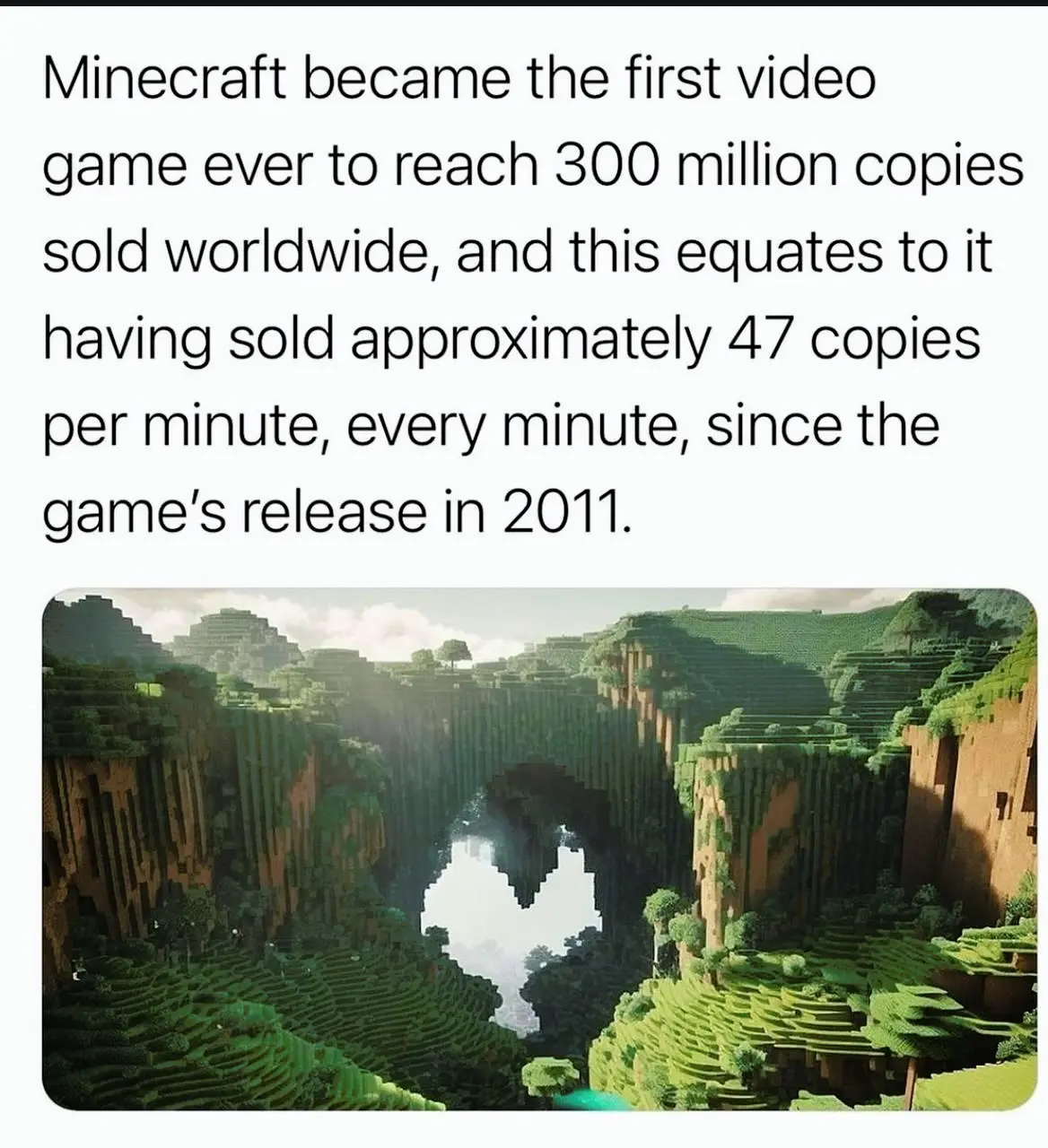
Minecraft holds the undisputed title of the best-selling video game of all time, officially surpassing 300 million copies sold globally. This monumental achievement cements the sandbox title’s status as a cultural icon, representing a decade-and-a-half of sustained growth, massive community influence, and unparalleled versatility across almost every available gaming platform.
The journey of Minecraft from an obscure indie project by Markus "Notch" Persson to a global juggernaut under the ownership of Microsoft is a study in the intersection of creativity, accessibility, and platform ubiquity. While other major franchises rely on annual sequels or graphical fidelity, Minecraft has remained a constant, evolving entity that redefined the survival and creative building genres. Reaching the 300 million unit threshold signifies more than just commercial success; it reflects the game’s transition into a fundamental digital infrastructure used in education, social connection, and infinite creative expression.
Historical Context and the Road to 300 Million
The story began in 2009 with a modest release that challenged the prevailing industry trend of linear, story-driven narratives. By allowing players to manipulate a world composed entirely of destructible blocks, Minecraft empowered the user to define their own objectives. This "sandbox" freedom was the catalyst for its initial explosive growth.
In 2014, Microsoft acquired Mojang Studios and the Minecraft franchise for $2.5 billion. At the time, critics questioned the valuation, but the subsequent decade proved that the acquisition was a masterful play. By standardizing the game under the "Bedrock" engine, Microsoft ensured that players on consoles, mobile devices, and PC could experience the same core game, effectively erasing the barriers between different hardware ecosystems.
Throughout the years, the game has been bolstered by constant, free content updates—such as the "Caves & Cliffs" expansion and the "Tricky Trials" update—which kept the player base engaged without forcing them to purchase a new iteration of the software. This consistent stream of content, combined with the game's porting to virtually every modern console, handheld, and operating system, turned a niche title into the most accessible game in human history.
The Factors Behind Unrivaled Commercial Longevity
Most triple-A titles experience a "front-loaded" sales cycle, where the majority of revenue is generated in the first few months of release. Minecraft operates on an entirely different model: the "Long Tail."
1. Cross-Platform Ubiquity
Minecraft is available on almost every device capable of rendering 3D graphics, including legacy hardware like the Xbox 360 and PlayStation 3, modern consoles like the PlayStation 5 and Xbox Series X|S, as well as iOS, Android, and Windows. By removing the "hardware barrier," Mojang enabled families and friends to play together regardless of their preferred device.
2. The Modding and Community Ecosystem
The PC version of Minecraft famously allows for deep modifications (mods), which transform the gameplay experience entirely. From technical "Redstone" computing projects to complex role-playing modpacks, the community has essentially created a thousand different games within the singular Minecraft shell. This vibrant ecosystem acts as free, crowdsourced content that keeps the game relevant for years, even after a player has exhausted the base game’s mechanics.
3. Educational and Institutional Integration
Minecraft: Education Edition and its integration into schools worldwide have made the title a standard tool for teaching geometry, coding, and history. By embedding itself into the educational curriculum, the game gained a foothold in households that might otherwise have been indifferent to gaming culture.
Comparing Minecraft to Other Industry Titans
While other games have achieved massive cultural relevance, none have touched the raw unit sales of Minecraft. It is useful to examine the landscape of high-selling titles to understand the rarity of this accomplishment.
| Game Title | Estimated Sales (Millions) | Primary Platform Focus |
|---|---|---|
| Minecraft | 300+ | Multi-platform |
| Grand Theft Auto V | 200+ | Multi-platform |
| Tetris (EA version/Multi) | 100+ | Multi-platform |
| Wii Sports | 82+ | Nintendo Wii |
| PUBG: Battlegrounds | 75+ | Multi-platform |
The table above illustrates the unique position of Minecraft. While titles like Grand Theft Auto V are massive commercial successes, they rely on significant marketing budgets and high-fidelity assets. Minecraft relies on the strength of its fundamental loop—mining, crafting, and building—which remains compelling regardless of the graphical limitations or age of the software.
Technical Specifications and User Accessibility
One of the primary reasons for Minecraft's continued dominance is its remarkably low technical barrier to entry. The game is intentionally designed to run on a wide array of hardware specifications.
- Minimum Requirements: The game functions on hardware that is over a decade old, including basic integrated graphics and limited RAM, which ensures that it remains playable in developing markets and on budget-conscious hardware.
- Version Disambiguation: Users often encounter confusion between "Java Edition" (the original version on PC) and "Bedrock Edition" (the cross-platform version). Java Edition is preferred by the modding community and power users, while Bedrock is the engine used for consoles, mobile, and seamless cross-play, contributing to the total sales figures across all storefronts.
- Cloud Synchronization: With a Microsoft account, players can move their progress across devices, a feature that solidified the game’s role as a platform rather than a disposable software product.
Challenges and Future Outlook
Despite its success, the game faces challenges. The maintenance of two separate codebases (Java and Bedrock) continues to be a point of friction for power users, and the increasing complexity of game updates risks alienating players who prefer the simplicity of the early 2010s.
Furthermore, the rise of "Roblox" and other user-generated content platforms presents a competitive landscape where younger audiences seek even more extreme levels of customization. However, with 300 million copies already sold, Minecraft has established a "network effect"—a situation where the game is so ubiquitous that it becomes the default social space for new generations of gamers.
Frequently Asked Questions
Is Minecraft still receiving updates in 2026?
Yes. Despite the massive sales milestone, Mojang continues to release regular updates that introduce new biomes, mobs, and gameplay mechanics, ensuring that the game remains fresh for both long-term veterans and new players.
Does the "300 million copies" figure include free trials?
No. The official milestone of 300 million refers to paid copies sold across all platforms. It does not account for limited-time trials, subscription-based access (like Xbox Game Pass), or educational licenses, meaning the actual number of active users is likely significantly higher.
Can I transfer my Minecraft progress between different consoles?
If you are playing the Bedrock Edition, your progress is tied to your Microsoft Account. This allows you to access your "Realms" and saved worlds across different supported devices, provided you own the game on those respective platforms.
Is it necessary to buy different versions of Minecraft for different devices?
Yes, generally, a license for the game on one platform (such as PlayStation) does not grant you a free license on another (such as PC or mobile). You must purchase the game for the specific platform you intend to use.
Why is Minecraft’s price stable after all these years?
Minecraft is rarely subject to aggressive discounting because its value proposition remains constant. Unlike games that drop in price as they age, Minecraft provides a modular, expanding sandbox that retains its utility over time, making it a "evergreen" product.
Recommendation for New Players
For those looking to engage with the best-selling game of all time, the best entry point depends on your goals. If you are interested in the infinite depth of community-made modifications, focus on the Java Edition on PC. If you prioritize social play with friends on various devices (phones, consoles, tablets), the Bedrock Edition is the superior choice. Start by exploring "Survival" mode to understand the core loop of gathering resources and managing threats, then transition to "Creative" mode when you are ready to focus purely on architectural and systemic builds.