Chris Van Allsburg is an acclaimed American author and illustrator renowned for his surreal, highly textured artwork and enigmatic children's classics, most notably Jumanji and The Polar Express. Born in Grand Rapids, Michigan, in 1949, he transitioned from studying sculpture and architecture to creating some of the most enduring, visually striking picture books in modern literature. His works frequently blur the lines between reality and imagination, earning him two Caldecott Medals and widespread literary acclaim.
The journey of Chris Van Allsburg from a sculptor working with metal and stone to a titan of children's literature is a testament to an unconventional artistic evolution. While many picture book creators begin with a background in traditional painting or graphic design, Van Allsburg's spatial awareness, preoccupation with shadow and light, and minimalist narrative style stem directly from his training as a fine artist. Understanding his background, publication history, and enduring impact requires a close examination of how his unique aesthetic reshaped the landscape of illustrated storytelling.
Early Life and Artistic Beginnings
Christopher Van Allsburg was born on June 18, 1949, in Grand Rapids, Michigan. Growing up, he did not initially display a fixation on drawing or writing stories. Instead, he was fascinated by how things were built, taking apart mechanical objects and exploring the physical world around him. This early tactile curiosity laid the groundwork for his eventual focus on three-dimensional forms.
He attended the University of Michigan, where he pursued a Bachelor of Fine Arts degree, specializing in sculpture. During his undergraduate years, he worked extensively with materials like wood, stone-casting, and resin. Following his time at Michigan, he moved to Rhode Island to attend the Rhode Island School of Design (RISD), where he earned a Master of Fine Arts degree in sculpture in 1972.
After completing his education, Van Allsburg set up a studio in Providence, Rhode Island, and began creating large-scale, minimalist sculptures. His art during this period often featured mysterious, heavy objects placed in sparse environments—a motif that would later define his illustrated books. However, the commercial market for massive sculptures was limited, and maintaining a studio required substantial financial resources.
The pivot toward illustration happened almost by accident. His wife, Lisa Van Allsburg, was an elementary school art teacher who recognized the striking, narrative quality of his sculptural sketches. She encouraged him to show his drawings to children's book editors in New York City. Among those who took notice was Walter Lorraine, an editor at Houghton Mifflin. Lorraine recognized that Van Allsburg’s dramatic command of perspective and chiaroscuro lighting could translate powerfully to the page, prompting the artist to try his hand at a picture book format.
The Breakthrough and the Caldecott Success
Van Allsburg’s entry into children's literature was nothing short of meteoric. In 1979, Houghton Mifflin published his very first book, The Garden of Abdul Gasazi. The story follows a boy named Alan Mitz who loses his aunt's dog on the estate of a retired magician, only to encounter bizarre and uncanny events.
The Garden of Abdul Gasazi immediately established Van Allsburg's signature style. Rather than relying on bright, primary colors typical of late-1970s children's books, he used moody charcoal drawings and stark contrasts to create a sense of psychological suspense. The book was a critical triumph, earning a Caldecott Honor in 1980, an extraordinarily rare feat for a debut author-illustrator.
Just two years later, Van Allsburg cemented his place in literary history with the publication of Jumanji in 1981. The book introduces a seemingly ordinary board game found in a park that brings jungle hazards—from monsoons to charging rhinoceroses—directly into a suburban living room. The visual execution, featuring rich black-and-white illustrations that exude stillness and menace simultaneously, captivated readers of all ages. Jumanji won the prestigious Caldecott Medal in 1982, awarded by the American Library Association to the artist of the most distinguished American picture book for children.
Selected Major Works by Chris Van Allsburg
| Title | Publication Year | Major Accolades / Notes |
|---|---|---|
| The Garden of Abdul Gasazi | 1979 | Caldecott Honor (1980); debut picture book. |
| Jumanji | 1981 | Caldecott Medal (1982); adapted into a major feature film in 1995. |
| The Polar Express | 1985 | Caldecott Medal (1986); adapted into a 3D animated film in 2004. |
| The Mysteries of Harris Burdick | 1984 | Cult classic featuring enigmatic illustrations with open-ended captions. |
| Zathura | 2002 | Science-fiction sequel to Jumanji; adapted into a film in 2005. |
Signature Themes and Artistic Style
To truly understand Chris Van Allsburg, one must examine the distinct visual and thematic elements that separate his bibliography from conventional children's literature. His books do not talk down to readers; instead, they embrace ambiguity, philosophical questions, and a mild sense of unease.
Surrealism and Spatial Awareness
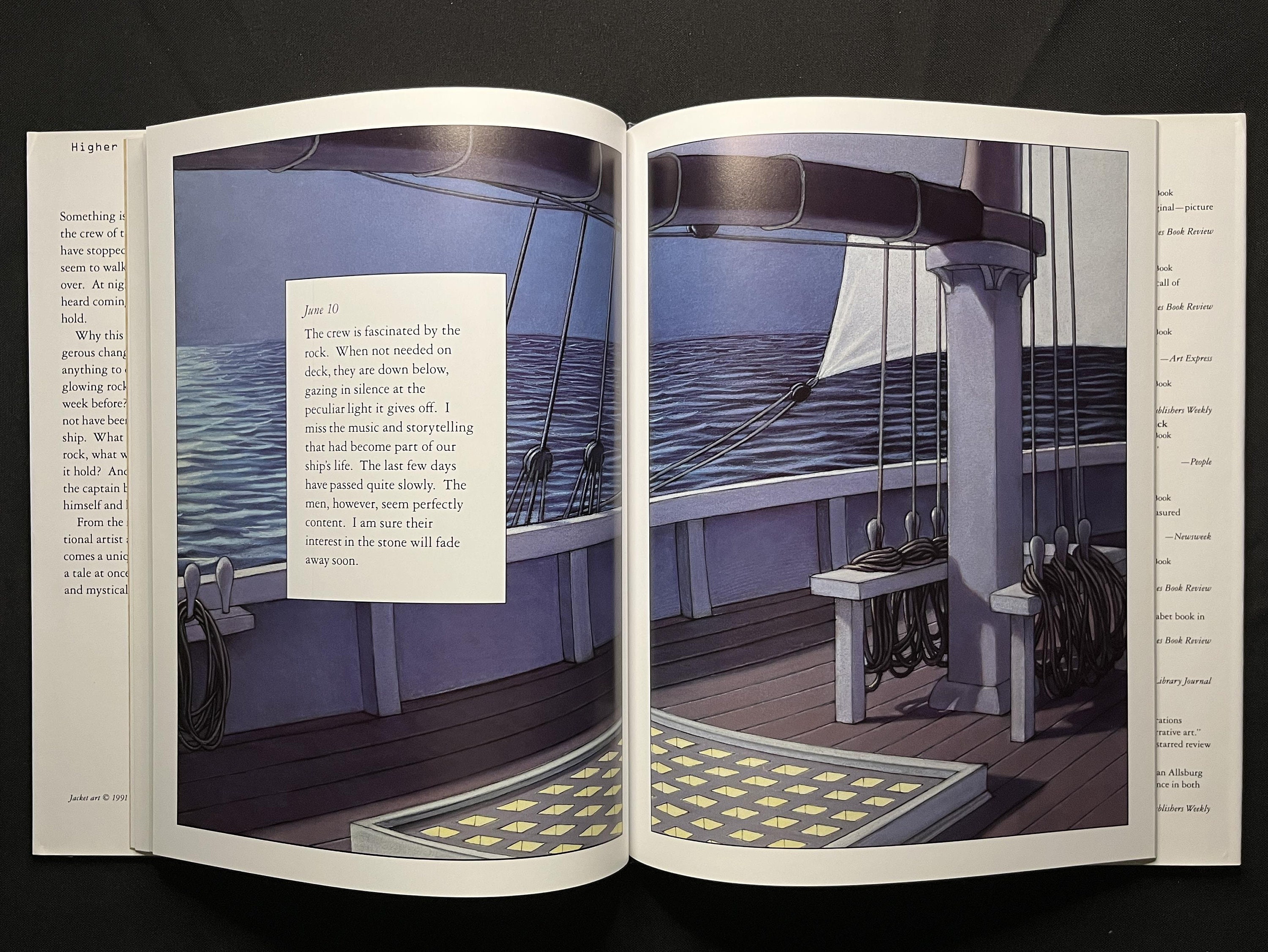
Because Van Allsburg was trained as a sculptor, his compositions are grounded in a deep understanding of volume, gravity, and perspective. Objects and characters occupy physical space with immense weight. His use of low-angle or high-angle perspectives makes readers feel as though they are viewing a meticulously staged theatrical set or a surrealist painting by René Magritte or Giorgio de Chirico. In books like The Wreck of the Zephyr, boats float mysteriously in the air, challenging the laws of physics while maintaining a hyper-realistic rendering style that makes the impossible look plausible.
Chiaroscuro and Color Palette
While later books like The Polar Express and The Wreck of the Zephyr introduced rich, painterly oil pastels and colored pencils, Van Allsburg's early work relied heavily on black-and-white charcoal and Conté crayon. He mastered chiaroscuro—the dramatic contrast between light and dark—to evoke mystery, tension, and warmth. Even in his full-color works, his palettes tend to be muted, heavy on deep blues, midnight blacks, and rich browns, which heighten the nocturnal or otherworldly atmosphere of his narratives.
Moral Ambiguity and Open-Ending
Unlike many children's books that wrap up with a neat, unambiguous moral lesson, Van Allsburg's stories frequently leave room for interpretation. In The Mysteries of Harris Burdick, he provides fourteen bizarre illustrations accompanied by only a title and a single line of text, leaving the reader entirely responsible for constructing the narrative. This respect for the reader's imagination is a hallmark of his career, challenging children and adults alike to think critically about narrative structure.
Cultural Impact and Film Adaptations
Van Allsburg's work has transcended the printed page, leaving a massive imprint on popular culture through high-profile cinematic adaptations.
Released in 1995, the live-action film adaptation of Jumanji, starring Robin Williams, transformed the quiet, atmospheric picture book into a blockbuster adventure spectacle. While the film expanded significantly on the book’s premise—introducing adult characters and escalating the chaotic scale of the jungle incursions—it retained the core premise of a board game that bleeds into reality. The film spawned an entire franchise, including subsequent sequels like Jumanji: Welcome to the Jungle (2017) and Jumanji: The Next Level (2019).
In 2004, director Robert Zemeckis released a motion-capture animated adaptation of The Polar Express, starring Tom Hanks. The book itself, published in 1985, is a staple of holiday traditions worldwide, telling the story of a doubting boy who boards a mysterious midnight train bound for the North Pole. The film adaptation became a technological milestone in performance-capture animation and cemented the book's status as a modern holiday classic.
Additionally, his 2002 space-adventure book Zathura, conceived as a sequel to Jumanji, was adapted into a cinematic feature directed by Jon Favreau in 2005.
Frequently Asked Questions
What is Chris Van Allsburg's most famous book?
His two most famous books are Jumanji (1981) and The Polar Express (1985), both of which won the Caldecott Medal and were adapted into major Hollywood films.
Did Chris Van Allsburg start his career as an author?
No. He trained as a fine artist, earning a Master of Fine Arts in sculpture from the Rhode Island School of Design in 1972. He worked primarily as a sculptor before turning to illustration in the late 1970s.
How many Caldecott Medals has Chris Van Allsburg won?
He has won two Caldecott Medals (Jumanji in 1982 and The Polar Express in 1986) and one Caldecott Honor (The Garden of Abdul Gasazi in 1980).
What is The Mysteries of Harris Burdick about?
Published in 1984, it is a unique collection of fourteen standalone illustrations with brief captions that purport to be drawings left behind by a missing man named Harris Burdick. The book invites readers to write their own stories to explain the strange images.
Are Chris Van Allsburg's books intended only for children?
While classified as children's literature, Van Allsburg's works are celebrated across all age groups. Their complex visual metaphors, philosophical undertones, and sophisticated design appeal deeply to adult art collectors and literature enthusiasts.
Next Actions and Exploration
For those looking to explore the artistry of Chris Van Allsburg further, the best approach is to examine his physical books rather than digital reproductions, as the tactile quality of the paper and the fidelity of the printing are integral to his medium. Beginning with his debut, The Garden of Abdul Gasazi, and tracing his evolution through monochrome works to his lush colored pastel books provides a masterclass in visual storytelling. Reviewing retrospective collections or visiting exhibitions featuring original illustrations will also reveal the meticulous craftsmanship behind his deceptively simple surrealist visions.