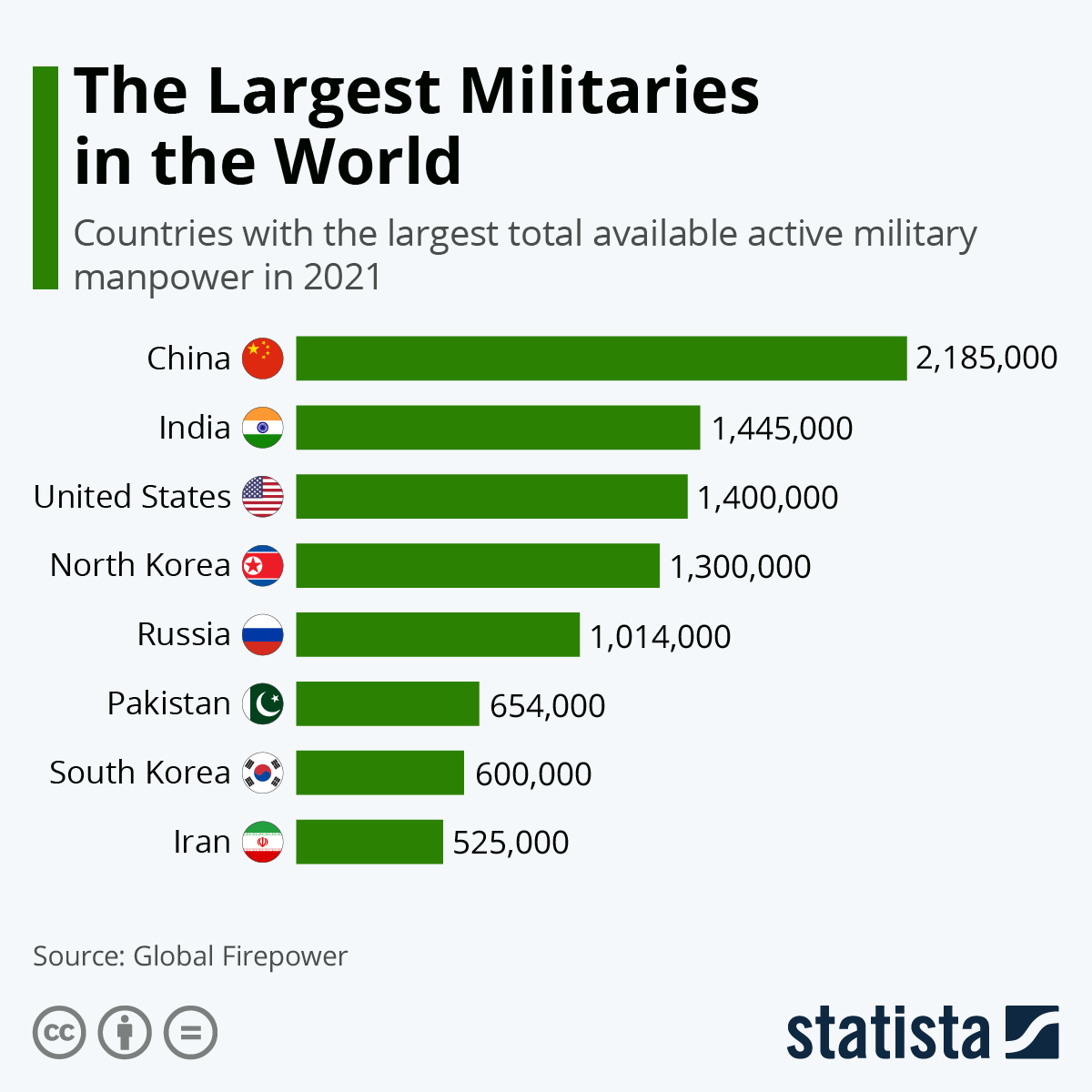
As of 2026, the Russian Federation holds the rank of the second-most powerful military in the world according to the Global Firepower Index. However, if the ranking is based strictly on the number of active-duty personnel, India occupies the second-largest position, maintaining a force of over 1.4 million active soldiers.
Understanding the Metric: Power Index vs. Personnel Count
When discussing which nation ranks second in the world’s military hierarchy, it is essential to distinguish between "size" and "power." These two metrics often yield different results, leading to common confusion in geopolitical discussions. In the context of 2026, the global landscape evaluates military strength through a combination of quantitative data (manpower and equipment) and qualitative factors (technological sophistication, logistical reach, and financial stability).
The "size" of an army typically refers to the total number of active-duty personnel. Under this specific lens, India has long held the second-place spot, trailing only China. India’s military structure is heavily reliant on human capital to manage its extensive and often volatile land borders. Conversely, "power" rankings, such as the Global Firepower (GFP) index, use a complex formula involving over 60 individual factors. These include the diversity of weapons, natural resources, available manpower, and financial health. In this comprehensive ranking, Russia has historically and continues to hold the second position, situated between the United States at number one and China at number three.
Russia: The World’s Second Most Powerful Military
Despite the significant resource drain and international sanctions experienced in the early 2020s, Russia remains the second-ranked nation in terms of overall military firepower in 2026. This ranking is sustained by several structural pillars that many other nations cannot yet match, even those with larger populations or faster-growing economies.
The Nuclear Triad and Strategic Deterrence
Russia’s primary claim to the second-place rank is its massive nuclear arsenal. Along with the United States, Russia maintains a "Nuclear Triad," meaning it can launch nuclear strikes from land-based silos, submarine-launched missiles, and strategic bombers. As of 2026, Russia continues to modernize its Intercontinental Ballistic Missiles (ICBMs), ensuring that its deterrent remains a core component of its global standing. This strategic depth provides a level of geopolitical leverage that conventional-only forces cannot achieve.
Land Force Resilience and Armored Capacity
Russia possesses one of the world's largest inventories of tanks, self-propelled artillery, and towed artillery. While modern warfare has shifted toward drone technology and precision strikes, the sheer volume of Russian "iron" remains a significant factor in military ranking models. By 2026, the Russian domestic defense industry has largely transitioned to a sustained high-output footing, replenishing armored vehicle stocks and integrating lessons learned from recent theater operations into new designs, such as the T-14 Armata platform and modernized T-90 variants.
Naval and Submarine Capability
While the Russian surface fleet is often viewed as secondary to the U.S. Navy, its submarine force is world-class. The Borei-class and Yasen-class submarines are quiet, lethal, and capable of projecting power far from Russian shores. This underwater capability is a critical metric that keeps Russia ahead of nations like India or the UK in overall power rankings.
India: The World’s Second Largest Active Personnel Force
If the question "who is the second largest army" is interpreted strictly by the number of people in uniform, India is the clear answer. For decades, India has maintained a massive volunteer force to secure its interests in South Asia and manage complex border disputes with neighboring nuclear powers.
The Human Capital Advantage
By 2026, India’s active-duty strength remains approximately 1.45 million personnel. This is supported by a massive reserve force of over 1.1 million. Unlike China, which has seen some downsizing in favor of automation and professionalization, or the United States, which struggles with recruitment targets, India possesses a nearly bottomless pool of eligible military-age citizens. The Indian Army is the largest branch, specializing in high-altitude warfare and counter-insurgency operations.
The Agnipath Scheme Evolution
In 2026, the Indian military is seeing the mid-term results of the Agnipath recruitment scheme introduced years prior. This program, which recruits youth for four-year terms (Agniveers), was designed to lower the average age of the fighting force and reduce the massive pension burden on the national budget. While controversial at its inception, by 2026, it has successfully infused the "rank 2" personnel force with younger, more tech-savvy soldiers, though debates remain regarding the long-term depth of specialized training.
Modernization and "Make in India"
India is no longer just a "manpower" army. It has aggressively pursued the "Aatmanirbhar Bharat" (Self-Reliant India) initiative. By 2026, India has significantly reduced its reliance on foreign imports—particularly from Russia—by developing indigenous platforms like the Tejas fighter jet, the Vikrant-class aircraft carriers, and the Arjun main battle tank. This transition from a buyer to a builder is narrowing the gap between India's "personnel size" and its "overall power ranking."
Comparative Analysis of the Top Global Militaries in 2026
To understand why Russia holds the #2 spot in power while India holds it in personnel, a direct comparison of metrics is necessary. The following data reflects the estimated military standings for 2026 across key categories.
| Country | Global Power Rank | Active Personnel | Total Aircraft | Total Tanks | Nuclear Warheads |
|---|---|---|---|---|---|
| United States | 1 | ~1,300,000 | ~13,000 | ~4,500 | ~5,000 |
| Russia | 2 | ~1,100,000 | ~4,100 | ~10,000+ | ~5,500 |
| China | 3 | ~2,000,000 | ~3,200 | ~4,800 | ~500+ |
| India | 4 | ~1,450,000 | ~2,200 | ~4,600 | ~170 |
| South Korea | 5 | ~500,000 | ~1,500 | ~2,400 | 0 |
Note: Data based on Global Firepower and SIPRI 2025/2026 projected reports.
Why China Isn't Ranked Second in Power
A common point of confusion is why China, which has the largest active-duty army and the second-largest defense budget, is often ranked third behind Russia. In the 2026 landscape, this is attributed to a few specific factors:
- Combat Experience: The Russian military has been in a state of nearly constant operational deployment for decades (Syria, Georgia, Ukraine). China's People's Liberation Army (PLA) has not fought a major high-intensity conflict since 1979. Ranking algorithms often weigh recent "battle-proven" status heavily.
- Nuclear Parity: Russia maintains nuclear parity with the U.S., whereas China, though rapidly expanding its silo fields, still has a significantly smaller total stockpile.
- Geography and Logistics: Russia's vast landmass and established rail-logistics networks for internal defense are considered superior to China's current ability to project and sustain massive force far beyond the "First Island Chain" in a contested environment.
However, many analysts predict that by the late 2020s, the "China vs. Russia" ranking for the #2 spot may flip as China's naval expansion (Blue Water Navy) and indigenous jet engine technology mature further.
Logistics and Financial Sustainability: The Hidden Ranking Factors
The rank of "2nd largest" or "2nd most powerful" is not just about who has the most guns. In 2026, the sustainability of a military is just as important as its size.
Defense Budgeting
The United States outspends the next ten countries combined, which is why its #1 spot remains secure. Russia, despite having a smaller GDP than nations like Germany or Japan, directs a massive percentage of its economy toward defense. This "war economy" allows it to maintain the #2 rank in hardware despite economic limitations. India, conversely, has the world's third-largest defense budget, but a huge portion of that is allocated to salaries and pensions for its massive personnel pool, sometimes at the expense of rapid modernization.
Technological Integration
Modern rankings now account for cyber warfare capabilities, satellite constellations, and AI-driven logistics. Russia has historically excelled in electronic warfare (EW), which is a "force multiplier." India has made massive strides in space-based surveillance and software, but Russia’s legacy EW systems still give it a slight edge in comprehensive power indices as of 2026.
Regional Implications of the #2 Ranking
The fact that Russia and India occupy these second-place spots has profound implications for global stability.
- The Indo-Pacific: India’s role as the second-largest manpower force makes it the primary "counterweight" to China in Asia. Its ability to mobilize hundreds of thousands of troops along the Line of Actual Control (LAC) is a major deterrent against regional hegemony.
- Eastern Europe: Russia’s status as the second-most powerful military forces NATO to remain in a state of high readiness. The ranking confirms that despite hardware losses, Russia’s ability to reconstitute its forces makes it a persistent peer-competitor to the West.
Frequently Asked Questions
Which country has the 2nd largest army by total number of troops?
India ranks second in active-duty troops with approximately 1.45 million soldiers. If you include reserve forces and paramilitaries, the rankings can shift, but India consistently maintains the second-largest standing professional force.
Is Russia still the 2nd most powerful military in 2026?
Yes, most military analytics firms, including Global Firepower, continue to rank Russia at #2. This is due to its massive nuclear arsenal, its enormous inventory of land-based weapon systems, and its significant domestic defense production capacity, which outpaces most Western European nations.
How does North Korea fit into these rankings?
North Korea often ranks in the top five for total military personnel (active plus reserve plus paramilitary), sometimes appearing as the "largest" on paper. However, because their equipment is largely obsolete (dating back to the 1960s and 70s) and their logistical capacity is limited, they rank much lower (usually between 10th and 25th) in actual power rankings.
What is the difference between active and reserve personnel?
Active personnel are full-time soldiers currently serving in the military. Reserve personnel are trained individuals who have completed their service but can be called back to duty during a national emergency. India’s rank of #2 is based on active-duty numbers.
Does the 2nd largest army always win against smaller ones?
No. Military history is full of examples where smaller, technologically superior, or better-led forces defeated larger ones. Factors like air superiority, intelligence, and logistics often outweigh simple personnel counts. This is why the U.S. remains #1 despite having fewer active troops than China or India.
Recommendations for Further Research
To stay updated on these rankings, it is recommended to monitor annual reports from the International Institute for Strategic Studies (IISS), specifically their "Military Balance" publication. Additionally, the Stockholm International Peace Research Institute (SIPRI) provides the most accurate data on military spending and arms transfers, which are the leading indicators of future shifts in these rankings. For those interested in real-time personnel shifts, official government defense portals for the Russian Ministry of Defence and the Indian Ministry of Defence provide the most granular (though sometimes biased) data on recruitment and modernization milestones.