Navigating the criminal justice landscape in Miami-Dade County requires an understanding of local judicial infrastructure, records management, and procedural compliance. Whether you are searching for active case dockets, researching a criminal history, or preparing to attend a hearing at the Richard E. Gerstein Justice Building, knowing how the Eleventh Judicial Circuit operates is essential. This comprehensive guide outlines the operational mechanisms, record-retrieval protocols, and strategic considerations for handling criminal matters in Miami-Dade County for 2026.
Understanding the Miami-Dade Criminal Justice Infrastructure
The Miami-Dade criminal justice system is managed by a combination of state courts, local law enforcement agencies, and county administration offices. The primary hub for criminal proceedings is the Eleventh Judicial Circuit of Florida, which operates out of several key facilities downtown and across the county.
The administrative backbone of the court system is the Miami-Dade Clerk of the Courts, headed by the Clerk. This office maintains all official court records, processes warrants, manages court calendars, and collects fines and fees. Understanding where to go and who to contact minimizes delays when dealing with legal proceedings.
Operational Authority Notice Official Governance: All state-level criminal proceedings fall under the jurisdiction of the Eleventh Judicial Circuit of Florida and the State Attorney's Office for the Eleventh Judicial Circuit. Local municipal ordinances and code violations may be handled by individual city courts, but felonies and misdemeanors are consolidated under county administration.
Key Facilities and Contact Points
- Richard E. Gerstein Justice Building: Located at 1351 NW 12th Street, Miami, FL 33125, this facility houses the main criminal courthouse, central booking, and the Clerk’s criminal division.
- Miami-Dade County Corrections and Rehabilitation Department: Manages the county's detention facilities, including the Turner Guilford Knight (TGK) Correctional Center and the Metro West Detention Center.
- Law Library: Located in downtown Miami, providing public access to legal statutes, case law, and self-help resources for individuals navigating the system without counsel.
How to Search Miami-Dade Criminal Records and Case Dockets
Public access to criminal records in Miami-Dade County is governed by Florida’s broad public records laws (Chapter 119, Florida Statutes). However, accessing specific files requires knowing the correct digital portals and physical offices.
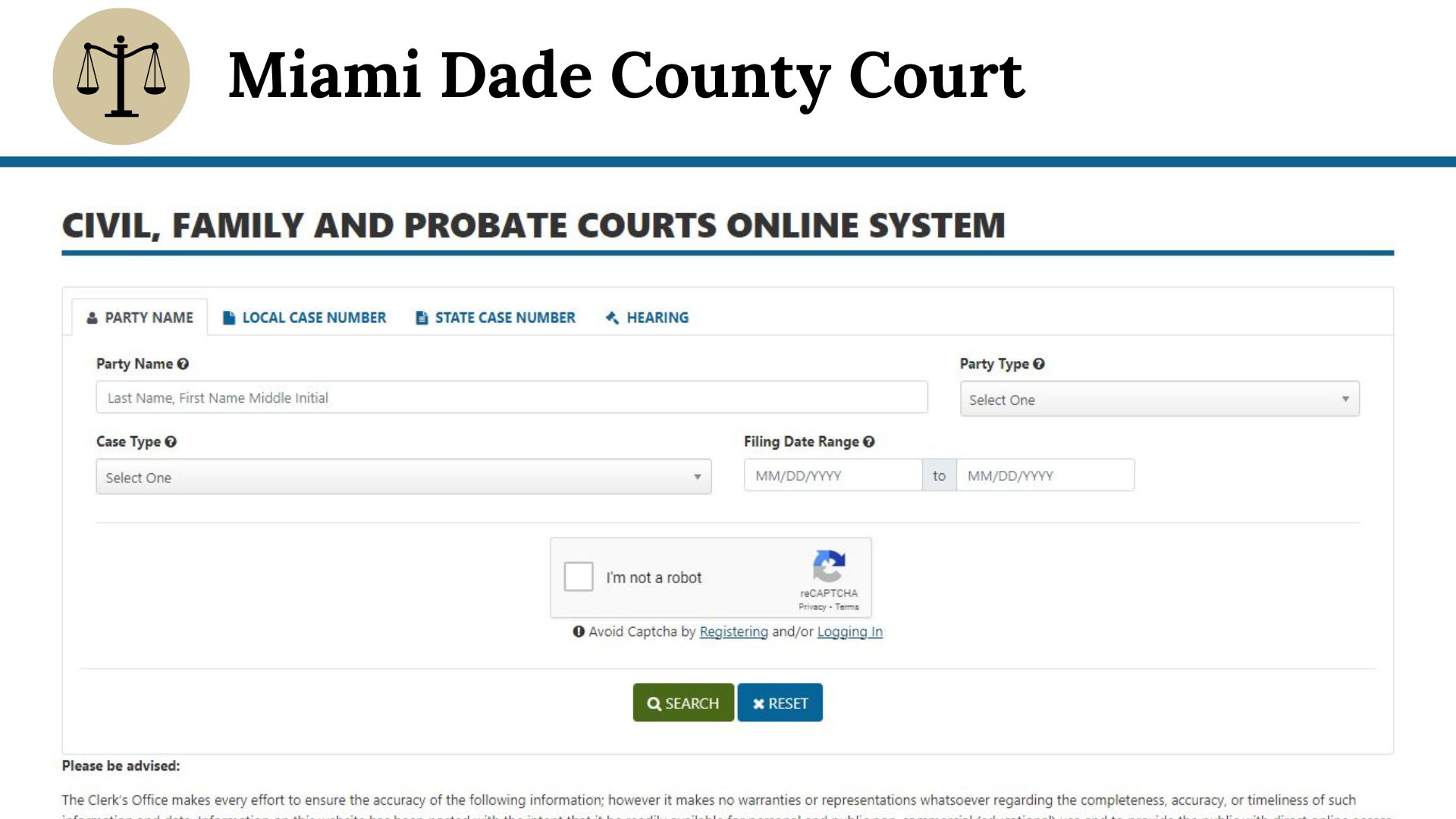
For online research, the Clerk of the Courts provides an online case search tool. Users can query cases using a defendant's name, case number, or citation number.
Step-by-Step Guide to Online Criminal Case Searches
- Navigate to the Official Portal: Access the Miami-Dade Clerk of Courts official website and select the "Online Services" or "Court Records" search portal.
- Select the Proper Division: Choose the Criminal Division, specifying whether you are looking for Felony or Misdemeanor/Traffic records.
- Input Search Criteria: Enter the defendant's full legal name (Last Name, First Name) and date of birth if known to narrow down common name matches.
- Review Case Dockets: Examine the docket events, charges filed, upcoming hearing dates, and presiding judge assignments.
- Request Certified Copies: If official documentation is required for employment or immigration purposes, request certified physical or digital copies through the Clerk's record room.
Overview of Criminal Case Processing Stages
A criminal case in Miami-Dade County moves through several structured phases from initial arrest to final disposition. Familiarity with these milestones helps defendants and their families anticipate legal requirements.
[Arrest & Booking] ---> [First Appearance (Bond Court)] ---> [Arraignment] ---> [Pre-Trial Discovery & Motions] ---> [Trial or Plea Negotiation] ---> [Sentencing & Probation]
- First Appearance: Held within 24 hours of arrest at the Turner Guilford Knight facility or via video link. A judge reviews probable cause, determines bond conditions, and appoints a public defender if the defendant qualifies financially.
- Arraignment: The formal reading of charges where the defendant enters a plea (Guilty, Not Guilty, or No Contest). In many cases, defense counsel can file a written plea of not guilty to waive the defendant's appearance.
- Pre-Trial Conference: An opportunity for the defense and the State Attorney to discuss plea offers, review discovery evidence, and resolve evidentiary motions before scheduling a trial date.
- Trial / Disposition: Cases that are not dismissed or resolved via plea agreement proceed to a bench trial or jury trial before an Eleventh Judicial Circuit judge.
Comparing Legal Representation Options in Miami-Dade
Defendants facing criminal charges must decide between securing private counsel or utilizing public legal services. Each option has distinct operational realities within the Miami-Dade court system.
| Representation Type | Cost Structure | Caseload & Availability | Local Court Familiarity | Best Suited For |
|---|---|---|---|---|
| Private Defense Attorney | Flat fees or high hourly retainers ($3,500 - $15,000+) | Lower caseload, highly personalized attention | Varies, but often includes specialized former prosecutors | Complex felony charges, white-collar crimes, individuals with financial means |
| Public Defender (11th Circuit) | Income-dependent nominal application fee (~$50) | High volume, fast-paced docket management | Extremely high local courtroom familiarity and relationships | Indigent defendants meeting strict federal/state poverty guidelines |
| Pro Se (Self-Representation) | Court filing fees only | N/A | Low familiarity with local procedural nuances | Minor administrative infractions (strongly discouraged for criminal trials) |
Expungements and Sealing of Miami-Dade Criminal Records
Many individuals seek to clear their criminal history in Florida to improve employment and housing prospects. The Florida Department of Law Enforcement (FDLE) and the Miami-Dade State Attorney's Office process applications for record sealing and expungement under Florida Rule of Criminal Procedure 3.692.
Eligibility Criteria for Sealing vs. Expungement
- Record Sealing: Hides a criminal history from public view, though certain government and law enforcement entities retain access. Generally available if adjudication was withheld following a plea or trial.
- Record Expungement: Physically destroys or removes the non-judicial records of an arrest. Available if the charges were dropped, dismissed, or resulted in a "not guilty" verdict, provided the petitioner has no prior convictions or sealed records.
- Certificate of Eligibility: Must be obtained directly from the FDLE before filing a formal petition with the Miami-Dade Clerk of the Courts.
Frequently Asked Questions About Miami-Dade Criminal Matters
How can I find out if someone is currently in jail in Miami-Dade County?
You can search the Miami-Dade County Corrections inmate locator online using the inmate's booking number or full legal name and date of birth. The database provides current facility location, bond amounts, and upcoming court dates.
Can I pay a Miami-Dade criminal traffic fine online?
Yes, minor traffic infractions and certain fine payments can be processed through the Miami-Dade Clerk of Courts online payment portal using a major credit card. Criminal misdemeanor traffic offenses requiring a mandatory court appearance cannot be paid online without prior judicial authorization.
What should I do if there is an active warrant out for my arrest in Miami-Dade?
You should immediately consult with a qualified criminal defense attorney to discuss arranging a voluntary surrender or walk-through bond. Ignoring an active warrant can result in unexpected arrest during routine traffic stops and may negatively impact bond negotiations.
How long does a criminal record stay public in Florida?
Criminal records remain publicly accessible indefinitely unless an official order of sealing or expungement has been successfully granted by a judge in the Eleventh Judicial Circuit and executed by the FDLE.
Are public defender services free in Miami-Dade?
While public defenders do not charge hourly rates, Florida law mandates a nominal application fee for public defender services, and the court may assess a lien for legal services upon the conclusion of the case.
How do I obtain a certified copy of a court disposition?
Certified copies can be requested in person at the records division of the Richard E. Gerstein Justice Building or ordered online through the Miami-Dade Clerk of Courts official records request portal for a small statutory fee per page.
Expert Strategic Guidance for Defendants and Families
Navigating the criminal justice system demands diligence, adherence to court deadlines, and professional guidance. Never miss a scheduled court date, as failure to appear results in an immediate bench warrant and bond forfeiture. Always verify information directly through official county channels rather than third-party public records aggregators, which frequently display outdated data. For tailored legal counsel regarding specific charges, consult a licensed member of The Florida Bar practicing within the Eleventh Judicial Circuit.