The 2019 election results across major democratic nations marked pivotal shifts in global political alignments, delivering decisive parliamentary majorities in the United Kingdom and India, a minority government in Canada, and a re-elected Coalition in Australia. These democratic contests reshaped legislative priorities, trade agreements, and domestic policies worldwide.
Overview of Major 2019 Democratic Elections
The year 2019 featured an extraordinary concentration of national elections across several of the world’s largest constitutional democracies. Millions of voters cast ballots in elections that determined national leadership, altered party compositions, and dictated international policy trajectories for subsequent years.
Because the term "2019 election results" refers to multiple high-profile national contests, understanding the outcome requires examining each major democratic vote individually:
- United Kingdom: A landmark parliamentary vote triggered by Brexit gridlock, resulting in a substantial Conservative majority.
- India: The world's largest democratic election, where the ruling Bharatiya Janata Party (BJP) expanded its single-party majority.
- Australia: A federal election where the Liberal-National Coalition retained government in a result that defied pre-election polling predictions.
- Canada: A federal election resulting in a transition from a Liberal majority to a Liberal minority government.
Each of these electoral contests operated under distinct constitutional frameworks, voting methods, and regional dynamics.
United Kingdom General Election Results (December 2019)
On December 12, 2019, the United Kingdom held a snap general election—its third in less than five years. Called by Prime Minister Boris Johnson after months of parliamentary paralysis regarding the UK's withdrawal from the European Union, the election served as a de facto referendum on the Brexit withdrawal agreement.
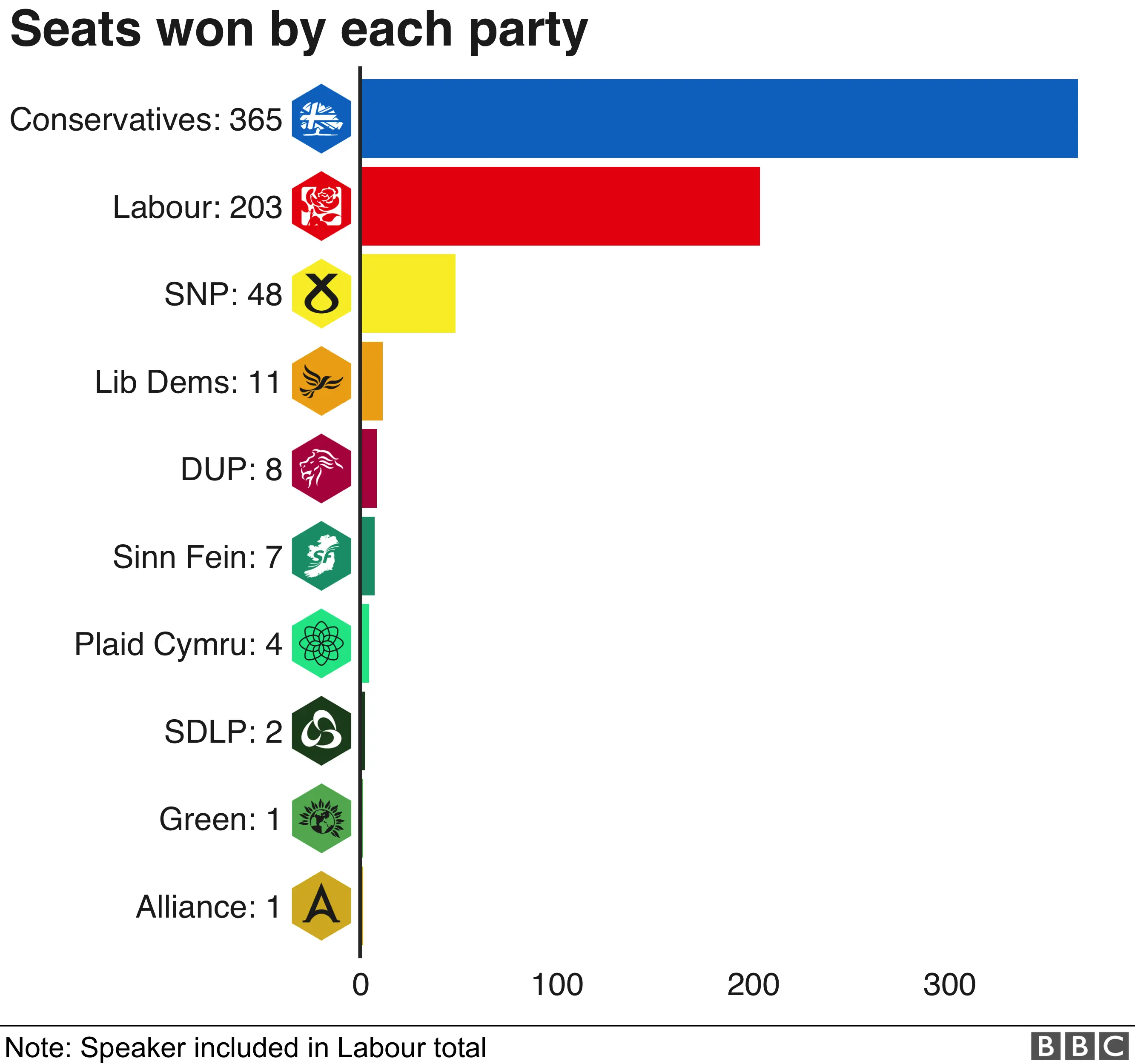
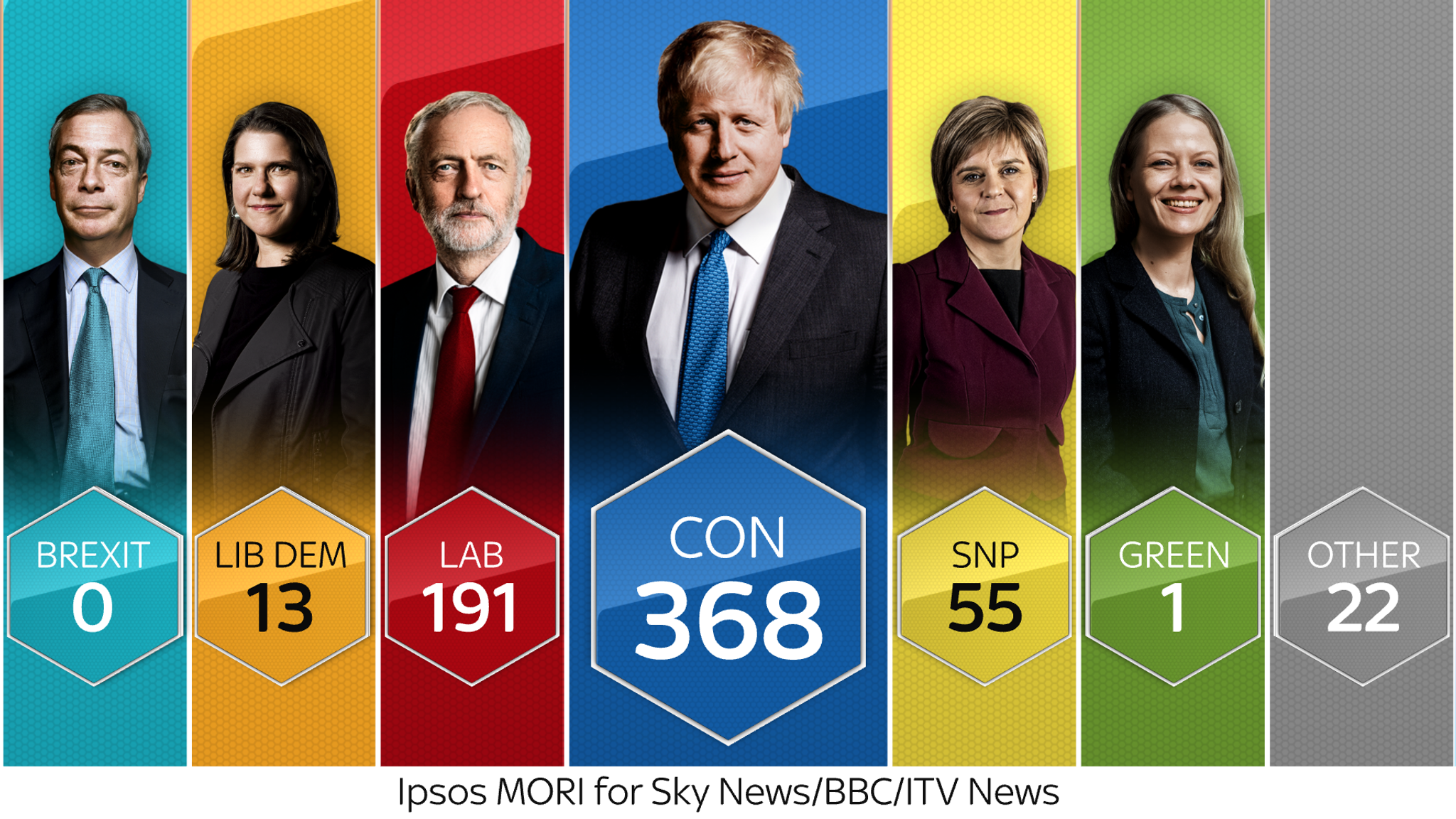
UK 2019 House of Commons Seat Distribution (650 Total Seats) ============================================================= Conservative Party : [365] #################################### Labour Party : [202] #################### Scottish National : [ 48] #### Liberal Democrats : [ 11] # Other Parties : [ 24] ##
Key Seat and Vote Share Figures
The Conservative Party achieved its largest parliamentary majority since 1987, securing an 80-seat overall majority in the House of Commons.
- Conservative Party: Won 365 seats (+47 net gain) with 43.6% of the popular vote.
- Labour Party: Won 202 seats (-60 net loss) with 32.1% of the popular vote.
- Scottish National Party (SNP): Won 48 seats (+13 net gain) with 3.9% of the national vote (45.0% within Scotland).
- Liberal Democrats: Won 11 seats (-1 net loss) with 11.5% of the vote, though party leader Jo Swinson lost her seat in East Dunbartonshire.
- Democratic Unionist Party (DUP): Won 8 seats (-2 net loss).
- Sinn Féin: Won 7 seats (unchanged).
- Plaid Cymru: Won 4 seats (unchanged).
- Social Democratic and Labour Party (SDLP): Won 2 seats (+2 net gain).
- Green Party: Won 1 seat (unchanged).
- Alliance Party: Won 1 seat (+1 net gain).
Voter turnout across the United Kingdom stood at 67.3%, a minor decrease of 1.5 percentage points compared to the 2017 general election. Official data on constituency turnout and certified vote counts are preserved by the UK Electoral Commission.
Realignment of the "Red Wall"
The defining geographic feature of the UK 2019 election result was the collapse of Labour's "Red Wall"—a belt of industrial and post-industrial constituencies across the Midlands and Northern England that had reliably elected Labour MPs for generations. Constituencies such as Blyth Valley, Workington, Leigh, and Bishop Auckland elected Conservative representatives for the first time in decades, or in some cases, in over a century.
This realignment was largely driven by voter dissatisfaction with Labour’s ambiguous Brexit position under Jeremy Corbyn, contrasted with the Conservatives' explicit campaign slogan, "Get Brexit Done."
Legislative and Political Impact
The 365-seat Conservative majority fundamentally broke the legislative deadlock in Westminster. Within weeks of the election, Parliament passed the European Union (Withdrawal Agreement) Act 2020. This enabled the United Kingdom to formally exit the European Union on January 31, 2020, entering a transition period that concluded at the end of that year.
India Lok Sabha General Election Results (April–May 2019)
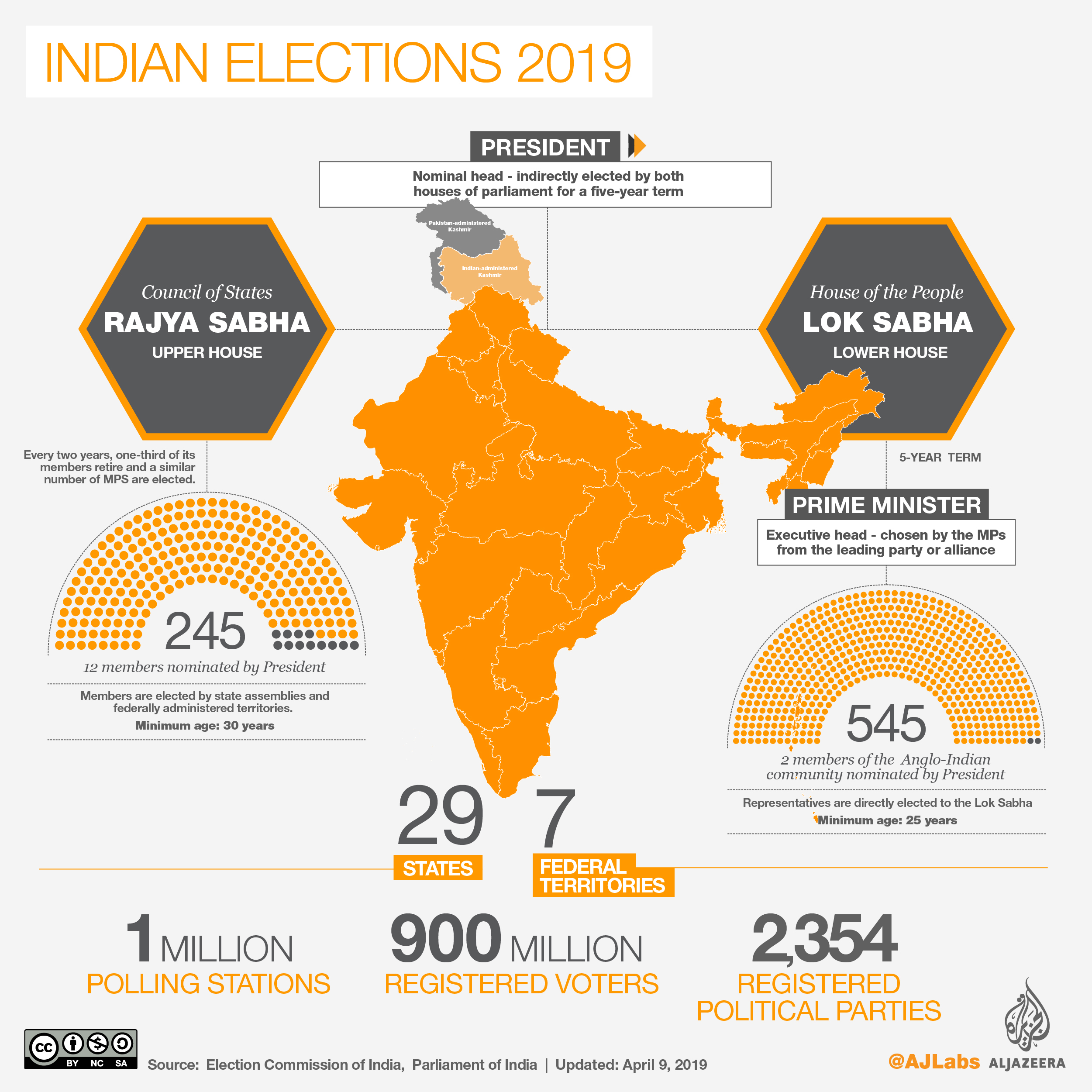
India held its 17th Lok Sabha (Lower House of Parliament) general election in seven phases from April 11 to May 19, 2019, with vote counting taking place on May 23. It stood as the largest democratic exercise in human history, with approximately 912 million registered voters.
India 2019 Lok Sabha Alliance Breakdown (543 Elected Seats) =========================================================== National Democratic Alliance (NDA) : [353] ############################## United Progressive Alliance (UPA) : [ 91] ######## Unaligned / Other Regional Parties : [ 99] ########
Mandatory Seat Thresholds and Alliance Figures
To form a government in India's 543-member elected Lok Sabha, a party or coalition requires a simple majority of 272 seats. The incumbent Bharatiya Janata Party (BJP), led by Prime Minister Narendra Modi, not only crossed this threshold independently but expanded its previous majority from 2014.
- Bharatiya Janata Party (BJP): Won 303 seats (+21 net gain) with 37.36% of the national vote.
- National Democratic Alliance (NDA): Secured a combined total of 353 seats.
- Indian National Congress (INC): Won 52 seats (+8 net gain) with 19.49% of the national vote.
- United Progressive Alliance (UPA): Secured a combined total of 91 seats.
- Key Regional Parties: Dravida Munnetra Kazhagam (DMK) won 24 seats; All India Trinamool Congress (AITC) won 22 seats; YSR Congress Party won 22 seats; Biju Janata Dal (BJD) won 12 seats.
Voter turnout reached a record high of 67.11%, exceeding the 66.40% recorded in 2014. Comprehensive constituency records and state-by-state breakdowns are managed by the Election Commission of India.
Political Drivers and Significance
The 2019 Indian election result represented the first time since 1971 that a single political party secured an absolute majority in two consecutive Lok Sabha elections. The BJP consolidated its dominance in its traditional strongholds across Northern and Western India while making unprecedented inroads into Eastern India, notably in West Bengal and Odisha.
Key factors contributing to the BJP's victory included:
- High personal popularity ratings for Prime Minister Narendra Modi.
- Strong emphasis on national security following the Balakot airstrikes in February 2019.
- Direct benefit transfer (DBT) schemes providing rural housing, sanitation facilities, cooking gas, and financial support directly to low-income households.
- An fragmented opposition unable to form a cohesive, unified national coalition.
Because the Congress Party failed to win 10% of total Lok Sabha seats (55 seats), the house once again lacked an official Leader of the Opposition.
Australian Federal Election Results (May 2019)
On May 18, 2019, Australians voted to elect all 151 members of the House of Representatives and 40 of the 76 seats in the Senate. Pre-election opinion polling had consistently favored the Australian Labor Party (ALP), led by Bill Shorten, to defeat the incumbent Liberal-National Coalition, led by Prime Minister Scott Morrison.
Electoral Outcome and Seat Distribution
In what commentator dynamics widely labeled a major political surprise, the Coalition achieved a re-election victory, securing an absolute majority in the House of Representatives.
- Liberal-National Coalition: Won 77 seats (+1 net gain) with 41.44% of the primary vote, achieving a single-seat majority (76 seats required).
- Australian Labor Party (ALP): Won 68 seats (-1 net loss) with 33.34% of the primary vote.
- Australian Greens: Won 1 seat with 10.40% of the primary vote.
- Katter's Australian Party (KAP): Won 1 seat.
- Centre Alliance: Won 1 seat.
- Independents: Won 3 seats.
Under Australia's compulsory voting system, voter turnout was 91.9%. Detailed voting trends, preferential vote flows, and Senate counts are published by the Australian Electoral Commission.
Primary Policy Factors
The Coalition's victory was heavily underpinned by strong support in Queensland and regional Australia. Key issues that influenced the voter preference included:
- Tax Policy: Coalition messaging effectively targeted Labor's proposed changes to franking credits, negative gearing, and capital gains tax.
- Economic Management: The Coalition highlighted fiscal discipline and economic growth, positioning itself as a lower-tax alternative.
- Resource and Regional Jobs: Opposition to major infrastructure projects like the Carmichael coal mine in Queensland alienated regional voters, driving swing preferences toward Coalition candidates.
Following the outcome, Labor leader Bill Shorten resigned as party leader, leading to Anthony Albanese assuming the leadership of the Opposition.
Canadian Federal Election Results (October 2019)
Canada held its 43rd federal general election on October 21, 2019, to elect members to the House of Commons across 338 electoral districts (ridings). Prime Minister Justin Trudeau sought a second term after leading the Liberal Party to a majority government in 2015.
Seat Allocations and Electoral Split
The election resulted in a shift from a Liberal majority to a Liberal minority government. Although the Conservative Party won the popular vote, the Liberal Party retained the largest number of individual seats due to the concentration of Conservative votes in Western provinces.
- Liberal Party: Won 157 seats (-27 net loss) with 33.12% of the popular vote.
- Conservative Party: Won 121 seats (+22 net gain) with 34.34% of the popular vote.
- Bloc Québécois: Won 32 seats (+22 net gain) with 7.63% of the popular vote (focused exclusively in Quebec).
- New Democratic Party (NDP): Won 24 seats (-15 net loss) with 15.98% of the popular vote.
- Green Party: Won 3 seats (+2 net gain) with 6.55% of the popular vote.
- Independent: Won 1 seat (former Liberal Justice Minister Jody Wilson-Raybould).
Voter turnout stood at 67.0%. Certified election outcomes by riding are available via Elections Canada.
Electoral Map Dynamics and Governance Implications
The 2019 Canadian results highlighted stark regional divisions within the electorate:
- Western Canada: The Conservatives swept Saskatchewan and Alberta, shutting out the Liberals completely in both provinces and capturing 33 out of 34 seats in Alberta.
- Central Canada and Atlantic Region: The Liberals retained vital seat density in urban areas around Toronto (the Greater Toronto Area) and Montreal, alongside solid representation in Atlantic Canada.
- Quebec Resurgence: The Bloc Québécois under Yves-François Blanchet experienced a major political resurgence, regaining official party status and becoming the third-largest party in Parliament.
Because 170 seats are required for a majority, Prime Minister Trudeau formed a minority government, requiring case-by-case support from opposition parties—primarily the NDP—to pass budgets and key legislation.
Summary Comparison of 2019 Major National Elections
The table below synthesizes the official election metrics, turnout figures, winning entities, and primary political mandates across these four key democratic elections held in 2019.
| Country | Election Date | Voter Turnout | Winning Party / Coalition | Seats Won / Total Seats | Majority Status | Primary Political Mandate |
|---|---|---|---|---|---|---|
| United Kingdom | Dec 12, 2019 | 67.3% | Conservative Party | 365 / 650 | Majority (+80) | Execute UK withdrawal from the European Union ("Get Brexit Done"). |
| India | Apr 11 – May 19, 2019 | 67.11% | Bharatiya Janata Party (BJP) | 303 / 543 (BJP)353 / 543 (NDA) | Single-Party Majority | National security, infrastructure expansion, and welfare delivery. |
| Australia | May 18, 2019 | 91.9% | Liberal-National Coalition | 77 / 151 | Majority (+1) | Income tax reductions, economic management, and resource sector support. |
| Canada | Oct 21, 2019 | 67.0% | Liberal Party | 157 / 338 | Minority | Middle-class tax credits, climate initiatives, and balanced regional policy. |
Long-Term Governance and Policy Outcomes
The 2019 electoral cycle created lasting structural changes in international affairs and domestic governance across all four nations.
Brexit Realization and Foreign Policy
In the United Kingdom, the decisive 2019 result resolved years of constitutional uncertainty. It enabled the ratification of the EU-UK Trade and Cooperation Agreement at the end of 2020 and freed the British government to execute an independent international trade policy. Furthermore, the realignment of working-class northern constituencies forced both major parties to adjust their long-term economic strategies toward regional industrial development and "leveling up" investments.
Indian Constitutional Reforms and Legislative Speed
In India, the enhanced 303-seat majority gave the BJP government the parliamentary momentum to enact key political and legal reforms shortly after taking office. In August 2019, Parliament abrogated Article 370 of the Indian Constitution, revoking the special autonomous status of Jammu and Kashmir and bifurcating the state into two Union Territories. This was followed by the passage of the Citizenship Amendment Act (CAA) in December 2019.
Australian Fiscal and Energy Directions
The election of the Morrison Coalition in 2019 locked in multi-stage personal income tax cuts and preserved the expansion of Australia’s traditional energy and mining exports. However, it also set up contentious national debates over long-term net-zero emissions targets that continued to dominate Australian political discussion into subsequent elections.
Minority Governance Dynamics in Ottawa
Canada’s 2019 result re-established minority rule in Ottawa, forcing the Liberal administration to negotiate legislative compromises with the New Democratic Party (NDP). This structure kept the government focused on progressive policy alignments, healthcare funding expansions, and climate policy commitments while balancing intense political friction from Western provincial governments.
Accessing Official and Historical Election Data
For academic research, historical verification, or detailed demographic analysis, readers should rely directly on official statutory bodies rather than third-party summaries:
- United Kingdom: Parliament’s official election archive and the UK Electoral Commission supply downloadable CSV datasets of seat-by-seat results and voter counts.
- India: The Statistical Reports published by the Election Commission of India contain polling-station-level data, candidate expenditure records, and detailed party share metrics.
- Australia: The Australian Electoral Commission (AEC) provides full Tally Room archives, Senate preference distribution tables, and informal voting breakdowns.
- Canada: Elections Canada maintains official reports on the 43rd General Election, including validated turnout by age demographic, riding maps, and financial return logs.
Frequently Asked Questions
What was the final seat tally in the 2019 UK General Election?
The Conservative Party won 365 seats, the Labour Party won 202 seats, the Scottish National Party (SNP) won 48 seats, and the Liberal Democrats won 11 seats. The remaining seats were split among regional parties in Northern Ireland and Wales, along with the Green Party. This outcome gave the Conservatives a working majority of 80 seats in the 650-seat House of Commons.
How many seats did Narendra Modi's BJP win in 2019?
In the 2019 Indian Lok Sabha election, the Bharatiya Janata Party (BJP) won 303 seats out of 543 elected seats, expanding beyond the 282 seats it won in 2014. The broader alliance led by the BJP, the National Democratic Alliance (NDA), won a total of 353 seats.
Why were the 2019 Australian election results considered a surprise?
Prior to the May 18, 2019 election, virtually every published opinion poll over a two-year period indicated that the Australian Labor Party (ALP) would defeat the Liberal-National Coalition. The Coalition's victory—winning 77 seats to secure a majority—defied expectations due to last-minute swings in regional Queensland and strong voter resistance to Labor's proposed tax policy changes.
Who won the popular vote in the 2019 Canadian federal election?
The Conservative Party, led by Andrew Scheer, won the national popular vote with 34.34% (6.24 million votes), compared to the Liberal Party's 33.12% (5.91 million votes). However, because Canada uses a first-past-the-post electoral system across 338 individual ridings, the Liberal Party's votes were more efficiently distributed across urban electoral districts, allowing them to win 157 seats compared to the Conservatives' 121 seats.
What was the voter turnout rate in the 2019 Indian Lok Sabha election?
Voter turnout in the 2019 Indian general election was officially recorded at 67.11%. This was the highest voter turnout ever recorded in a national election in India's history at the time, representing over 614 million citizens casting ballots across 1.03 million polling stations.
Verification and Next Actions
When citing or analyzing 2019 election statistics for research, journalism, or public policy:
- Cross-reference national aggregate numbers against certified returns from official government election agencies.
- Distinguish carefully between popular vote percentages and legislative seat counts, particularly in first-past-the-post systems like the UK and Canada.
- Consult official electoral commission archives to examine specific riding or constituency level preference distributions.