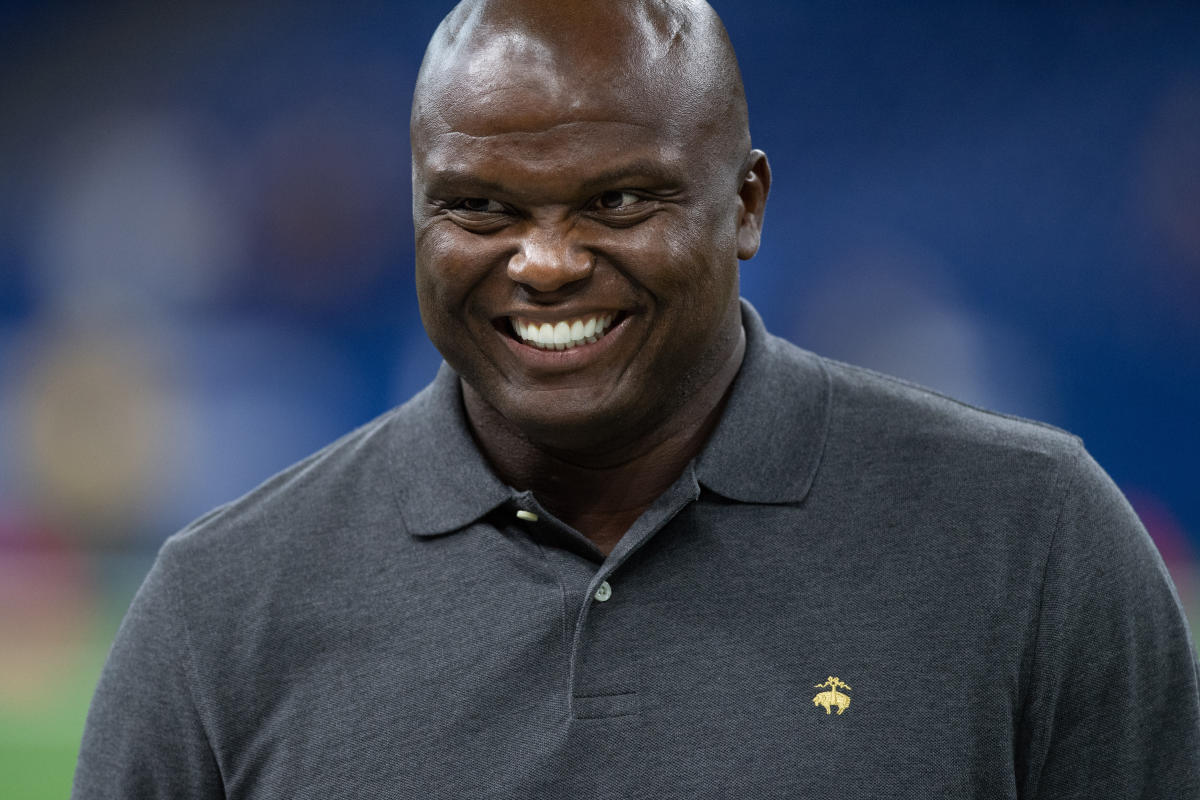
Booger McFarland is a former NFL defensive tackle and two-time Super Bowl champion who transitioned into a high-profile media career as a lead analyst for ESPN and the SEC Network. Known for his blunt, high-energy commentary and deep technical knowledge of line play, he remains a central figure in football broadcasting as of 2026.
Early Life and Collegiate Stardom at LSU
Anthony Darelle "Booger" McFarland was born on December 18, 1977, in Winnsboro, Louisiana. The nickname "Booger," which would eventually become a household name in sports media, was a childhood moniker given to him by his mother because he was a "wild" and "unruly" child. Despite the lighthearted nickname, McFarland’s approach to the game of football was anything but playful.
McFarland attended Louisiana State University (LSU), where he became a cornerstone of the Tigers' defensive line from 1995 to 1998. During his time in Baton Rouge, he established himself as one of the most explosive interior linemen in the Southeastern Conference (SEC). His ability to leverage his 6-foot frame against much taller offensive guards made him a nightmare for opposing quarterbacks.
By his senior year in 1998, McFarland had earned First-team All-SEC honors and was named a First-team All-American. He finished his collegiate career with 15 sacks and 250 tackles, but his impact was often measured in the "dirty work"—absorbing double teams and disrupting the pocket so linebackers could roam free. His performance at LSU solidified his status as a top-tier professional prospect, leading him to the 1999 NFL Draft.
The NFL Journey: From Tampa Bay to Indianapolis
The Tampa Bay Buccaneers selected McFarland with the 15th overall pick in the first round of the 1999 NFL Draft. Joining a defense already headlined by future Hall of Famers like Warren Sapp, Derrick Brooks, and John Lynch, McFarland was the final piece of the puzzle for defensive coordinator Monte Kiffin’s legendary "Tampa 2" system.
The Tampa Bay Years (1999–2006)
In Tampa, McFarland played the "nose tackle" position, frequently lining up alongside Warren Sapp. While Sapp was the flashy disruptor, McFarland provided the brute strength and gap integrity required for the Tampa 2 to function. His career reached its pinnacle in 2002, when the Buccaneers' defense dominated the league, culminating in a 48-21 victory over the Oakland Raiders in Super Bowl XXXVII.
McFarland’s technical proficiency was his greatest asset. He understood the "leverage game," using a low center of gravity to get under the pads of offensive linemen. In an era where defensive tackles were often massive, immovable objects, McFarland was a "three-technique" hybrid who could both stuff the run and penetrate the backfield.
The Indianapolis Colts and a Second Ring (2006–2007)
In October 2006, McFarland was traded to the Indianapolis Colts in exchange for a second-round pick. The move reunited him with head coach Tony Dungy, who had previously coached him in Tampa. The Colts’ defense had struggled significantly against the run, and McFarland was brought in to provide immediate veteran stability.
The acquisition proved to be a masterstroke. McFarland’s presence allowed the Colts' defense to tighten up during the playoffs. He was a vital part of the team that defeated the Chicago Bears in Super Bowl XLI, making McFarland one of the few players to win Super Bowl rings with two different franchises in the 2000s. Unfortunately, a career-ending knee injury suffered during training camp in 2007 forced him into retirement, ending his playing days with 22.5 career sacks and 252 tackles.
Transitioning to Sports Media
Following his retirement from the NFL, McFarland did not stay away from the game for long. He began his broadcasting career in local radio in the Tampa Bay area, co-hosting a popular sports talk show. His natural charisma, combined with an ability to explain complex defensive schemes in layman's terms, quickly caught the attention of national networks.
In 2014, McFarland joined the newly launched SEC Network as a studio analyst. His chemistry with host Greg McElroy and his willingness to criticize underperforming teams made him a fan favorite. Unlike many former players who hesitate to critique their peers, McFarland became known for "telling it like it is," a trait that would eventually propel him to the biggest stage in sports broadcasting.
The Monday Night Football Era and the "Booger Mobile"
In 2018, ESPN announced a radical shift for its flagship program, Monday Night Football (MNF). McFarland was hired as a field-level analyst, a role that involved him sitting in a customized, elevated crane known as the "Booger Mobile."
The Booger Mobile Controversy
The "Booger Mobile" was designed to give McFarland a unique vantage point, allowing him to see the line of scrimmage from an elevated field-level perspective. However, the experiment was met with significant backlash from fans in attendance, as the large vehicle frequently obstructed the views of spectators who had paid for expensive sideline seats.
Furthermore, the logistics of having McFarland on the field while play-by-play announcer Joe Tessitore and analyst Jason Witten were in the booth created a disjointed broadcast rhythm. Despite the technical and PR hurdles, McFarland’s analysis remained sharp, leading ESPN to move him into the primary broadcast booth as the lead color commentator for the 2019 season.
The Move to the Booth
McFarland’s tenure as the lead MNF analyst was polarizing. While some viewers appreciated his bluntness and defensive-minded perspective, others criticized his tendency to repeat certain points or state the obvious. Nevertheless, his time on MNF cemented his status as a household name. In 2020, ESPN reshuffled the MNF booth again, and McFarland transitioned back into a high-level studio role, where many experts believe his talents are best utilized.
Booger McFarland in 2026: A Studio Veteran
As of 2026, Booger McFarland has evolved into one of the most respected studio analysts in the industry. He is a fixture on Monday Night Countdown and plays a critical role in ESPN’s coverage of the NFL Draft and the College Football Playoff.
His role in 2026 involves more than just highlights; he provides "film room" style breakdowns that have become a staple of modern sports media. In an era where sports betting and advanced analytics dominate the conversation, McFarland’s ability to bridge the gap between "old school" toughness and "new school" data has kept him relevant. He frequently appears on Get Up and First Take, providing a defensive perspective to counter the offensive-leaning narratives that often dominate football talk.
| Category | Details |
|---|---|
| Full Name | Anthony Darelle "Booger" McFarland |
| Draft Position | 1999, Round 1, Pick 15 (Tampa Bay Buccaneers) |
| Super Bowl Titles | 2 (XXXVII with Tampa Bay, XLI with Indianapolis) |
| Primary Position | Defensive Tackle / Nose Tackle |
| Broadcasting Peak | Monday Night Football Lead Analyst (2019) |
| Current Role (2026) | Senior NFL & SEC Studio Analyst (ESPN) |
| College | LSU Tigers (All-American) |
The Mechanics of McFarland’s Analysis
What sets McFarland apart in the 2026 media landscape is his focus on the "trenches." While most analysts focus on the "skill positions"—quarterbacks, wide receivers, and running backs—McFarland dedicates his time to explaining how games are won and lost at the line of scrimmage.
Technical Depth in Commentary
McFarland often uses his platform to discuss the nuances of defensive line play, such as:
- The Three-Technique: Explaining how a defensive tackle lines up on the outside shoulder of a guard to penetrate the "B-gap."
- Hand Fighting: Detailing how linemen use "swipes," "rips," and "clubs" to disengage from blockers.
- Gap Integrity: Helping fans understand that a defensive player can have a "great game" even without recording a single tackle, simply by occupying two blockers and maintaining their assigned gap.
This technical depth has made him an invaluable resource for serious students of the game, even as his boisterous personality appeals to the casual viewer.
Financial Impact and Personal Life
McFarland’s success on the field and in the booth has led to a significant net worth, estimated by various financial outlets to be in the range of $9 million to $11 million as of 2026. This wealth is a combination of his NFL contracts, long-term deals with ESPN, and various endorsement partnerships.
Off the air, McFarland is known for his commitment to family and community. He is married to Tammie McFarland, and the couple has two children. He is also active in various charitable endeavors in both the Tampa and Baton Rouge areas, often focusing on youth sports and educational initiatives.
FAQs About Booger McFarland
Why is Anthony McFarland called "Booger"?
The nickname was given to him by his mother when he was a young child in Louisiana. According to McFarland, he was a very active and sometimes troublesome toddler, and the name "Booger" was a Southern colloquialism for a wild child. He embraced the name throughout his athletic career, and it eventually became his professional brand.
How many Super Bowls did Booger McFarland win?
Booger McFarland won two Super Bowl rings. His first came with the Tampa Bay Buccaneers in Super Bowl XXXVII (2002 season), and his second came with the Indianapolis Colts in Super Bowl XLI (2006 season). He is one of a select group of players to win championships with two different franchises.
What happened to the "Booger Mobile"?
The "Booger Mobile" was a motorized, elevated chair used during the 2018 Monday Night Football season. It was discontinued after one season due to heavy criticism from fans whose views of the field were blocked by the device. For the 2019 season, McFarland moved into the traditional broadcast booth.
Does Booger McFarland still work for ESPN in 2026?
Yes, as of 2026, McFarland remains a prominent analyst for ESPN. While he no longer calls Monday Night Football games as a color commentator, he is a lead studio analyst for the network’s NFL and college football coverage, appearing on NFL Countdown and major event broadcasts like the NFL Draft.
What position did Booger McFarland play?
McFarland was a defensive tackle. In the Buccaneers' 4-3 defense, he primarily played the nose tackle or the three-technique spot. His role was to disrupt the interior of the offensive line and stop the run.
Practical Recommendation for Fans and Aspiring Analysts
For those who want to understand the game of football through the lens of a professional, following Booger McFarland’s studio segments is highly recommended. To get the most out of his analysis:
- Watch the Trenches: During a live game, try to ignore the ball for a few plays and watch the defensive tackles. Look for the "leverage" and "hand fighting" that McFarland frequently mentions.
- Listen for Scheme Over Narrative: McFarland is excellent at pointing out when a play fails due to a schematic breakdown rather than just a player "not trying hard enough."
- Engage with SEC Network Content: For a more relaxed and often more humorous side of his personality, his work on the SEC Network provides a great balance of entertainment and football IQ.
By focusing on the interior line play that McFarland champions, fans can develop a much deeper appreciation for the complexities of the sport.