Sagittarius is a fire sign because traditional astrology categorizes the zodiac wheel into four classical elements—fire, earth, air, and water—assigning Sagittarius to the fire triplicity alongside Aries and Leo. This elemental classification stems from ancient Hellenistic and Babylonian astrological traditions, which linked the behavior, temperament, and symbolic energy of a constellation's corresponding period to the physical characteristics of nature. Governed by Jupiter and symbolized by the Archer, Sagittarius embodies the dynamic, expansive, and transformative qualities of fire, manifesting as philosophical curiosity, boundless optimism, and a relentless pursuit of truth.
Understanding why Sagittarius is classified as a fire sign requires examining the historical evolution of elemental astrology, the philosophical framework of the zodiac triplicities, and how planetary rulership shapes this sign's expressive nature. Rather than being a random assignment, the connection between Sagittarius and fire represents a sophisticated synthesis of seasonal observation, ancient myth, and symbolic psychology that has endured for millennia.
The Foundations of Elemental Astrology
To understand why Sagittarius is a fire sign, one must first examine how the four classical elements became the structural backbone of Western astrology. The system of elemental triplicities is not a modern invention; its roots stretch back to ancient cosmological models that sought to explain human nature and the physical universe through fundamental building blocks.
In ancient Greek philosophy, particularly through the works of Empedocles and later Aristotle, the cosmos was believed to be composed of four elements: fire, earth, air, and water. These elements possessed distinct properties—hot, cold, dry, and moist—that interacted to form all matter and experience. Fire was classified as hot and dry, representing energy, action, expansion, and spiritual illumination.
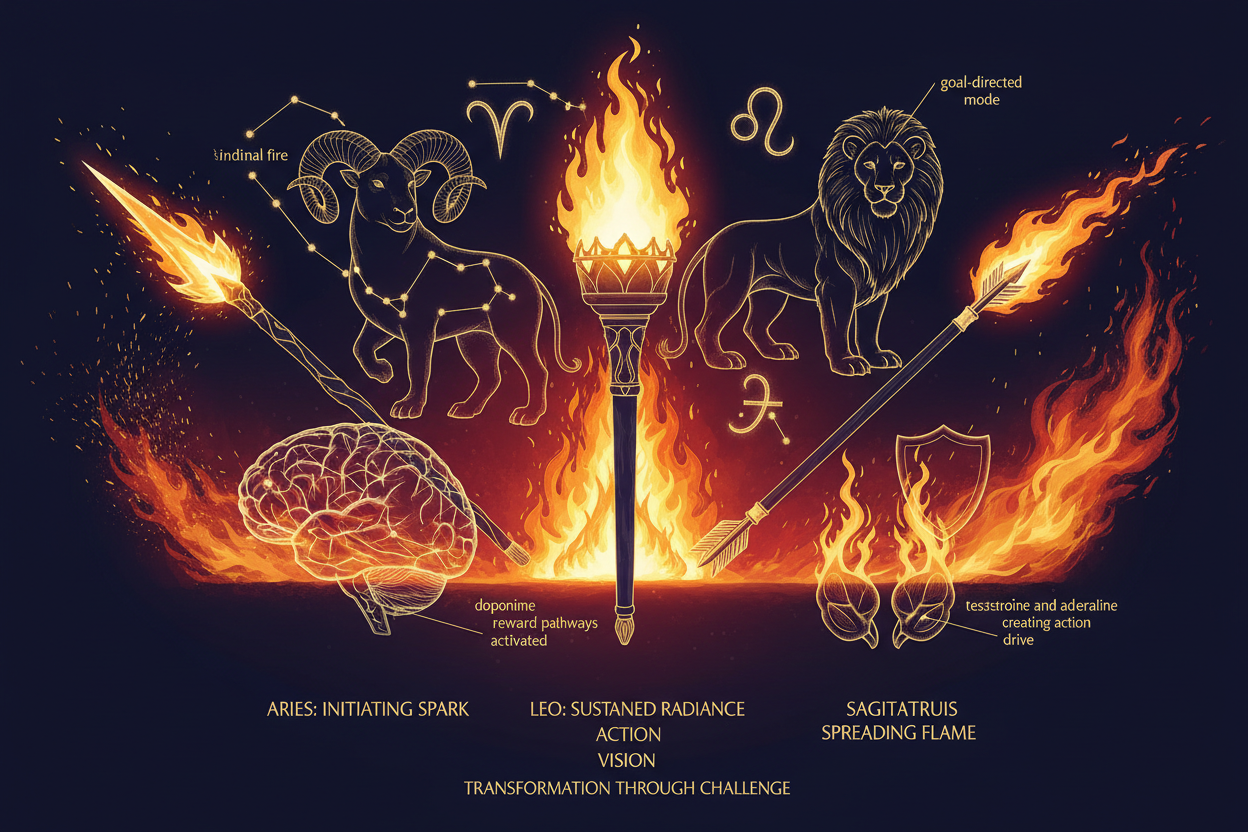
Astrologers adapted this philosophical framework to map the cycle of the zodiac. The twelve signs are divided into four groups of three, known as triplicities, with each group corresponding to one of the four elements. The fire triplicity includes:
- Aries: Representing the spark, initiation, and cardinal impulse of fire.
- Leo: Representing the steady, radiant, and fixed warmth of the mid-summer sun.
- Sagittarius: Representing the wild, expansive, and mutable flame of a spreading wildfire or a guiding torch.
This distribution ensures that every element cycles through the zodiac three times, touching different modalities (cardinal, fixed, and mutable). By understanding fire as a primal force of creation and destruction, ancient astrologers laid the groundwork for interpreting Sagittarius through an energetic lens.
The Mutable Nature of Sagittarius Fire
A critical component of why Sagittarius functions the way it does involves its modality. In astrology, signs are divided into three modalities—cardinal, fixed, and mutable—which describe how a sign expresses its elemental energy. Sagittarius is a mutable fire sign, which fundamentally distinguishes its flame from that of Aries or Leo.
| Zodiac Sign | Element | Modality | Expression of Fire |
|---|---|---|---|
| Aries | Fire | Cardinal | The initiating spark; sudden, impulsive, and direct bursts of energy. |
| Leo | Fire | Fixed | The sustained hearth; focused, radiant, steady, and proud warmth. |
| Sagittarius | Fire | Mutable | The wild torch or spreading wildfire; adaptable, searching, and expansive. |
Mutable signs occur at the transition points of the seasons. Sagittarius arrives in late autumn in the Northern Hemisphere (spanning roughly from November 22 to December 21), just as the year transitions from the deep introspective work of Scorpio toward the structured cold of Capricorn. Because it bridges seasons, mutable fire is adaptable, restless, and transitional.
Instead of burning in a localized hearth like Leo or striking out abruptly like Aries, Sagittarius fire acts like a campfire tossed on a windy plain or a guiding beacon carried by a traveler. It is searching, philosophical, and perpetually restless. This adaptability explains why Sagittarius individuals are frequently drawn to travel, higher education, cross-cultural exploration, and philosophical inquiry. Their fire seeks new oxygen constantly, refusing to be contained in a single stove.
Astrological Rulership: Jupiter and the Amplification of Fire
Another primary reason Sagittarius maintains its fiery reputation is its traditional and modern planetary ruler: Jupiter. In traditional astrology, planets are assigned domiciles—signs where they hold special dominion and express their nature most fluently. Jupiter is the ruler of Sagittarius, and this planetary association supercharges the sign's elemental tendencies.
In classical mythology and astrology, Jupiter (the Roman equivalent of Zeus) is the king of the gods, associated with luck, abundance, expansion, philosophy, and higher wisdom. When you combine the expansive, larger-than-life energy of Jupiter with the hot, dry, upward-reaching nature of fire, the result is a personality archetype defined by:
- Optimism: An intrinsic belief that things will work out, often leading to bold risk-taking.
- Expanse: A desire to stretch beyond physical, mental, and geographical boundaries.
- Zest for Life: An infectious enthusiasm for experiencing everything the world has to offer.
Jupiter ensures that Sagittarius fire is not destructive in a malicious sense, but rather consuming in its hunger for knowledge and experience. Where Mars (ruler of Aries) drives fire through conflict and assertion, Jupiter drives fire through vision, meaning, and faith.
Mythological Symbolism: The Centaur Archer
The imagery associated with Sagittarius further reinforces its elemental assignment. The sign is symbolized by the Centaur—half-man, half-horse—wielding a bow and arrow. This mythical creature bridges the gap between raw animal instinct and elevated human intellect, a duality that perfectly captures the behavior of fire.
The horse’s body represents physical vitality, raw power, and unbridled forward motion—attributes aligned with the impulsive energy of fire. Meanwhile, the human torso holding the drawn bow represents conscious direction, aiming high toward distant horizons, and intellectual pursuit. The arrow itself is a projectile of fire, launched into the unknown sky with the intent to pierce distant truths.
This mythological backdrop explains why Sagittarius fire is so often conceptualized as a quest. It is not fire for the sake of burning; it is fire used as a torch to illuminate dark, uncharted territories. The Archer aims upward and outward, reflecting the element's natural tendency to rise toward the heavens.
Manifestation of Fire in Personality and Behavior
Translating these ancient frameworks into human psychology reveals why astrologers and enthusiasts identify specific behavioral patterns with Sagittarius. Because fire is an extroverted, expressive element, Sagittarius personality traits naturally gravitate toward visibility, movement, and interaction with the external world.
Intellectual Curiosity and Philosophical Zeal
Just as physical fire requires fuel to survive, Sagittarius fire feeds on ideas, concepts, and philosophies. This manifests as an insatiable appetite for learning, debating, and exploring different belief systems. They are rarely satisfied with surface-level answers; they want to know the grand design behind why things happen.
Freedom and Independence
Fire cannot be easily caged or cornered without suffocating. Similarly, Sagittarius individuals place an exceptionally high value on personal freedom. Confinement, rigid dogmas, and suffocating routines stifle their mutable flame, prompting them to break away in search of open spaces.
Blunt Honesty and Enthusiasm
Fire is direct and unvarnished. Sagittarius is widely recognized for brutal honesty, often speaking truths without a filter because their primary objective is authenticity rather than diplomacy. This is paired with an exuberant, motivating energy that inspires those around them, much like gathering around a warm fire on a cold night.
Common Misconceptions About Sagittarius Fire
When examining why Sagittarius is a fire sign, it is helpful to address common points of confusion regarding how this element operates compared to earth, air, and water signs.
- Mistaking Fire for Aggression: While Aries fire can manifest as hot-headed combativeness, Sagittarius fire is typically philosophical rather than hostile. When a Sagittarius becomes passionate, it is usually in defense of an idea, a freedom, or a worldview, rather than a personal ego attack.
- Confusing Mutable Fire with Lack of Direction: Because Sagittarius is mutable, critics sometimes view them as scattered. However, while they may shift interests frequently, their overarching trajectory remains consistent: they are always searching for meaning, acting as the spiritual seeker of the zodiac.
- Overlooking the Cold Season Contrast: Many people assume fire signs must be born in summer. However, the elemental assignment is based on symbolic alignment with the sun's journey and seasonal shifts, not literal weather temperatures at birth.
Frequently Asked Questions
What are the three fire signs in astrology?
The three fire signs are Aries, Leo, and Sagittarius. Each represents a different phase of the elemental cycle: Aries is the cardinal spark, Leo is the fixed hearth, and Sagittarius is the mutable, spreading flame. Together, they share traits of enthusiasm, energy, leadership, and passion.
How does Sagittarius differ from Aries and Leo as a fire sign?
While all three share the fire element, Aries is impulsive and action-oriented (cardinal), Leo is proud, focused, and steady (fixed), and Sagittarius is philosophical, expansive, and adaptable (mutable). Sagittarius uses fire to explore ideas, travel, and seek higher meaning rather than to initiate projects or command center stage.
Why is Sagittarius ruled by Jupiter?
Traditional astrology assigns Jupiter to Sagittarius because the qualities of the planet—expansion, luck, philosophy, and higher wisdom—harmonize with the fiery, upward-reaching, and truth-seeking nature of the sign. This rulership amplifies the sign's optimism and love for exploration.
Does being a fire sign mean Sagittarius is always angry?
No. In astrology, fire represents energy, inspiration, vitality, and passion, not just anger. While fire can flare up into temper, for Sagittarius, that elemental heat is primarily channeled into humor, wanderlust, philosophical inquiry, and an enthusiastic approach to life.
What season does Sagittarius represent in the zodiac?
Sagittarius represents late autumn, bridging the transition from the deep emotional transformation of Scorpio into the structured discipline of winter embodied by Capricorn. This seasonal placement explains its mutable nature, as it adapts to shifting conditions and prepares for new cycles.
Conclusion and Next Actions
Sagittarius is a fire sign because its foundational traits—boundless optimism, philosophical curiosity, a need for freedom, and an expansive worldview—mirror the classical element of fire interpreted through a mutable, Jupiter-ruled lens. Whether exploring the history of Hellenistic astrology or observing personality archetypes, the connection between the Archer and the flame remains a cornerstone of astrological tradition. To deepen your understanding, examine your own birth chart to see how fire houses or aspects interact with Sagittarius placements, or explore how complementary elements like air feed and sustain this fiery archetype.