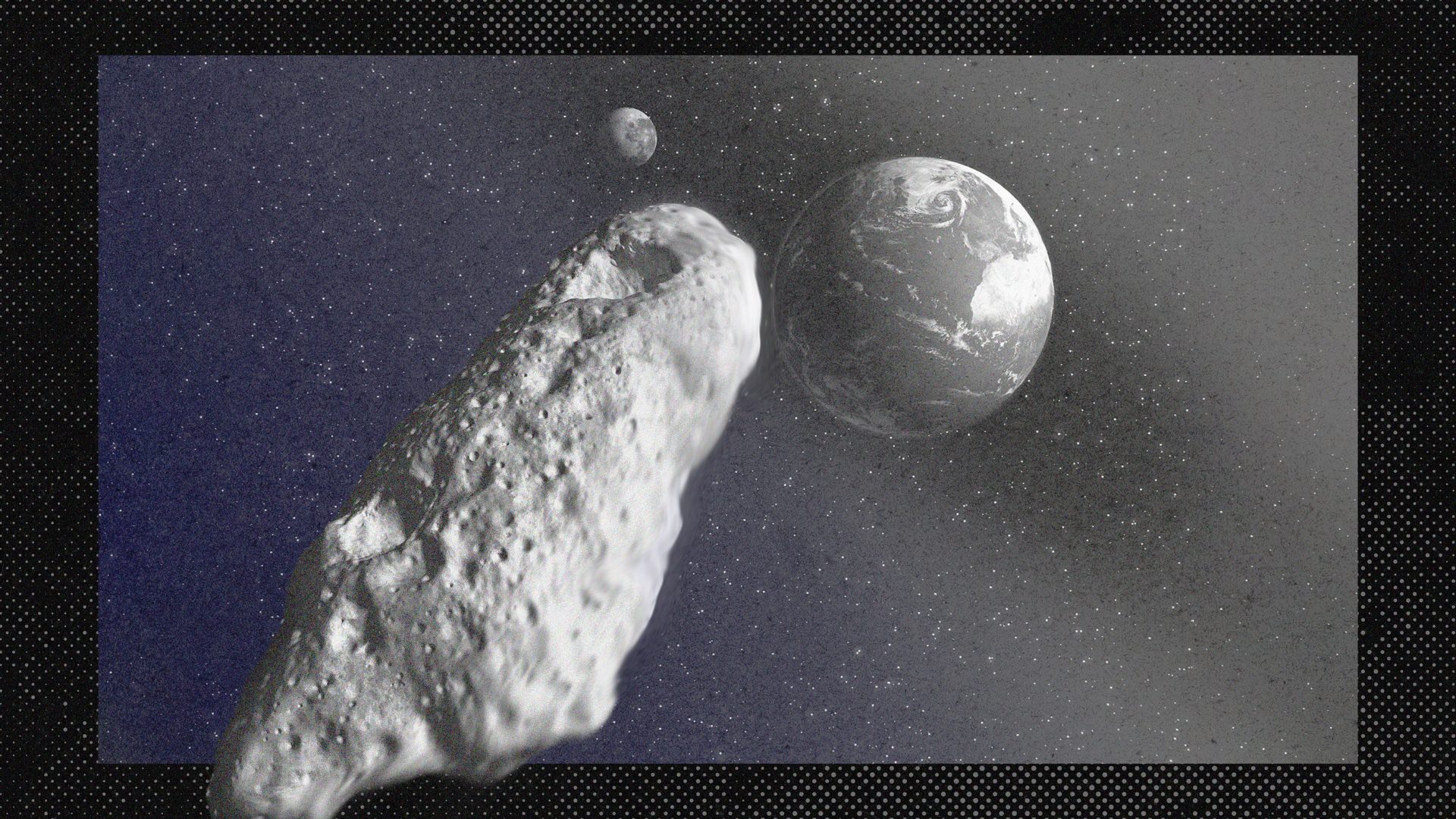
The 2036 asteroid encounter refers to the extensive scientific monitoring and trajectory analysis of near-Earth object 99942 Apophis, particularly regarding its historically significant close approaches to Earth, with 2036 marking the conclusion of a multi-decade risk assessment period that ultimately ruled out any possibility of an impact.
The Discovery of Apophis and Early Hazard Assessments
On June 19, 2004, astronomers Roy A. Tucker, David J. Tholen, and Fabrizio Bernardi discovered a near-Earth asteroid from the Kitt Peak National Observatory in Arizona. Initially designated provisionally as 2004 MN4, the object quickly captured the intense attention of the global astronomical community. Preliminary calculations of its orbit suggested an unusually high probability of colliding with Earth in the coming decades, making it a focal point for planetary defense agencies worldwide.
Initial Torino Scale Ratings and Public Alarm
When astronomers first computed the trajectory of the newly discovered asteroid, the potential risk of an impact prompted a rating of 4 on the Torino Scale—the highest rating ever assigned to an asteroid at that time. A Torino Scale rating of 4 indicates a 1% or greater chance of a localized devastation or regional destruction event, signaling a need for public attention and rigorous monitoring by space agencies.
Subsequent observations and pre-discovery image recoveries—images captured years earlier without the object being recognized—allowed orbital dynamicists to refine their models. As more data points were integrated into the calculations, the estimated probability of an impact fluctuated before further observations completely altered the baseline understanding of the asteroid's path.
Physical Characteristics and Size Estimates
Understanding the potential threat of any near-Earth object requires precise measurements of its physical dimensions, mass, and composition. Ground-based radar observations, particularly those conducted using the Arecibo Observatory and the Goldstone Deep Space Communications Complex, provided crucial data regarding the physical nature of the object.
- Composition: Classified primarily as an S-type asteroid, indicating a stony composition rich in silicate materials and nickel-iron.
- Dimensions: Approximately 340 meters (1,120 feet) across, roughly comparable to the length of three football fields.
- Mass: Estimated to be approximately $2.7 \times 10^{10}$ kilograms, possessing substantial kinetic energy given its velocity relative to Earth.
Orbital Dynamics and the 2029 Flyby Context
To understand why the year 2036 held such significance in planetary defense discussions, one must examine the precise mechanics of the asteroid's orbit around the Sun and its interaction with Earth's gravitational field.
Understanding Resonant Orbits and Gravitational Keyholes
Near-Earth asteroids often travel in orbits that bring them into regular intersections with the orbital paths of terrestrial planets. In the case of this specific asteroid, its orbit intersects that of Earth twice during each solar revolution.
Of particular concern during the early assessment phase was the concept of a "gravitational keyhole." A keyhole is a small, precise region in space through which an asteroid must pass during a close flyby so that Earth's gravitational pull alters its trajectory into a resonant orbit—an orbit that ensures the asteroid will impact Earth on a subsequent return visit.
The Historic 2029 Approach
Calculations revealed that on April 13, 2029, the asteroid would pass extraordinarily close to Earth—closer than the altitude of geostationary communication satellites, or roughly 31,300 kilometers (19,450 miles) above the Earth's surface.
This approach was predicted to be visible to the naked eye for observers in parts of Europe, Africa, and western Asia. While astronomers quickly ruled out an impact during this 2029 encounter, they recognized that the intense gravitational tug exerted by Earth during the flyby would drastically alter the asteroid's subsequent orbit, making long-term predictions for the following decade vital.
| Approach Year | Minimum Distance (Kilometers) | Minimum Distance (Miles) | Impact Risk Status |
|---|---|---|---|
| 2004 | Varied across multiple passes | Varied across multiple passes | Initial high uncertainty |
| 2029 | ~31,300 km | ~19,450 km | Impact completely ruled out |
| 2036 | ~22.5 million km (Revised) | ~14 million miles (Revised) | Originally monitored, later ruled out |
| 2068 | Distant pass | Distant pass | Extremely low probability ruled out |
Scientific Resolution of the 2036 Threat
The primary reason 2036 became a landmark date in asteroid tracking history was the persistence of a potential impact scenario for April 13, 2036, should the asteroid pass through the specific 2029 gravitational keyhole. Resolving this question required intensive radar astrometry and optical tracking over several years.
Radar Astrometry and Yarkovsky Effect Integration
To definitively determine whether the asteroid would thread the keyhole in 2029, astronomers needed exceptionally precise measurements of its position and velocity. Radar observations bounce radio waves off the surface of the asteroid, allowing scientists to measure distance and speed with extreme accuracy—down to a fraction of a kilometer over millions of kilometers.
Furthermore, scientists had to account for the Yarkovsky effect, a subtle force acting on rotating bodies in space. When an asteroid absorbs sunlight and re-emits it as thermal radiation, the escaping heat acts as a tiny thruster, slowly changing the orbit over long periods. Factoring in the Yarkovsky effect was essential for modeling the post-2029 trajectory leading up to the hypothetical 2036 encounter.
Declassification of Risk
As additional radar data from the 2013 and 2021 close approaches were analyzed by institutions such as NASA's Center for Near Earth Object Studies (CNEOS) and the European Space Agency (ESA), the uncertainties in the asteroid's trajectory shrank dramatically.
In March 2021, following a close radar observation run as the asteroid passed safely at a distance of about 17 million kilometers, scientists announced that new radar measurements allowed them to completely exclude any impact risk for 2036—as well as for the subsequent 2068 potential pass. The asteroid was officially removed from planetary defense risk tables, confirming that Earth is safe from this particular object for the foreseeable future.
Planetary Defense Methodologies and Lessons Learned
The comprehensive tracking campaign associated with this asteroid transformed modern planetary defense, establishing frameworks and technologies that continue to protect Earth from other potential cosmic hazards.
Evolution of Tracking and Early Warning Networks
The intensive scrutiny directed at the object catalyzed improvements in global asteroid detection infrastructure. International cooperation between optical observatories, radar facilities, and space agencies matured significantly during this period.
- Automated Survey Telescopes: Programs like the Asteroid Terrestrial-impact Last Alert System (ATLAS) and the Zwicky Transient Facility expanded the capability to discover hazardous objects years before potential close approaches.
- Space-Based Infrared Sensors: Missions designed to detect dark, non-reflective near-Earth asteroids using infrared wavelengths enhanced inventory completeness for objects in challenging solar geometries.
- Data Sharing Protocols: The International Asteroid Warning Network (IAWN) and NASA's Planetary Defense Coordination Office (PDCO) established standardized communication channels for verifying threats and notifying governmental authorities.
Deflection Concepts Validated by Mission Data
While mitigation was ultimately unnecessary for this specific asteroid, the theoretical work surrounding its potential deflection spurred advancements in kinetic impactor technology. Subsequent missions, such as NASA's Double Asteroid Redirection Test (DART), successfully demonstrated that humanity possesses the technological capability to alter the trajectory of a celestial body through deliberate kinetic force if an actual threat ever materializes.
Frequently Asked Questions
Could the asteroid still hit Earth in the future?
No. Comprehensive radar tracking and orbital analysis have allowed scientists to map the trajectory of the asteroid decades into the future. All potential impact risks for the 2036 encounter, as well as passes later in the 21st century, have been definitively ruled out by observational data.
How close will the asteroid come to Earth during future encounters?
During its landmark flyby on April 13, 2029, the asteroid will pass approximately 31,300 kilometers above Earth's surface. Subsequent passes, such as those occurring in the mid-2030s and beyond, will occur at much greater, completely safe distances measured in millions of kilometers.
What instruments were used to determine the orbit of the asteroid?
Scientists utilized a combination of optical telescopes for long-term tracking and high-precision radar systems—primarily the Arecibo Observatory (before its structural failure in 2020) and the Goldstone Deep Space Communications Complex—to bounce radio waves off the asteroid's surface, measuring its position and velocity with extreme precision.
What is a gravitational keyhole?
A gravitational keyhole is a small, precise region in space through which a near-Earth object must pass during a close flyby so that Earth's gravity alters its orbital path in a specific way, potentially setting up a collision on a subsequent orbit. Rigorous tracking confirmed that the asteroid will not pass through any such keyhole.
Why was the asteroid initially rated so high on the Torino Scale?
When the asteroid was discovered in 2004, early observational data had high statistical uncertainties. Based on limited initial orbital arcs, preliminary calculations suggested a roughly 2.7% chance of impact, prompting a temporary rating of 4 on the Torino Scale until additional data refined the trajectory.
Summary and Next Actions
The scientific investigation surrounding the near-Earth object 99942 Apophis and its projected close encounter serves as a triumph of modern astronomy, transforming an initial hazard assessment into a verified demonstration of orbital safety. For researchers, educators, and space enthusiasts, the primary action moving forward involves supporting ongoing near-Earth object survey programs, such as upcoming dedicated space telescopes, which continue to catalog and monitor the broader population of cosmic bodies sharing our orbital neighborhood.