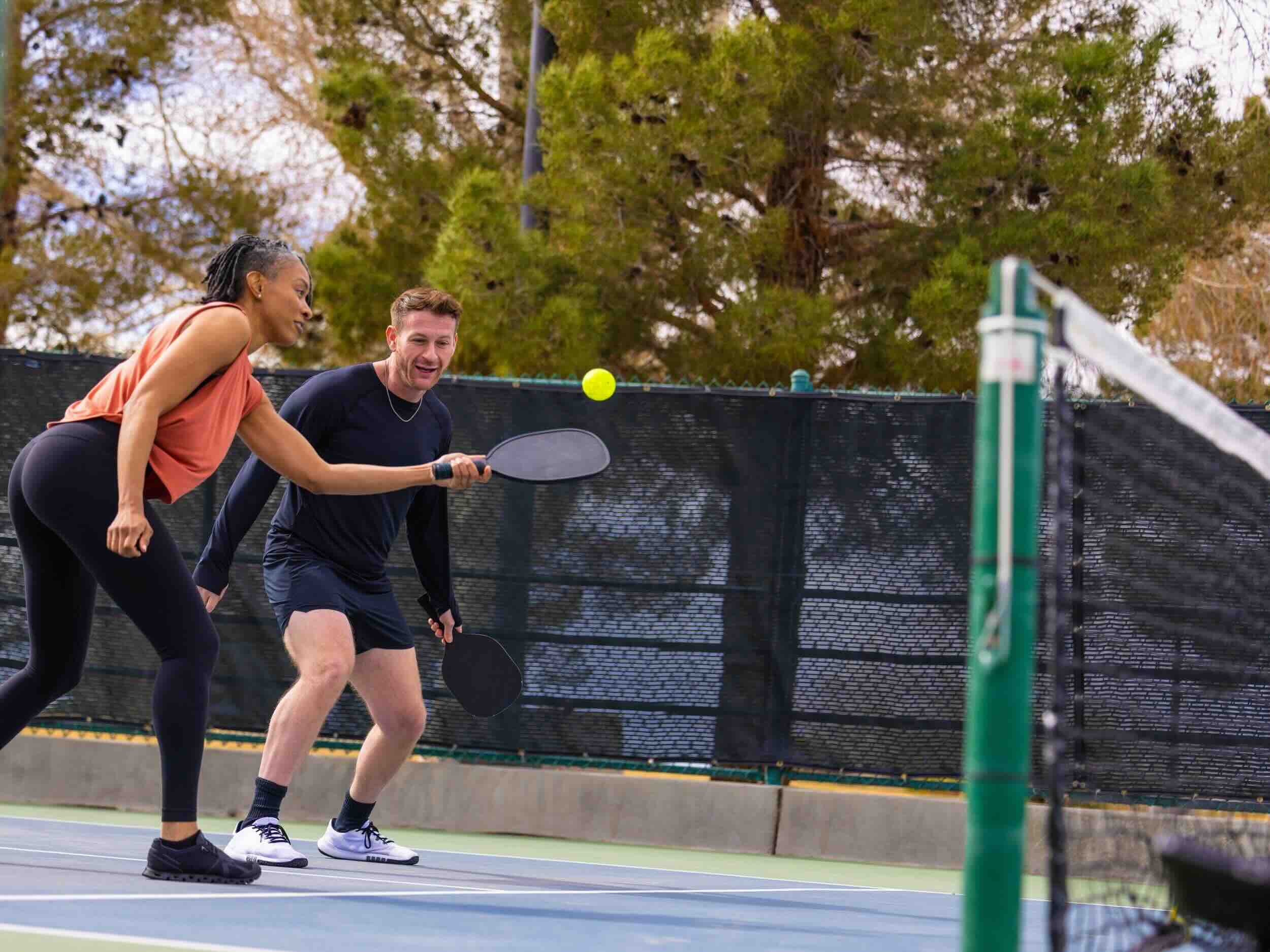
Pickleball is the fastest-growing sport in the United States, blending elements of tennis, badminton, and ping-pong into an accessible, fast-paced game that attracts millions of players of all ages and athletic backgrounds.
To fully understand the phenomenon sweeping local parks and dedicated sports complexes, it helps to look beneath the surface of the standard rules and equipment. Whether you are a seasoned tournament competitor stepping onto the non-volley zone line or a curious beginner picking up a composite paddle for the first time, exploring the quirky history, peculiar terminology, and surprising mechanics of the game reveals why it has captured the global sports imagination.
1. The Accidental Birth on a Bainbridge Island Backyard
Pickleball was invented during the summer of 1965 on Bainbridge Island, Washington, near Seattle. Joel Pritchard, Bill Bell, and Barney McCallum returned home from a golf outing to find their families bored. Seeking entertainment on an existing badminton court, they could not find a full set of badminton rackets. They improvised by lowering the net to waist height, fashioning oversized plywood paddles, and using a perforated plastic plastic wiffle ball. What started as a desperate way to keep children occupied on a lazy weekend afternoon inadvertently birthed a modern athletic movement.
2. The Real Story Behind the Name "Pickleball"
A persistent urban legend claims the sport was named after a family dog named Pickles who chased stray balls. However, Joan Pritchard, Joel's wife, clarified the naming origin. She stated that she named the game "pickleball" because the combination of different sports reminded her of the "pickle boat" in crew, where oarsmen were chosen from the leftovers of other boats. Over the decades, the canine myth proved so resilient that many players still accept it as gospel, even though the nautical explanation remains the official historical record.
3. The Curious Evolution of the Paddle
The original paddles used in 1965 were hand-cut from plywood sheets by Barney McCallum, making them heavy, thick, and lacking the modern responsiveness players expect today. For decades, wooden paddles dominated recreational play, offering durability at a low manufacturing cost. Today, advanced engineering has transformed the paddle market. Modern competitive paddles feature composite faces—such as fiberglass or raw carbon fiber—bonded to honeycomb cores made of polymer, Nomex, or aluminum, dramatically altering spin generation and power dynamics.
4. The Perforated Ball That Defies the Wind
Unlike the felt-covered rubber ball used in tennis or the lightweight cork-and-feather shuttlecock used in badminton, a pickleball is a dynamic plastic sphere containing between 26 and 40 circular holes. The exact number and size of these holes are heavily regulated by governing bodies for tournament play. Furthermore, balls are manufactured differently depending on the environment: outdoor balls feature smaller, more numerous holes to punch through breezes, while indoor balls possess larger, fewer holes designed for predictable flight in climate-controlled gymnasiums.
5. The Kitchen: A Unique Non-Volley Zone
One of the most defining and strategically fascinating features of a pickleball court is the "non-volley zone," universally known as "the kitchen." This is a seven-foot box extending on either side of the net. Players are strictly prohibited from striking the ball out of the air (volleying) while any part of their body or equipment touches the kitchen line or interior surface. This ingenious rule prevents towering players from standing directly at the net and smashing every shot downward, forcing competitors to engage in delicate dink rallies and tactical patience.
6. Scoring Peculiarities and the Third-Number Mystery
Pickleball scoring can notoriously confuse newcomers because standard recreational games are traditionally played to 11 points, and a team must win by a margin of two points. Furthermore, points can only be scored by the serving side. In doubles, both partners get a chance to serve before a side-out occurs (except for the very beginning of the game, where the starting team only gets one fault). When competitive players call out the score, they recite three numbers: the serving team's score, the receiving team's score, and the server number (one or two).
7. The Sport's Explosive Growth Metrics
While pickleball was invented in the mid-1960s, its meteoric rise occurred during the 2020s. According to the Sports & Fitness Industry Association (SFIA) and the Association of Pickleball Players (APP), participation numbers have surged by double-digit percentages year over year. Millions of active players now populate public parks, country clubs, and dedicated indoor facilities. This dramatic surge has driven commercial real estate developers to convert old retail spaces and tennis courts into multi-court pickleball complexes to meet surging local demand.
8. Celebrities, Entrepreneurs, and Professional Leagues
The cultural footprint of pickleball extends far beyond neighborhood recreation. Major celebrities, professional athletes, and billionaire investors—including LeBron James, Tom Brady, Kevin Durant, Drew Brees, and Naomi Osaka—have purchased stakes in professional pickleball teams. The sport now features fully realized professional circuits, such as the PPA Tour (Professional Pickleball Association) and Major League Pickleball (MLP), complete with lucrative broadcast contracts, official rankings, and high-stakes tournament prize purses.
9. Tennis vs. Pickleball: Court Dimensions Compared
A standard pickleball court shares the exact same overall footprint as a badminton doubles court: 20 feet wide by 44 feet long for both singles and doubles play. In stark contrast, a tennis court measures 36 feet wide by 78 feet long for doubles. This means roughly four pickleball courts can fit comfortably inside the boundaries of a single tennis court. This spatial efficiency has sparked friendly turf wars in municipal parks as cities try to balance the competing demands of tennis players and pickleball enthusiasts.
10. The Physics of the "Dink" Shot
Because the kitchen rule neutralizes high-velocity slam shots directly at the net, players mastered the "dink"—a soft, arcing shot that drops gently into the opponent's kitchen. Executing a proper dink requires immense touch, wrist control, and patience. Physics dictates that striking a lightweight plastic ball with a rigid paddle requires minimal kinetic energy transfer to clear the net by mere inches, forcing opponents to look for an unforced error or a floating ball they can aggressively attack.
| Equipment / Court Feature | Pickleball Specification | Tennis Specification | Badminton Specification |
|---|---|---|---|
| Court Length | 44 feet | 78 feet | 44 feet |
| Court Width (Doubles) | 20 feet | 36 feet | 20 feet |
| Net Height at Center | 34 inches | 34 inches | 5 feet 1 inch |
| Ball Type | Perforated plastic (polymer) | Felt-covered rubber | Feather or synthetic shuttlecock |
| Paddle / Racket Material | Solid composite/wood | Strung gut/synthetic racket | Strung lightweight racket |
11. International Reach and Global Governing Bodies
What began as an American backyard pastime has rapidly evolved into an international sport. The International Federation of Pickleball (IFP) and the World Pickleball Federation (WPF) boast member associations spanning dozens of countries across North America, Europe, Asia, Australia, and South America. National governing bodies continually standardize equipment specifications, referee certifications, and tournament guidelines to prepare the sport for future multi-sport international competitions.
12. Sound Controversy: The Infamous "Pop"
As pickleball facilities proliferate near residential neighborhoods, a unique friction point has emerged: the sound. When a hard composite paddle strikes a hard plastic ball, it produces a sharp, high-frequency acoustic sound—typically measuring around 80 to 90 decibels at close range—frequently described as a high-pitched "pop" or "thwack." This recurring acoustic profile has led to neighborhood noise disputes, zoning battles, legal injunctions, and a massive engineering push to develop quieter paddles and acoustic dampening fences.
13. Accessibility and Low Barrier to Entry
Unlike sports requiring expensive technical instruction, specialized footwear, or heavy gear investments, pickleball boasts a remarkably flat learning curve. A beginner can rent a paddle, buy a low-cost ball, step onto a court, and sustain a basic rally within ten minutes of instruction. This low barrier to entry makes the game exceptionally popular among older adults seeking low-impact cardiovascular exercise, as well as children and families looking for an inclusive recreational activity.
14. Senior Dominance and Intergenerational Play
While younger demographics and collegiate club teams are driving the modern competitive surge, older adults built the foundational infrastructure of the sport. Senior communities, retirement villages, and groups like the Huntsman World Senior Games embrace pickleball as a vital social outlet. Uniquely, pickleball bridges generational divides; it is common to see teenagers, parents, and grandparents playing in the same recreational rec-center rotation without significant physical disadvantages due to the smaller court dimensions.
15. The Evolution of Tournament Strategies and Kitchen Line Battles
Early pickleball strategy focused primarily on simply keeping the ball in play. As the sport professionalized, advanced tactics emerged. Modern elite players utilize aggressive third-shot drops, rapid hand speed exchanges at the non-volley zone line, and sophisticated stacking formations in doubles. Stacking allows partners to maintain their preferred forehand sides regardless of who is serving or receiving, maximizing court coverage efficiency and tactical matchups against opposing pairs.
16. Technological Innovations in Footwear
Playing pickleball requires constant lateral shuffling, explosive sprints, and sudden stops. General running shoes are poorly suited for this environment because their thick, cushioned soles and soft lateral treads increase the risk of ankle sprains and rolling injuries. Consequently, major athletic brands now manufacture dedicated pickleball and court shoes featuring reinforced toe guards, flat outsoles with specialized rubber compound grips, and robust lateral stability shanks designed specifically for abrasive asphalt, concrete, and indoor gym surfaces.
17. The Origins of USAPA and Official Rulebooks
As the sport grew past backyard casual gatherings, players realized centralized governance was necessary. In 1984, the United States Amateur Pickleball Association (USAPA)—now known as USA Pickleball—was incorporated. This organization published the first official rulebook, established equipment testing standards, sanctioned regional tournaments, and certified referees. Today, the USA Pickleball rulebook is updated annually to address evolving equipment technologies, tournament conduct codes, and officiating standards.
18. Indoor vs. Outdoor Pickleball Dynamics
Environmental factors radically alter how pickleball is played. Outdoor play exposes competitors to wind currents, glaring sun, changing temperatures that affect plastic ball elasticity, and abrasive outdoor court surfaces that wear down ball seams quickly. Indoor play offers a completely controlled climate where balls travel predictably, but lighting conditions, gymnasium floors, and background wall colors can introduce unique visual tracking challenges for fast-paced volley exchanges.
19. Physical Health Benefits and Injury Profiles
While pickleball is lower impact than tennis or basketball, it remains a legitimate cardiovascular workout. Regular participation improves agility, hand-eye coordination, balance, and aerobic conditioning. However, the sport's rapid growth has also brought attention to common athletic injuries. Orthopedic specialists frequently treat acute lower-extremity issues among recreational players, including ankle sprains, calf strains, Achilles tendonitis, and wrist overuse injuries often referred to colloquially as "pickleball elbow."
20. The Cultural Phenomenon of Open Play
Perhaps the most endearing and unique aspect of pickleball culture is the universal adoption of "open play" formats at public parks. Unlike tennis courts, where private groups reserve courts for hours at a time, public pickleball rotations typically operate on a paddle-stacking system. Players place their paddles in a rack or queue after finishing a match, ensuring continuous rotation, community mingling, and equal court access for strangers, friends, and players of varying skill levels alike.
Frequently Asked Questions
Why is it called pickleball if there are no pickles involved?
The name comes from co-inventor Joel Pritchard's wife, Joan Pritchard, who thought the improvised mishmash of sports equipment resembled a "pickle boat" in crew, where oarsmen were selected from leftover crew members. While a popular urban legend attributes the name to the family dog, Pickles, the nautical reference remains the official historical explanation.
Can you hit the ball out of the air while standing in the kitchen?
No. The rules strictly prohibit volleying—hitting the ball before it bounces—while any part of your body or clothing touches the non-volley zone, commonly called the kitchen, or its surrounding boundary lines. You must let the ball bounce inside the kitchen before striking it, or step completely outside the zone to execute a volley.
What is the difference between indoor and outdoor pickleballs?
Outdoor pickleballs feature smaller, more numerous holes (typically 40) and heavier plastic construction to resist wind interference and withstand abrasive asphalt surfaces. Indoor pickleballs feature larger, fewer holes (typically 26) and a softer plastic composition tailored for predictable flight dynamics in wind-free gymnasiums.
How big is a pickleball court compared to a tennis court?
A standard pickleball court measures 20 feet wide by 44 feet long for both singles and doubles. This is identical to a badminton court. In contrast, a tennis court measures 36 feet wide by 78 feet long for doubles, allowing roughly four pickleball courts to fit neatly inside a single tennis court footprint.
How do you keep score in recreational doubles pickleball?
Games are traditionally played to 11 points, and a team must win by a margin of 2 points. Only the serving team can score points. When calling the score, players state three numbers: the serving team's score, the receiving team's score, and the server number (one or two) indicating which partner is currently serving.
Conclusion
Pickleball is far more than a passing athletic trend; it is a meticulously structured sport with a fascinating history, a vibrant global community, and a unique set of mechanics that balances accessibility with high-level strategy. By understanding its origins, equipment specifications, and core rules, players can deepen their appreciation for the game every time they step onto the court. Grab a paddle, head to your local open-play court, and experience firsthand why millions of enthusiasts have made pickleball their sport of choice.