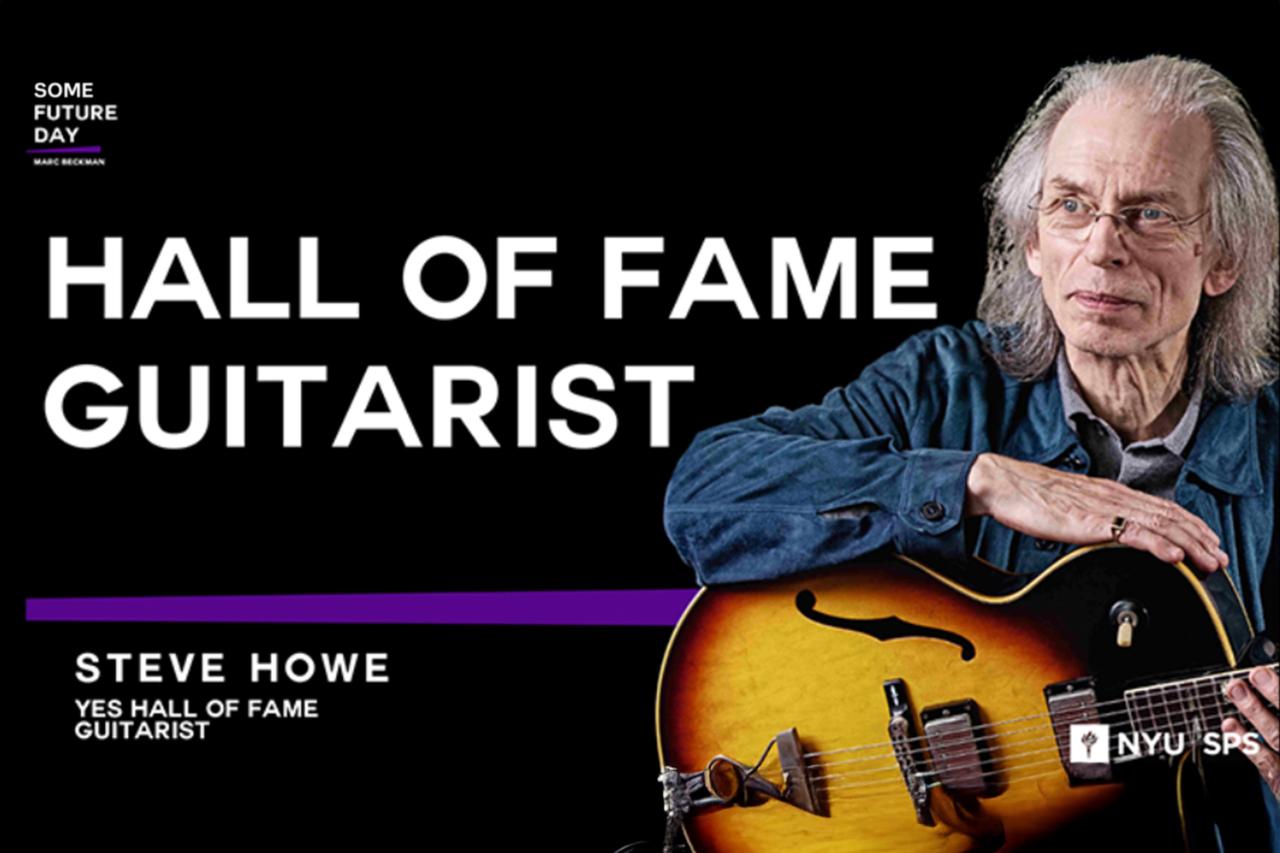
Steve Howe is a virtuoso guitarist best known for his work with the progressive rock band Yes and the supergroup Asia. His unique style blends jazz, classical, country, and rock influences, characterized by intricate fingerpicking, rapid-fire runs, and a diverse arsenal of stringed instruments that redefined the role of the electric guitar in progressive music.
The Formative Years: From The Syndicats to Tomorrow
Born in April 1947 in North London, Stephen James Howe was largely self-taught, influenced by the jazz of Barney Kessel and the fingerstyle mastery of Chet Atkins. His career began in the mid-1960s with several groups that showcased his early versatility. With The Syndicats, Howe worked under the legendary producer Joe Meek, developing a sharp, aggressive R&B style. By 1967, he joined the psychedelic rock band Tomorrow, contributing to "My White Bicycle," a track that remains a cornerstone of the UK’s psychedelic era.
These early years were crucial for establishing his technical foundation. Unlike many of his contemporaries who focused on blues-based pentatonic scales, Howe was fascinated by the complex chord voicings of jazz and the rhythmic discipline of classical music. This "poly-genre" approach would eventually become the hallmark of the progressive rock movement. By the time he was invited to join Yes in 1970, replacing Peter Banks, Howe was not just a guitarist but a multi-instrumentalist capable of shifting the band's entire sonic architecture.
The Yes Era: Redefining Progressive Rock Guitar
When Steve Howe joined Yes, the band was at a crossroads. His debut on The Yes Album (1971) signaled a massive shift in their sound. The track "The Clap," a solo acoustic piece recorded live, introduced mainstream audiences to his hybrid-picking technique and country-influenced speed. It was clear that Howe brought a level of technical sophistication that allowed Yes to move away from standard rock structures into long-form, symphonic compositions.
Throughout the 1970s, Howe’s contributions to albums like Fragile, Close to the Edge, and Tales from Topographic Oceans established him as one of the world's premier guitarists. His ability to switch between a Gibson ES-175, a Martin acoustic, and a pedal steel guitar within a single song gave Yes a textural depth that few other bands could match. His solo in "Starship Trooper" (the "Würm" section) is a masterclass in building tension through repetitive, evolving scales, while his work on "Roundabout" remains one of the most recognizable acoustic-to-electric transitions in rock history.
Technical Mastery: The Steve Howe Playing Style
The "Howe Sound" is not easily categorized because it relies on several distinct technical disciplines. While most rock guitarists of the 1970s relied heavily on a plectrum (pick) and high-gain distortion, Howe utilized a much cleaner signal path and a more complex physical approach to the strings.
Hybrid Picking and Fingerstyle
One of Howe’s most significant contributions to rock is his use of hybrid picking. He often holds a flatpick between his thumb and index finger while using his middle and ring fingers to pluck individual strings. This allows him to play rapid lead lines and complex, multi-voiced chords simultaneously. This technique is heavily influenced by Chet Atkins and allows for the "piano-like" quality found in tracks like "Mood for a Day."
Use of Space and Volume Swells
Howe is a master of the volume pedal. Instead of letting a note ring out with a sharp attack, he often "swells" the note in, removing the percussive sound of the pick hitting the string. This creates a violin-like effect, most notably heard on "And You and I." His use of space is equally important; he often plays "around" the beat, using syncopation that draws from his early interest in jazz and ragtime.
Multi-Instrumentalism
Beyond the standard six-string guitar, Howe is proficient on:
- The Vachalia: A Portuguese stringed instrument used on "Your Move."
- Lap Steel and Pedal Steel: Used to provide ethereal, atmospheric textures or country-inflected leads (e.g., "Going for the One").
- Spanish Guitar: Utilizing nylon strings for a softer, classical resonance.
- Electric Sitar: The Danelectro Coral Sitar provided the unique Eastern-influenced drone on "Close to the Edge."
The Essential Gear: Instruments and Amplification
Steve Howe’s gear collection is legendary, reportedly numbering hundreds of instruments. However, a few specific pieces have become synonymous with his career. As of 2026, many of these vintage pieces remain in his active collection, though he has increasingly turned to modern reproductions for touring purposes to protect his historical assets.
The 1964 Gibson ES-175
This is Howe’s "soul mate" guitar. While the ES-175 is traditionally a jazz "box" with a hollow body, Howe used it to create a high-gain, yet articulate, rock sound. He famously modified the bridge to handle the rigors of rock performance. The hollow body allows for a unique type of controlled feedback, which Howe mastered to sustain notes without needing excessive distortion pedals. Gibson eventually released a Steve Howe Signature ES-175 in recognition of his influence.
Martin 00-18 and Signature Models
For acoustic work, Howe has long favored the Martin 00-18. Its smaller body provides a mid-range punch that sits perfectly in a dense mix alongside keyboards and drums. His relationship with Martin led to the creation of the MC-38 and 00-18SH signature models. In the studio, he often uses vintage Martins from the 1930s and 40s to achieve a crisp, "woody" tone that hasn't aged a day.
Amplification and Effects
Historically, Howe’s tone is built on Fender Twin Reverb amplifiers. He prefers the clean headroom these amps provide, allowing the natural character of his various guitars to shine through. In modern touring contexts (as of the mid-2020s), he has been known to use Line 6 modeling technology (specifically the Spider and Flextone series or Helix units) to replicate his vast array of tones without hauling dozens of fragile vintage amps across the globe.
| Guitar Model | Primary Use / Iconic Song | Key Technical Feature |
|---|---|---|
| Gibson ES-175 (1964) | The Yes Album, Fragile | Hollow-body resonance with dual humbuckers |
| Martin 00-18 | "The Clap," "Mood for a Day" | Small-body acoustic with mahogany back/sides |
| Fender Dual Professional | "And You and I" | Steel guitar for atmospheric swells |
| Gibson Les Paul Junior | Going for the One | Single P-90 pickup for raw, biting rock tones |
| Danelectro Coral Sitar | "Close to the Edge" | Sympathetic strings for Eastern tonality |
| Vachalia | "I've Seen All Good People" | 12-string Portuguese folk instrument |
Supergroups and Solo Ventures: Asia and GTR
In 1981, following the first dissolution of Yes, Howe co-founded Asia alongside John Wetton, Carl Palmer, and Geoff Downes. This move marked a shift toward a more radio-friendly, arena-rock sound. While the complexity of the arrangements was scaled back compared to Yes, Howe’s guitar work remained meticulously crafted. The debut album Asia (1982) became a global phenomenon, fueled by "Heat of the Moment," where Howe’s staccato riffing provided the song's rhythmic backbone.
Later in the 1980s, Howe teamed up with fellow progressive rock giant Steve Hackett (formerly of Genesis) to form GTR. The project was designed to showcase the "guitar as orchestra" concept, utilizing guitar synthesizers and intricate layering. Although GTR only released one studio album, it remains a fascinating snapshot of Howe’s willingness to experiment with the technology of the era.
His solo career, beginning with Beginnings (1975) and The Steve Howe Album (1979), has allowed him to explore genres that didn't always fit the Yes mold, including classical, bluegrass, and solo jazz. As of 2026, he continues to release solo material, often collaborating with his son, Dylan Howe, on jazz-oriented projects.
Steve Howe in 2026: The Custodian of Yes
In the current landscape of 2026, Steve Howe remains the definitive leader and musical director of Yes. Following the passing of founding bassist Chris Squire in 2015, Howe took on a more prominent role in preserving the band's legacy while pushing for new creative output. Recent albums like Mirror to the Sky have shown that even in his late 70s, his technical facility remains remarkably intact.
His current live rig is a testament to his adaptability. While he still carries his signature ES-175 and a selection of Martins, he has embraced digital switching systems to manage the complex transitions required for Yes’s epic compositions. For fans and students of the guitar, Howe’s career serves as a blueprint for longevity, proving that a foundation in diverse musical styles and a relentless curiosity for gear are the keys to a lasting impact.
Frequently Asked Questions
What is Steve Howe's most famous guitar?
His most famous instrument is the 1964 Gibson ES-175 in sunburst finish. He purchased it in 1964 while playing with The Syndicats and has used it on nearly every album and tour since. It is unique in rock history because it is a "jazz box" used to play high-energy progressive rock.
Does Steve Howe use a pick or his fingers?
He uses both, often simultaneously. This is called hybrid picking. He holds a standard teardrop pick between his thumb and index finger for fast alternate picking and uses his remaining fingers to pluck chords or counter-melodies, a technique heavily influenced by his idol, Chet Atkins.
Why is Steve Howe's tone so clean compared to other rock guitarists?
Howe prefers the "purity" of the instrument's natural sound. He believes that excessive distortion masks the nuances of his playing and the character of the wood. He achieves sustain through volume pedals and the natural resonance of his hollow-body guitars rather than through high-gain pedals.
How did Steve Howe join Yes?
Howe joined in 1970 after the band decided they needed a more versatile guitarist than Peter Banks. He was invited to a rehearsal after the band saw him perform with the group Bodast. His arrival coincided with the band's most commercially and creatively successful period, starting with The Yes Album.
What tuning does Steve Howe use?
While he primarily uses standard EADGBE tuning, he is known for using a variety of open tunings on his lap steel and pedal steel guitars. For example, he has used Open E and Open G for various atmospheric sections in Yes's long-form pieces to allow for resonant, ringing chords.
Final Recommendation for Aspiring Guitarists
To truly understand Steve Howe's technique, one must look beyond rock music. Study the jazz phrasing of Barney Kessel and the thumb-bass patterns of Chet Atkins. For gear enthusiasts, focusing on the attack and decay of a note is more important than finding the right distortion pedal. Start by practicing "Mood for a Day" or "The Clap" slowly to master the independence of the thumb and fingers, as this rhythmic separation is the foundation of Howe’s legendary career.