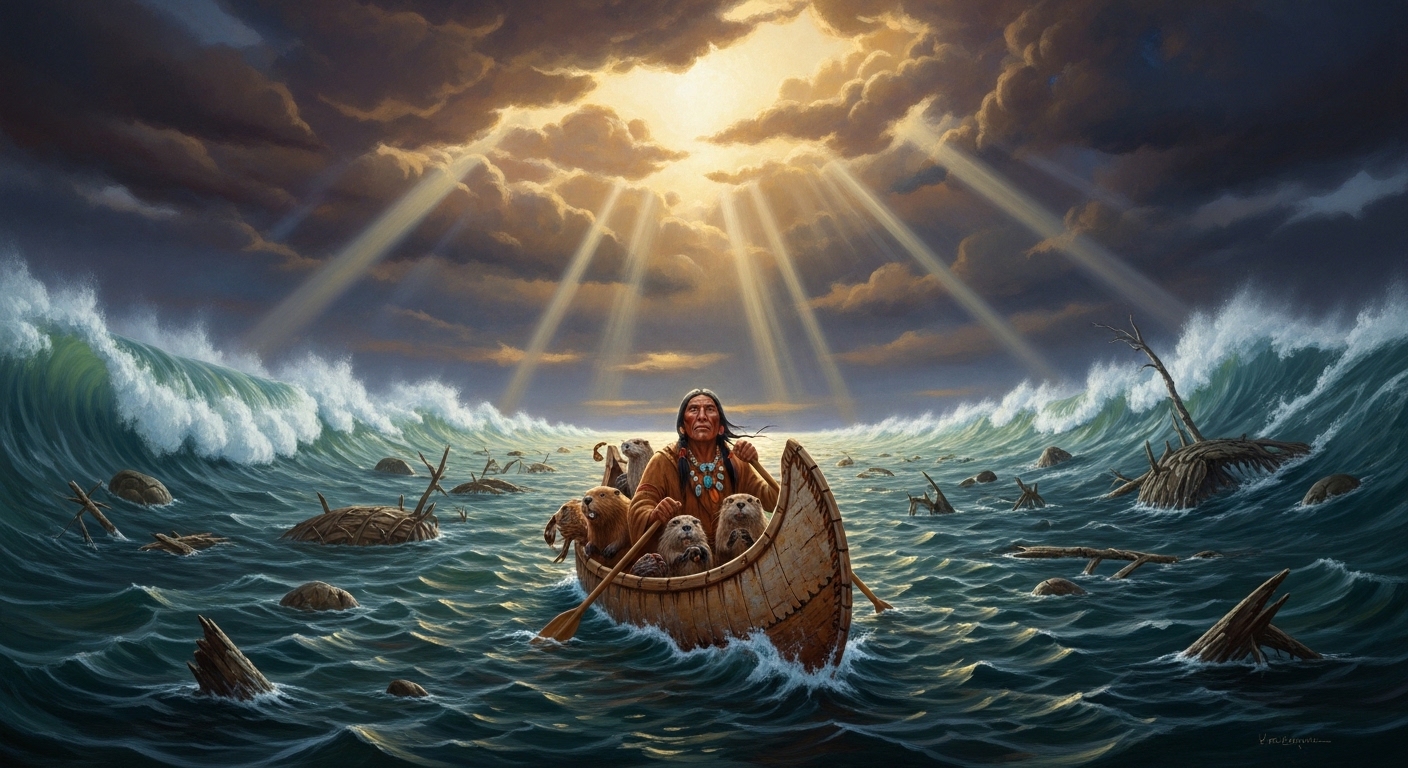
In an Earth Diver story, the featured character is typically an animal—often a small, aquatic, or diving creature such as a muskrat, turtle, duck, or toad—who dives into a primordial ocean to retrieve a tiny grain of mud or sand, enabling a supreme being or culture hero to expand it into the habitable world.
Mythology and folklore preserve some of the oldest records of human imagination, attempting to explain the origins of the cosmos, landmasses, and human existence. Among the various creation myth typologies found across global cultures, the Earth Diver motif stands out as one of the most widespread and structurally fascinating. Understanding who or what drives this narrative forward requires examining the specific archetypes, cultural variations, and symbolic meanings embedded within these ancient stories. Rather than featuring a muscular human demigod or an all-powerful celestial architect, the narrative engine of an Earth Diver story is almost universally driven by humble, unassuming animals.
Defining the Earth Diver Motif in Comparative Mythology
Comparative mythology classifies creation stories into several distinct categories, such as emergence myths, world-parent myths, cosmic egg myths, and earth-diver myths. The Earth Diver motif is characterized by a specific sequence of events: a primordial world consists entirely of water, sometimes inhabited by sky beings or water-dwellers who reside above or within the endless sea. Recognizing a need for solid land, a divine or terrestrial creator commands various animals to dive into the watery abyss to bring back a piece of earth.
One after another, larger, stronger, or seemingly more capable animals try and fail, often drowning in the attempt or returning empty-pawed. Finally, a small, weak, or seemingly insignificant animal volunteers or makes the attempt, successfully retrieving a tiny speck of mud. From this microscopic particle, the earth is expanded, grown, or magically blown outward until it becomes the solid ground humans inhabit.
This structural pattern appears across a vast geographical expanse, stretching from North America to Eastern Europe and across parts of Siberia and Asia. Despite the geographical distances, the core narrative architecture remains remarkably stable, relying heavily on the contrast between the majestic primeval ocean and the modest, persistent nature of the diving protagonist.
Primary Characteristics of the Featured Character
The character at the heart of an Earth Diver story is rarely a traditional apex predator or a majestic mythological beast. Instead, folklorists identify specific traits that define the successful diver across multiple cultural traditions:
- Physical Inconspicuousness: The creature is typically small, unassuming, and physically unimposing compared to animals that tried before it.
- Aquatic or Semi-Aquatic Nature: While not always fully aquatic, the successful character often possesses natural swimming, diving, or burrowing traits that make water interaction plausible, though the depth of the primeval sea renders ordinary biology impossible.
- Perseverance and Selfless Determination: The animal is driven by a willingness to try where others have perished or given up, often pushing past its physical limits.
- Cooperative Partnership: The diver rarely creates the world alone; it acts as the vital retrieval agent working in tandem with a creator deity, shaman, or collective assembly of sky beings who possess the magic required to expand the retrieved mud.
Why Small Animals Succeed Over Stronger Beasts
A central narrative tension in Earth Diver myths is the sequential failure of proud, powerful animals. Bears, eagles, loons, and sturgeons—creatures known for strength, flight, or swimming prowess—frequently attempt the dive first and fail.
From a folkloric perspective, this narrative device highlights a classic motif: the triumph of the weak over the strong, or the underdog archetype. It underscores a philosophical worldview common among indigenous and traditional societies that physical might alone is insufficient to unlock cosmic mysteries. Success requires humility, closeness to the earth or water, and a willingness to undergo a symbolic descent into death and rebirth. When the muskrat or the mud-turtle successfully breaches the surface with a grain of earth, it demonstrates that cosmic creation depends on cooperation and hidden resilience rather than raw dominance.
Regional Variations of the Earth Diver and Their Protagonists
Different cultural groups adapt the Earth Diver archetype to fit their local ecosystems and spiritual frameworks. Examining these regional variations reveals how the identity of the featured character shifts while maintaining the core narrative function.
| Cultural Region | Primary Dive Protagonists | Failed Predecessors | Divine / Assisting Figure | Geographic / Cultural Context |
|---|---|---|---|---|
| Indigenous North America (Algonquian, Iroquoian) | Muskrat, Beaver, Loon, Turtle | Hawk, Otter, Mink, Fish | Creator, Sky Woman, Great Spirit | Woodlands and Great Lakes regions |
| Siberian / Finno-Ugric (Buryat, Mansi, Uralic) | Water Beetle, Duck, Goose, Toad | Bear, Wolf, Pike | Supreme Creator (e.g., Num or God) | Taiga, tundra, and riverine environments |
| East Asian & Central Asian Traditions | Swallow, Turtle, Mudfish | Various large water fowl or mammals | Celestial beings or culture heroes | Steppes, wetlands, and coastal zones |
Indigenous North American Traditions
In many North American Indigenous mythologies—particularly among Eastern Woodlands, Great Lakes, and sub-Arctic nations—the Earth Diver is frequently a muskrat, a turtle, or a loon. In the well-known Iroquoian and Huron-Wyandot accounts related to Sky Woman falling onto the back of a giant turtle, various water animals attempt to dive to the bottom of the primeval sea to fetch soil.
The beaver, the otter, and the loon try and fail, floating back up unconscious or exhausted. Finally, the muskrat—often described as small and unassuming—dives down. Although the muskrat dies from the immense pressure and lack of air during the descent, its tiny paws are found to clutch a small grain of mud when its body floats to the surface. This mud is then placed on the turtle’s back, where it magically expands into Turtle Island (North America).
Siberian and Finno-Ugric Traditions
In Eurasian creation myths, particularly among Uralic and Siberian peoples (such as the Mansi, Khanty, and Buryat), the Earth Diver myth often takes on dualistic or shamanic undertones. Here, a creator god (sometimes alongside a trickster figure or adversary) commands animals to dive into the cosmic ocean.
In these accounts, a water-fowl—such as a duck or a goose—or a small aquatic insect like a water beetle acts as the diver. Among certain Finno-Ugric narratives, the diver brings up silt from the seabed in its bill or claws, which is then spread across the waters to form dry land. The presence of water birds in these Eurasian tales reflects the ecological reality of vast marshlands, taigas, and river networks that defined the creators' daily existence.
Symbolic and Psychological Interpretations
Beyond literal explanations of geographical origins, cultural anthropologists and depth psychologists view the Earth Diver character through symbolic and psychological lenses.
From a psychoanalytic perspective, the primeval ocean represents the unconscious mind, chaos, or undifferentiated potential. The act of diving into the deep water signifies a descent into the unconscious—a journey into fear, ego-death, and the unknown. The muskrat or turtle, as a small and seemingly insignificant creature, represents the ego or the vulnerable aspect of the human psyche that must brave the depths of the unconscious to retrieve a nugget of truth or renewal.
Furthermore, the motif emphasizes ecological humility. In traditional worldviews, humans are not separate from or superior to animals; rather, creation itself depended on the sacrifice and labor of humble creatures. The earth is literally built upon the foundation provided by an animal, creating an ethical bond of respect between human communities and the natural world.
Common Misconceptions About Earth Diver Myths
When studying creation narratives, casual observers often conflate different myth typologies or misunderstand the role of the characters involved. Clarifying these distinctions helps preserve the integrity of the folklore:
- Confusing Earth Diver with World-Parent Myths: In world-parent myths, the universe is born from the union or separation of two primordial deities (such as Earth and Sky). In Earth Diver myths, the world is constructed from a foreign material retrieved from the bottom of an already-existing ocean.
- Assuming the Diver is the Creator: The diving animal is almost never the supreme creator. While it performs the critical physical act of retrieval, it operates under the instruction of, or in partnership with, a higher creative intelligence that possesses the magic to expand the mud.
- Viewing the Choice of Animal as Arbitrary: The selection of specific animals like muskrats, turtles, or ducks is deeply tied to indigenous ecological knowledge, observing creatures that interact intimately with both water and earth boundaries.
Frequently Asked Questions
What is the most common animal featured as an Earth Diver?
The muskrat and the turtle are among the most frequently featured characters in North American Earth Diver traditions, while ducks, water beetles, and loons predominate in Eurasian and Siberian variants. These animals are chosen for their symbolic and behavioral association with water environments.
Do Earth Diver characters always survive the dive?
No. In many classic variants, particularly those featuring the muskrat, the animal dies from exhaustion or drowning during the long descent. However, its sacrifice is rewarded because it manages to grasp a grain of mud in its claws or mouth before expiring, allowing the creator to revive it or use the material.
How does the tiny grain of mud become the whole world?
The transformation of the grain of mud into dry land relies on magical expansion. The primary creator deity or spiritual force takes the microscopic speck retrieved by the diver and blows on it, sings over it, or places it upon a stable platform (such as a turtle's shell), causing it to grow outward infinitely until continents are formed.
Are Earth Diver myths found worldwide?
No. The Earth Diver motif has a specific distribution, concentrated most heavily across North America, Northern and Eastern Europe, and Siberia. It is largely absent from the traditional creation mythologies of Sub-Saharan Africa, Australia, and parts of the ancient Near East, which favor other creation motifs.
Why do stronger animals fail in these stories?
The failure of larger, stronger animals serves a narrative and philosophical purpose. It emphasizes that cosmic creation requires spiritual resilience, humility, and specialized attestation to the watery depths, rather than mere physical strength or aggressive prowess.
Conclusion and Next Steps
The featured character in an Earth Diver story is a humble, resilient animal—most often a muskrat, turtle, or water bird—that bridges the gap between chaos and creation by diving into the primordial deep. To deepen your understanding of comparative mythology, consider exploring collections of Indigenous North American folklore, comparative studies by folklorist Stith Thompson on motif-indexes, or regional European and Siberian creation epics to observe how diverse cultures interpret humanity's relationship with the natural world.