In the 2021 Major League Baseball season, team payrolls reflected a sport transitioning out of the pandemic-shortened 2020 season, with total spending reaching approximately $4 billion. The Los Angeles Dodgers led the league with a record-breaking payroll exceeding $285 million, while the Competitive Balance Tax (CBT) threshold sat at $210 million, penalizing several high-spending clubs.
The 2021 season stands as a pivotal financial benchmark in professional baseball history. It was the final year under the 2017–2021 Collective Bargaining Agreement (CBA), characterized by intense scrutiny regarding "tanking" teams with ultra-low payrolls and "super-teams" willing to pay steep luxury tax penalties. Understanding the 2021 payroll landscape requires looking beyond simple salary totals and examining the mechanics of the Competitive Balance Tax, the impact of deferred payments, and the strategic distribution of wealth across the 30 franchises.
Understanding the 2021 Competitive Balance Tax (CBT) Framework
While MLB does not have a "hard" salary cap like the NFL or NBA, the Competitive Balance Tax (CBT), often referred to as the luxury tax, serves as a soft cap designed to discourage runaway spending. In 2021, the base threshold was set at $210 million.
The calculation for the CBT differs significantly from a team's actual cash payroll. While cash payroll tracks what a team pays players in a specific calendar year, the CBT is calculated using the Average Annual Value (AAV) of a player's contract plus benefits. For example, if a player signed a five-year, $100 million contract, their CBT hit is $20 million per year, regardless of whether their actual salary for 2021 was $5 million or $30 million.
Tax Brackets and Penalties
For the 2021 season, teams exceeding the $210 million threshold faced graduated tax rates based on how many consecutive years they had been over the limit:
- First-time offenders: 20% tax on all overages.
- Second-time offenders: 30% tax on all overages.
- Third-time (or more) offenders: 50% tax on all overages.
Additionally, "surcharges" were applied for teams that blew past the threshold by significant margins. Exceeding the tax by $20 million to $40 million triggered a 12% surcharge. Exceeding it by more than $40 million triggered a 42.5% surcharge for first-time offenders and a 45% surcharge for repeaters. Furthermore, teams more than $40 million over the limit saw their highest selection in the next MLB Draft moved back 10 spots.
The Financial Heavyweights: Top MLB Payrolls in 2021
The 2021 season was defined by a massive spending gap between the league's "haves" and "have-nots." The top of the list was dominated by perennial big-spenders and a newly aggressive New York Mets front office.
1. Los Angeles Dodgers
The Dodgers entered 2021 with the highest payroll in MLB history at the time, finishing with a CBT payroll of roughly $285 million. Fresh off a 2020 World Series title, the Dodgers added Trevor Bauer on a massive short-term deal and maintained high-salary superstars like Mookie Betts, Clayton Kershaw, and David Price. Their strategy was clear: leverage their massive regional sports network revenue to absorb luxury tax hits in exchange for sustained championship contention.
2. New York Yankees
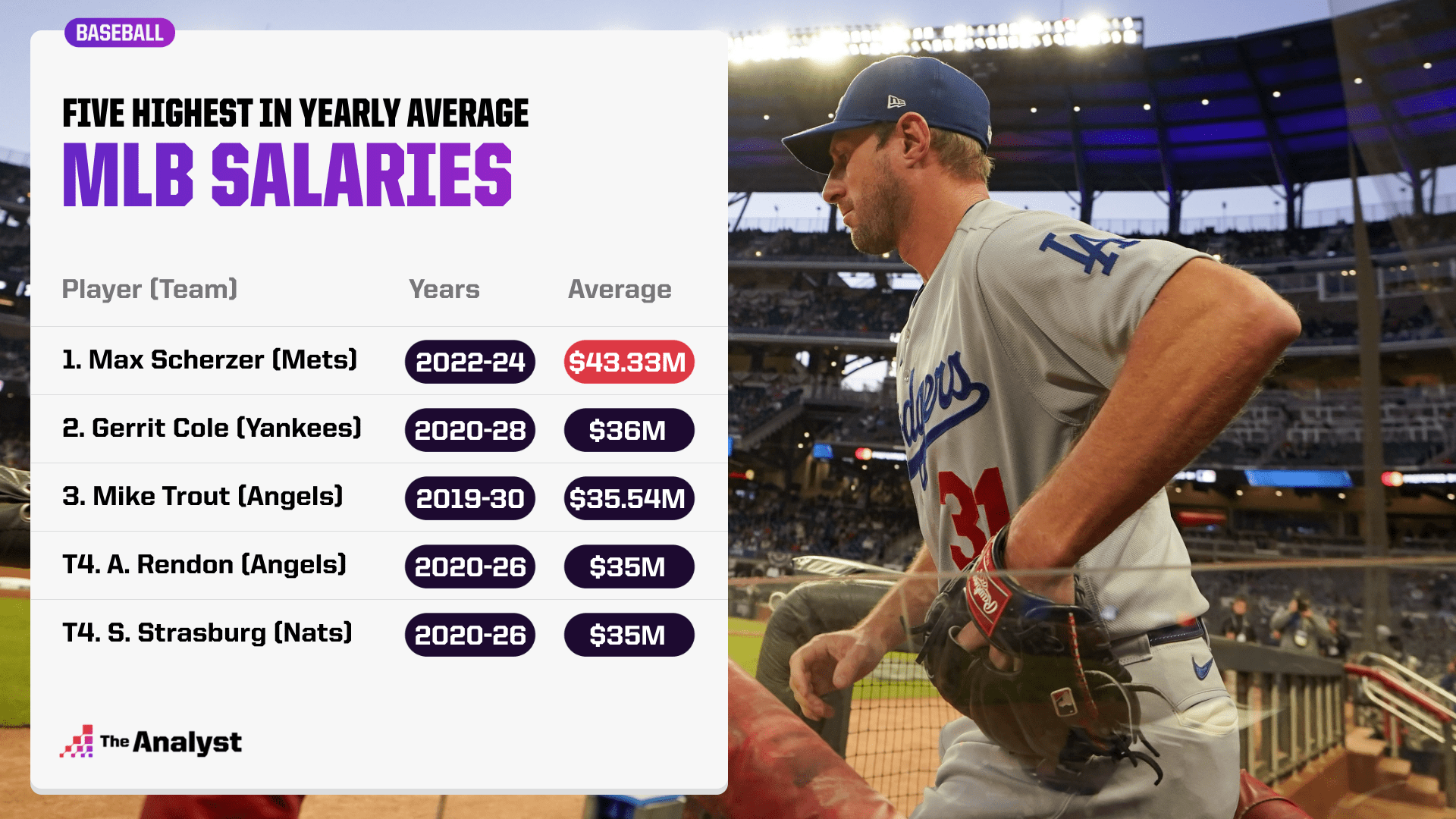
The Yankees continued their trend of hovering near or just above the luxury tax threshold. Their 2021 payroll was anchored by Gerrit Cole's $36 million AAV and Giancarlo Stanton's massive contract. Throughout the season, the Yankees' front office made several moves specifically designed to stay as close to the $210 million line as possible to reset their penalty clock, though they ultimately finished as tax payers.
3. New York Mets
The 2021 season was the first full year of Steve Cohen's ownership. The Mets immediately signaled a change in philosophy by trading for and extending Francisco Lindor to a 10-year, $341 million contract. Their payroll jumped into the top three, signaling the end of the "frugal" era for the Queens-based franchise.
Team-by-Team 2021 Payroll Breakdown
The following table provides the approximate 40-man roster payroll figures for the 2021 season. These figures represent the year-end totals, including mid-season acquisitions and adjustments for the CBT.
| Team | Estimated 2021 Payroll (Total) | CBT Status | Primary High-Earner |
|---|---|---|---|
| Los Angeles Dodgers | $285,600,000 | Over | David Price / Mookie Betts |
| New York Yankees | $203,500,000 | Over | Gerrit Cole |
| New York Mets | $199,200,000 | Under | Francisco Lindor |
| Philadelphia Phillies | $189,500,000 | Under | Bryce Harper |
| Houston Astros | $188,400,000 | Under | Justin Verlander |
| Boston Red Sox | $187,500,000 | Under | Chris Sale |
| San Diego Padres | $175,800,000 | Under | Manny Machado |
| Los Angeles Angels | $174,200,000 | Under | Mike Trout |
| Toronto Blue Jays | $150,100,000 | Under | George Springer |
| Chicago White Sox | $141,300,000 | Under | José Abreu |
| Atlanta Braves | $140,800,000 | Under | Freddie Freeman |
| St. Louis Cardinals | $139,100,000 | Under | Nolan Arenado |
| Chicago Cubs | $138,500,000 | Under | Jason Heyward |
| San Francisco Giants | $134,200,000 | Under | Buster Posey |
| Washington Nationals | $130,500,000 | Under | Stephen Strasburg |
| Cincinnati Reds | $124,100,000 | Under | Joey Votto |
| Colorado Rockies | $112,800,000 | Under | Charlie Blackmon |
| Minnesota Twins | $108,100,000 | Under | Josh Donaldson |
| Milwaukee Brewers | $100,200,000 | Under | Christian Yelich |
| Texas Rangers | $96,400,000 | Under | Khris Davis (Retained) |
| Kansas City Royals | $91,200,000 | Under | Salvador Perez |
| Detroit Tigers | $84,300,000 | Under | Miguel Cabrera |
| Seattle Mariners | $82,500,000 | Under | Kyle Seager |
| Arizona Diamondbacks | $81,300,000 | Under | Madison Bumgarner |
| Miami Marlins | $60,800,000 | Under | Starling Marte |
| Oakland Athletics | $56,100,000 | Under | Elvis Andrus |
| Tampa Bay Rays | $53,200,000 | Under | Kevin Kiermaier |
| Cleveland Indians | $51,500,000 | Under | José Ramírez |
| Baltimore Orioles | $42,100,000 | Under | Chris Davis |
| Pittsburgh Pirates | $40,200,000 | Under | Gregory Polanco |
Note: Figures are rounded and based on year-end 40-man roster accounting, which includes benefits and minor league call-ups.
Efficiency and ROI: Small Market Success vs. Big Spending
The 2021 season provided a fascinating case study in Return on Investment (ROI). While the Dodgers spent nearly $300 million to secure 106 wins, other teams achieved remarkable success with a fraction of the budget.
The Tampa Bay Rays Model
The Tampa Bay Rays finished 2021 with 100 wins and an American League East division title, despite having the 27th-lowest payroll in the league (approx. $53 million). Their "dollars per win" ratio was the most efficient in baseball. The Rays achieved this through an aggressive "churn" of the roster, relying on pre-arbitration players and a deep bullpen of "undervalued" assets.
The San Francisco Giants Surprise
Perhaps the most notable anomaly of 2021 was the San Francisco Giants. Entering the season with a mid-tier payroll of roughly $134 million and low expectations, the Giants won a league-leading 107 games. Their success was built on aging veterans like Buster Posey and Brandon Crawford outperforming their contracts, combined with elite coaching that maximized the output of low-cost reclamation projects in the starting rotation.
The "Dead Money" Problem
Several teams in 2021 were hamstrung by "dead money"—salaries paid to players no longer on the roster or performing at a replacement level. The Baltimore Orioles, for instance, paid Chris Davis roughly $23 million (nearly half their total payroll) while he was unable to contribute on the field. This financial drag is often why rebuilding teams appear to have "low" payrolls; they are waiting for massive, underperforming contracts to expire before reinvesting in new talent.
Strategic Spending and the 2021 CBA Influence
It is impossible to analyze the 2021 payrolls without mentioning the labor environment. 2021 was the final year before the major lockout that would occur in the winter of 2021-2022. Because the rules for the 2022 season and beyond were uncertain, many mid-market teams were hesitant to hand out long-term contracts.
This led to a "bipolar" market. Elite players still commanded massive deals, but the middle class of MLB players saw their salaries stagnate. Teams like the Cleveland Indians (now Guardians) and the Pittsburgh Pirates were criticized for keeping payrolls near the league floor, leading to intense debates between the MLB Players Association (MLBPA) and owners regarding a potential payroll floor—a minimum amount a team must spend.
The Impact of Revenue Sharing
In 2021, the revenue-sharing system continued to transfer funds from high-revenue teams (like the Yankees and Dodgers) to low-revenue teams (like the Marlins and Athletics). The intent is to help small-market teams compete, but critics argued that in 2021, some teams were using revenue-sharing checks to bolster their bottom line rather than improving their on-field product. This tension significantly influenced the 2022 CBA negotiations.
Frequently Asked Questions (FAQ)
What was the highest individual player salary in 2021?
In 2021, the highest-paid player by annual salary was Mike Trout of the Los Angeles Angels, earning approximately $37.1 million. However, when looking at the CBT (Average Annual Value), Gerrit Cole of the New York Yankees also sat near the top with a $36 million AAV.
Did any team actually pay the luxury tax in 2021?
Yes. The Los Angeles Dodgers and the San Diego Padres were the primary teams to exceed the $210 million threshold by the end of the 2021 season. The Dodgers' tax bill alone was estimated at over $32 million due to their high spending and status as a repeat offender.
How does MLB's "salary cap" compare to the NBA or NFL?
Unlike the NFL's "hard cap," which teams cannot exceed under any circumstances, or the NBA's "soft cap" with complex exceptions, MLB uses the Competitive Balance Tax. There is no upper limit on what a team can spend in MLB, provided they are willing to pay the escalating tax penalties and accept the potential draft pick penalties.
Why do some teams have payrolls under $50 million?
Teams like the 2021 Pirates or Orioles often have low payrolls because they are in a "rebuilding" phase. They focus on developing young players who are still in their "pre-arbitration" years, meaning the team can pay them near the league minimum (which was $570,500 in 2021).
How did COVID-19 affect 2021 payrolls?
While 2021 saw a return to a full 162-game schedule, the financial "hangover" from the 60-game 2020 season (where fans were not allowed in most stadiums) led to a more cautious approach from many owners. Most teams did not see their payrolls return to 2019 levels until 2022 or 2023.
Final Recommendation for Analyzing Baseball Finances
When evaluating MLB payrolls, it is essential to distinguish between Opening Day Cash Payroll and End-of-Year CBT Payroll. For a true understanding of a team’s financial health and strategy, focus on the CBT figure, as this accounts for the Average Annual Value and is the metric that actually triggers penalties and affects draft positioning. As seen in the 2021 season, spending the most money does not guarantee a championship, but spending efficiently—combining high-value stars with a core of low-cost, high-performance young talent—remains the most viable path to sustained success in the modern era.