The 2008 financial crisis was a severe global economic downturn triggered by the collapse of the US subprime mortgage market, which exposed systemic weaknesses in international banking, inadequate regulatory oversight, and the extreme risks of complex financial derivatives. This systemic failure resulted in widespread bank insolvencies, a historic liquidity freeze, and the worst global recession since the Great Depression.
Prerequisites and Foundations: The Mechanics of Modern Housing Finance
To understand how a localized decline in US housing values escalated into a global economic meltdown, one must first examine the structural changes within the American mortgage industry leading up to 2008. For decades, traditional banking operated on a relatively simple model: a local bank issued a mortgage to a homebuyer and held that loan on its own balance sheet, collecting interest over 15 to 30 years. Because the bank bore the risk of default, loan officers maintained strict underwriting standards, requiring thorough documentation of a borrower’s income, employment history, and credit score, alongside a substantial down payment.
During the late 1990s and early 2000s, this traditional model transformed dramatically through the process of securitization. Financial institutions realized they could bundle thousands of individual mortgages into large pools and sell them as bonds to investors worldwide. This practice, known as mortgage securitization, shifted credit risk away from the original lenders and onto global capital markets.
As a result, mortgage originators no longer cared whether a borrower could repay the loan over the long term, because the loan was sold off almost immediately. This shift incentivized lenders to prioritize volume over credit quality, laying the groundwork for predatory lending practices and the rapid expansion of the subprime market.
The Rise of Subprime Lending and Complex Derivatives
The low-interest-rate environment engineered by the US Federal Reserve in the early 2000s—designed to stimulate the economy after the dot-com bust—created a massive global search for yield. Institutional investors, pension funds, and foreign central banks demanded high-yielding assets. Wall Street investment banks satisfied this demand by aggressively marketing subprime mortgages: loans extended to borrowers with weak credit histories, high debt-to-income ratios, or insufficient documentation of income (often called "NINJA" loans, standing for No Income, No Job, or Asset verification).
To make these high-risk mortgages appealing to risk-averse institutional investors, Wall Street engineers created complex structured finance products:
- Mortgage-Backed Securities (MBS): Pools of individual mortgages packaged together, paying investors a share of the monthly principal and interest payments.
- Collateralized Debt Obligations (CDOs): Financial vehicles that sliced mortgage-backed securities into different risk tiers (called tranches). Lower-tier tranches offered high yields by absorbing the first wave of defaults, while senior tranches were marketed as safe, stable investments.
- Credit Default Swaps (CDS): Insurance-like contracts sold by institutions such as American International Group (AIG). For a periodic fee, the seller promised to compensate the buyer if a specific bond or CDO defaulted.
Crucially, major credit rating agencies—such as Moody's, Standard & Poor's, and Fitch—assigned their highest investment-grade ratings (AAA) to a vast majority of these structured CDO tranches. Relying on flawed historical models that assumed US housing prices had never declined nationwide on a cumulative basis, the rating agencies drastically underestimated the correlation of risk among subprime mortgages.
The Catalyst: Housing Market Peak and Delinquency Waves
The US housing market peaked in early 2006. As home construction outpaced real demand and adjustable-rate mortgages (ARMs)—which featured low introductory "teaser" rates that later reset much higher—began adjusting upward, millions of homeowners found themselves unable to make their monthly payments. Refinancing became impossible because property values had begun to stagnate and decline.
By late 2006 and early 2007, subprime mortgage delinquencies and foreclosures surged to unprecedented levels. As defaults mounted, the value of mortgage-backed securities plummeted. Because these toxic assets were distributed across the balance sheets of banks, hedge funds, and insurance companies globally, nobody knew which institutions held lethal concentrations of bad debt.
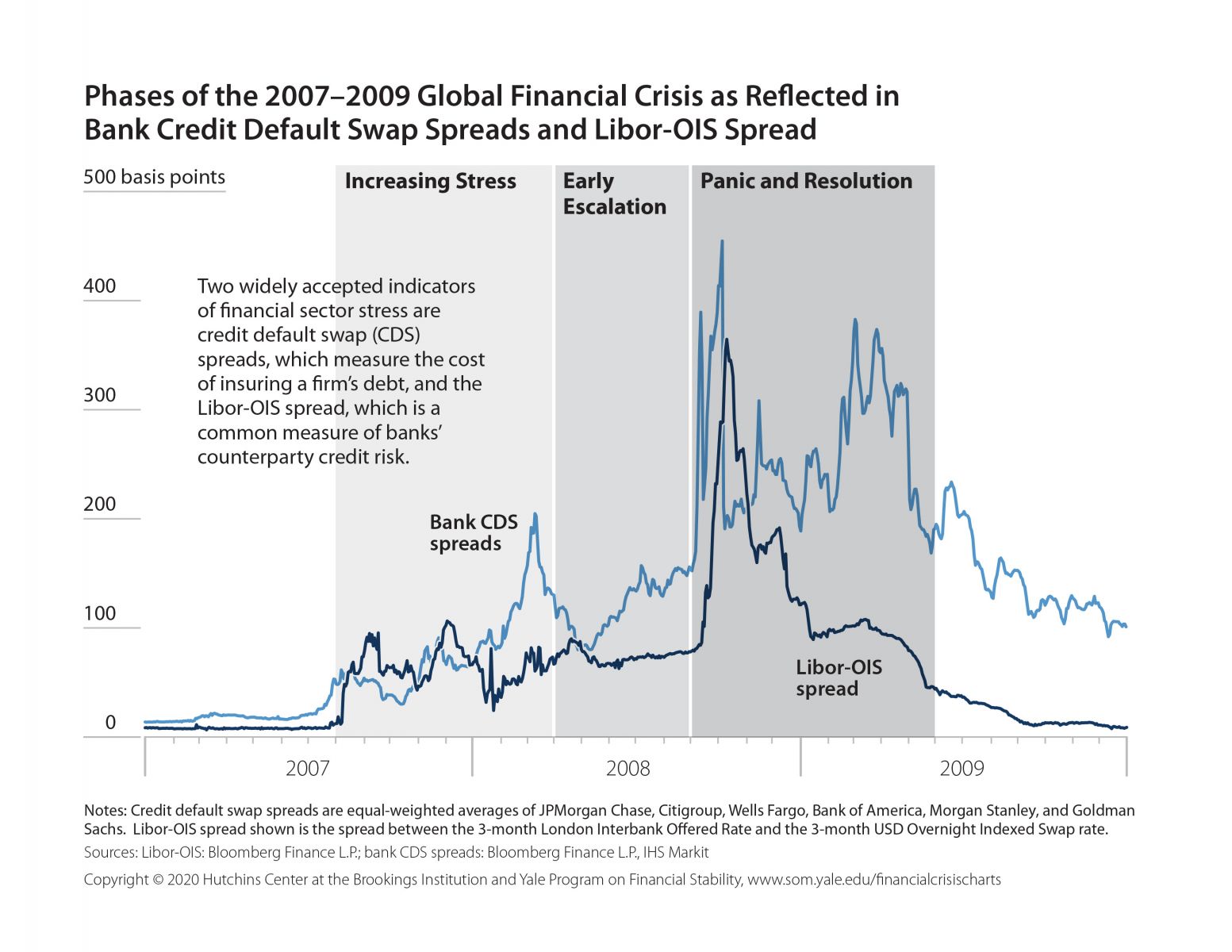
Trust evaporated within the interbank lending market. Banks, fearing that their lending partners might collapse overnight, hoarded cash and refused to lend to one another. Interbank lending rates spiked, and the global financial system experienced a severe liquidity freeze.
| Financial Instrument / Entity | Primary Function | Role in the 2008 Crisis |
|---|---|---|
| Subprime Mortgages | Loans given to borrowers with poor credit histories. | Acted as the underlying toxic asset base that triggered wave defaults. |
| Collateralized Debt Obligations (CDOs) | Structured products slicing debt into tranches with varying risk profiles. | Spread toxic mortgage risk throughout the global banking system disguised as AAA-rated assets. |
| Credit Default Swaps (CDS) | Private insurance contracts protecting against bond defaults. | Bankrupted massive insurers like AIG due to unhedged systemic exposure. |
| Shadow Banking System | Unregulated or lightly regulated financial intermediaries operating outside traditional banking rules. | Accelerated leverage and opacity, fueling the panic during the liquidity freeze. |
Key Institutional Collapses and Government Intervention
The crisis reached a violent crescendo in 2008, forcing governments and central banks to intervene on a scale never before seen in peacetime history.
The Bear Stearns Rescue (March 2008)
Bear Stearns, one of Wall Street's oldest and most prestigious investment banks, faced sudden bankruptcy due to heavy losses in subprime-backed assets. To prevent a broader systemic panic, the Federal Reserve orchestrated an emergency bailout, facilitating the acquisition of Bear Stearns by JPMorgan Chase backed by a $30 billion central bank credit line.
The Conservatorship of Fannie Mae and Freddie Mac (September 2008)
The Federal National Mortgage Association (Fannie Mae) and the Federal Home Loan Mortgage Corporation (Freddie Mac) either owned or guaranteed roughly half of the $12 trillion US mortgage market. As insolvency loomed due to mounting credit losses, the US federal government placed both government-sponsored enterprises into federal conservatorship under the newly formed Federal Housing Finance Agency (FHFA), injecting billions of dollars of taxpayer capital to keep them operational.
The Bankruptcy of Lehman Brothers (September 15, 2008)
Unlike Bear Stearns, Lehman Brothers was allowed to file for Chapter 11 bankruptcy protection when private rescue talks with Barclays and Bank of America collapsed and the US government declined to provide direct financial backing. The sudden collapse of Lehman Brothers instantly paralyzed global short-term funding markets, wiped out billions in institutional wealth, and transformed a severe banking crisis into a full-scale global panic.
TARP and Central Bank Monetary Policy
In October 2008, the US Congress passed the Emergency Economic Stabilization Act, establishing the $700 billion Troubled Asset Relief Program (TARP). Administered by the US Department of Treasury, TARP was deployed to inject equity directly into major commercial banks, stabilizing their core capital ratios and restoring partial confidence. Simultaneously, the Federal Reserve slashed its benchmark federal funds rate to near-zero (0% to 0.25%) and pioneered unconventional monetary policies, notably quantitative easing (QE), purchasing massive quantities of long-term Treasury securities and mortgage-backed securities to drive down long-term borrowing costs.
Economic Aftermath and Long-Term Global Consequences
The fallout of the 2008 crisis extended far beyond Wall Street, precipitating the Great Recession. Global gross domestic product contracted sharply, international trade plummeted, and millions of workers lost their jobs, homes, and retirement savings. In the United States alone, over 8 million jobs were lost, and median household wealth dropped significantly as home values plummeted by over 30% nationwide from their peak.
The severity of the crisis prompted sweeping regulatory reform aimed at preventing a recurrence:
- The Dodd-Frank Wall Street Reform and Consumer Protection Act (2010): Overhauled US financial regulation by establishing the Consumer Financial Protection Bureau (CFPB), imposing stricter capital and liquidity requirements on large banks (stress tests), and creating the Financial Stability Oversight Council to monitor systemic risk.
- Basel III Standards: An international regulatory framework agreed upon by the Basel Committee on Banking Supervision that raised bank capital adequacy requirements, introduced global liquidity standards, and discouraged excessive leverage.
Frequently Asked Questions
What was the root cause of the 2008 financial crisis?
The crisis was primarily caused by the widespread issuance and securitization of subprime mortgages to unqualified borrowers. When housing prices peaked and declined, these mortgages defaulted en masse, destroying the value of complex financial derivatives held by global banks and freezing interbank credit markets.
Why did Lehman Brothers fail while other banks were rescued?
US regulators and treasury officials decided they lacked the legal authority and financial justification to rescue Lehman Brothers without incurring unacceptable moral hazard. Unlike Bear Stearns or AIG, Lehman lacked sufficient collateral to secure a Federal Reserve loan, and private-sector buyers withdrew from negotiations at the final hour.
What is a mortgage-backed security (MBS)?
An MBS is an investment product consisting of a bundle of home loans purchased from banks. Investors who buy an MBS receive periodic payments derived from the principal and interest paid by the underlying homeowners.
How did the government bail out the financial system?
Governments intervened through direct capital injections into banks (such as TARP in the US), central bank emergency lending facilities, the purchase of toxic assets, and the implementation of near-zero interest rates alongside quantitative easing programs to restore market liquidity.
What regulatory changes were enacted after 2008?
Key reforms included the Dodd-Frank Act in the United States and the international Basel III accords. These laws increased bank capital and liquidity buffers, established consumer protection agencies, and subjected major financial institutions to mandatory annual stress tests.
Practical Next Steps and Further Research
For researchers, finance professionals, and students seeking to study the 2008 crisis in greater detail, primary source documents provide the most objective foundation. Review the official Financial Crisis Inquiry Commission (FCIC) Report published in 2011, examine transcripts and monetary policy statements from the US Federal Reserve archives for 2007–2009, and consult regulatory filings from the Federal Deposit Insurance Corporation (FDIC) regarding historic bank failures.