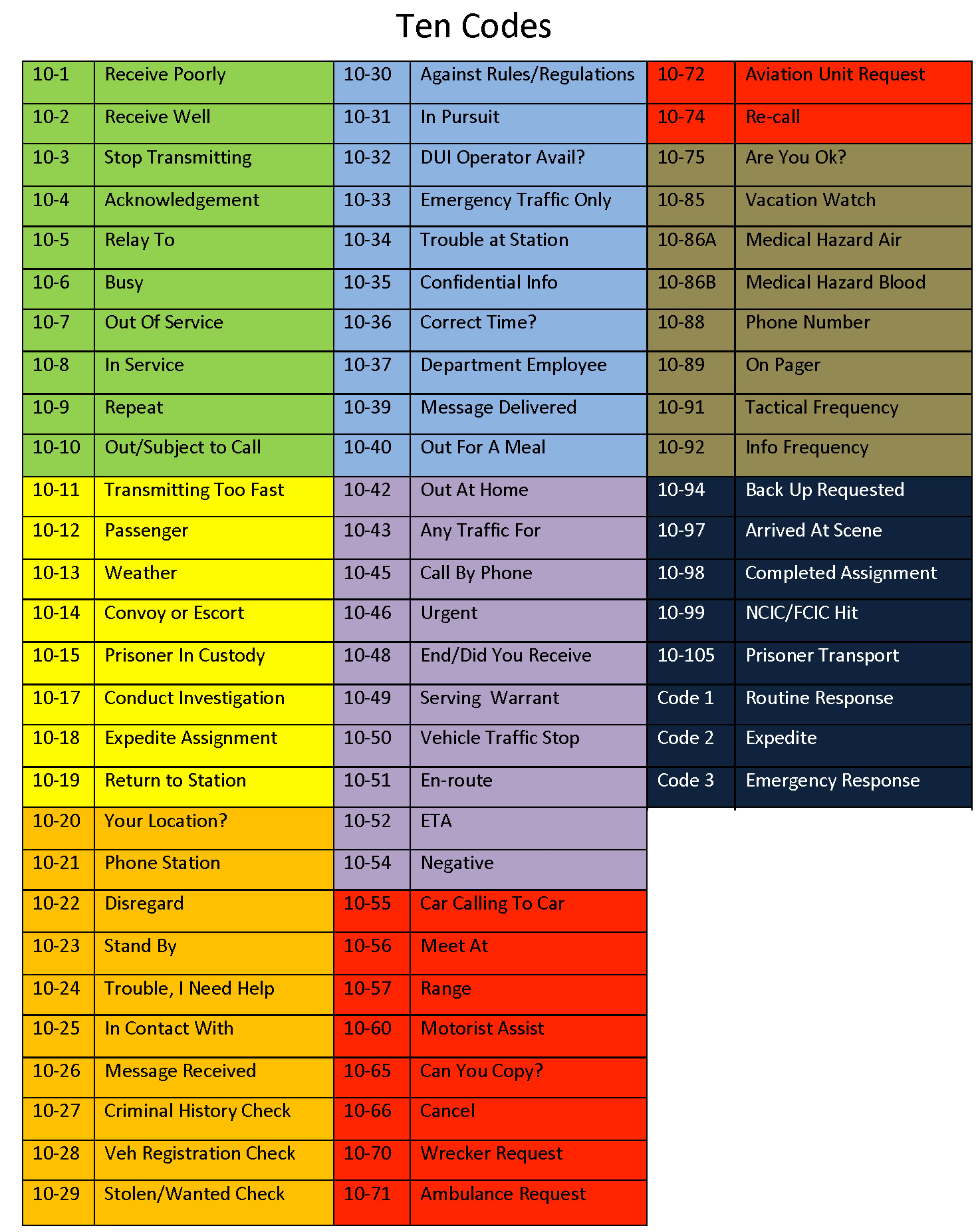
The term "police officer codes" primarily refers to the standardized system of radio signals—commonly known as 10-codes and signals—used by law enforcement agencies to communicate concise status updates, situational reports, and administrative requests over public safety radio frequencies. This guide focuses on the technical standards for professional communication protocols used in the United States as of 2026.
The Evolution of Law Enforcement Communication Standards in 2026
For decades, the "10-code" system was the bedrock of police communication. Developed in the mid-20th century, these numeric shorthand signals allowed officers to relay complex information quickly over narrow-band analog radio channels. However, the modernization of public safety communications has shifted significantly by 2026.
The primary driver for this evolution is the transition toward Plain Language protocols, mandated by many regional interoperability agreements and the National Incident Management System (NIMS). The objective is to ensure that when multi-agency responses occur—such as during large-scale emergency incidents involving police, fire, and EMS—units from different jurisdictions can understand each other without the risk of conflicting code definitions. While many agencies still utilize 10-codes for internal efficiency, the industry standard for inter-agency coordination is now clear, concise English.
Categorizing Common Police Radio Signals and Their Meanings
While agencies maintain individual autonomy over their specific codebooks, several universal standards have persisted through 2026. Understanding these codes is essential for enthusiasts, journalists, and civilians who monitor local public safety frequencies.
Frequently Used 10-Codes
The 10-code system was originally designed to start with the number 10, representing a radio "transmission break," followed by the specific signal code.
- 10-4: Acknowledgment or "Message received."
- 10-7: Out of service (often used when an officer is at a meal break or transport).
- 10-8: In service, available for calls.
- 10-12: Stand by or "Stop transmitting."
- 10-19: Returning to the station.
- 10-23: Arrived at the scene.
- 10-27: Driver’s license or vehicle registration status check.
- 10-28: Vehicle registration information.
- 10-29: Check for wanted or stolen status.
- 10-33: Emergency/Officer in need of assistance.
Comparison of Communication Protocols: Traditional Codes vs. Plain Language
The following table outlines the operational differences between legacy code systems and the current 2026 NIMS-compliant communication standards.
| Feature | Legacy 10-Code Protocol | Modern Plain Language Protocol |
|---|---|---|
| Primary Goal | Efficient use of limited airtime | Maximizing interoperability and clarity |
| Inter-Agency Compatibility | Low; varies significantly by county | High; standard across all departments |
| Training Requirement | High; requires memorizing codebooks | Low; utilizes standard English terms |
| Incident Command Usage | Discouraged during multi-agency events | Mandatory for all NIMS-compliant events |
| Error Probability | High due to differing agency meanings | Low due to direct communication |
Operational Realities of Radio Monitoring in 2026
As an observer or citizen monitoring police frequencies, it is vital to acknowledge the shift toward encrypted digital radio systems. By 2026, a vast majority of metropolitan police departments have moved away from open-frequency analog transmissions to P25 Phase II encrypted digital signals.
Privacy and Legal Limitations Encryption serves to protect sensitive information such as the names of crime victims, addresses of sensitive locations, and tactical movements. Monitoring encrypted frequencies is not possible with traditional off-the-shelf scanners. When researching police activities, always rely on official agency social media channels, authorized press releases, or secure CAD (Computer-Aided Dispatch) feeds if publicly provided by the agency.
Standard Signal Designations and Administrative Codes
Beyond the 10-codes, agencies often use "Signal" codes to identify the nature of a call. Unlike 10-codes which describe status, "Signals" describe the event type.
- Signal 1: Administrative or non-emergency meeting.
- Signal 4: Back-up requested at the scene.
- Signal 13: Emergency, lights and sirens.
- Signal 30: Property damage accident.
- Signal 40: Person deceased.
It is critical to note that these signal definitions are not federal mandates. A "Signal 4" in one municipality may refer to a burglary, while in an adjacent jurisdiction, it may refer to a traffic stop. Always consult the specific agency’s publicly available manual if attempting to interpret local traffic.
Frequently Asked Questions Regarding Police Codes
Are 10-codes still used by police officers in 2026?
Yes, many agencies still use them for internal, rapid communication, though they are being phased out in favor of plain language for inter-agency operations. Officers frequently use them as a shorthand to keep radio traffic brief and efficient during routine patrol.
Why can I no longer hear my local police department on my scanner?
Most jurisdictions have migrated to encrypted digital radio systems, such as P25 Phase II. This change is designed to protect officer safety and sensitive data, making it impossible for standard consumer scanners to intercept the transmissions.
Are there universal police codes used across the entire United States?
No, there is no federal mandate requiring a universal codebook for local law enforcement. Codes are decided at the departmental or municipal level, which is why terminology often changes when crossing county or state lines.
What is the difference between a 10-code and a Signal code?
A 10-code typically identifies the officer’s status (e.g., in service, at the station, out of service), whereas a Signal code identifies the specific type of incident or nature of the call (e.g., vehicle accident, medical emergency, suspicious activity).
Where can I find the official radio code list for my local police department?
Many departments provide an abbreviated code list on their official government website or within their public information office manuals. If a list is not available, it is often due to the department’s preference for plain language, which renders extensive codebooks unnecessary.
Best Practices for Public Transparency and Information Gathering
If you are a member of the press or an interested citizen seeking to understand police activity in 2026, move away from reliance on radio scanners. Modern transparency tools provide more accurate and timely information.
- Utilize official agency data dashboards for real-time incident mapping.
- Monitor verified government accounts on digital social platforms.
- Access open-data portals for crime statistics and non-emergency call logs.
- Reach out to the department’s Public Information Officer (PIO) for clarification on major events.
By focusing on these official channels, you ensure the information gathered is accurate, contextualized, and legally obtained. For those seeking a career in public safety, internalizing the transition from traditional 10-codes to the NIMS-standardized plain language is a prerequisite for success in the current 2026 operational environment.