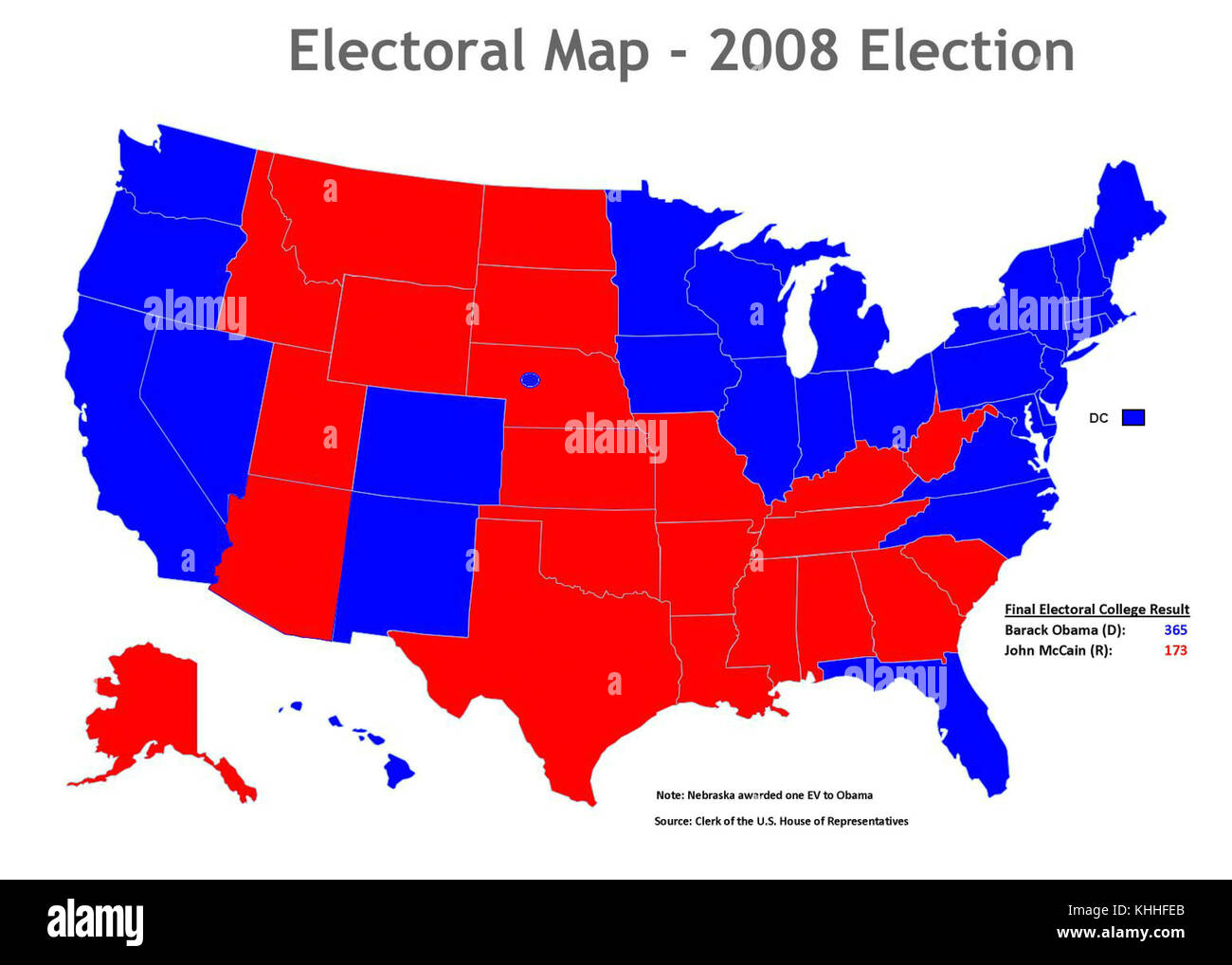
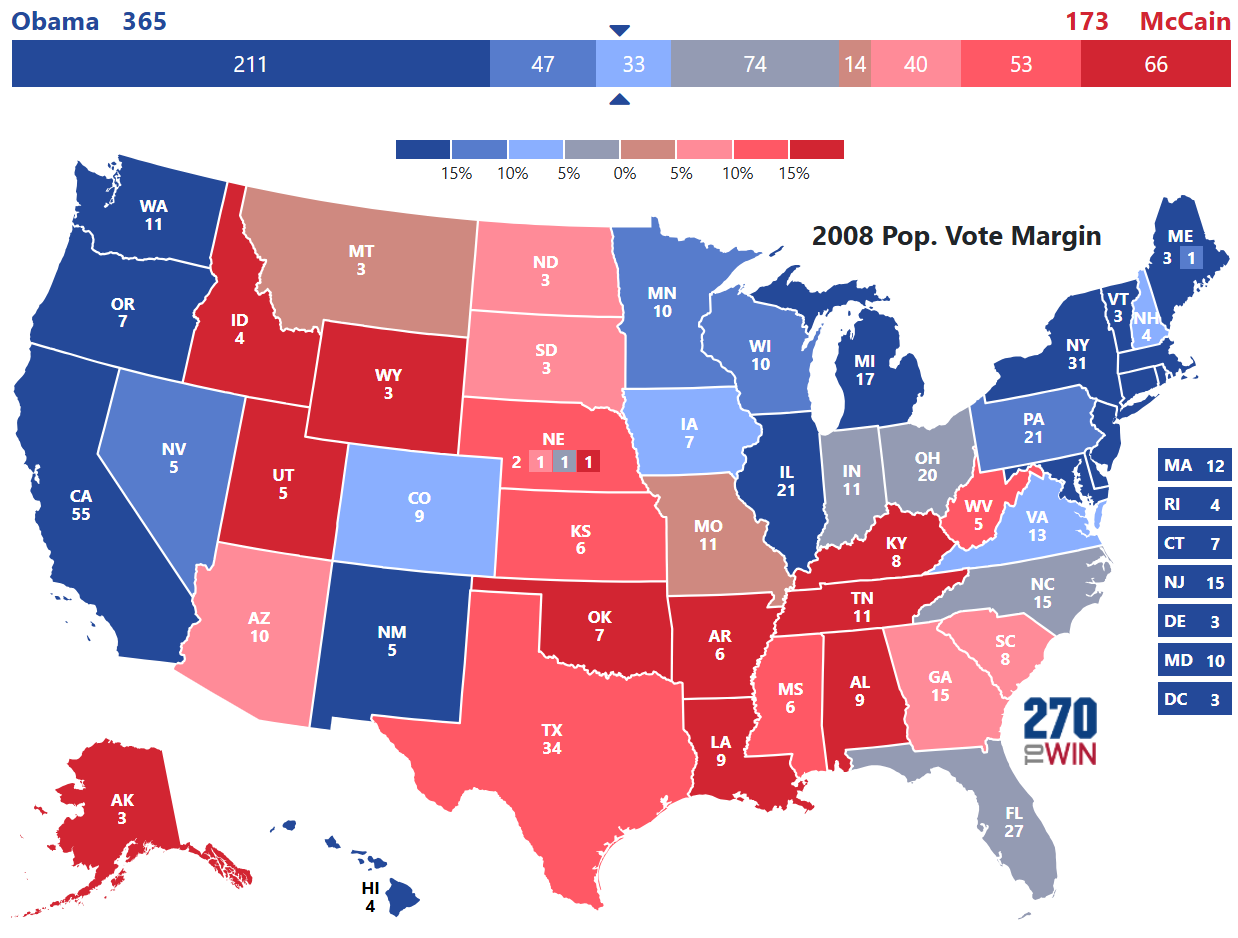
The 2008 United States presidential election took place on November 4, 2008, resulting in a decisive victory for Democratic nominee Barack Obama over Republican nominee John McCain. Obama secured 365 electoral votes and 52.9% of the popular vote, becoming the first African American president in United States history amid the emerging Great Recession.
Overview of the 2008 Presidential Race
The 56th quadrennial presidential election was a historic turning point in modern American political history. For the first time since 1952, neither an incumbent president nor an incumbent vice president appeared on the general election ballot. Incumbent President George W. Bush was term-limited by the Twenty-Second Amendment, and Vice President Dick Cheney chose not to seek the presidency.
The political environment favored Democrats due to widespread public fatigue with the Iraq War and an economy entering the worst economic crisis since the 1930s. The contest between Senator Barack Obama of Illinois and Senator John McCain of Arizona presented voters with distinct philosophies on foreign policy, economic recovery, and the role of government.
Key Election Milestones: January 3, 2008: Iowa Caucuses kick off the primary season. June 3, 2008: Barack Obama secures enough delegates to clinch the Democratic nomination. August 29, 2008: John McCain selects Alaska Governor Sarah Palin as his running mate. September 15, 2008: Lehman Brothers files for bankruptcy, intensifying the financial crisis. November 4, 2008: Barack Obama is elected the 44th President of the United States.
The Primary Campaigns
Both major political parties experienced competitive, protracted primary battles before selecting their standard-bearers.
The Democratic Primary: Obama vs. Clinton
The 2008 Democratic primary was one of the closest and most consequential nomination battles in American history. Initially, New York Senator and former First Lady Hillary Clinton entered the race as the formidable frontrunner, backed by established party leadership, robust fundraising networks, and high universal name recognition.
Barack Obama, then a first-term U.S. Senator from Illinois who had risen to national prominence following his keynote address at the 2004 Democratic National Convention, mounted an insurgent campaign. Obama’s campaign manager, David Plouffe, devised a disciplined strategy that focused on winning caucus states and amassing proportional delegates under Democratic National Committee rules, rather than relying strictly on large, high-population primary states.
Key dynamics of the Democratic primary included:
- The Iowa Victory: On January 3, 2008, Obama won the Iowa Democratic caucuses, demonstrating viability with white rural and suburban voters.
- The New Hampshire Resurgence: Clinton rebounded days later with a surprise victory in New Hampshire, establishing a protracted battle.
- Caucus vs. Primary Strategy: Obama built commanding delegate leads across caucus states (such as Idaho, Kansas, and Washington), while Clinton secured major primary victories in California, Ohio, Pennsylvania, and Texas.
- Delegate Accumulation: Despite Clinton winning several late-stage popular vote totals, Obama maintained an insurmountable pledged delegate lead. On June 3, 2008, Obama reached the required 2,118 delegate threshold, and Clinton formally conceded and endorsed him on June 7.
To balance the ticket with foreign policy and legislative experience, Obama selected Senator Joe Biden of Delaware, then chairman of the Senate Foreign Relations Committee, as his vice presidential nominee on August 23, 2008.
The Republican Primary: McCain’s Comeback
The Republican race began with a wide, fractured field that included former Massachusetts Governor Mitt Romney, former Arkansas Governor Mike Huckabee, former New York City Mayor Rudy Giuliani, and former Tennessee Senator Fred Thompson.
John McCain, a veteran senator and former naval aviator known as a political "maverick," saw his campaign nearly collapse in the summer of 2007 due to weak fundraising and internal staff disputes. However, McCain revived his candidacy by focusing resources almost exclusively on New Hampshire.
- New Hampshire Primary: McCain won the New Hampshire primary on January 8, 2008, regaining institutional momentum.
- Consolidation on Super Tuesday: On February 5, 2008, McCain won key winner-take-all states, outlasting Romney's conservative coalition and Huckabee's evangelical base.
- Securing the Nomination: By early March 2008, McCain had locked down the requisite 1,191 delegates.
In an effort to energize the conservative grassroots and disrupt the race, McCain selected Alaska Governor Sarah Palin as his vice presidential running mate on August 29, 2008. Palin was the first woman on a Republican national ticket and initially generated enthusiasm among religious and populist conservatives, though she later faced scrutiny regarding her readiness for executive federal governance.
Core Campaign Issues and Catalysts
Three primary factors dominated the 2008 general election debate: the economy, foreign policy, and campaign methodology.
The Financial Crisis of September 2008
Heading into late summer, public polling showed a competitive race. However, the dynamics shifted abruptly in mid-September 2008 when the subprime mortgage meltdown triggered a systemic Wall Street collapse.
On September 15, Lehman Brothers filed for bankruptcy, and the federal government orchestrated bailouts for insurance giant AIG and mortgage purchasers Fannie Mae and Freddie Mac. Public anxiety spiked, and voter attention shifted almost entirely to the economy.
The candidates responded with contrasting styles:
- McCain's Response: McCain suspended his campaign on September 24 and called for postponing the first presidential debate to return to Washington to negotiate the Emergency Economic Stabilization Act (TARP). This move drew criticism as reactive and erratic.
- Obama's Response: Obama maintained an even, measured demeanor—earning him the moniker "No Drama Obama"—while consulting with former Treasury secretaries and federal economic advisers. He framed the collapse as the natural culmination of eight years of deregulation and supply-side economic policy under President Bush.
Polling data showed that after the financial crisis intensified in late September, Obama took a sustained lead across both national polls and swing states that he never relinquished.
Foreign Policy and the War on Terror
The ongoing conflicts in Iraq and Afghanistan remained central to the debate. McCain emphasized his long military background, his support for the 2007 Iraq troop surge orchestrated by General David Petraeus, and his commitment to military victory.
Obama emphasized his early opposition to the 2003 invasion of Iraq, which he had characterized as a strategic distraction from the fight against al-Qaeda in Afghanistan. Obama proposed a phased withdrawal of American combat forces from Iraq and a strategic pivot toward securing Afghanistan and Pakistan.
Modern Digital Campaigning
The 2008 Obama campaign altered modern campaign operations by demonstrating the power of internet-based organization and small-dollar fundraising:
- Digital Organization: Utilizing a platform engineered by Chris Hughes, Obama’s campaign (My.BarackObama.com) mobilized millions of volunteers down to individual precincts.
- Small-Dollar Fundraising: The campaign rejected general election public financing under the presidential matching fund system, allowing it to raise record sums from millions of small individual donors. This financial advantage enabled Obama to run advertisements in traditionally Republican states.
- Voter Registration and Turnout: Massive voter registration operations focused heavily on young voters, African Americans, and suburban independents.
2008 General Election Results
On November 4, 2008, voter turnout reached 61.6% of the eligible voting population—the highest rate since the 1968 presidential election. Obama won an Electoral College majority of 365 votes to McCain’s 173, carrying 28 states, the District of Columbia, and one electoral vote from Nebraska's 2nd congressional district.
Comprehensive Election Summary
| Metric / Category | Barack Obama / Joe Biden (Democrat) | John McCain / Sarah Palin (Republican) | Margin / Difference |
|---|---|---|---|
| Popular Vote Count | 69,498,516 | 59,948,323 | +9,550,193 (Obama) |
| Popular Vote Percentage | 52.93% | 45.65% | +7.28% |
| Electoral College Votes | 365 | 173 | +192 |
| States Carried | 28 + D.C. + NE-02 | 22 | +6 states |
| Total Campaign Fundraising | ~$745 Million | ~$370 Million (including public grant) | +$375 Million (Obama) |
| Key Red-to-Blue State Flips | VA, NC, IN, OH, FL, IA, CO, NV, NM | None | 9 states flipped to Democratic |
Electoral Map Realignment
The 2008 election was marked by shifts across the political map, breaking Republican streaks that had lasted decades:
- Virginia: Had not voted Democratic for president since Lyndon B. Johnson in 1964. Obama won it by 6.3 percentage points.
- Indiana: Had not voted Democratic since 1964. Obama won the state by just 28,391 votes (a 1.03% margin).
- North Carolina: Had not voted Democratic since Jimmy Carter in 1976. Obama won by approximately 14,177 votes (a 0.33% margin).
- Mountain West: Obama carried Colorado, Nevada, and New Mexico by comfortable margins, signaling demographic and political changes in the interior West.
- The Rust Belt: Traditional battlegrounds including Ohio, Pennsylvania, Michigan, and Wisconsin voted Democratic by comfortable spreads.
Third-party candidates had minimal impact on the outcome. Independent Ralph Nader received 738,475 votes (0.56%), Libertarian Bob Barr received 523,686 votes (0.39%), Constitution Party candidate Chuck Baldwin won 199,314 votes (0.15%), and Green Party candidate Cynthia McKinney received 161,603 votes (0.12%).
Long-Term Political Legacy
The 2008 election reshaped American governance and electoral politics in several enduring ways:
- Healthcare Legislation: The expanded Democratic majorities in the House (257 seats) and Senate (which eventually reached a filibuster-proof 60 seats with Arlen Specter's party switch and Al Franken's certification) provided the legislative foundation to pass the Patient Protection and Affordable Care Act (ACA) in 2010.
- Rise of the Tea Party Movement: Conservative reaction to the election outcome, federal stimulus spending (the American Recovery and Reinvestment Act of 2009), and healthcare reform fueled the 2009–2010 Tea Party movement. This coalition shifted the Republican Party's internal dynamics, leading to large GOP gains in the 2010 midterm elections.
- Data-Driven Politics: The digital, demographic, and precinct-level targeting developed by Obama's 2008 operation became the standard playbook for both major parties in subsequent cycles.
- Shifting Coalitions: The election revealed emerging demographic trends—such as the growing political influence of Latino voters, college-educated suburbanites, and younger generations—alongside deepening urban-rural geographic divisions.
Frequently Asked Questions
What was the final Electoral College tally in the 2008 presidential election?
Barack Obama received 365 electoral votes, and John McCain received 173 electoral votes. To win the presidency, a candidate needs 270 electoral votes. Obama flipped nine states that had voted for George W. Bush in 2004: Colorado, Florida, Indiana, Iowa, Nevada, New Mexico, North Carolina, Ohio, and Virginia, along with one electoral vote from Nebraska's 2nd congressional district.
Why did Barack Obama win the 2008 presidential election?
Obama won primarily due to three factors: voter dissatisfaction with the Bush administration, the September 2008 financial crisis, and superior campaign infrastructure. The sudden collapse of Wall Street institutions made the economy the central issue, favoring Obama's critique of Republican economic policies. Additionally, Obama built a large grassroots fundraising network and expanded turnout among minority, young, and suburban voters.
Who were the third-party candidates in the 2008 election?
The most notable third-party candidates were Ralph Nader (running as an Independent), Bob Barr (Libertarian Party), Chuck Baldwin (Constitution Party), and Cynthia McKinney (Green Party). None of the third-party candidates received more than 1% of the national popular vote or won any electoral votes, exerting minimal influence on the final result.
Did John McCain use public campaign financing in 2008?
Yes. John McCain accepted federal public financing for the general election, which limited his spending to approximately $84 million between his official nomination in September and Election Day. In contrast, Barack Obama chose to opt out of the post-Watergate public financing system, allowing his campaign to raise and spend historic sums directly from private contributions, providing a marked advertising and field-office advantage.
What was historic about the 2008 vice presidential nominees?
The 2008 election featured milestones on both tickets. Republican vice presidential nominee Sarah Palin was the first woman to appear on a national Republican ticket (and only the second woman on a major-party ticket, after Geraldine Ferraro in 1984). Democratic vice presidential nominee Joe Biden went on to serve two terms as vice president and was later elected the 46th President of the United States in 2020.
Verification and Next Steps
To verify historical voting data, state-by-state certifications, or detailed FEC filings from the 2008 general election, review the official election publications provided by the Federal Election Commission (FEC) and the National Archives and Records Administration (NARA).
Researchers studying electoral patterns can access official certified returns through the FEC Federal Elections 2008 Report and primary documents from the National Archives Electoral College Archive.