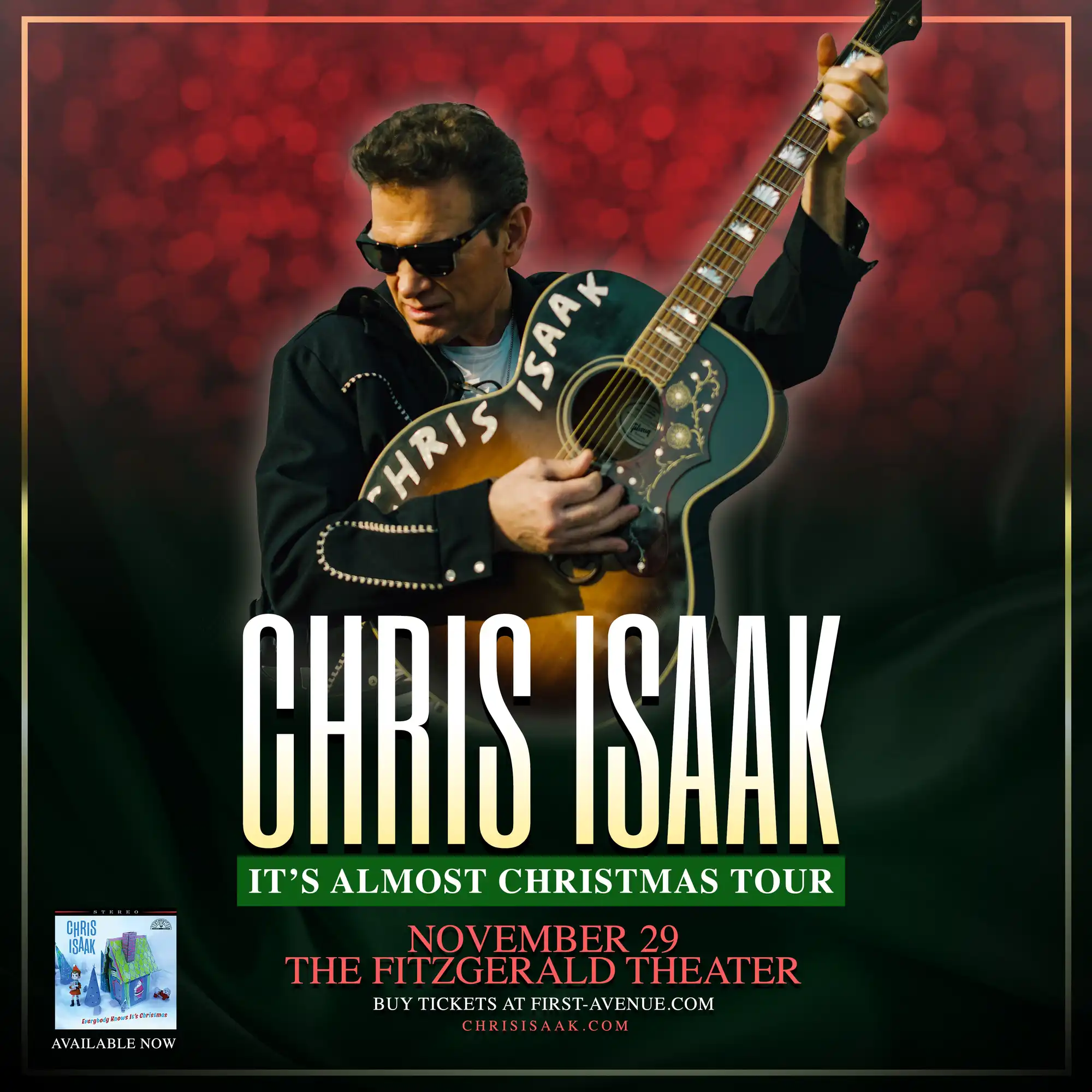
Chris Isaak is an American musician, songwriter, and actor celebrated for his signature "modern crooner" aesthetic, which blends 1950s rockabilly with surf rock and melancholic roots music. Best known for his multi-platinum hits "Wicked Game" and "Baby Did a Bad, Bad Thing," Isaak has sustained a four-decade career characterized by his distinctive baritone-to-falsetto vocal range and his cinematic, noir-inspired visual style.
The Foundations of the Silvertone Sound
Born on June 26, 1956, in Stockton, California, Christopher Joseph Isaak grew up in a working-class environment that deeply influenced his musical sensibilities. Unlike many of his contemporaries who leaned into the synthesizer-heavy trends of the late 1970s and early 1980s, Isaak found inspiration in the Sun Records era. His early influences included Elvis Presley, Roy Orbison, and Carl Perkins—artists who mastered the art of the "reverb-drenched" heartbreak song.
After a brief stint as an amateur boxer and a period spent studying in Japan, Isaak returned to California to pursue music. He formed his long-standing band, Silvertone, named after the affordable guitar brand sold through Sears catalogs. The original lineup featured James Calvin Wilsey on lead guitar, Kenney Dale Johnson on drums, and Rowland Salley on bass. This core group became essential to the "Isaak sound," particularly Wilsey, whose "weeping" guitar lines provided the atmospheric backdrop for Isaak’s vocals.
His debut album, Silvertone (1985), and its follow-up, Chris Isaak (1987), were critical successes but failed to achieve significant commercial traction initially. Critics praised his ability to channel the ghost of 1950s rock and roll without appearing like a mere nostalgia act. His music felt timeless, a quality that would eventually catch the attention of filmmakers and lead to his mainstream breakthrough.
The Global Phenomenon: "Wicked Game" and Cinematic Success
The trajectory of Chris Isaak’s career changed forever due to a single instrumental decision by director David Lynch. In 1990, Lynch featured an instrumental version of "Wicked Game"—a track from Isaak’s 1989 album Heart Shaped World—in the film Wild at Heart. When Lee Chesnut, a radio program director in Atlanta, began playing the vocal version of the song, it sparked a national and international frenzy.
The Impact of "Wicked Game"
"Wicked Game" is often cited as one of the most romantic and melancholic songs in the rock canon. Its success was further solidified by the iconic music video directed by fashion photographer Herb Ritts. Filmed on a black-sand beach in Hawaii and featuring supermodel Helena Christensen, the video became a staple of MTV rotation.
The song’s success achieved several things for Isaak:
- Mainstream Visibility: It propelled Heart Shaped World to multi-platinum status.
- Vocal Recognition: It showcased Isaak’s ability to transition seamlessly from a deep, velvety baritone to a hauntingly beautiful falsetto.
- Visual Identity: It established Isaak as a fashion icon, often seen in tailored Nudie-style suits and a classic pompadour.
Expansion into the 1990s
Following the success of Heart Shaped World, Isaak released San Francisco Days (1993) and the critically acclaimed Forever Blue (1995). The latter was a deeply personal exploration of heartbreak following his breakup with manager and girlfriend Sonya Miller. The album featured "Somebody’s Crying" and "Baby Did a Bad, Bad Thing," the latter of which experienced a second life years later when Stanley Kubrick featured it in his final film, Eyes Wide Shut.
Musical Style and Technical Proficiency
Isaak’s music is frequently categorized as Rockabilly or Roots Rock, but these labels often oversimplify the technical sophistication of his arrangements. His sound is built on several specific technical pillars:
Vocal Technique
Isaak is a natural baritone, but he utilizes a "head voice" technique to reach high notes that mimic the vulnerability of Roy Orbison. His delivery is often characterized by "vocal frying" (a low, raspy sound) and precise breath control, which allows him to sustain notes through heavy artificial reverb.
Instrumentation and Gear
The "Silvertone" sound is heavily dependent on specific equipment choices:
- Guitars: Isaak is most commonly associated with the Gibson J-200 acoustic and various Gretsch hollow-body electrics, including the 6120 and the White Falcon.
- Amplification: To achieve the signature "shimmer," the band traditionally used Fender Twin Reverb or Deluxe Reverb amplifiers, often pushing the built-in spring reverb to its limits.
- Delay Effects: A subtle slapback delay—a staple of the 1950s Sun Records sound—is used to provide rhythm and depth to the vocals and lead guitar.
Production Collaboration
Much of Isaak’s consistency is attributed to his long-standing partnership with producer Erik Jacobsen. Jacobsen helped refine the balance between Isaak’s retro influences and modern production standards, ensuring that the recordings sounded lush and expansive rather than dated.
Chris Isaak in the Television and Film Industry
Beyond his musical career, Chris Isaak has maintained a steady presence as an actor. His "leading man" looks and natural comedic timing allowed him to transition into film and television more successfully than many of his musical peers.
- Film Roles: He appeared in Jonathan Demme’s The Silence of the Lambs (as a SWAT commander), David Lynch’s Twin Peaks: Fire Walk with Me (as Special Agent Chester Desmond), and Bernardo Bertolucci’s Little Buddha.
- The Chris Isaak Show: From 2001 to 2004, Isaak starred in a fictionalized version of his own life on Showtime. The series was praised for its dry humor and its "behind-the-scenes" look at the life of a touring musician. It also showcased his band members as comedic foils.
- Television Hosting: Isaak has served as a judge on The X Factor Australia and hosted his own talk show, The Chris Isaak Hour, on the Biography Channel, where he interviewed and performed with artists like Stevie Nicks and Glen Campbell.
Current Status and Legacy in 2026
As of 2026, Chris Isaak remains a vital figure in the Americana and Roots music scenes. At 70 years old, he continues to maintain a rigorous touring schedule, often performing at prestigious venues such as the Hollywood Bowl and international jazz festivals. His voice remains remarkably intact, a testament to his technical discipline over the decades.
In recent years, Isaak has focused on "legacy" projects. His 2022 Lifetime Achievement Award from the Americana Music Association signaled his transition from a contemporary hitmaker to a respected elder statesman of American music. His later albums, such as Beyond the Sun (recorded at Sun Studio in Memphis), serve as a tribute to the pioneers who inspired him, bridging the gap for younger generations of listeners.
Discography Highlights and Performance
The following table provides an overview of Isaak’s most influential studio albums and their historical impact.
| Album Title | Release Year | Key Singles | Cultural Impact / Certification |
|---|---|---|---|
| Silvertone | 1985 | "Dancin'", "Gone Ridin'" | Established the "Silvertone" sound; cult favorite. |
| Heart Shaped World | 1989 | "Wicked Game" | Multi-platinum breakthrough; redefined retro-cool. |
| San Francisco Days | 1993 | "Two Hearts", "Can't Do a Thing" | Solidified his international commercial appeal. |
| Forever Blue | 1995 | "Somebody's Crying" | Nominated for Best Rock Album Grammy; platinum status. |
| Beyond the Sun | 2011 | "Ring of Fire" (Cover) | Top 10 debut; tribute to Sun Records pioneers. |
| First Comes the Night | 2015 | "First Comes the Night" | Recorded in Nashville; explored country-roots depth. |
Frequently Asked Questions
Is Chris Isaak still touring in 2026?
Yes, Chris Isaak continues to tour extensively as of 2026. He is known for a high-energy live show that blends his atmospheric ballads with humorous anecdotes and rockabilly standards. He frequently performs summer residency tours in North America and headline slots at international blues and roots festivals.
Who played the famous guitar lead in "Wicked Game"?
The iconic, haunting guitar lead was played by James Calvin Wilsey. Wilsey’s use of the Stratocaster's tremolo bar and a high-feedback reverb created the "crying" effect that became the song's sonic signature. Wilsey remained a key part of Isaak's band until the early 1990s.
What is Chris Isaak's most famous movie role?
While he has appeared in several high-profile films, his most analyzed role is likely Special Agent Chester Desmond in David Lynch's Twin Peaks: Fire Walk with Me (1992). His performance was praised for its stoic, mysterious quality, which fit perfectly within the Lynchian universe.
Did Chris Isaak ever win a Grammy Award?
Despite his massive commercial success and critical acclaim, Chris Isaak has been nominated for several Grammy Awards (notably for Forever Blue) but has not won a competitive Grammy as of 2026. However, his influence is widely acknowledged through various lifetime achievement honors and the enduring popularity of his catalog.
Why is Chris Isaak's music often associated with David Lynch?
The association began with the inclusion of his music in Blue Velvet and Wild at Heart. Both artists share a fascination with the "dark underbelly" of 1950s Americana. Isaak’s music provides the perfect sonic equivalent to Lynch’s visual style—beautiful and polished on the surface, but filled with an underlying sense of longing or dread.
What kind of guitar does Chris Isaak play?
Isaak is most famous for playing a Gibson J-200 acoustic, often customized with his name on the pickguard. For electric work, he frequently uses Gretsch hollow-body guitars, which are essential for achieving the twangy, resonant rockabilly sound he is known for.
Final Recommendation for Fans and New Listeners
For those looking to explore Chris Isaak’s work in 2026, the best entry point remains the 1995 album "Forever Blue". It represents the perfect intersection of his songwriting maturity, his band’s technical peak, and the raw emotional honesty that defines his best work. For a more comprehensive overview, his Best of Chris Isaak compilation offers a concise look at how he navigated the changing musical landscapes of the 90s and 2000s without ever losing his stylistic identity. Whether through his music or his charismatic screen presence, Isaak remains the gold standard for the "modern retro" artist.