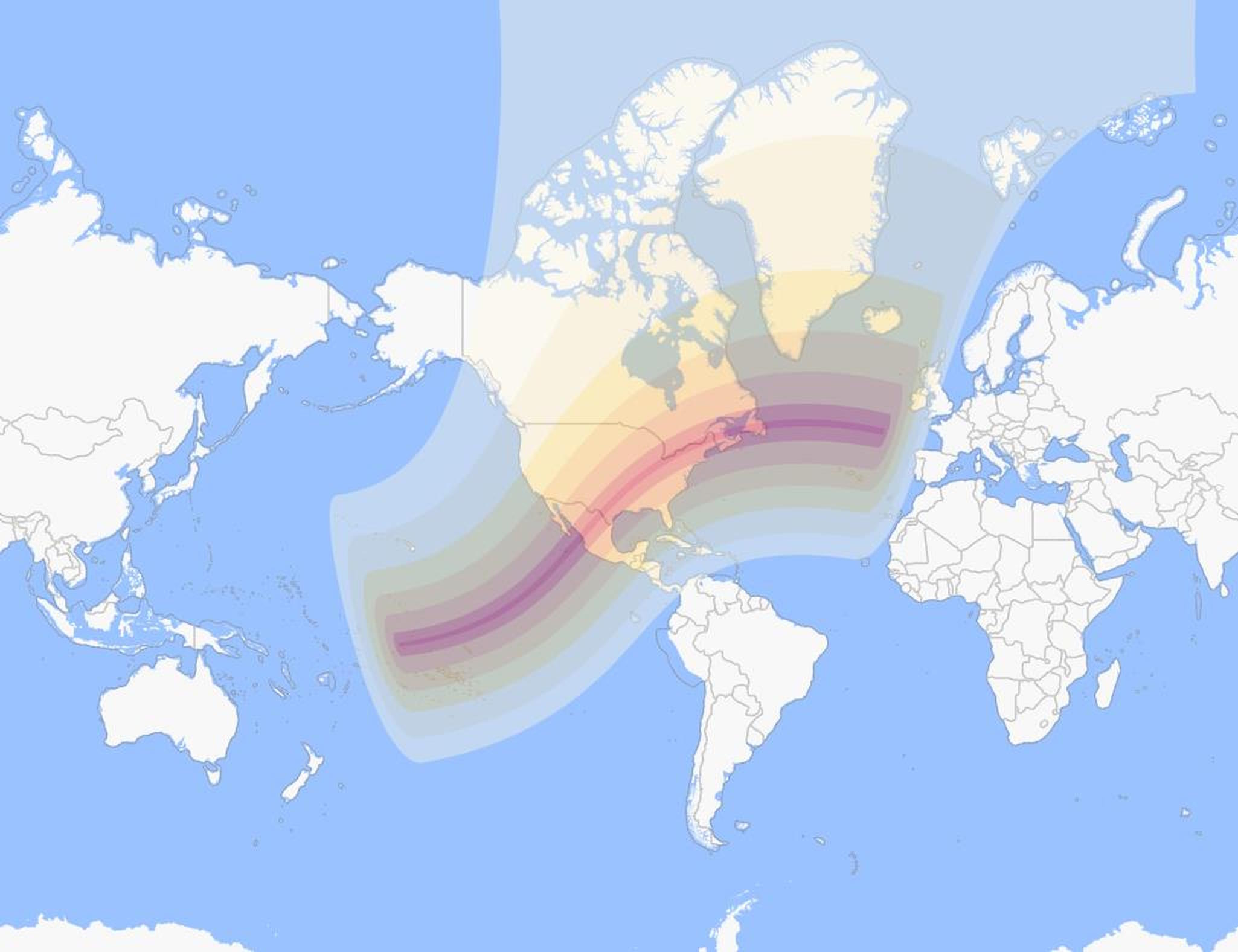
The total solar eclipse of April 8, 2024—often referred to as the Great North American Eclipse—was a major astronomical event that crossed North America, passing over Mexico, 15 U.S. states, and eastern Canada. Observers within the path of totality experienced up to 4 minutes and 28 seconds of pitch darkness during daytime, revealing the sun's outer atmosphere (the corona) in extraordinary detail during a period of high solar activity.
Understanding the Mechanics of the 2024 Solar Eclipse
A total solar eclipse occurs when the Moon passes directly between the Earth and the Sun, completely blocking the face of the Sun from the observer's line of sight. This alignment requires three specific celestial conditions to converge simultaneously: a new moon phase, the Moon crossing the Earth's orbital plane at a lunar node, and the observer being positioned along the narrow swath where the Moon's central shadow (the umbra) strikes Earth's surface.
[Sun] --------------> (Moon) ---------------> [Earth: Umbra / Path of Totality]
During the 2024 eclipse, the Moon was relatively close to Earth in its elliptical orbit (near perigee), which made the Moon's apparent diameter larger than the Sun's disk. This favorable geometric relationship yielded a wider path of totality—approximately 108 to 122 miles (174 to 196 kilometers) wide—and a maximum totality duration significantly longer than the previous North American eclipse in August 2017.
Solar Maximum vs. Solar Minimum Phenomena
One of the defining scientific aspects of the April 8, 2024 eclipse was its timing relative to Solar Cycle 25. The Sun operates on an approximately 11-year magnetic cycle, shifting between solar minimum (low activity) and solar maximum (high activity). The August 21, 2017 total eclipse occurred near solar minimum, presenting a calmer solar corona with streamlined magnetic field structures extending primarily from the solar equator.
By contrast, the 2024 event coincided with the peak of Solar Maximum. This resulted in a dynamic, complex, and highly structured coronal display:
- Radial Structure: The solar corona extended in all directions from the solar disk rather than concentrating at the equator.
- Solar Prominences: Bright pink or reddish loops of plasma anchored in the photosphere extended hundreds of thousands of miles into space, clearly visible along the edges of the dark lunar silhouette without magnification.
- Coronal Mass Ejections (CMEs): Observational datasets and high-resolution imagery captured potential solar eruptions active in real time during the alignment.
Path of Totality across North America
The umbral shadow made landfall on the Pacific coast of Mexico near Mazatlán at 11:07 a.m. MST (18:07 UTC) before traveling northeast across North America. It entered the United States through Texas, traversed the Midwest and Northeast, and crossed into the Canadian Maritime provinces before exiting into the Atlantic Ocean over Newfoundland.
Mexican Territory
Mexico offered some of the longest durations of totality and historically clear atmospheric conditions. The line of totality crossed the states of Sinaloa, Durango, and Coahuila. Near the town of Nazas in Durango, the eclipse reached its point of greatest duration, lasting 4 minutes and 28.1 seconds. Major urban centers along the centerline included Durango City, Torreón, and Monclova.
United States Trajectory
The path spanned 15 U.S. states: Texas, Oklahoma, Arkansas, Missouri, Illinois, Kentucky, Indiana, Ohio, Pennsylvania, New York, Vermont, New Hampshire, and Maine, along with small portions of Tennessee and Michigan.
Mexico (Mazatlán, Durango) ➔ Texas (Dallas) ➔ Midwest (Indianapolis) ➔ Northeast (Buffalo, Burlington) ➔ Canada (Montreal, Newfoundland)
- Texas: The shadow entered near Eagle Pass, moving across major metropolitan areas including San Antonio, Austin, and Dallas. Texas served as a primary destination for atmospheric research teams and international travelers due to favorable historical climatology.
- Midwest and Ohio Valley: The eclipse passed over Little Rock (Arkansas), Cape Girardeau (Missouri), Carbondale (Illinois), and Indianapolis (Indiana). Carbondale earned the distinction of being located at the intersection of both the 2017 and 2024 paths of totality.
- Northeast and New England: The umbra swept across Cleveland (Ohio), Erie (Pennsylvania), Buffalo and Rochester (New York), Burlington (Vermont), and northern Maine. Unusually clear sky conditions in New England provided optimal viewing conditions across the region.
Canadian Provinces
In Canada, the path passed through southern Ontario, southern Quebec, central New Brunswick, western Prince Edward Island, and central Newfoundland. Cities such as Hamilton, Montreal, and Sherbrooke witnessed total coverage, marking the first total solar eclipse visible from Montreal since 1932.
Key Data Comparison: 2017 vs. 2024 vs. Upcoming Eclipses
To contextualize the scale and properties of the 2024 total eclipse, the table below compares key observational parameters of recent and upcoming total solar events.
| Eclipse Date | Primary Geographic Regions | Max Width of Path | Max Duration of Totality | Solar Cycle Status |
|---|---|---|---|---|
| August 21, 2017 | United States (Oregon to South Carolina) | ~70 miles (113 km) | 2 minutes, 40 seconds | Solar Minimum (Cycle 24) |
| April 8, 2024 | Mexico, United States, Canada | ~115 miles (185 km) | 4 minutes, 28 seconds | Solar Maximum (Cycle 25) |
| August 12, 2026 | Greenland, Iceland, Spain, Portugal | ~182 miles (293 km) | 2 minutes, 18 seconds | Declining Phase (Cycle 25) |
| August 2, 2027 | Spain, North Africa, Middle East | ~160 miles (258 km) | 6 minutes, 23 seconds | Approaching Solar Minimum |
| August 23, 2044 | Canada, Northern US (MT, ND, SD) | ~300 miles (480 km) | 2 minutes, 04 seconds | Solar Minimum (Cycle 26) |
| August 12, 2045 | US (Coast-to-Coast), Caribbean, South America | ~150 miles (240 km) | 6 minutes, 06 seconds | Solar Peak (Cycle 26) |
Scientific Experiments and Airborne Observations
The 2024 total solar eclipse presented a rare opportunity for ground- and air-based scientific studies. Because the moon blocks the intense light of the photosphere, scientists were able to conduct experiments examining the lower atmosphere of the Sun, the Earth's ionosphere, and animal behavior under abrupt illumination changes.
NASA High-Altitude WB-57 Aircraft Operations
NASA deployed two specialized WB-57 research aircraft to track the path of totality from an altitude of 50,000 feet (15,000 meters). Flying well above cloud cover and the majority of Earth's atmosphere, these aircraft carried high-resolution infrared and visible-light imaging equipment designed by research institutions like the Southwest Research Institute (SwRI).
The high altitude permitted two distinct advantages:
- Extended Observation Time: Flying at over 460 mph (740 km/h) in the direction of the shadow extended the duration of totality onboard the aircraft by approximately 25 percent compared to ground observations.
- Atmospheric Spectral Clarity: Operating above 90 percent of the Earth's atmosphere allowed detectors to capture faint infrared radiation emitted by the inner corona, yielding measurements of magnetic field structures and plasma temperatures unavailable from ground stations.
Ground Level Observation (Max ~4m 28s) <-- Shadow Speed: ~1,500 to 2,400 mph WB-57 High-Altitude Jet Observation <-- Tracks Shadow at ~500 mph (Extends Viewing Window)
Ionospheric Disturbance Studies (SuperDARN and Atmospheric Sounding)
The sudden drop in solar ultraviolet radiation during totality causes rapid cooling and de-ionization in Earth's ionosphere—the ionized layer of the upper atmosphere situated between 30 and 600 miles above the surface.
Researchers utilized the Super Dual Auroral Radar Network (SuperDARN) and launched suborbital sounding rockets from NASA’s Wallops Flight Facility in Virginia under the APEP (Atmospheric Perturbations around Eclipse Path) project. These instruments measured changes in radio signal propagation, electron density, and atmospheric electric fields, providing empirical data to refine global space-weather models.
Safety Standards, Eyewear Verification, and Viewing Protocols
Directly viewing the Sun without proper protection causes permanent solar retinopathy—thermal and photochemical damage to the rod and cone photoreceptors in the retina. Because the retina lacks pain receptors, tissue damage can occur without immediate discomfort.
The ISO 12312-2 Standard
For partial phases of any solar eclipse, standard sunglasses, dark photography filters, or unverified films are strictly insufficient. Safe solar viewers must comply with the international testing standard ISO 12312-2 (Filters for Direct Observation of the Sun).
Proper compliance requires meeting strict optical density requirements:
- Luminous Transmittance: The filter must transmit no more than 0.0032% of sunlight (optical density of 4.5 or greater).
- Ultraviolet (UV) Blocking: Transmission of solar UV radiation (280 nm to 400 nm) must be reduced to less than 0.0032%.
- Infrared (IR) Attenuation: Far-infrared light must be significantly attenuated to prevent thermal ocular injury.
The American Astronomical Society (AAS) Solar Eclipse Task Force maintains a recognized list of verified manufacturers and suppliers whose products have passed testing by accredited independent laboratories.
Safe Direct and Indirect Observation Methods
- Solar Filters for Optics: When using binoculars, telescopes, or camera lenses, specialized aperture filters must be mounted securely on the front (objective end) of the device. Viewing the Sun through an unfiltered optic while using eclipse glasses causes the concentrated beam to burn through the optical film, leading to immediate optical damage.
- Pinhole Projection: An indirect observation technique that passes sunlight through a small aperture (e.g., a card with a hole, a colander, or tree foliage) onto an opaque background surface, projecting an inverse image of the solar crescent without direct exposure to the eye.
- Totality Exception: The only period when it is safe to look at the Sun with the naked eye is during full totality—when the Moon completely covers the bright solar disk, and no direct sunlight is visible. The moment the bright photosphere reappears (the "diamond ring" effect), direct safety filters must be reapplied immediately.
Technical Data and Photographic Analysis Guidelines
Analyzing imagery and observational scientific data from the 2024 eclipse requires an understanding of dynamic range techniques and optical artifacts inherent in solar photography.
Capturing the Corona: Exposure Bracketing
The brightness of the inner solar corona near the lunar limb exceeds that of the outer streamers by several orders of magnitude. A single exposure setting cannot capture the full extent of the structures visible during totality. High-dynamic-range (HDR) astronomical processing requires an exposure bracket spanning multiple steps:
Fast Exposure (1/1000s) ---> Captures Inner Corona & Prominences Medium Exposure (1/30s) ---> Captures Middle Coronal Streamers Slow Exposure (1s - 2s) ---> Captures Outer Coronal Filament extensions & Earthshine
- Short Exposures (1/2000s to 1/500s): Captures details of high-surface-brightness features, including pink solar prominences, Baily's Beads, and the chromosphere.
- Medium Exposures (1/250s to 1/15s): Reveals the complex magnetic loops and middle structure of the inner solar corona.
- Long Exposures (1/4s to 2s): Exposes faint outer coronal streamers and reveals surface details on the unilluminated side of the Moon illuminated solely by sunlight reflected off Earth ("Earthshine").
Baily's Beads and the Chromosphere
Immediately preceding and following total phase alignment, low-lying topography along the lunar limb—mountains, craters, and valleys—allows isolated beads of sunlight to shine through. This phenomenon, known as Baily's Beads, provides structural data used by lunar cartographers to refine lunar profile models (such as those derived from NASA's Lunar Reconnaissance Orbiter data).
[Moon Profile] )))))))))) <-- Valleys allow rays to pass [Sunlight] * * * * <-- Baily's Beads effect
Following Baily's Beads, a brief flashes of the crimson chromosphere become visible before the outer corona takes dominance. Flash spectroscopy conducted during these brief seconds allows astronomers to measure atomic emission lines of hydrogen, helium, and ionized metals in the low solar atmosphere.
Frequently Asked Questions
What was the path of totality for the 2024 eclipse?
The path of totality stretched across North America, beginning over the Pacific Ocean, entering mainland Mexico near Mazatlán, crossing through 15 U.S. states from Texas to Maine, and traversing eastern Canadian provinces from Ontario to Newfoundland before ending over the Atlantic Ocean.
Why was the 2024 solar eclipse longer than the 2017 eclipse?
The 2024 eclipse lasted longer because the Moon was closer to Earth in its elliptical orbit (near perigee) than it was during the 2017 event. This larger apparent lunar size cast a broader umbral shadow over Earth, extending the maximum totality duration to 4 minutes and 28 seconds, compared to 2 minutes and 40 seconds in 2017.
How can I verify if solar eclipse glasses are safe?
Safe eclipse glasses must be certified under the ISO 12312-2 international standard. Verify that the lenses are undamaged (free of scratches, tears, or punctures) and were produced by an authorized vendor recognized by reputable astronomical authorities such as the American Astronomical Society (AAS).
What solar phenomena were visible during totality in 2024?
Because the 2024 eclipse coincided with the peak of Solar Cycle 25 (Solar Maximum), observers witnessed a multi-directional corona with prominent plasma loops (prominences), coronal mass ejections (CMEs), and optical phenomena like Baily's Beads and the diamond ring effect.
When is the next total solar eclipse visible from North America?
The next total solar eclipse visible from the contiguous United States will take place on August 23, 2044, touching portions of Montana, North Dakota, and South Dakota. A broader coast-to-coast total solar eclipse will sweep across North America on August 12, 2045. Globally, the next total solar eclipse will occur on August 12, 2026, passing over Greenland, Iceland, Spain, and Portugal.
Recommended Next Actions and Future Planning
For scientific researchers, educators, and astronomy enthusiasts planning for future total solar events, early operational and logistical planning is essential:
- Map Out Future Eclipse Paths: Review global eclipse predictions maintained by official organizations like the NASA Eclipse Web Site to evaluate viewing coordinates for upcoming events, such as the August 12, 2026 eclipse over Iceland and Spain.
- Inspect and Store Solar Optics: Inspect equipment used during previous events. Dispose of damaged paper eclipse glasses. Standard solar optical filters designed for camera lenses or telescopes should be stored in clean, moisture-controlled environments away from sharp objects.
- Engage with Public Science Projects: Consider submitting archival high-resolution photographic datasets to open science archives (such as the Eclipse Megamovie database) to support ongoing longitudinal studies of solar coronal dynamics.