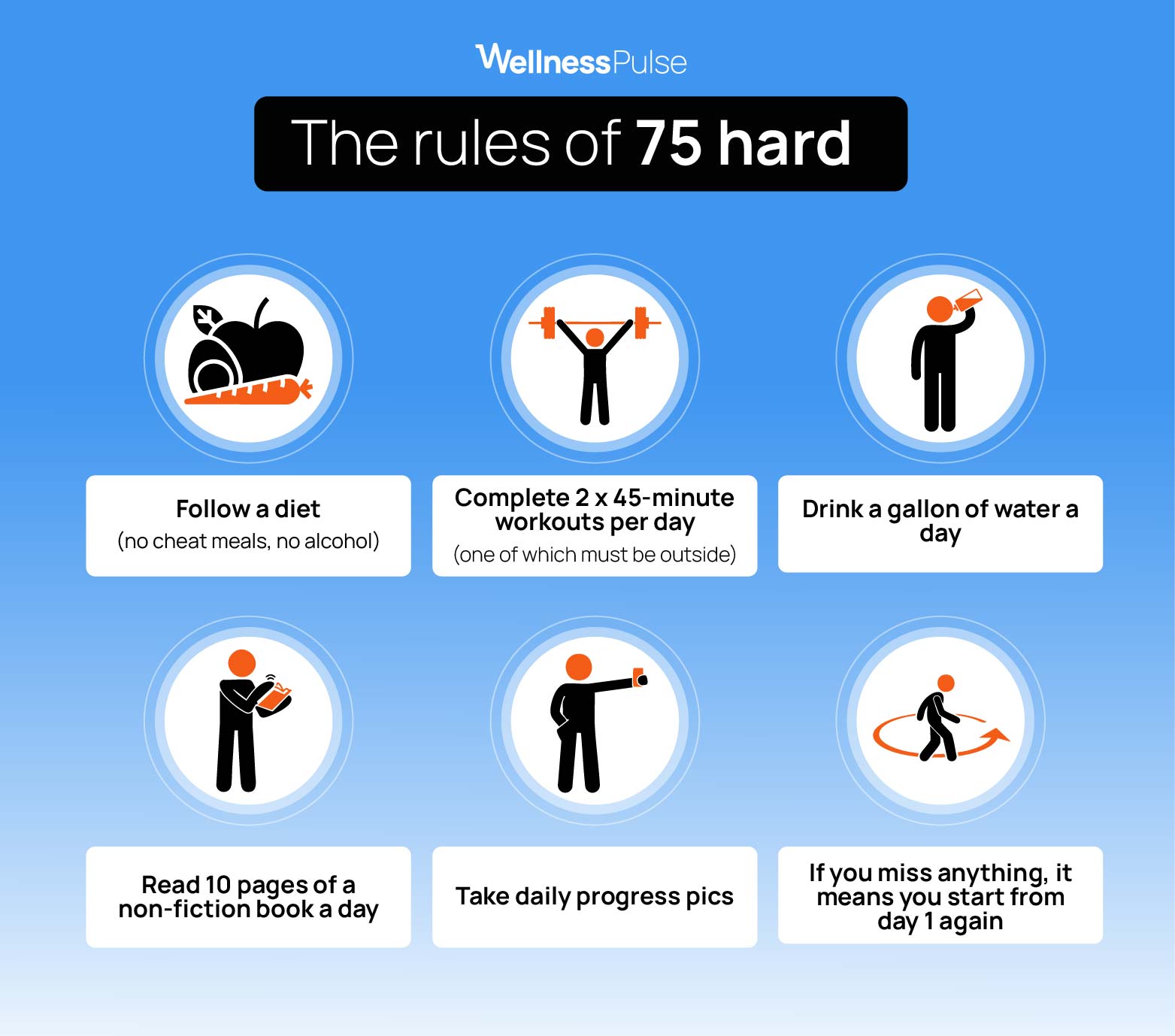
The 75 Hard program is a 75-day mental toughness protocol created by entrepreneur and podcaster Andy Frisella. It requires participants to complete five strict daily tasks—following a diet with no cheat meals or alcohol, two 45-minute workouts (one outdoors), drinking a gallon of water, reading 10 pages of non-fiction, and taking a progress photo—with zero allowance for compromises or substitutions.
What Is 75 Hard?
Created in 2019 by entrepreneur, author, and podcaster Andy Frisella, 75 Hard is officially marketed not as a traditional fitness challenge, but as a "transformational mental toughness program." Frisella developed the protocol after interviewing endurance athletes and high performers, concluding that physical changes are merely a byproduct of developing extreme self-discipline, resilience, confidence, and mental fortitude.
Unlike standard fitness routines that focus primarily on weight loss, muscle gain, or athletic performance metrics, 75 Hard focuses entirely on non-negotiable consistency over a continuous 75-day period. The core philosophy posits that by eliminating excuses, rationalizations, and daily compromises, participants rewire their mindset to execute necessary tasks regardless of external circumstances, weather conditions, fatigue, or lack of motivation.
While the program has gained massive viral popularity on social media platforms like TikTok and Instagram—where millions share daily progress photos and completion milestones—it remains an intense, rigid regime. Understanding what the program demands and how its daily components operate is essential before attempting to begin.
The 5 Non-Negotiable Rules of 75 Hard
To successfully complete 75 Hard, participants must execute five specific daily tasks for 75 consecutive calendar days. There are no rest days, no modifications based on personal schedules, and no exceptions for illness or travel. If even a single task is missed or incomplete when you go to sleep, you fail the challenge and must immediately restart at Day 1.
- 75 HARD DAILY REQUIREMENT FLOW
- DIET & NO ALCOHOL/CHEAT
- TWO 45-MIN WORKOUTS (1 OUTDOORS)
- 1 GALLON PLAIN WATER
- 10 PAGES OF NON-FICTION
- DAILY PHOTO OF PROGRESS
1. Follow a Structured Diet (Zero Alcohol or Cheat Meals)
The protocol requires you to follow a structured nutrition plan tailored to your personal goals. The creator intentionally leaves the choice of diet open—whether that is ketogenic, vegan, carnivore, flexible dieting (macronutrient tracking), calorie deficit, or Mediterranean.
However, two explicit constraints apply to whichever diet you select:
- Zero Cheat Meals: You cannot deviate from your selected diet under any circumstances. Eating a single unauthorized snack, candy bar, or unmeasured meal constitutes an immediate failure.
- Zero Alcohol: No beer, wine, spirits, or alcohol-infused foods are permitted for the entire 75 days.
The rationale behind this rule is to eliminate the habit of using food or alcohol as an emotional reward, coping mechanism, or social crutch.
2. Complete Two 45-Minute Workouts Daily (One Must Be Outdoors)
Participants must complete two separate 45-minute exercise sessions every day. These two sessions cannot be combined into one 90-minute workout; there must be a distinct period of rest and separation between them (typically 2 to 3 hours at minimum).
Crucially, one of the two workouts must take place completely outdoors, regardless of environmental conditions. Whether it is raining, snowing, blistering hot, or freezing cold, 45 minutes must be spent exercising in the elements.
The nature of the exercise is flexible. It can range from intense weightlifting, running, and cross-training to low-impact walking, outdoor cycling, or gentle yoga. The requirement emphasizes duration, discipline, and execution over extreme intensity during every single session.
3. Drink One Gallon of Plain Water Daily
Participants must consume one U.S. gallon (approximately 3.78 liters or 128 fluid ounces) of plain water each day.
- No Additives: You cannot add flavor enhancers, electrolyte powders, lemon juice, or BCAAs to count toward your gallon.
- No Substitutions: Coffee, tea, protein shakes, and soda do not count toward the target fluid volume.
- Consistency: The full gallon must be consumed before going to sleep; catching up the following morning is prohibited.
This requirement builds physical hydration habits while reinforcing time management, as drinking a gallon of water requires pacing consumption throughout the waking hours.
4. Read 10 Pages of a Non-Fiction Book Daily
You must read at least 10 physical or digital text pages of a non-fiction, self-development, business, or educational book every day.
- Format Restrictions: Audiobooks do not count toward this requirement. The rule mandates visual reading to build focus, retention, and sustained attention.
- Content Focus: Novels, fiction, comic books, and entertaining literature are excluded. The goal is active personal development and cognitive skill expansion.
Reading 10 pages per day results in reading 750 pages over the course of the program—typically completing two to three full self-improvement or professional books.
5. Take a Daily Progress Photo
Every single day, you must take a clear photograph of your physical body.
While taking a photo seems simple, it represents one of the most frequent points of failure due to forgetfulness. The purpose of the daily progress photo is twofold: it provides a granular visual record of physical changes over 75 days, and it acts as an anchor task that demands acute daily awareness. Missing a single day's photo—even if all workouts, reading, diet, and water targets were achieved—requires a full restart at Day 1.
The Compromise Rule: Why Zero Tolerance Defines the Program
What sets 75 Hard apart from almost all other self-improvement protocols is its strict Zero Tolerance Policy. The program explicitly forbids:
- Modifications or Substitutions: You cannot swap an outdoor workout for indoor cardio because of lightning or snow. You must adapt your footwear, clothing, or activity type (e.g., walking safely) to complete the requirement outside.
- Making Up Missed Tasks: If you drink only three-quarters of a gallon of water on Tuesday, you cannot drink five-quarters on Wednesday to make up for it.
- Partial Days: Failing a task at 11:00 PM means the streak is broken.
In the words of its creator, the entire purpose of 75 Hard is to defeat the "bitch voice"—the internal monologue that rationalizes minor compromises, delays tasks, or seeks special exemptions. The program forces an absolute binary outcome: you either completed all five non-negotiable tasks today, or you did not.
75 Hard Daily Requirements at a Glance
The following table summarizes each rule, its exact execution guidelines, and common mistakes that result in failing the challenge:
| Requirement | Mandatory Execution Rules | What Is NOT Allowed | Common Failure Points |
|---|---|---|---|
| Structured Diet | Choose a clear diet plan and follow it 100% of the time. | Zero alcohol; zero cheat meals or unauthorized snacks. | Eating unmeasured social foods; consuming sauce/dressings not permitted by your diet plan. |
| Workout 1 (45 Min) | Any physical movement lasting at least 45 minutes continuous. | Combining with Workout 2 into a single 90-minute block. | Stopping at 42 minutes due to fatigue; failing to track duration accurately. |
| Workout 2 (Outdoors, 45 Min) | Must be performed completely outside in open weather conditions. | Covered patios with heating, indoor turf fields, or garage workouts with open doors. | Returning indoors early due to rain, cold, or heat; bad time management leading to late-night outdoor walks. |
| 1 Gallon Water | Consuming 128 oz (3.78 L) of pure, unflavored water throughout the day. | Flavor packets, lemon drops, protein shakes, tea, or carbonated water counting toward total. | Chugging massive amounts right before bed, leading to sleep disturbance; forgetting total consumed. |
| 10 Pages Reading | Direct text reading from a physical book or e-reader (non-fiction/self-help). | Audiobooks, podcasts, fiction, executive summaries, or news articles. | Falling asleep while reading late at night; reading fiction by mistake. |
| Daily Progress Photo | Clear body photo taken daily to track transformation. | Skipping a day and planning to take two photos the next morning. | Forgetting to take the photo before going to bed on busy days. |
Potential Benefits of Completing 75 Hard
Participants who complete the full 75-day protocol often report profound physical, psychological, and behavioral changes. Because the tasks are designed to build operational habits, the benefits extend beyond physical aesthetics.
1. Rapid Development of Discipline and Grit
By executing tasks daily regardless of emotional state, energy levels, or external commitments, participants build self-efficacy. You learn to detach action from emotion—doing what needs to be done even when you do not feel like doing it.
2. High Internal Accountability and Time Management
Fitting two 45-minute workouts, dedicated reading, hydration tracking, and meal preparation into a standard work and family schedule requires precise daily planning. Participants quickly learn to eliminate low-value time sinks, such as excessive social media scrolling or passive television viewing.
3. Physical Health and Fitness Progress
Consistently exercising for 90 minutes per day, staying fully hydrated, eliminating processed cheat foods, and abstaining from alcohol almost universally leads to improved cardiovascular health, fat loss, increased muscle tone, and better sleep quality.
4. Continuous Learning and Cognitive Focus
Reading 10 pages of educational material daily fosters long-term reading habits. Replacing screen time before bed with focused physical reading frequently leads to better sleep hygiene and expanded knowledge in personal or professional fields.
Criticisms, Safety Considerations, and Health Risks
While 75 Hard offers notable psychological and physiological benefits, it has drawn criticism from sports scientists, dietitians, and medical professionals. Understanding the risks is crucial before jumping into such an aggressive regimen.
- HEALTH & SAFETY RISK FACTORS
- OVERTRAINING & INJURY
- HYPONATREMIA (WATER EXCESS)
- PSYCHOLOGICAL BURNOUT
Overtraining and Acute Physical Injury
Exercising twice a day for 75 consecutive days without built-in rest days goes against standard sports physiology guidelines. The body requires active recovery and rest to repair muscular tissue, adapt to training stress, and balance endocrine function.
- Risk Factor: Beginners who launch directly into high-intensity interval training (HIIT), heavy weightlifting, or long-distance running twice a day face severe risks of tendonitis, stress fractures, joint pain, and systemic overtraining syndrome.
- Mitigation Strategy: Listen to your body. Active recovery sessions—such as slow outdoor walking, gentle mobility routines, low-intensity cycling, and restorative yoga—count validly as 45-minute workouts under the rules.
Potential Hyponatremia (Water Intoxication)
Drinking one gallon of water per day is generally safe for active adults in hot climates or those performing intense physical activity. However, for smaller individuals, those with kidney conditions, or individuals who consume the entire gallon in a very short window, excessive fluid intake can cause hyponatremia—a dangerous drop in blood sodium concentration.
- Symptoms: Nausea, headache, confusion, fatigue, and muscle cramps.
- Mitigation Strategy: Pace water intake evenly across 14 to 16 waking hours. Do not attempt to force-drink large volumes late at night.
Rigidity vs. Disordered Eating Patterns
Nutritionists note that the binary definition of "cheat meals" can foster an unhealthy relationship with food, framing eating choices in moralistic terms ("good" vs. "bad"). Additionally, the absolute refusal to modify workouts during severe illness or extreme weather (such as lightning storms or severe heat waves) can prioritize compliance over personal safety.
Health Disclaimer: 75 Hard is an extreme behavioral program. Individuals with underlying medical conditions, cardiovascular concerns, kidney issues, or a history of disordered eating should consult a licensed healthcare professional or physician before undertaking the challenge.
How to Prepare and Succeed on 75 Hard
If you decide to commit to 75 Hard, success depends almost entirely on pre-challenge planning rather than raw willpower alone. Below is a structured blueprint to help you prepare effectively:
Step 1: Select a Realistic, Sustainable Diet Plan
Do not select an overly restrictive diet (such as an ultra-low-calorie crash diet) that is impossible to sustain for 75 days alongside 90 minutes of daily exercise. Choose a nutrition framework focused on adequate macronutrients and energy support—such as hitting daily protein and calorie targets or eating whole foods.
Step 2: Establish Smart Exercise Variations
Design a weekly workout schedule that alternates intensity. For example:
- Morning (Indoor): Weight training or resistance exercise (45 min).
- Evening (Outdoor): Low-impact brisk walking, light jogging, or outdoor stretching (45 min).
Having low-intensity options ready ensures you can fulfill the daily requirement without causing excessive physical breakdown.
Step 3: Complete High-Risk Tasks Early
The top three failure points on 75 Hard are:
- Forgetting the daily progress photo.
- Running out of time for the outdoor workout.
- Realizing at 10:00 PM that you still have half a gallon of water to drink.
Strategy: Take your progress photo immediately upon waking up. Complete your outdoor walk or workout early in the day, and consume at least 50% of your water target before noon.
Step 4: Keep Your Non-Fiction Book on Your Bedside Table
Read your 10 pages early in the day or as part of a structured morning routine. If you leave reading until late at night when exhausted, you risk falling asleep midway through page six, resulting in an inadvertent failed day.
Frequently Asked Questions
Can I listen to an audiobook instead of reading a physical book?
No. The rules of 75 Hard explicitly ban audiobooks, podcasts, and digital summaries from counting toward the 10-page requirement. You must read from a physical book or a text-based e-reader (such as a Kindle).
What happens if it rains, snows, or storms during my outdoor workout?
You are expected to gear up appropriately and complete the 45-minute outdoor workout regardless of weather. However, exercise extreme common sense regarding severe environmental hazards (such as lightning strikes, dangerous ice storms, or hurricane conditions). In hazardous conditions, prioritize personal safety—if safety forces you indoors or forces a missed task, take the safety-first choice and restart the challenge when conditions allow.
What counts as a "cheat meal" on 75 Hard?
A cheat meal is defined as any food, treat, or drink that violates the specific diet plan you established at the beginning of the challenge. For instance, if your diet plan explicitly restricts refined sugar, consuming a single piece of candy constitutes a cheat meal and causes a failure.
Is 75 Hard suitable for fitness beginners?
While beginners can complete 75 Hard, they must approach it with extreme caution regarding exercise selection. Beginners should avoid daily high-impact training and instead rely heavily on walking, low-intensity cardiovascular work, mobility exercises, and stretching to prevent overuse injuries.
What happens after completing 75 Hard?
75 Hard is technically Phase 1 of Andy Frisella's broader year-long mental toughness system known as the Live Hard Program. After completing the initial 75 days, participants can choose to progress through subsequent phases—Phase 1, Phase 2, and Phase 3—which introduce additional daily habits like cold showers, visualization, and random acts of kindness.
Practical Recommendation: Is 75 Hard Right for You?
The 75 Hard program is a powerful, unyielding tool for building extreme operational discipline, mental focus, and habit consistency. However, its zero-tolerance nature means it is not optimal for everyone at every stage of life.
You should consider 75 Hard if:
- You have plateaued in personal discipline and want a structured, non-negotiable mental framework.
- You are physically healthy, free from acute injuries, and capable of managing 90 minutes of daily physical activity.
- You thrive on clear, binary rules without gray areas or self-negotiation.
You should seek an alternative or modified program if:
- You are recovering from an injury, managing a chronic illness, or pregnant.
- You have a history of orthorexia or disordered eating habits.
- Your current schedule cannot safely accommodate two separate daily workout blocks without severe sleep deprivation.
If you decide to begin, set your starting date, establish your specific diet rules, purchase your non-fiction books, and execute Day 1 without compromise.