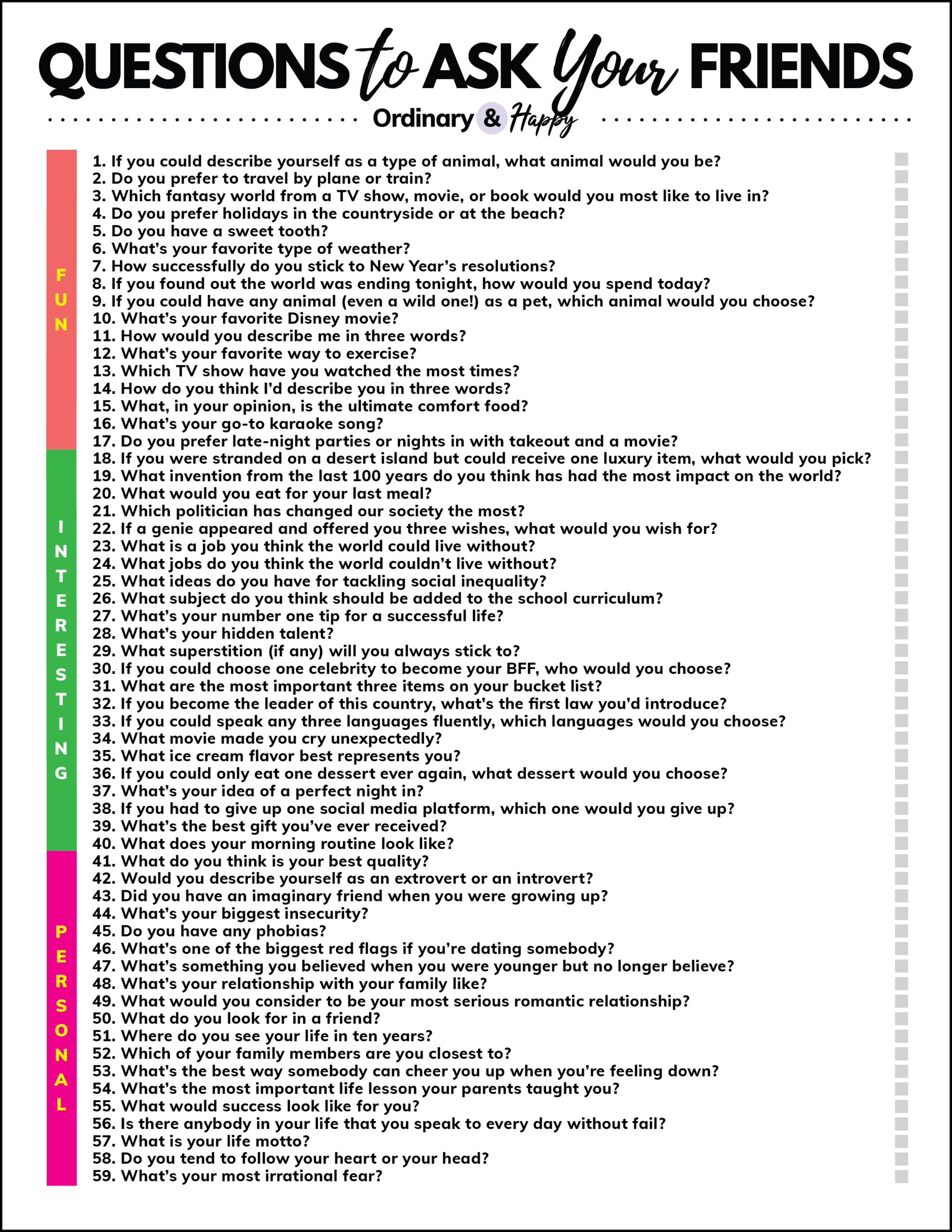
Moving past surface-level small talk to build genuinely meaningful bonds requires intentional effort, emotional safety, and the right prompts. This practical guide explores how to use targeted inquiries to transform casual friendships into lasting, substantive connections while respecting personal boundaries.
Understanding the Anatomy of Deeper Conversations
Human connection relies heavily on self-disclosure and perceived responsiveness. Small talk about the weather, daily inconveniences, or recent pop culture serves a vital social purpose: it acts as a low-stakes testing ground where individuals can assess psychological safety. However, relationships stall when they remain indefinitely trapped in these shallow waters. Transitioning to deeper conversations requires moving from descriptive communication—discussing facts, schedules, and events—to evaluative and vulnerable communication, which involves sharing feelings, core values, fears, and personal aspirations.
Achieving this shift is not merely a matter of asking an intense question out of nowhere. It requires mutual consent and environmental readiness. A conversation about childhood trauma dropped casually into a noisy, crowded bar will likely cause withdrawal rather than intimacy. Conversely, a quiet environment, low environmental distractions, and a shared understanding that both parties can pass on a question create the ideal container for exploration.
Furthermore, the mechanics of deep questioning depend heavily on active listening and emotional validation. When a friend shares a vulnerable answer, the listener's response dictates whether future openness will occur. Interruption, immediate problem-solving, or judgment shuts down communication instantly. Reflective listening, open-ended follow-up questions, and empathetic validation encourage further elaboration. By viewing conversation as a collaborative exploration rather than an interview, participants can bridge the gap between casual companionship and profound mutual understanding.
Preparing the Groundwork: Prerequisites for Vulnerability
Before diving into a list of fifty questions, establishing the psychological and environmental prerequisites for vulnerability is essential. Without these foundational elements, even the most thoughtfully crafted questions can feel intrusive, awkward, or interrogative.
- Phase 1: Environmental Setup
- Choose a quiet, private, or low-distraction setting.
- Ensure time is not rushed (avoid tight schedules).
- Phase 2: Psychological Safety
- Establish mutual opt-out rights ("pass" rule).
- Model vulnerability first by sharing moderately.
- Phase 3: Relational Calibration
- Match the depth of the question to the current bond.
- Observe non-verbal cues (comfort vs. withdrawal).
Psychological Safety and the "Pass" Rule
For a conversation to go deep, participants must feel entirely safe from judgment, mockery, or weaponized disclosures. Introducing a conversational framework where either person can "pass" or decline to answer a specific question without explanation is a powerful tool. This rule preserves autonomy and removes the pressure that often turns exploratory dialogue into an interrogation.
Calibration and Context
Depth is not a binary state; it exists on a spectrum. Friends who have known each other for months require a different starting point than lifelong companions. Calibrating the questions to the existing foundation of the relationship ensures that neither party feels emotionally ambushed. Beginning with reflective or nostalgic prompts before advancing to existential or deeply personal fears allows the connection to build organically.
The 50 Questions to Ask Friends, Categorized
To help navigate different dimensions of friendship, memory, and personal growth, the following fifty questions are divided into distinct categories. Each tier targets a specific psychological or emotional layer.
Tier 1: Nostalgia and Formative Memories (Questions 1–10)
These prompts explore personal history, shedding light on how early experiences, family dynamics, and formative milestones shaped current worldviews.
- What is your earliest clear memory, and how does it make you feel when you look back on it?
- Which family tradition from your childhood do you hope to carry on, and which one do you happily discard?
- Who was the most influential adult in your life outside of your parents growing up, and why?
- What was your favorite hiding spot or sanctuary as a kid or teenager?
- What is a belief or worldview you held firmly as a teenager that you have completely abandoned today?
- What is the most memorable family vacation or trip you took, and what made it stand out?
- How did your family handle conflict when you were growing up, and how has that influenced your own conflict style?
- What is a specific piece of advice an older relative gave you that still resonates with you?
- What was your relationship with books, movies, or music as an escape during your adolescence?
- If you could time-travel back to witness one ordinary day from your childhood, which day would you choose?
Tier 2: Values, Passions, and Core Beliefs (Questions 11–20)
Moving beyond history, these questions examine the internal compass guiding daily choices, ethical frameworks, and personal motivations.
- If you had to define your core personal philosophy in a single sentence, what would it be?
- What is a cause, issue, or injustice that you care about deeply, even if you do not actively campaign for it?
- What does personal success look like to you, independent of financial wealth or societal status?
- How do you decide whether a risk is worth taking versus when it is safer to stay cautious?
- What role does creativity play in your daily life, and do you feel you have enough space for it?
- When do you feel most authentically yourself, and what environments or people pull that out of you?
- What is something you value deeply that you feel modern society frequently overlooks or undervalues?
- How do you define integrity, and who is someone in your life who exemplifies it?
- What does rest look like to you—is it physical relaxation, mental escapism, or creative productivity?
- If money and time were completely unlimited, what problem would you dedicate your life to solving?
Tier 3: Vulnerability, Fears, and Growth (Questions 21–30)
These inquiries peel back layers of self-protection, addressing inner doubts, recurring patterns, and emotional hurdles.
- What is a fear that you rarely talk about because it feels embarrassing or irrational?
- How has your relationship with failure changed over the last five years?
- What is a critique or piece of negative feedback you received in the past that ultimately made you better?
- When do you find it most difficult to ask for help, and where does that hesitation stem from?
- What is a personal habit or defense mechanism you are actively trying to unlearn?
- How do you typically react when you feel misunderstood, and how do you wish you reacted?
- What is something you need to forgive yourself for from your past?
- When do you feel the most lonely, even when you are surrounded by people?
- What is an assumption people often make about you upon first meeting that is completely inaccurate?
- What emotional boundary do you find hardest to maintain with the people you love?
Tier 4: Future Aspirations and Imagination (Questions 31–40)
Looking forward, these prompts explore long-term visions, untapped potential, and imaginative possibilities for the chapters ahead.
- Where do you hope you will be emotionally, mentally, and socially ten years from now?
- What is a skill, art form, or language you have always wanted to master but haven't prioritized yet?
- If you could live anywhere in the world for one year without any logistical constraints, where would you go?
- What kind of legacy do you want to leave behind in the memories of the people who know you best?
- What is a project or dream you have put on the back burner that you still think about regularly?
- How do you want your relationship with aging and time to evolve as you get older?
- If you could instantly acquire absolute mastery over one domain of knowledge, what would it be?
- What is an adventure or experience you are saving for a specific milestone in your life?
- How do you envision your ideal daily routine during your retirement years?
- What is something you want to try before you die that genuinely scares you a little bit?
Tier 5: The Friendship Itself (Questions 41–50)
These meta-conversational questions focus directly on the dynamic between the two friends, strengthening mutual appreciation and addressing relational health.
- What is your favorite memory of the two of us hanging out or traveling together?
- In what ways do you feel I support you best as a friend, and where could I improve?
- What is a quality you admire in me that you wish you possessed more of yourself?
- How has our friendship changed since we first met, and what do you appreciate about its evolution?
- What is a topic or conversation you wish we explored more often with each other?
- How do you prefer to be supported when you are going through a difficult emotional season?
- What is something funny or embarrassing we experienced together that always makes you smile?
- How can we ensure our friendship remains a priority despite our busy adult schedules?
- What is a boundary or preference of yours that I should always keep in mind?
- What is something you have always wanted to tell me or ask me, but never found the right moment?
| Question Category | Core Focus | Recommended Relationship Stage | Safety Level |
|---|---|---|---|
| Nostalgia & Memory | Personal history and background | Casual to Established | Low to Moderate |
| Values & Beliefs | Ethics, worldviews, and motivations | Established Friends | Moderate |
| Vulnerability & Fears | Inner doubts, emotional patterns | Close Friends | High |
| Future Aspirations | Long-term visions and goals | Casual to Established | Moderate |
| The Friendship Itself | Relational health and feedback | Established to Close Friends | High |
Frameworks for Managing Conversational Depth
Engaging in deep conversations is not a linear exercise. Discrepancies in communication styles, emotional bandwidth, or pacing can cause friction. Understanding how to manage these dynamics ensures that conversations remain nourishing rather than draining.
The Principle of Reciprocal Vulnerability
Vulnerability should ideally function as a two-way street. If one person constantly answers deep questions while the other offers short, evasive replies, an imbalance forms that can breed resentment or discomfort. When posing a question from Tier 3 or Tier 4, the person asking should be prepared to share their own perspective first or immediately afterward. This modeling behavior signals trust and equality.
Recognizing and Respecting Emotional Limits
Not every day is suited for introspection. A friend dealing with acute burnout, intense work stress, or personal grief may lack the cognitive and emotional energy required to process existential or vulnerable prompts. Checking in with a simple situational assessment—such as asking, "Hey, I have some interesting questions I'd love to explore, or we can just chill and catch up casually—how is your brain feeling today?"—prevents conversational tone-deafness.
Common Mistakes to Avoid When Deepening Friendships
When people first discover tools for deeper communication, they often make tactical errors that stall progress. Avoiding these pitfalls preserves trust and keeps interactions natural.
- Treating the list like an interrogation: Firing off questions rapidly without pausing to discuss, laugh, or reflect turns a bonding exercise into a job interview.
- Giving unsolicited advice too quickly: When a friend shares a fear or vulnerability, the immediate impulse is often to fix it. Often, people simply want to be heard and understood rather than corrected.
- Forcing artificial intensity: Trying to jump straight to existential dread with a casual acquaintance creates forced intimacy, which feels unnatural and awkward.
- Breaking confidentiality: Sharing personal disclosures discussed in confidence with outside parties destroys trust irreparably. Depth requires absolute privacy.
- Ignoring non-verbal feedback: If a friend gives short answers, crosses their arms, or changes the subject, pushing harder is counterproductive. Respect the yellow and red lights.
Practical Steps to Implement Deeper Conversations
To integrate these questions into real-world friendships without feeling awkward, use structured settings designed for connection.
- Intentionally schedule a dedicated format: Propose a specific activity that naturally lends itself to talking, such as a long evening walk, a road trip, or a quiet dinner at home rather than a loud venue.
- Introduce the concept playfully: Frame the questions casually. Bring up three or four questions on your phone during a hangout and say, "I saw this list of interesting questions the other day; want to hear one?"
- Practice active listening: Put away mobile phones, make eye contact, and resist the urge to formulate your own response while your friend is still speaking.
- Follow up on previous disclosures: In future interactions, reference past vulnerable shares naturally. Asking, "Hey, how did that difficult conversation with your manager turn out last week?" shows genuine care and cements the depth achieved previously.
Conclusion
Deepening friendships is a deliberate craft that rewards patience, empathy, and active listening. By moving past surface-level small talk and utilizing carefully calibrated prompts, friends can uncover new dimensions of shared history, values, and mutual support. True intimacy does not happen by accident; it is built one honest, courageous conversation at a time.